

Report Overview
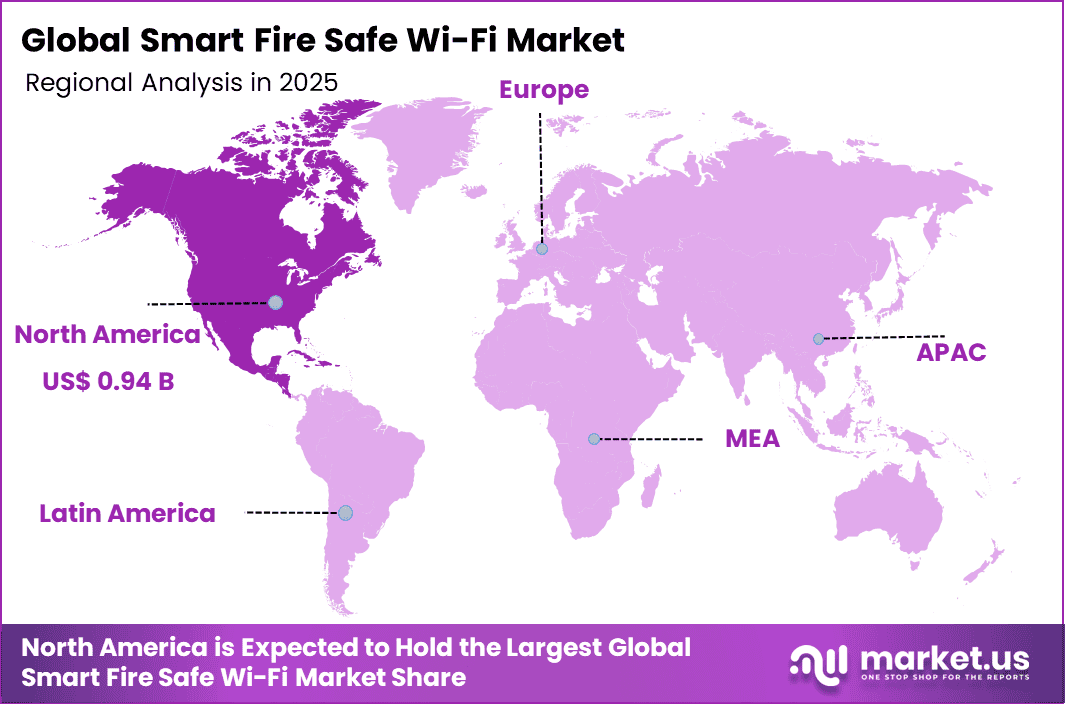
The Global Smart Fire Safe Wi‑Fi Market generated USD 2.7 billion in 2025 and is predicted to register growth from USD 3 billion in 2026 to about USD 8.6 billion by 2035, recording a CAGR of 12.40% throughout the forecast span. In 2025, North America held a dominan market position, capturing more than a 35.1% share, holding USD 0.94 Billion revenue.
Smart Fire Safe Wi-Fi market refers to connected safes that combine fire resistant storage with digital access and remote monitoring features. These products are designed to protect cash, documents, jewellery, and other valuables while allowing users to manage access through mobile apps or connected systems. The market is growing as consumers and small businesses look for storage products that offer both physical protection and better day to day control.
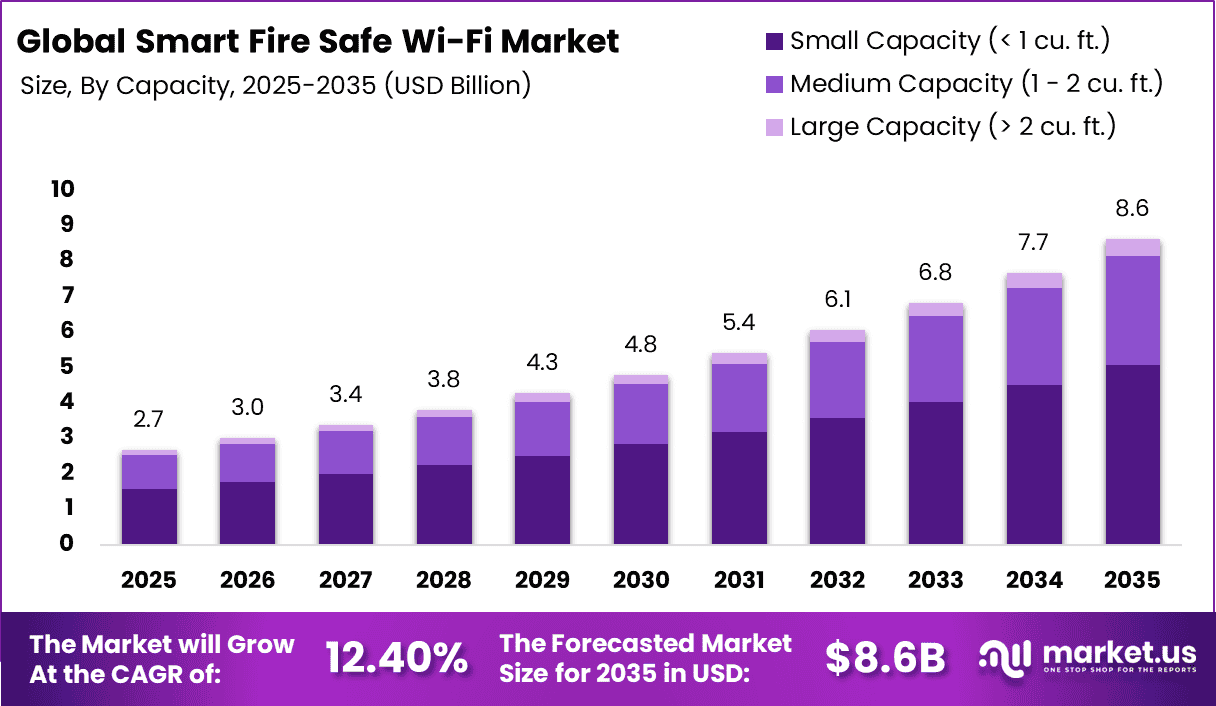
A major factor driving this market is the rising demand for connected security products in homes and small commercial spaces. Buyers increasingly prefer safes that can provide app based access, alert notifications, access history, and easier user management. The added value of fire protection also supports adoption, as customers want one product that can protect important items from both theft risk and heat damage.
Demand for smart fire safe Wi-Fi products is increasing among homeowners, apartment users, small offices, and retail operators that need secure and flexible storage. Residential users value convenience and remote visibility, while business users look for better control over sensitive items and important documents. Demand is also supported by the wider shift toward smart security systems and connected property management tools.
Top Market Takeaways
- By Capacity, small capacity (< 1 cu. ft.) dominates with 58.9% share, serving document protection, jewelry storage, and medication security in compact home environments.
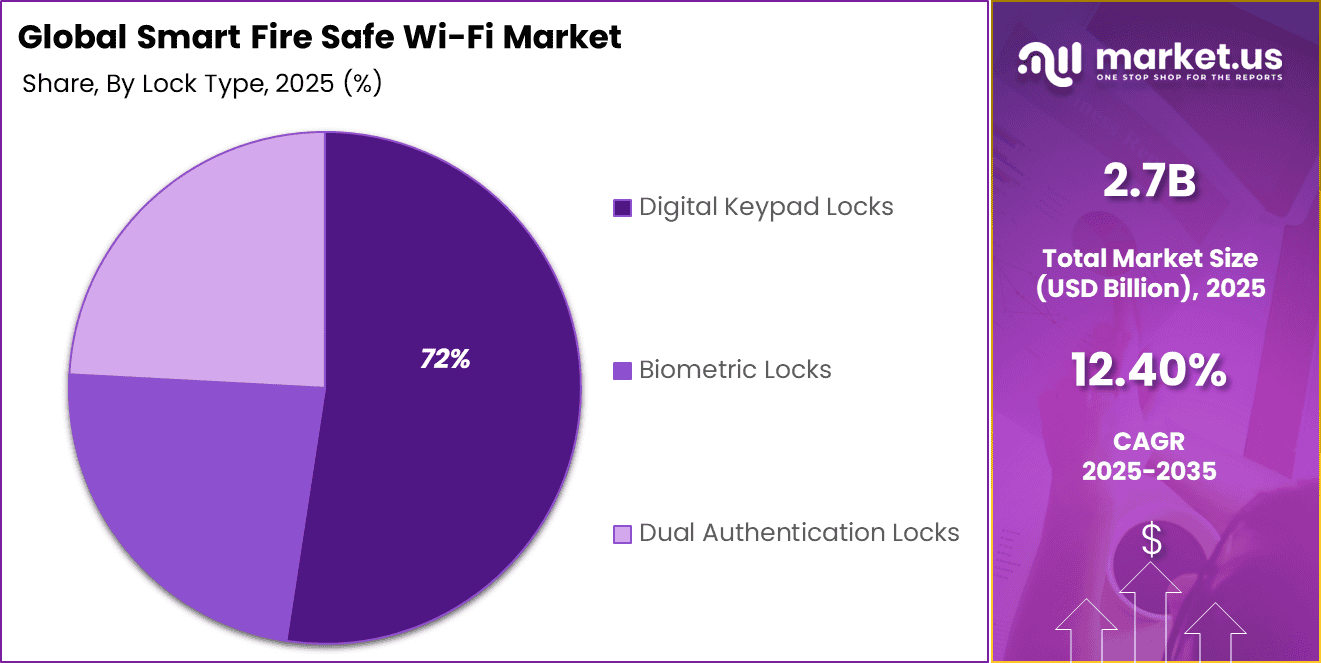
- By Lock Type, digital keypad locks capture 71.6%, offering PIN access, temporary codes, and audit trails integrated with Wi-Fi remote monitoring.
- By Application, residential claims 74.3%, enabling smartphone alerts, geofencing unlock, and family-shared access for valuables protection.
- By Sales Channel, online retail leads at 63.8%, driving e-commerce trials, subscription monitoring, and bundle sales with smart home ecosystems.
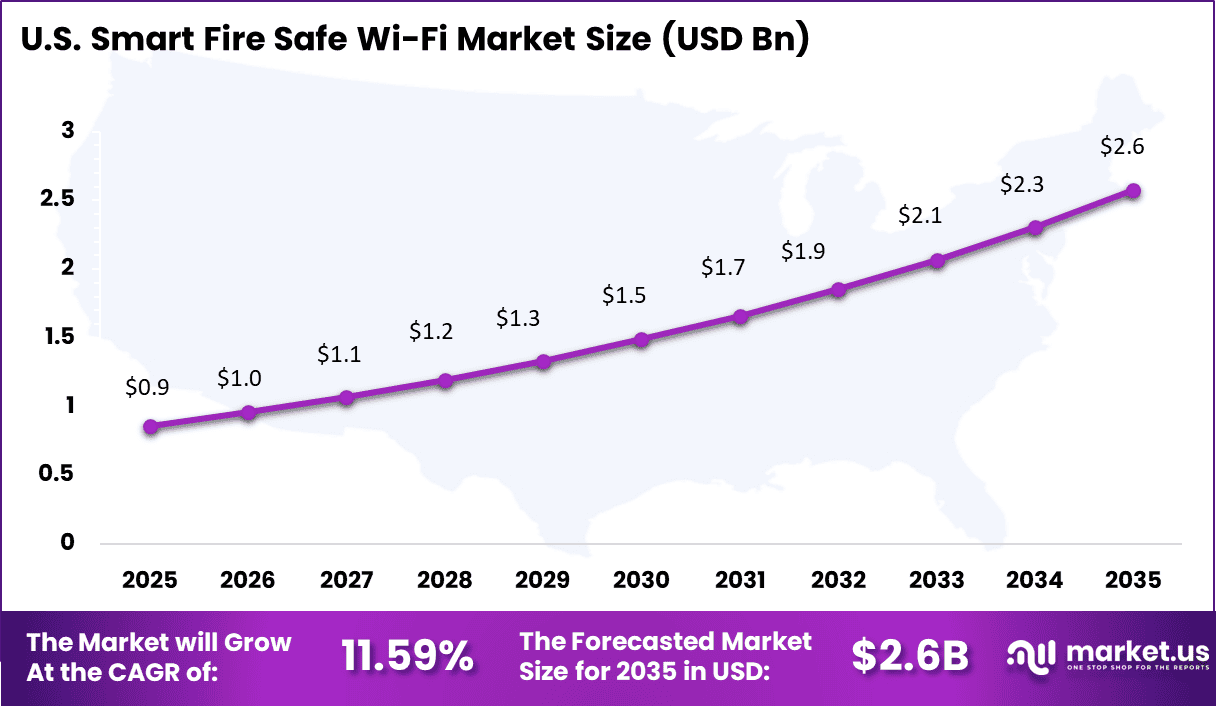
- Regionally, North America accounts for 35.1% global share, with the U.S. market valued at USD 0.86 billion and a CAGR of 11.59%, fueled by wildfire risks and insurance discounts for connected safes.
Drivers Impact Analysis
| Key Driver | Impact on CAGR Forecast (~%) | Geographic Relevance | Impact Timeline | Strategic Effect |
|---|---|---|---|---|
| Rising demand for connected home safety systems | +2.5% | North America, Europe, Asia Pacific | Short to Mid Term (2025–2031) | Expands adoption of smart fire safety devices |
| Increasing awareness of fire safety regulations and compliance | +2.2% | US, Europe, Australia | Mid Term (2026–2032) | Drives installation in residential and commercial spaces |
| Growth of IoT enabled home automation ecosystems | +2.0% | Global | Mid to Long Term (2026–2035) | Integrates fire safety with smart home systems |
| Rising urbanization and smart building infrastructure | +1.9% | Asia Pacific, Middle East | Mid to Long Term (2026–2035) | Supports large scale deployment |
| Expansion of remote monitoring and alert systems | +1.7% | Global | Short to Mid Term (2025–2030) | Enhances real time safety response |
Restraints Impact Analysis
| Key Restraint | Impact on CAGR Forecast (~%) | Geographic Relevance | Impact Timeline | Strategic Effect |
|---|---|---|---|---|
| High cost of smart fire safety devices | -1.8% | Global | Mid Term (2026–2032) | Limits adoption in price sensitive markets |
| Connectivity issues in low network coverage areas | -1.6% | Emerging regions | Short to Mid Term (2025–2030) | Reduces system reliability |
| Cybersecurity risks in connected safety systems | -1.5% | Global | Mid to Long Term (2026–2035) | Raises concerns over system vulnerabilities |
| Limited awareness in developing economies | -1.4% | Asia Pacific, Africa | Short to Mid Term (2025–2030) | Slows adoption rate |
| Integration challenges with existing fire safety infrastructure | -1.3% | North America, Europe | Mid Term (2026–2032) | Increases deployment complexity |
By Capacity Analysis
Small capacity less than 1 cu. ft. accounted for 58.9% of the Smart Fire Safe Wi-Fi Market. This segment leads because compact safes are widely preferred for personal use, especially for storing documents, cash, and small valuables. Their size makes them suitable for apartments, home offices, and limited space environments.
The segment is also supported by affordability and ease of installation. Consumers prefer smaller safes that can be easily placed in closets or hidden areas while still offering fire resistance and smart connectivity features, which continues to drive demand in this category.
By Lock Type Analysis
Digital keypad locks held 71.6% of the market. This segment dominates because keypad based systems offer a simple and reliable method of access without requiring physical keys. Users can easily set and change access codes, which improves convenience and security for daily use.
The segment also benefits from growing demand for quick access solutions combined with smart functionality. Digital keypads often integrate with Wi-Fi systems to provide alerts, remote access control, and monitoring features, which strengthens their adoption across modern safe systems.
By Application Analysis
Residential accounted for 74% of the Smart Fire Safe Wi-Fi Market. This segment leads because homeowners increasingly seek secure storage solutions for important items such as documents, jewelry, and emergency cash. Smart fire safes provide both protection against fire damage and remote monitoring capabilities.
The segment is also driven by rising awareness of home safety and personal asset protection. As more households adopt connected security devices, smart safes become part of a broader home security ecosystem, which supports steady growth in residential applications.
By Sales Channel Analysis
Online retail captured 63.8% of the market. This segment leads because consumers prefer the convenience of browsing and purchasing security products through e commerce platforms. Online channels offer a wide range of options, detailed product information, and customer reviews that support informed decision making.
The growth of online retail is also supported by increasing trust in digital transactions and home delivery services. Many consumers choose to buy smart safes online due to competitive pricing, easy comparison, and the availability of installation guidance, which continues to strengthen this sales channel.
Investor Type Impact Analysis
| Investor Type | Growth Sensitivity | Risk Exposure | Geographic Focus | Investment Outlook |
|---|---|---|---|---|
| Venture Capital Firms | High | Medium | US, Europe | Growth in smart safety startups |
| Private Equity Firms | High | Medium | North America, Europe | Expansion of safety equipment companies |
| Strategic Technology Investors | High | Medium | US, China, South Korea | Strengthens IoT safety ecosystem |
| Corporate Venture Arms | Medium to High | Medium | Global | Partnerships with smart home platforms |
| Government and Infrastructure Funds | Medium | Low | Asia Pacific, Europe | Support for building safety initiatives |
Technology Enablement Analysis
| Technology Enabler | Impact on CAGR Forecast (~%) | Geographic Relevance | Impact Timeline | Implementation Significance |
|---|---|---|---|---|
| IoT enabled fire detection and alert systems | +2.6% | Global | Short to Mid Term (2025–2031) | Enables real time monitoring |
| Wi Fi based connectivity for remote alerts | +2.3% | North America, Europe, Asia Pacific | Short to Mid Term (2025–2030) | Improves instant notifications |
| AI based fire and smoke detection analytics | +2.1% | US, Europe, Japan | Mid Term (2026–2032) | Enhances detection accuracy |
| Cloud based monitoring platforms | +1.9% | Global | Mid Term (2026–2032) | Supports centralized safety management |
| Integration with smart home ecosystems | +1.8% | Global | Mid to Long Term (2026–2035) | Improves system interoperability |
Key Challenges
- High product cost remains a key challenge because smart fire safes with Wi Fi features, digital controls, and remote monitoring are more expensive than traditional safes.
- Internet and power dependence can affect reliability, as weak connectivity, app failure, or battery issues may limit access to smart functions when users need them most.
- Cybersecurity is a major concern because connected safes may face risks such as hacking, unauthorized access, or data privacy issues through mobile apps and cloud systems.
- Consumer awareness is still limited, as many buyers do not fully understand the benefits of smart fire safes or may prefer conventional products with simpler features.
- Product durability and maintenance also create challenges because manufacturers must ensure strong fire protection, secure locking performance, and long term software support in one system.
Emerging Trends
A key trend in the Smart Fire Safe Wi-Fi market is the shift toward connected safety devices that allow users to monitor and manage fire resistant storage remotely. These safes are increasingly equipped with Wi-Fi connectivity, enabling real time alerts, remote locking control, and activity tracking through mobile applications.
Users can receive notifications about unauthorized access attempts or environmental changes such as heat exposure. This trend reflects a growing preference for combining physical safety with digital monitoring, making fire safes more responsive and user friendly in modern residential and commercial settings.
Growth Factors
The rising need to protect valuable documents, digital storage devices, and important assets is supporting the growth of smart fire safe solutions. Individuals and businesses are becoming more aware of risks related to fire damage, theft, and unauthorized access, which increases demand for advanced protection systems.
Smart fire safes provide an added layer of control by allowing users to monitor their belongings remotely and respond quickly to potential threats. The expansion of connected home technologies also encourages adoption, as consumers prefer integrated safety solutions that align with their broader digital environments.
Key Market Segments
By Capacity
- Small Capacity (< 1 cu. ft.)
- Medium Capacity (1 – 2 cu. ft.)
- Large Capacity (> 2 cu. ft.)
By Lock Type
- Digital Keypad Locks
- Biometric Locks
- Dual Authentication Locks
By Application
- Residential
- Commercial (Retail, Offices)
- Hospitality (Hotel Rooms)
By Sales Channel
- Online Retail
- Specialty Security & Safe Retailers
- Direct Sales
Regional Analysis
North America accounted for 35.1% of the Smart Fire Safe Wi Fi Market, reflecting strong adoption of connected safety and security solutions across residential and commercial spaces. Consumers and businesses increasingly invest in smart fire safes that combine fire protection with Wi Fi enabled monitoring and remote alerts.
The rising focus on protecting critical documents, digital assets, and valuables has encouraged the use of intelligent safes that provide real time notifications and access control. As smart home ecosystems continue to expand, demand for connected fire safety storage solutions continues to grow across the region.
The U.S. generated about USD 0.86 Bn within the regional market and is projected to expand at a CAGR of 11.59%. Households and enterprises across the country continue to adopt smart safes that offer remote locking, environmental monitoring, and integration with mobile applications.
Increasing awareness of fire risks and property protection has strengthened the use of advanced fire resistant storage systems. As consumers seek both physical protection and digital connectivity in security devices, demand for smart fire safe Wi Fi solutions continues to rise steadily across the US market.
Key Regions and Countries
- North America
- US
- Canada
- Europe
- Germany
- France
- The UK
- Spain
- Italy
- Russia
- Netherlands
- Rest of Europe
- Asia Pacific
- China
- Japan
- South Korea
- India
- Australia
- Singapore
- Thailand
- Vietnam
- Rest of APAC
- Latin America
- Brazil
- Mexico
- Rest of Latin America
- Middle East & Africa
- South Africa
- Saudi Arabia
- UAE
- Rest of MEA
Competitive Analysis
The Smart Fire Safe Wi Fi Market is driven by security product manufacturers that offer fire resistant safes integrated with digital monitoring and connectivity features. SentrySafe, Honeywell International, Inc., and First Alert provide advanced fireproof safes with smart locking systems and remote alert capabilities. These solutions are widely used in residential and small business environments to protect documents, valuables, and sensitive data.
Established safe manufacturers and access control brands contribute to product reliability and durability. Gardall Safe Corporation, Yale under Assa Abloy AB, and Mesa Safe Company offer fire rated safes with enhanced locking mechanisms and tamper resistance features. These companies focus on combining traditional fire protection with modern digital access systems. Their products are widely adopted in commercial, hospitality, and institutional settings.
Emerging and consumer focused brands further expand the competitive landscape. Amazon through Amazon Basics, Barska, SereneLife, Stack-On, and GunVault provide affordable smart safes with Wi Fi connectivity and mobile control features. Additional vendors such as Vaultz, Hollon Safe Company, and Viking Security Safe focus on compact designs and user friendly interfaces.
Top Key Players in the Market
- SentrySafe
- Honeywell International, Inc.
- First Alert, Inc. (BRK Brands)
- Gardall Safe Corporation
- Vaultz
- Yale (Assa Abloy AB)
- Barska
- Amazon Basics
- SereneLife
- Hollon Safe Company
- Viking Security Safe
- Mesa Safe Company
- BARSKA
- Stack-On Products Co.
- GunVault
- Others
Future Outlook
The future outlook for the Smart Fire Safe Wi Fi Market looks positive as more users seek secure storage solutions that combine fire protection with real time digital monitoring. Demand is expected to grow in homes and businesses as connected safety devices become more common and users look for remote alerts, access control, and better asset protection. Rising interest in smart home systems and stronger focus on safety and convenience are likely to support steady market growth in the coming years.
Recent Developments
- January, 2026 – SentrySafe launched Wi-Fi Fire Safe SFW123GDC with app alerts. Users receive instant tamper notifications across 2,100 cu in interiors. ETL fire rating withstands 1,700°F for 1 hour; water-resistant up to 8 inches.
- February, 2026 – Honeywell SafeGuard series added geofencing alerts. Owners get push notifications when safes open outside set zones. 0.5 cu ft models resist fires up to 45 minutes at 1,200°F. App logs track access history. Integration with Google Home enables voice queries. Honeywell secures 500K households.