

Report Overview
The Global Commercial Food Dehydrators Market size is expected to be worth around USD 1,389.5 million by 2035 from USD 792.7 million in 2025, growing at a CAGR of 5.8% during the forecast period 2026 to 2035.
Commercial food dehydrators are industrial-grade machines that remove moisture from food products. Manufacturers use them to extend shelf life without adding chemical preservatives. These systems serve food processors, hospitality providers, and specialty snack producers across diverse industries worldwide.
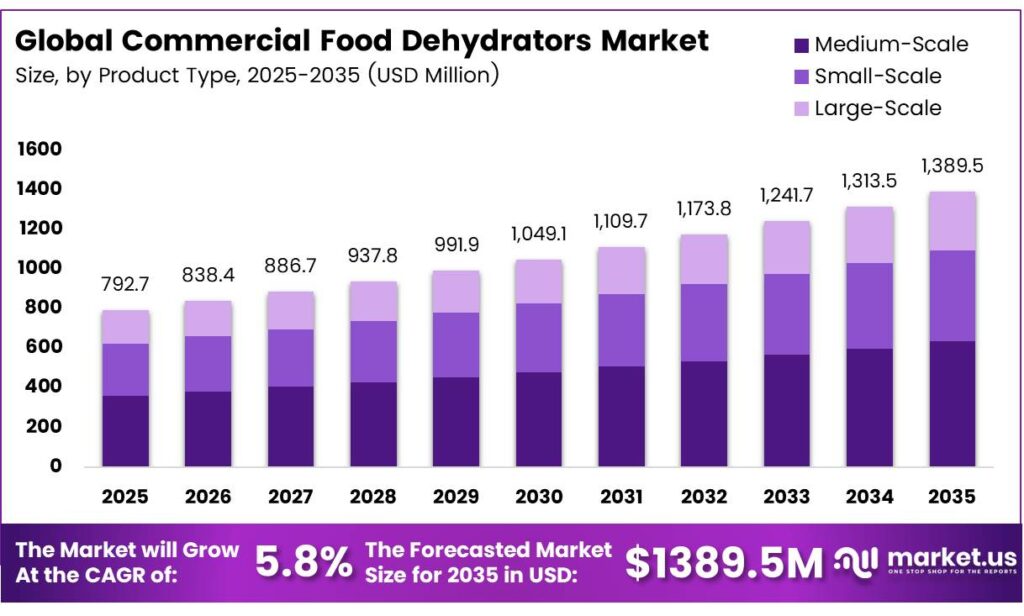
The market covers a wide range of equipment, from small-scale units for specialty producers to large-scale systems for industrial processors. Horizontal and vertical airflow technologies dominate the product landscape. Moreover, these systems process fruits and vegetables, meats, herbs, and pet food ingredients efficiently.
The United States recorded imports of non-domestic, non-electric dryers worth USD 328,457.53 thousand in 2024, ranking as the highest import value globally. This figure confirms North America’s central role as a leading consumption market for commercial drying equipment.
China exported non-domestic dryers worth USD 707,806.85 thousand across 3,695,840 items in 2024. This export volume reflects China’s dominant manufacturing position and its growing influence as a global supplier of food processing equipment.
Growing consumer demand for clean-label, preservative-free snacks drives strong commercial adoption. Food manufacturers increasingly invest in dehydration equipment to meet retail and export demand. Additionally, the global expansion of the health and wellness food sector creates sustained procurement activity across processing facilities.
Key Takeaways
- The Global Commercial Food Dehydrators Market is valued at USD 792.7 million in 2025 and is projected to reach USD 1,389.5 million by 2035, growing at a CAGR of 5.8%.
- Medium-Scale holds the dominant share at 53.7% in 2025.
- Horizontal Airflow leads with a 65.3% market share in 2025.
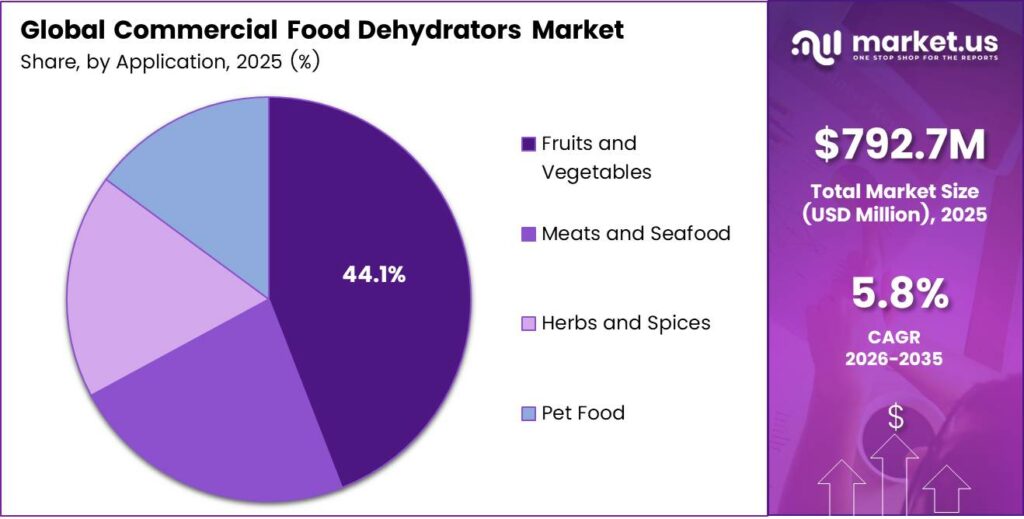
- Fruits and Vegetables account for the largest share at 44.1% in 2025.
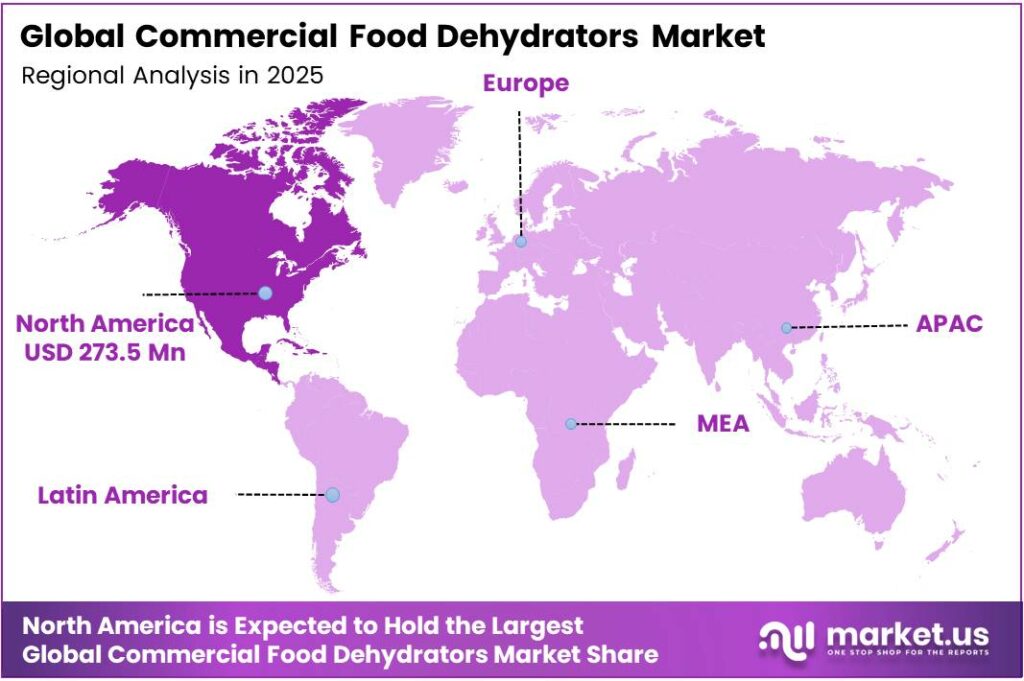
- North America dominates the regional landscape with a 34.5% share, valued at USD 273.5 million in 2025.
By Capacity Analysis
Medium-Scale dominates with 53.7% due to its versatility across mid-size food processing operations.
In 2025, Medium-Scale held a dominant market position in the By Capacity segment of the Commercial Food Dehydrators Market, with a 53.7% share. Mid-size processors prefer this capacity range because it balances throughput with operational cost. Moreover, medium-scale units serve restaurants, catering businesses, and regional food manufacturers effectively without requiring large facility upgrades.
Small-Scale dehydrators attract specialty food producers, artisan brands, and small restaurant operators. These units require lower capital investment and suit low-volume, high-margin product lines. However, limited throughput restricts their use in high-demand commercial settings, keeping their share below medium-scale adoption levels.
Large-Scale dehydrators serve industrial processors handling bulk volumes of fruits, meats, and pet food ingredients. These systems deliver high continuous output and suit large export-oriented manufacturers. Additionally, large-scale equipment adoption grows steadily as processors expand production capacity to meet rising global demand for shelf-stable food products.
By Technology Analysis
Horizontal Airflow dominates with 65.3% due to proven performance across diverse food processing applications.
In 2025, Horizontal Airflow held a dominant market position in the By Technology segment of the Commercial Food Dehydrators Market, with a 65.3% share. This technology distributes hot air evenly across all trays simultaneously. Consequently, horizontal systems deliver consistent drying results for fruits, vegetables, and meat products with minimal batch variation.
Vertical Airflow systems are gaining traction among energy-conscious operators seeking uniform drying at lower operating costs. These units move air upward through stacked trays, reducing heat loss. Moreover, manufacturers are innovating vertical airflow designs to capture growing demand for efficient and compact dehydration solutions in space-constrained commercial kitchens.
By Application Analysis
Fruits and vegetables dominate with 44.1% due to high global consumption and strong retail demand for dried produce.
In 2025, Fruits and Vegetables held a dominant market position in the By Application segment of the Commercial Food Dehydrators Market, with a 44.1% share. Processors use dehydration to extend shelf life and reduce logistics costs for produce. Additionally, growing consumer preference for healthy snack alternatives supports sustained investment in fruit and vegetable drying capacity.
Meats and Seafood processing represents a significant application segment driven by demand for jerky, dried fish, and shelf-stable protein products. Commercial operators serving the foodservice and retail sectors invest in specialized meat dehydration lines. Export-oriented processors in North America and the Asia Pacific expand meat drying capacity to meet international demand.
Herbs and Spices producers rely on precise temperature-controlled dehydration to preserve essential oils and flavor compounds. Nutraceutical and culinary producers require consistent moisture reduction without degrading active ingredients. Therefore, this segment attracts premium equipment investments from specialty food manufacturers seeking product differentiation.
Key Market Segments
By Capacity
- Medium-Scale
- Small-Scale
- Large-Scale
By Technology
- Horizontal Airflow
- Vertical Airflow
By Application
- Fruits and Vegetables
- Meats and Seafood
- Herbs and Spices
- Pet Food
By Region
- North America
- Europe
- Asia Pacific
- Middle East & Africa
- Latin America
Emerging Trends
IoT and Smart Controls Transform Commercial Dehydration Operations
Food processors increasingly adopt IoT-enabled smart controls for real-time monitoring of temperature, humidity, and drying cycles. These systems reduce human error and improve batch consistency across high-volume operations. Moreover, India imported non-domestic dryers worth USD 84,980.09 thousand across 237,730 items in 2024, reflecting growing Asian demand for advanced processing equipment.
Sustainable Hybrid Drying Technologies Gain Commercial Momentum
Manufacturers focus on hybrid drying technologies that combine conventional heat sources with solar alternatives. These innovations reduce energy consumption and operational costs for commercial processors. Consequently, nutraceutical and herbal ingredient producers drive customization demand for specialized dehydration lines that preserve bioactive compounds while meeting sustainability goals.
Drivers
Rising Demand for Preservative-Free Foods Accelerates Equipment Adoption
Consumer preference for clean-label, nutrient-rich snacks pushes food manufacturers to expand dehydration capacity. Processors across North America and Europe invest in commercial equipment to meet retail shelf-stable food demand. The European Union exported non-domestic dryers worth USD 539,647.97 thousand in 2024, highlighting strong regional manufacturing and supply activity.
Expanding Foodservice Sector Requires High-Capacity Dehydration Solutions
The global hospitality and foodservice sector expands steadily, creating consistent demand for high-capacity commercial dehydrators. Restaurant chains, catering companies, and food distributors require reliable drying systems for volume production. Additionally, small and medium enterprises prioritize commercial dehydration equipment as a cost-effective inventory management strategy, reducing spoilage and extending product availability across distribution networks.
Restraints
High Capital Investment Limits Adoption Among Small-Scale Operators
Commercial food dehydrators require significant upfront investment, making entry difficult for small processors and startups. Equipment costs, installation, and facility modifications strain limited capital budgets. ANDRITZ Group’s Environment and Energy division reported revenue of EUR 1,503.5 million in FY2024, up 14.7%, reflecting that large operators continue expanding processing infrastructure despite broader market cost pressures.
High Energy Consumption Reduces Long-Term Operational Profitability
Continuous dehydration operations consume significant electricity, directly impacting profit margins for commercial operators. Energy costs represent a persistent challenge, especially for mid-size processors running multi-shift production schedules. Therefore, operators in high-energy-cost regions delay equipment upgrades or limit production capacity, which constrains overall market growth potential in price-sensitive segments.
Growth Factors
Asia-Pacific Expansion Creates Strong Demand for Localized Equipment
Emerging markets in the Asia Pacific drive significant procurement of commercial food dehydration equipment. Indonesia recorded imports of non-domestic dryers worth USD 148,486.04 thousand in 2024, placing second globally by import value. This volume reflects rapid food processing industrialization across Southeast Asia, creating strong demand for both imported and locally manufactured dehydration solutions.
Plant-Based Food Growth and E-Commerce Open New Application Channels
Rising plant-based and vegan food production creates new application demand for precision dehydration equipment. Brands producing dried legumes, vegetables, and fruit-based snacks invest in scalable commercial systems. Alfa Laval’s Food and Water division reported net sales of SEK 25,635 million in FY2025, demonstrating sustained industry investment in food processing technologies that align with health-focused consumer trends.
Regional Analysis
North America Dominates the Commercial Food Dehydrators Market with a Market Share of 34.5%, Valued at USD 273.5 Million
North America leads the global commercial food dehydrators market with a 34.5% share, valued at USD 273.5 million in 2025. The United States drives demand through its large food processing and snack manufacturing sector. Moreover, strong retail distribution networks and growing consumer preference for dried, preservative-free snacks sustain commercial dehydration equipment investment across the region.
Asia Pacific registers the fastest growth in commercial dehydration equipment adoption. Expanding food processing industries in China, India, and Southeast Asia drive strong import demand. Additionally, rising middle-class consumption of packaged and snack foods encourages regional manufacturers to invest in scalable dehydration systems to serve both domestic and export markets.
The Middle East and Africa market grows steadily, supported by food security initiatives and expanding food processing infrastructure. Gulf Cooperation Council countries invest in processed food manufacturing to reduce fresh produce dependency. However, limited local equipment manufacturing and high import costs present challenges for smaller operators across the region.
Latin America shows consistent demand growth for commercial food dehydrators, led by Brazil and Mexico’s large agri-food processing sectors. Fruit processors and herb exporters invest in commercial drying equipment to meet international quality standards. Moreover, growing export activity in dried fruits and spices drives procurement across mid-size food manufacturing operations in the region.
Key Regions and Countries
North America
- US
- Canada
Europe
- Germany
- France
- The UK
- Spain
- Italy
- Rest of Europe
Asia Pacific
- China
- Japan
- South Korea
- India
- Australia
- Rest of APAC
Latin America
- Brazil
- Mexico
- Rest of Latin America
Middle East & Africa
- GCC
- South Africa
- Rest of MEA
Key Players Analysis
Tribest Corporation is a well-established player in the commercial food dehydrator segment, known for producing durable, multi-tray systems suited to professional food processing applications. The company targets health-conscious operators and specialty food producers. Moreover, Tribest’s product engineering focuses on consistent airflow performance and energy-efficient operation across its commercial equipment range.
Koolatron Corporation serves both commercial and semi-professional markets with a broad dehydrator portfolio. The company positions its products for small and mid-size food businesses seeking reliable drying solutions at accessible price points. Additionally, Koolatron’s distribution strength across North American retail and e-commerce channels supports steady market penetration among emerging food brands.
Excalibur Dehydrator holds a strong reputation among commercial users for its horizontal airflow technology and high-capacity tray configurations. Professional kitchens, herbal product manufacturers, and specialty snack producers rely on Excalibur’s systems. Furthermore, the company’s focus on precision temperature control and uniform drying performance strengthens its competitive position in demanding commercial environments.
National Presto Industries, Inc. brings established manufacturing capability and brand recognition to the commercial dehydrator segment. The company serves both retail and foodservice channels through diversified kitchen equipment product lines. Consequently, its ability to leverage existing distribution infrastructure and brand trust supports consistent sales performance across North American commercial and institutional food preparation markets.
Top Key Players in the Market
- Tribest Corporation
- Koolatron Corporation
- Excalibur Dehydrator
- National Presto Industries, Inc.
- Lem Products Holding LLC
- Hamilton Beach Brands, Inc.
- COSORI
- Aroma Housewares
- Presto
- Magic Mill
- Harvest Right
Recent Developments
- In 2025, Tribest Corporation’s dehydrator with Stainless Steel Trays, positioned for commercial and light-commercial use, featuring large capacity and reusable air filters. Other models include the Sedona Express, Combo, and Classic variants. The company’s most recent notable announcement was the launch of the Tribest Backspin Contra-Rotating Impact Blender—a wellness appliance innovation—but it does not involve dehydrators.
- In 2025, Koolatron offers the Total Chef Countertop Food Dehydrator (5-tray model) for home use, emphasizing superior airflow for fruits, jerky, vegetables, herbs, and pet treats. New dehydrator models, launches, updates, or company developments in the food dehydration/preservation sector. The product remains listed as a current offering with no recent modifications noted.