

Report Overview
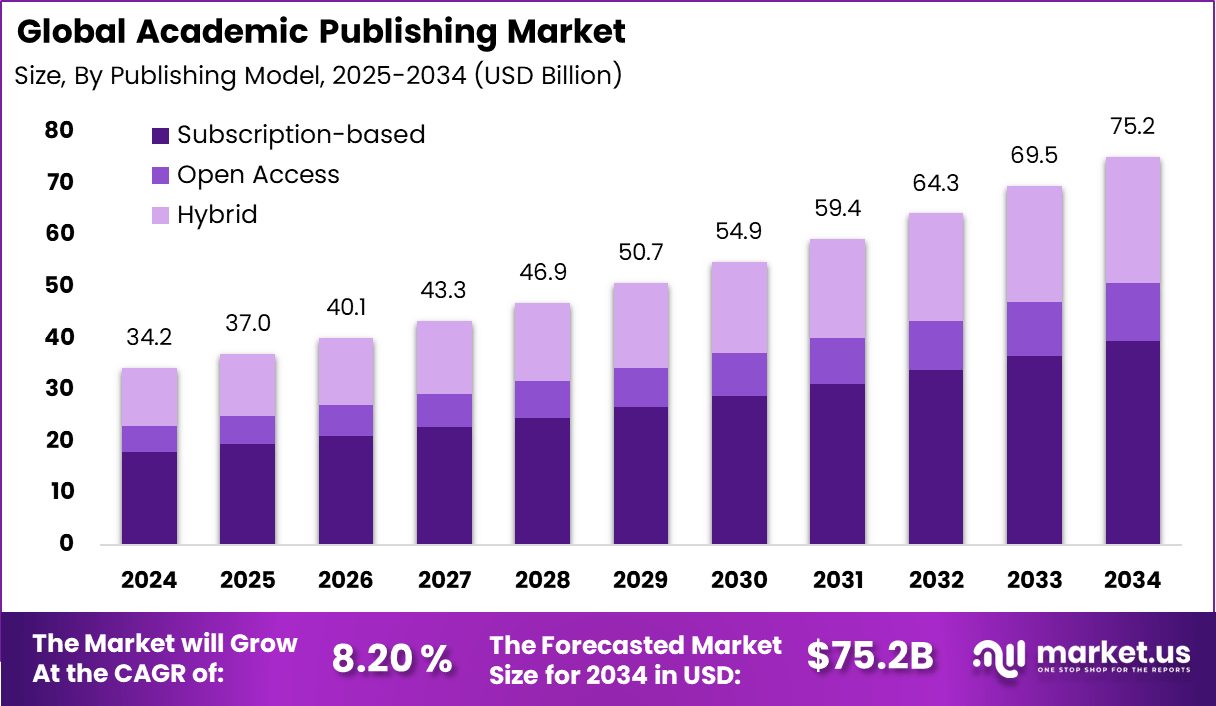
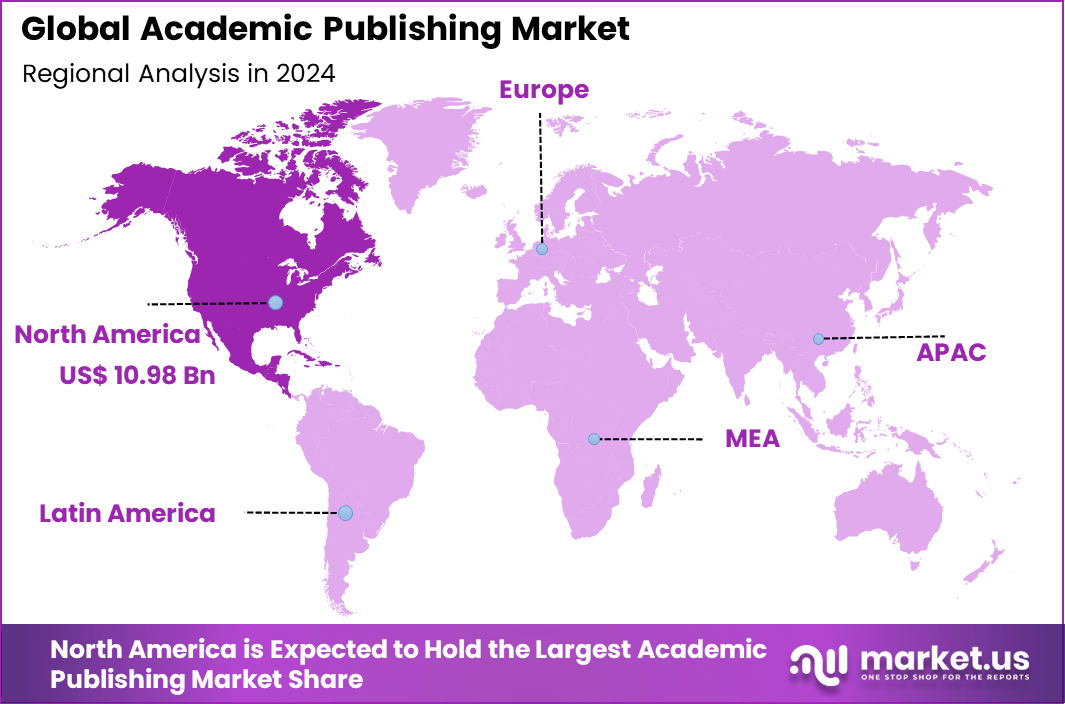
The Global Academic Publishing Market generated USD 34.2 billion in 2024 and is predicted to register growth from USD 37 billion in 2025 to about USD 75.2 billion by 2034, recording a CAGR of 8.20% throughout the forecast span. In 2024, North America held a dominan market position, capturing more than a 32.1% share, holding USD 10.98 Billion revenue.
The academic publishing market refers to the ecosystem of publishing research outputs, scholarly articles, textbooks, conference proceedings, and related educational materials through journals, books, and digital platforms. These publications are peer reviewed and intended to disseminate validated knowledge to scholars, professionals, students, and research institutions. Academic publishers support content creation, editorial review, distribution, indexing, archiving, and licensing.
Adoption spans universities, libraries, research laboratories, and individual authors seeking formal recognition of research. Market development has been shaped by the expansion of global research activity, increased demand for credible knowledge dissemination, and growth in higher education. Traditional print based models have evolved into digital and open access formats that enhance accessibility and distribution speed.
One major driver of the academic publishing market is the exponential growth in global research output. Governments, corporations, and academic institutions invest heavily in research and development across scientific, technical, medical, and social science domains. This expansion generates a steady supply of manuscripts seeking peer reviewed publication.
Academic publishers provide platforms and processes that validate and share research findings. Demand for academic publishing services is influenced by rising enrollments in higher education and research programmes. Universities require current, high quality content for teaching, learning, and knowledge creation. Textbooks, reference works, and research journals are core to academic curricula and scholarly communication. This institutional demand sustains significant content production and acquisition.
Global academic publishing continues to expand at a rapid pace. According to wordsrated, more than 5.14 million academic papers, including reviews, surveys, and conference proceedings, are published each year. The volume of published academic articles has grown consistently, recording a 22.78% increase over the last five years. This trend reflects rising research activity and greater emphasis on knowledge creation worldwide.
Publication output is highly concentrated across a small number of countries. Since 2022, China has become the world’s largest publisher of academic papers and is the first country to produce over 1 million papers within a 12 month period. Together, the United States and China account for more than 36% of global academic articles. Overall, just 10 countries contribute over 87% of all academic papers published globally.
Top Market Takeaways
- By content type, journals took 68.4% of the academic publishing market, as they share research papers and peer-reviewed studies.
- By publishing model, subscription-based held 52.6% share, used by libraries for ongoing access to collections.
- By end-user, academic and research institutions captured 71.5%, relying on publications for teaching and discovery.
- By subject area, science, technology, and medicine led with 76.8%, driving high-impact research output.
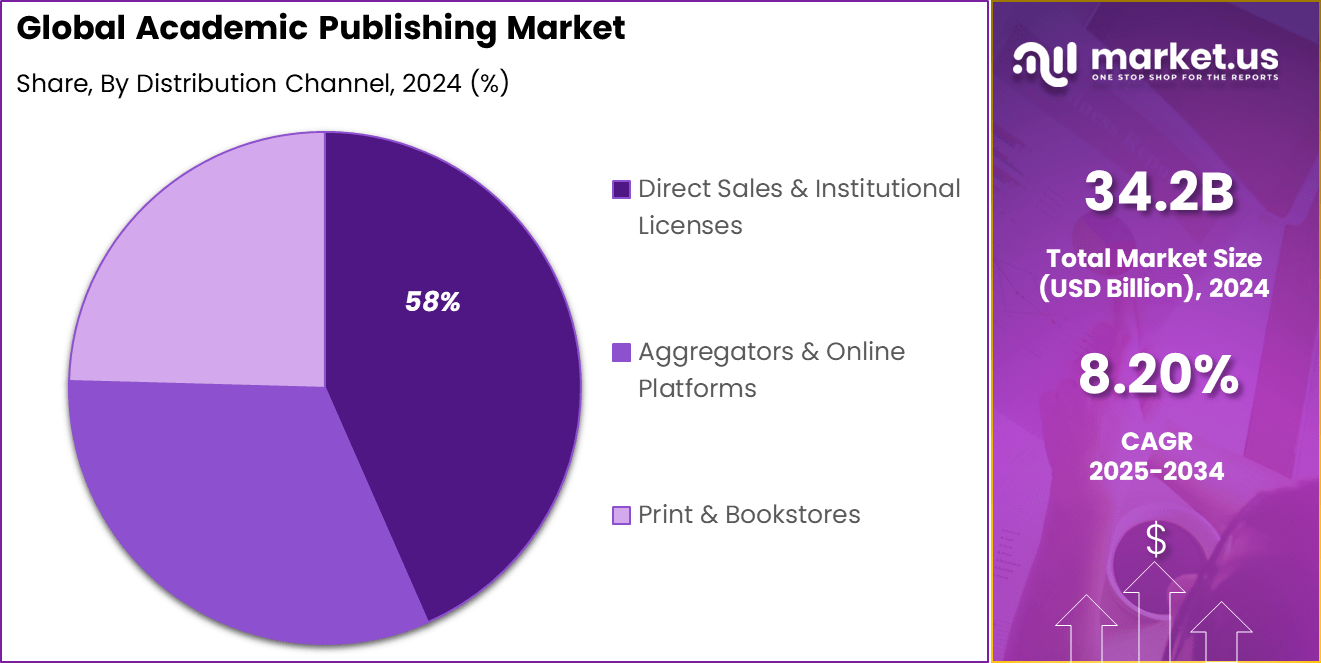
- By distribution channel, direct sales and institutional licenses accounted for 58.3%, securing bulk deals with universities.
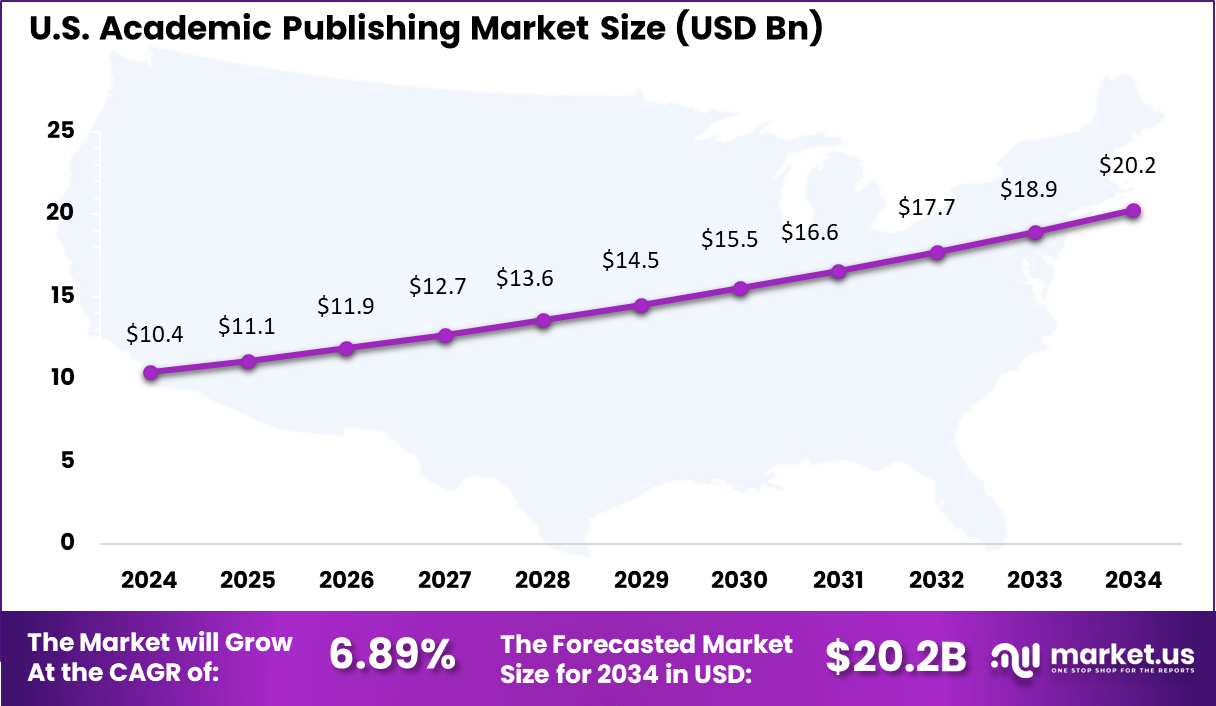
- North America had 32.1% of the global market, with the U.S. at USD 10.04 billion in 2025 and growing at a CAGR of 6.89%.
Drivers Impact Analysis
| Driver Category | Key Driver Description | Estimated Impact on CAGR (%) | Geographic Relevance | Impact Timeline |
|---|---|---|---|---|
| Growth in global research output | Increasing volume of academic publications | ~2.4% | Global | Short Term |
| Expansion of higher education | Rising university enrollments | ~1.9% | Asia Pacific, North America | Mid Term |
| Digital publishing adoption | Shift from print to online journals | ~1.6% | Global | Short Term |
| Government research funding | Public investment in R and D | ~1.3% | North America, Europe | Mid Term |
| International research collaboration | Cross border academic partnerships | ~1.0% | Global | Long Term |
Risk Impact Analysis
| Risk Category | Risk Description | Estimated Negative Impact on CAGR (%) | Geographic Exposure | Risk Timeline |
|---|---|---|---|---|
| Open access disruption | Pressure on traditional subscription models | ~2.8% | Europe, North America | Short to Mid Term |
| Budget constraints | Reduced library spending | ~2.3% | Global | Short Term |
| Piracy and content sharing | Unauthorized access to paid content | ~1.9% | Global | Mid Term |
| Author dissatisfaction | Concerns over publishing fees | ~1.4% | Global | Mid Term |
| Policy uncertainty | Changing publication mandates | ~1.0% | Europe | Long Term |
Restraint Impact Analysis
| Restraint Factor | Restraint Description | Impact on Market Expansion (%) | Most Affected Regions | Duration of Impact |
|---|---|---|---|---|
| High subscription costs | Limited affordability for institutions | ~2.6% | Emerging Markets | Short to Mid Term |
| Lengthy publication cycles | Delayed research dissemination | ~2.1% | Global | Mid Term |
| Peer review bottlenecks | Reviewer shortages | ~1.7% | Global | Mid Term |
| Print dependency | Slow transition in some regions | ~1.3% | Emerging Markets | Long Term |
| Language barriers | Limited global reach of research | ~0.9% | Global | Long Term |
Content Type Analysis
Journals account for 68.4%, making them the most dominant content type in academic publishing. Scholarly journals are the primary medium for sharing peer-reviewed research. They support validation, citation, and academic recognition. Researchers rely on journals to disseminate findings. Journals maintain high standards of quality and credibility.
The dominance of journals is driven by academic evaluation systems. Institutions emphasize journal publications for career advancement. Regular publication cycles ensure continuous content flow. Digital access improves reach and discoverability. This sustains strong demand for journal-based content.
Publishing Model Analysis
Subscription-based models represent 52.6%, highlighting their continued relevance. Institutions subscribe to journals and databases for broad access. Subscription models provide stable revenue structures. Libraries manage access for students and researchers. Long-term agreements support content continuity.
Adoption of subscription-based publishing is driven by institutional requirements. Universities prefer comprehensive content access. Subscriptions support archival and historical research. Predictable access supports academic planning. This keeps subscription models widely used.
End-User Analysis
Academic and research institutions account for 71.5%, making them the largest end-user group. These institutions depend on scholarly content for teaching and research. Access to peer-reviewed material supports academic rigor. Libraries manage large content collections. Institutional demand remains strong.
Growth in this segment is driven by expanding research activities. Universities invest in knowledge resources. Research output increases demand for access. Collaboration across institutions supports shared usage. This sustains institutional dominance.
Subject Area Analysis
Science, technology, and medicine account for 76.8%, making them the leading subject area. STM research generates a high volume of publications. Rapid innovation drives frequent updates. Journals support dissemination of experimental and clinical findings. Accuracy and validation are critical.
The dominance of STM is driven by global research investment. Medical and technological advancements require constant publication. Researchers rely on journals for timely updates. Funding supports extensive research output. This keeps STM at the forefront.
Distribution Channel Analysis
Direct sales and institutional licenses represent 58.3%, showing preference for centralized access. Institutions negotiate licenses for broad usage rights. Direct agreements simplify access management. Licensing supports compliance and usage tracking. Institutions value controlled distribution.
Growth in this channel is driven by institutional purchasing practices. Libraries manage large user bases. Licensing supports predictable access terms. Digital delivery improves efficiency. This sustains strong use of direct and licensed channels.
Key Reasons for Adoption
- The need for credible and peer-reviewed knowledge sharing is increasing across universities and research institutions
- Researchers are required to publish findings to support academic careers, funding access, and institutional ranking
- Digital publishing platforms are improving global access to journals and academic content
- Collaboration between researchers across regions is supported through standardized publishing systems
- Policy makers and industries rely on published research to support evidence-based decisions
Benefits
- Research quality is improved through structured peer review and editorial standards
- Global visibility is provided to authors, institutions, and funded research projects
- Long-term preservation of academic knowledge is ensured through digital archives
- Citation tracking and indexing help measure research impact and credibility
- Open access models support wider knowledge sharing and public learning
Usage
- Universities use academic publishing to document and validate faculty research output
- Research organizations publish findings to share innovation and scientific progress
- Governments use published studies to support policy development and regulation
- Corporations rely on academic journals for technology validation and product research
- Libraries and educational platforms use journals to support teaching and learning activities
Emerging Trends
| Key Trend | Description |
|---|---|
| Open Access Expansion | Open access models and transformative agreements are becoming central, with funders and institutions increasingly mandating free public access to research outputs. |
| AI in Publishing Workflows | AI tools support manuscript screening, reviewer suggestions, plagiarism checks, and workflow automation, reducing publication time while maintaining quality. |
| Data Sharing and Transparency | Publishers and funders promote open data, requiring datasets alongside articles to improve reproducibility, verification, and secondary analysis. |
| Shift to Digital First Models | E journals, e books, and online platforms dominate as print declines, supported by mobile access and online discovery tools. |
| Globalization and Localization | Publishers localize content, expand translation, and pursue regional partnerships to reach new markets and support emerging research hubs. |
Growth Factors
| Key Factors | Description |
|---|---|
| Rising Research Output | Growth in universities, research institutes, and R&D intensive sectors increases the volume of articles, books, and conference outputs needing publication. |
| Digital Transformation | Migration from print to digital platforms improves accessibility, reduces distribution costs, and enables new interactive content formats. |
| Open Science Policies | Government and funder mandates for open access and open data expand publishing opportunities in journals and repositories. |
| Technology and Analytics | AI, big data, and advanced search technologies enhance content discovery, personalization, and platform revenues. |
| Government and Institutional Funding | Increased budgets for science, higher education, and innovation sustain long term demand for scholarly content, especially in STEM fields. |
Key Market Segments
By Content Type
- Journals
- Books & Monographs
- Conference Proceedings
- Reference Works
- Others
By Publishing Model
- Subscription-based
- Open Access
- Hybrid
By End-User
- Academic & Research Institutions (Libraries)
- Individual Researchers & Students
- Corporate R&D
- Government & Non-profits
- Others
By Subject Area
- Science, Technology & Medicine (STM)
- Humanities & Social Sciences (HSS)
- Engineering
- Others
By Distribution Channel
- Direct Sales & Institutional Licenses
- Aggregators & Online Platforms
- Print & Bookstores
Regional Analysis
North America accounted for 32.1% share, supported by a well established academic and research ecosystem across universities, research institutions, and professional societies. The region has shown consistent demand for scholarly journals, books, and digital research platforms, driven by strong research funding and high publication output.
Regional Driver Comparison
| Region | Primary Growth Driver | Regional Share (%) | Regional Value (USD Bn) | Adoption Maturity |
|---|---|---|---|---|
| North America | Strong research funding ecosystem | 32.1% | USD 10.98 Bn | Advanced |
| Europe | Open science and collaboration programs | 28.6% | USD 9.78 Bn | Advanced |
| Asia Pacific | Rapid expansion of universities | 26.4% | USD 9.03 Bn | Developing to Advanced |
| Latin America | Research capacity building | 7.4% | USD 2.53 Bn | Developing |
| Middle East and Africa | Emerging academic infrastructure | 5.5% | USD 1.88 Bn | Early |
Adoption of digital publishing models has increased access to academic content and improved distribution efficiency. Libraries and institutions in the region have continued to invest in subscription based and hybrid publishing models to support research and education needs.
The U.S. market reached USD 10.04 Bn and is projected to grow at a 6.89% CAGR, reflecting sustained demand from higher education institutions, government research bodies, and corporate research centers. Academic publishing in the U.S. has benefited from strong research output and continued emphasis on knowledge dissemination. Digital journals and online platforms have become the primary channels for accessing scholarly content, supporting faster publication and wider reach.
Key Regions and Countries
- North America
- US
- Canada
- Europe
- Germany
- France
- The UK
- Spain
- Italy
- Russia
- Netherlands
- Rest of Europe
- Asia Pacific
- China
- Japan
- South Korea
- India
- Australia
- Singapore
- Thailand
- Vietnam
- Rest of APAC
- Latin America
- Brazil
- Mexico
- Rest of Latin America
- Middle East & Africa
- South Africa
- Saudi Arabia
- UAE
- Rest of MEA
Investor Type Impact Matrix
| Investor Type | Adoption Level | Contribution to Market Growth (%) | Key Motivation | Investment Behavior |
|---|---|---|---|---|
| Academic institutions | Very High | ~71.5% | Research dissemination | Subscription driven |
| Government bodies | High | ~14% | National research visibility | Funding based |
| Research consortia | Moderate | ~8% | Shared access models | Collective licensing |
| Corporate research centers | Moderate | ~5% | Applied research insights | Selective subscriptions |
| Independent researchers | Low | ~2% | Individual access | Article based purchase |
Opportunity
A strong opportunity lies in enhancing interoperability and data integration across research systems. Platforms that connect publication records with grant information, research identifiers, and data repositories can improve discoverability and reduce redundancy. These connections support more efficient workflows for researchers and institutions.
Another opportunity exists in expanding multilingual and regional content access. Much research remains behind language barriers or outside mainstream indexing. Publishers that support translation, regional journal inclusion, and culturally relevant dissemination can broaden participation and global knowledge exchange.
Challenge
One challenge for the academic publishing market is balancing openness with financial sustainability. Open access models promote accessibility, but they often shift costs to authors or institutions through processing charges. Finding equitable models that support both access and long-term viability is essential.
Another challenge involves ensuring quality and integrity in the face of increasing publication volume. The growth in submissions can strain peer review systems and increase the likelihood of errors or misconduct. Maintaining rigorous standards while managing workflow scale remains a core operational concern.
Competitive Analysis
The Academic Publishing Market is led by large global publishers with strong journal portfolios and digital platforms. RELX Group and Springer Nature focus on high-impact journals and advanced research databases. John Wiley & Sons, Inc. and Taylor & Francis Group, part of Informa, emphasize multidisciplinary research coverage. SAGE Publishing supports social sciences and humanities. These players benefit from strong author networks and institutional relationships.
University presses and professional societies strengthen subject depth and academic credibility. Oxford University Press and Cambridge University Press focus on scholarly books and peer-reviewed journals. American Chemical Society, Institute of Electrical and Electronics Engineers, and Association for Computing Machinery publish discipline-specific, high-citation content. IOP Publishing and American Physical Society focus on physics and applied sciences.
Medical and specialist publishers add focused expertise to the market. Wolters Kluwer N.V. integrates publishing with clinical decision tools. BMJ Publishing Group, Ltd. emphasizes evidence-based medical research. Thieme Medical Publishers, Inc. supports clinical education and journals. Other publishers continue to expand open access models and digital delivery. This drives wider research visibility and evolving publishing standards.
Top Key Players in the Market
- RELX Group
- Springer Nature
- John Wiley & Sons, Inc.
- Taylor & Francis Group (Informa plc)
- SAGE Publishing
- Oxford University Press
- Cambridge University Press
- Wolters Kluwer N.V.
- American Chemical Society
- Institute of Electrical and Electronics Engineers (IEEE)
- Association for Computing Machinery (ACM)
- IOP Publishing
- American Physical Society (APS)
- BMJ Publishing Group, Ltd.
- Thieme Medical Publishers, Inc.
- Others
Future Outlook
Growth in the Academic Publishing market is expected to continue as demand for high quality research content remains strong across education, science, and industry. Digital publishing formats are being used more widely to improve access, speed of distribution, and global reach of academic content.
Open access models and data sharing practices are also shaping how research is published and consumed. Over time, stronger use of digital platforms, analytics, and research management tools is likely to improve visibility, collaboration, and research impact.
Recent Developments
- September, 2025 – John Wiley & Sons outlined plans for six new Advanced Portfolio journals in health, life sciences, chemistry, and AI by end of 2026, as part of portfolio enhancements announced earlier.
- May, 2025 – BC Partners launched a dedicated acquisition fund for Springer Nature, led by Neuberger Berman, to fuel further growth through organic expansion and selective mergers in scientific publishing.