

Report Overview
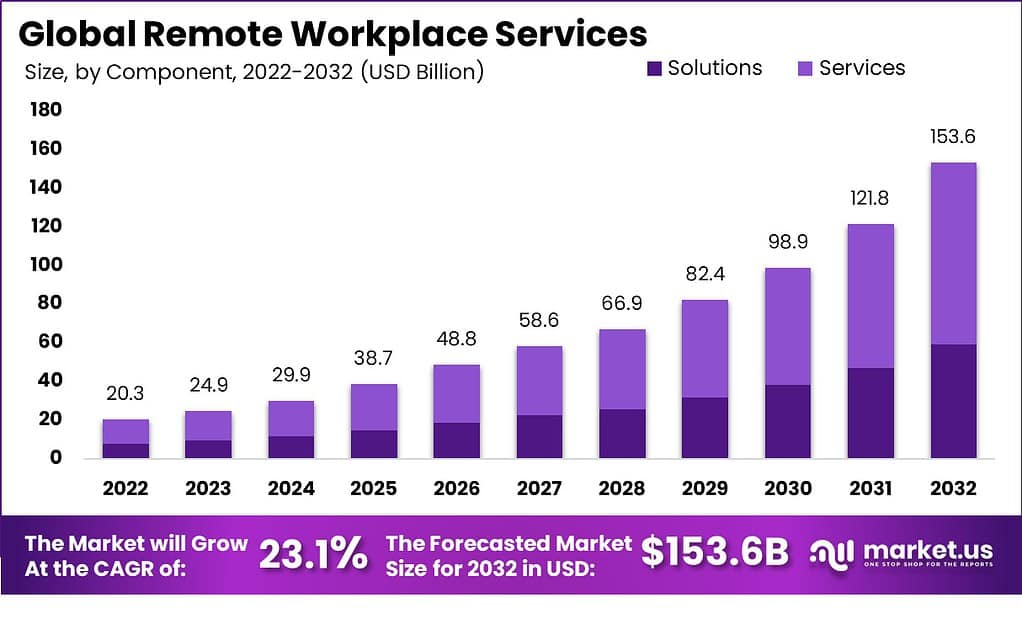
The Global Remote Workplace Services Market size is expected to be worth around USD 153.6 Bn by 2032 from USD 24.9 Bn in 2023, growing at a CAGR of 23.1% during the forecast period.
Remote Workplace Services can be referred services that enhance the work experience of employees working outside office environments by leveraging modern technology. These services can be helpful for employees working from home, in co-working spaces, or in remote locations. Remote Workplace Services help facilitate communication among employees working from different locations.
These services also help establish the proper IT Infrastructure required for remote working. During the COVID-19 Pandemic, the demand for remote workplace services witnessed exponential growth as employees could not work in office settings due to the risk of infection. In today’s modern era, traditional workplaces are undergoing rapid technological changes. With the constantly evolving technology, the remote workplace services market is expected to witness rapid growth in the upcoming years.
Note: The figures presented here are subject to change in the final report.
Key Takeaways
- Market Growth Projection: The Remote Workplace Services Market is set to reach USD 153.6 billion by 2032 from USD 20.3 billion in 2022, with a projected CAGR of 23.1%.
- Definition of Remote Workplace Services: These services enable efficient remote work by providing technology and solutions for employees working outside traditional office environments.
- Remote Working Culture Surge: The accelerated adoption of remote work, prompted by the pandemic and technological progress, has transformed it from a flexible option to an integral part of professional work.
- Cybersecurity Challenges: Increased remote work has amplified cybersecurity risks, demanding advanced solutions to safeguard against unauthorized access and data breaches.
- Dominance of Cloud-Based Solutions: Cloud-based services lead the market due to their scalability, cost-effectiveness, and rapid implementation, facilitating the smooth transition to remote work.
- Service Segment Significance: Services play a crucial role in managing the complexities of remote work environments, leading to an increased demand for training, cybersecurity, and infrastructure optimization.
- Prevalence in Large Enterprises: Large enterprises drive the market, investing heavily in sophisticated remote workplace solutions to manage their intricate business operations.
- IT & Telecommunications Dominance: The IT & Telecommunications sector holds a significant market share, leveraging digital tools and platforms to foster remote work adoption.
- Opportunities in Digital Transformation: The surge in digital transformation across industries has created opportunities for remote workplace services, emphasizing the need for digital adaptation.
- Hybrid Work Models Trend: The adoption of hybrid work models, combining on-site and remote work, is gaining traction, enhancing work flexibility and maintaining a healthy work culture.
- North America Market Leadership: North America leads the global market, driven by the presence of advanced technology firms and early technology adoption.
- Key Players in the Market: Major companies such as Microsoft, Google, Cisco, and IBM, among others, are actively shaping the Remote Workplace Services Market.
Driving Factor
Growing Remote Working Culture
The rapidly growing remote working culture has been a prominent trend in the 21st century. Several factors, including the COVID-19 Pandemic and Rapid technological advancements, have fueled the remote working culture globally. The culture, which was once viewed as a flexibility option, has now become an integral part of professional working due to its several benefits. Remote working benefits both employees and employers by enhancing their efficiency and convenience.
Remote working can help employees by reducing commuting time, providing flexibility, and improving their work-life balance. Employers can also be benefited from remote working as they can reduce their expenses on maintaining office spaces, hire people from various regions globally, and enhance the overall employee working experience. This factor is expected to upsurge the demand for remote workplace services globally.
Restraining Factor
Cyber Security Concerns
Adopting remote work has increased cyber security concerns for both employees and employers. Employees commonly use their devices for remote working, which may increase the risk of cyberattacks and data breaches. Due lack of security infrastructure, many firms are vulnerable to various cybersecurity risks, including unauthorized access and phishing attacks.
Also, the shift to cloud-based services may lead to vulnerabilities if not properly secured. These security issues have also led to development new and advanced remote working solutions in the remote workplace services market. This factor may hinder the adoption of remote working and negatively affect market growth.
Deployment Mode Analysis
Cloud-Based segment Leads the Global Remote Workplace Services Market by Holding Major Revenue Share in Account.
Based on deployment mode, the global remote workplace services market is classified into cloud-based and on-premise. Among these deployment modes, the cloud-based segment dominates the market by holding the major revenue share in the global remote workplace services market. This dominance of the cloud-based segment is due to cloud-based solutions’ scalability and cost-effectiveness.
Also, cloud-based solutions can be quickly implemented, enabling organizations to rapidly adapt to remote work demands. Owing to these benefits, many organizations prefer to adopt cloud-based remote workplace services solutions rather than on-premise ones. Overall, these factors are boosting cloud-based growth in the deployment mode segment in the global remote workplace services market.
Component Analysis
Services Dominate the Component Segment by Securing Major Revenue Share in the Account.
The global remote workplace services market is segmented into solutions and services based on components. Among these components, the services lead the market by covering the global remote workplace services market’s major revenue share of 61.4%. This growth of the services segment can be attributed to the complexities associated with implementing and managing remote work environments.
The rapid adoption of remote work by businesses led to various challenges including training, cybersecurity, and infrastructure optimization. These challenges led to an increased demand for remote workplace services to manage remote work environments. However, the solutions segment is also expected to grow significantly during the forecast period.
Organization Size Analysis
Large Size Enterprises Lead the Organization Size Segment with Major Revenue Share in Account.
Based on the organization size segment the global remote workplace services market is segmented into large enterprises and SMEs. Among these organization size segments, the large-size enterprise segment dominates the market by holding a major revenue share of 64.7% in the global remote workplace services market. This growth of large-size enterprises owes to large operations and vast workforces among these enterprises. Large-size enterprises often invest heavily in advanced remote workplace solutions to manage their complex business operations.

Note- The figures presented here are subject to change in the final report.
Industry Vertical Analysis
IT & Telecommunications segment Hold largest market share during the forecast period.
Based on Industry Vertical, the global remote workplace services market is classified into IT & telecommunications, BFSI, retail and e-commerce, healthcare, education, manufacturing, government and public sector, media & entertainment, and other industry verticals. Among these industry verticals, the IT & telecommunications segment holds the major revenue share account to dominate the industry vertical segment in the global remote workplace services market. This growth of the IT & telecommunications industry can be attributed to the growing remote working trend in the industry post the COVID-19 pandemic. The IT & telecommunications industry is primarily equipped with various digital tools and platforms that rapidly propelled remote working adoption in the industry.
Key Market Segments
Deployment Mode
- Cloud-Based
- On-Premise
Component
- Solutions
- Unified Communication and Collaboration
- Unified Endpoint Management
- Enterprise Mobility Management
- Services
- Professional Services
- Managed Services
Organization Size
- SMEs
- Large Size Enterprises
Industry Vertical
- IT & Telecommunications
- BFSI
- Retail and E-commerce
- Healthcare
- Education
- Manufacturing
- Government and Public Sector
- Media & Entertainment
- Other Industry Verticals
Growth Opportunity
Digital Transformation
The rapid digital transformation across various sectors has led to an increased demand for remote workplace services. The COVID-19 pandemic acted as a catalyst for the digital transformation of various companies worldwide. During the pandemic, businesses started adapting to remote working, which highlighted the need for digital transformation in various companies. With the growing digital transformation in various companies, the working environment and models are expected to transform digitally, creating various opportunities in the global remote workplace services market.
Latest Trends
Hybrid Work Models
Workplace concepts are constantly evolving with time. Many organizations are adopting a hybrid model by combining both on-site and remote work. This approach not only offers employees work flexibility but also helps in maintaining a healthy work environment and culture. This model can help bring balance between traditional office interaction and the convenience of remote work, maximizing productivity while respecting individual needs. This factor is expected to trend in the global remote workplace services market.
Regional Analysis
North America Dominates the Global Remote Workplace Services Market by Holding the Major Revenue Share in Account.
The North American region dominates the global remote workplace services market by holding a major revenue share of 36.1%. This massive growth of the region can be attributed to the presence of various technology firms, especially in the United States.
Also, the advanced infrastructure and early adoption of advanced technology are proving as a major factor in the growth of the North American region. These factors are boosting the growth of the North American region in the Global remote workplace services market. The Asia Pacific region is anticipated to grow at a significant CAGR over the forecast period owing to the rapid adoption of advanced technologies and improving technology infrastructure in the region.

Note- The figures presented here are subject to change in the final report.
Key Regions and Countries Covered in this Report
- North America
- The US
- Canada
- Europe
- Germany
- France
- The UK
- Spain
- Italy
- Russia & CIS
- Rest of Europe
- APAC
- China
- Japan
- South Korea
- India
- Rest of APAC
- Latin America
- Brazil
- Mexico
- Rest of Latin America
- Middle East & Africa
- GCC
- South Africa
- Rest of MEA
Key Player Analysis
The global remote workplace services market is fragmented into many companies offering remote workplace services solutions and services. Key players in the market are focusing on strengthening their position in the market through various strategies, including mergers, acquisitions, collaborations, and partnerships. Some of the major players in the global remote workplace services market are Microsoft Corporation, Google LLC, Cisco Systems, Inc., Accenture plc, IBM Corporation, Tata Consultancy Services, HCL Technologies Limited, Atos, The Hewlett-Packard Company, VMware, Inc., and Other Key Players.
Top Key Players
- Microsoft Corporation
- Google LLC
- Cisco Systems, Inc.
- Accenture plc
- IBM Corporation
- Tata Consultancy Services
- HCL Technologies Limited
- Atos
- The Hewlett-Packard Company
- VMware, Inc.
- Other Key Players
Recent Developments
- In August 2023, Microsoft Corporation announced that more than 60% of the Fortune 500 companies use Microsoft 365 to empower frontline productivity in remote and non-remote work environments.