

Report Overview
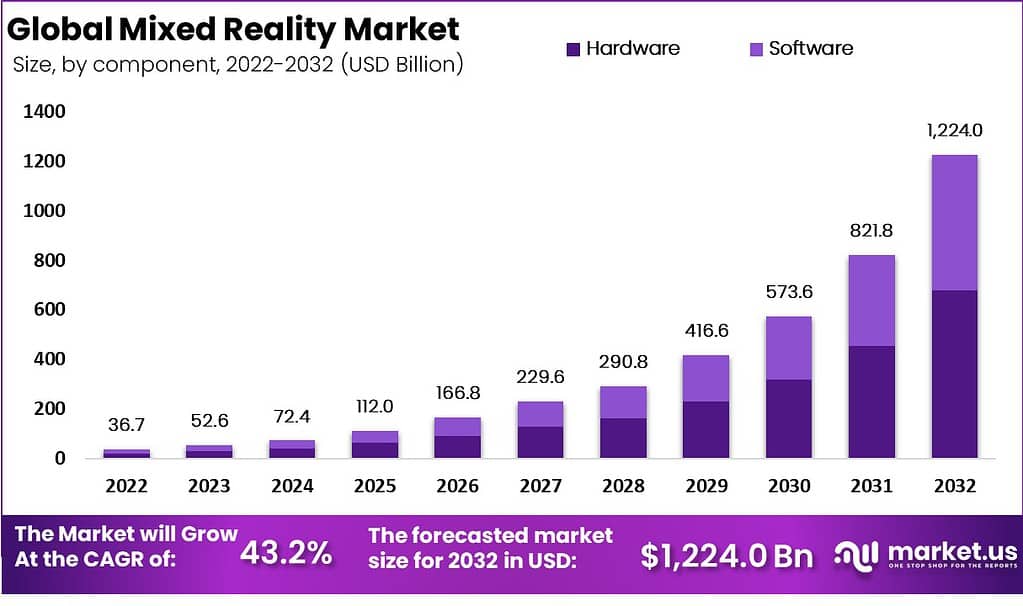
The Global Mixed Reality Market size is expected to be worth around USD 1,224.0 Bn by 2032 from USD 52.6 Bn in 2023, growing at a CAGR of 43.2% during the forecast period from 2023 to 2032.
The mixed reality market is experiencing significant growth and is poised to revolutionize various industries, including gaming, entertainment, healthcare, education, and more. Mixed reality combines elements of both virtual reality (VR) and augmented reality (AR) to create immersive and interactive experiences that blend the physical and digital worlds.
The market for mixed reality is being driven by several key factors. Firstly, advancements in technology, such as improved hardware capabilities, more powerful processors, and better tracking systems, have enabled more realistic and seamless mixed reality experiences. This has led to increased adoption and interest from both consumers and businesses.
The gaming and entertainment industry has been one of the primary drivers of the mixed reality market. With mixed reality, gamers can step into virtual worlds and interact with virtual objects and characters in a more immersive and engaging way. This has opened up new possibilities for gaming experiences, from interactive storytelling to multiplayer experiences that blend the physical and virtual realms.
In addition to gaming, mixed reality has significant applications in other sectors. In healthcare, for example, it can be used for medical training, simulation, and patient education. Surgeons can practice complex procedures in a virtual environment, and medical students can learn through realistic simulations. Mixed reality also has the potential to enhance telemedicine by allowing healthcare professionals to remotely diagnose and treat patients using augmented reality tools.
Education is another area where mixed reality is making an impact. It enables students to visualize complex concepts and interact with virtual objects, enhancing their learning experiences. For example, students can explore historical landmarks, travel to different parts of the world, or conduct virtual experiments in a safe and controlled environment.
The market for mixed reality is also being driven by enterprise applications. Businesses are utilizing mixed reality for training purposes, product design and prototyping, remote collaboration, and customer engagement. For example, architects can use mixed reality to visualize building designs in real-world environments, and remote teams can collaborate on projects as if they were in the same physical space.
Key Takeaways
- Projected Market Growth: It is projected that the global Mixed Reality Market will reach USD 1,224.0 billion by 2032, experiencing an astounding compound annual growth rate of 43.2% from 2023-2032.
- Definition and Scope of Mixed Reality: Mixed Reality (MR) is an immersive technology that seamlessly combines elements from both worlds to provide users with an interactive experience.
- Component Analysis: The hardware segment has emerged as the primary driver of market revenue, accounting for 78.5% of the total market share in 2022.
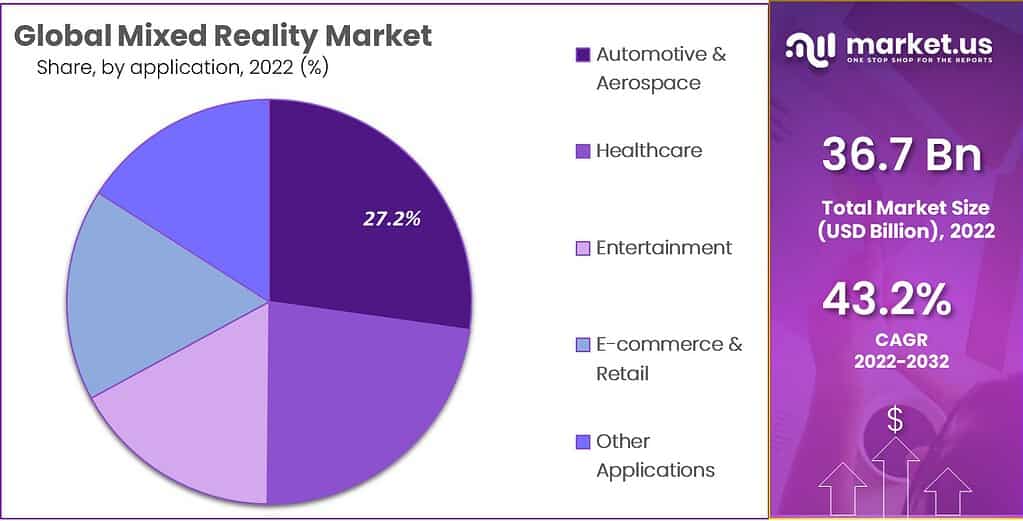
- Application Diversity: The market’s applications span various sectors, including automotive and aerospace, healthcare, entertainment, e-commerce, retail, and others, showcasing the versatility and broad-ranging impact of mixed reality technology.
- Dominant Players: Major players in the market include Microsoft Corporation, Magic Leap Inc., Alphabet Inc., and HTC Corporation, among others, each contributing to the innovation and growth of the mixed reality landscape.
- Driving Factors: Continuous technological advancements, including improved hardware components, enhanced visual quality, immersive experiences, and software improvements, alongside the utilization of AI and machine learning, are propelling the market’s growth.
- Challenges: The shortage of skilled professionals poses a significant constraint for the industry, necessitating collaboration with educational institutions and ongoing training to address the gap in the mixed reality workforce.
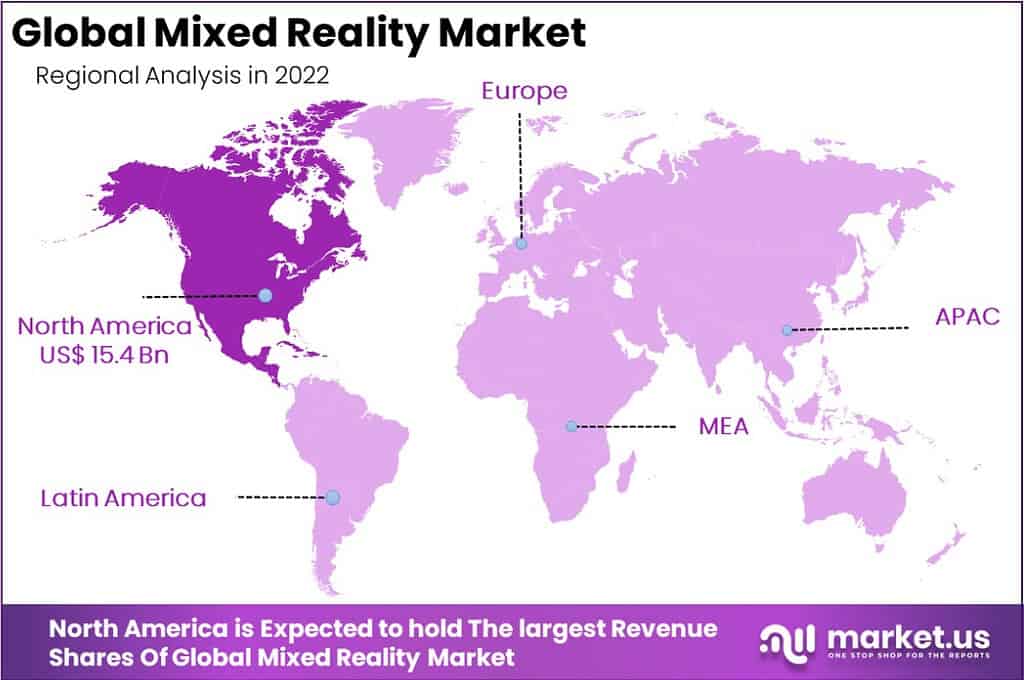
- Regional Impact: North America currently holds a significant share of the market, followed closely by the Asia-Pacific region, which is projected to witness significant growth during the forecast period, driven by increasing demands in communication and marketing strategies.
- Market Opportunity: The market presents a significant opportunity for enhancing creative capabilities, enabling immersive content creation, interactive design, and personalized experiences across various industries, including education, architecture, entertainment, and marketing.
Component Analysis
Hardware Segment to Witness Significant Growth
The global mixed reality market is segmented into software and hardware based on components. The hardware segment accounted for the largest market revenue share of 78.5% in 2022. The segment hardware is probable to witness major growth over the forecast period because of the growth of the innovative MR hardware. The novel MR hardware contains sensors, processors, and former displays.
The prominent Companies in the mixed reality market, for example, MAGIC LEAP, INC. and major player Microsoft Corporation, are projected to commercialize their upcoming MR devices in 2016, which may severely affect the growth of the hardware segment. Also, several companies, for example, Intel Corporation, are working on improving the value of semiconductor chips and the workstations used in MR devices.
By Application Analysis
The Automotive and Aerospace Segment Dominates the Market
Based on application, the global mixed reality market is categorized into automotive & aerospace, medical, entertainment, e-commerce & retail, and others. The aerospace and automotive registered the highest market share revenue during the forecast period due to the mixed reality method in the automobile project that has been advanced completely using novel equipment from gaming computer production. This upcoming system assures the noteworthy reimbursements by the virtual reality systems that have been to date, so distributing virtual reality on the developer workstations.
Note- The figures presented here are subject to change in the final report.
Key Market Segments
By Component
- Software
- Hardware
By Application
- Automotive & Aerospace
- Healthcare
- Entertainment
- E-commerce
- Retail
- Other Applications
Driving Factors
Development of New Technology Drives Market Growth
Continuous technological advancements propel the growth of the global mixed reality market. These innovations enhance hardware components, leading to improved visual quality and immersive experiences. Software improvements facilitate better interactions and object recognition, while AI and machine learning personalize experiences. Cloud and edge computing ease computational demands, widening access to mixed reality. These advancements also foster diverse content creation, spanning industries like healthcare and education. Overall, the evolution of technology enriches user experiences, broadens applications, and drives the market’s expansion.
Restraining Factors
Lacked Skilled Professionals
The shortage of skilled professionals poses a significant constraint in the global mixed reality market. The multidisciplinary nature of mixed reality requires expertise in various fields, leading to a scarcity of individuals with the necessary skill sets. Rapid technological advancements exacerbate this shortage, and businesses across sectors face recruitment and innovation challenges. Addressing this restraint requires collaboration with educational institutions, ongoing training, and user-friendly tools to nurture a proficient mixed reality workforce.
Market Opportunity
Enhancing Creative Capabilities
The global mixed reality market offers a significant opportunity to enhance creative capabilities through the merging of physical and digital realms. This innovation enables immersive content creation, interactive design, personalization, spatial computing, and collaborative creativity. It benefits education, architecture, entertainment, art, and marketing by fostering engaging experiences and novel forms of expression. This potential for transformative creative engagement underscores mixed reality’s impact across industries.
Latest Trends
High Acceptance and Emerging Players boosted the global market
The global mixed reality market’s upward trend is propelled by two main factors: the widespread acceptance of mixed reality technologies across industries and the emergence of new players in the market. The increasing recognition of mixed reality’s potential for enhancing experiences and efficiency has led to higher demand for its applications. Concurrently, the entry of innovative newcomers has introduced fresh perspectives and solutions, fostering competition and novel use cases. This combined effect is driving the market’s growth as industries adopt mixed reality and new players contribute to its evolution.
Regional Analysis
North American region accounted for a Significant Share of the Mixed Reality Market.
North America accounted for a significant mixed reality market revenue share of 42.1%. Due to the presence of prominent and larger design organizations. and investment in novel marketing strategies. The increasing e-commerce industry is the major factor propelling the growth of the North American region. The Asia-Pacific is anticipated to hold the second-largest region in the market during the forecast period. The rising need for communicating with the target audience designs that business purpose to survive in the market.
Note- The figures presented here are subject to change in the final report.
Key Regions and Countries Covered in this Report:
North America
- US
- Canada
Europe
- Germany
- France
- The UK
- Spain
- Italy
- Russia
- Netherland
- Rest of Europe
APAC
- China
- Japan
- South Korea
- India
- Australia
- New Zealand
- Singapore
- Thailand
- Vietnam
- Rest of APAC
Latin America
- Brazil
- Mexico
- Rest of Latin America
Middle East and Africa
- South Africa
- Saudi Arabia
- UAE
- Rest of MEA
Key Players Analysis
The global mixed reality market was characterized by significant players driving industry growth. Microsoft led with HoloLens and a Mixed Reality platform for enterprise and consumer applications. Magic Leap stood out with advanced spatial computing devices, while Meta (formerly Oculus), a Facebook subsidiary, influenced mixed reality through VR and AR initiatives. These key players innovated in hardware, software, and content creation, shaping the mixed reality landscape. Their strategies aimed to enhance user experiences, expand content libraries, and increase mixed reality accessibility.
The following are some of the major key players in the global mixed reality market industry
- HTC Corporation
- META COMPANY
- Magic Leap Inc.
- Alphabet Inc.
- Microsoft Corporation
- Hewlett Packard Enterprise
- Dell Technologies Inc.
- Asus Tek Computer Inc.
- Other Key Players
Recent Development
- In May 2022, Microsoft India announced the collaboration with Jodhpur’s All-India Institute of Medical Sciences (AIIMS). The company aims to establish a Mixed Reality Center of Excellence at AIIMS, Jodhpur, which can increase remote healthcare capabilities, and promote educational opportunities for both staff and students.
- In April 2022, Nikon announced the launch of a fully-owned subsidiary called Nikon Creates Corporation in partnership with Microsoft’s Mixed Reality Capture Studios. This partnership will enable the planning, shooting, and creation of volumetric, VR, 3D content, and expand the company’s presence in corporate-level content creation.