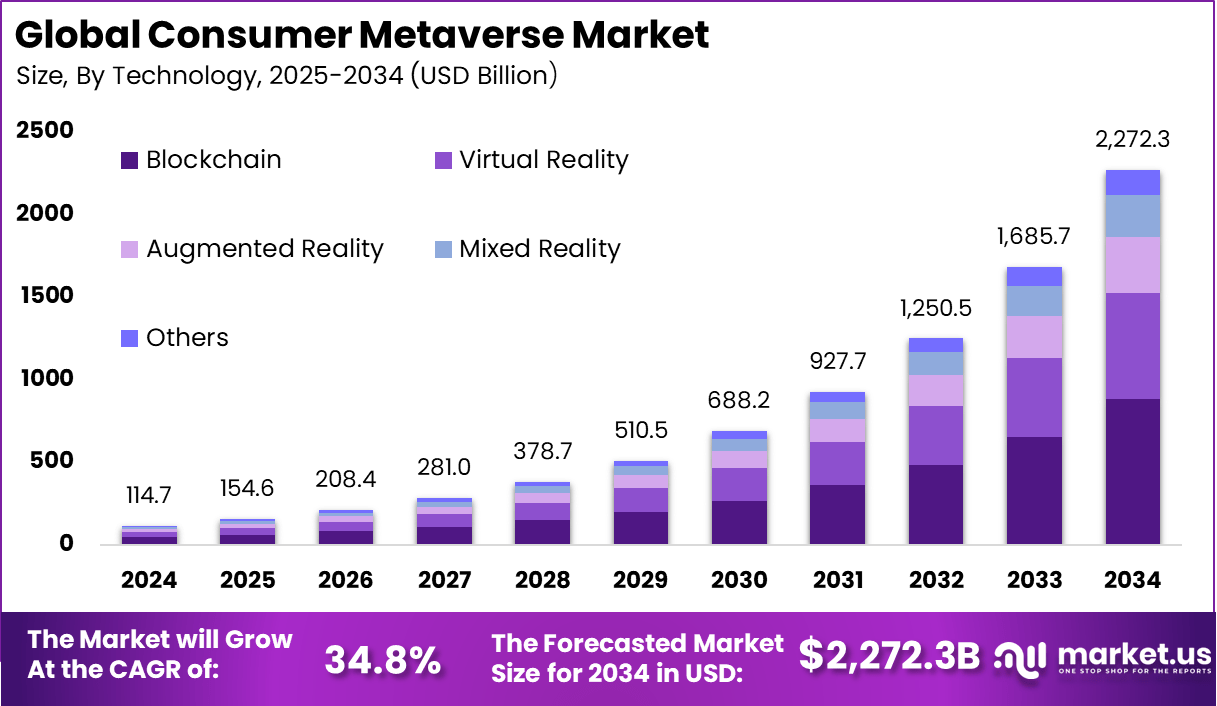
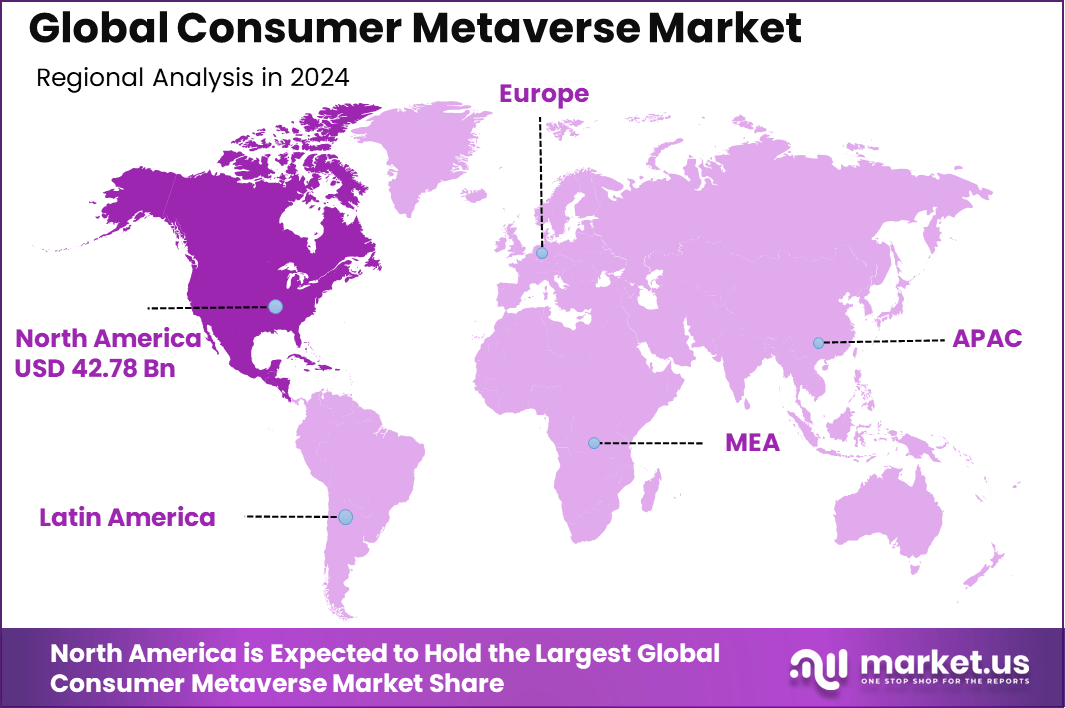
The Global Consumer Metaverse Market generated USD 114.7 billion in 2024 and is predicted to register growth from USD 154.6 billion in 2025 to about USD 2,272.3 billion by 2034, recording a CAGR of 34.8% throughout the forecast span. In 2024, North America held a dominan market position, capturing more than a 37.3% share, holding USD 42.78 Billion revenue.
Top Market Takeaways
Hardware components lead with 54.7%, reflecting demand for AR/VR headsets, sensors, and immersive devices.
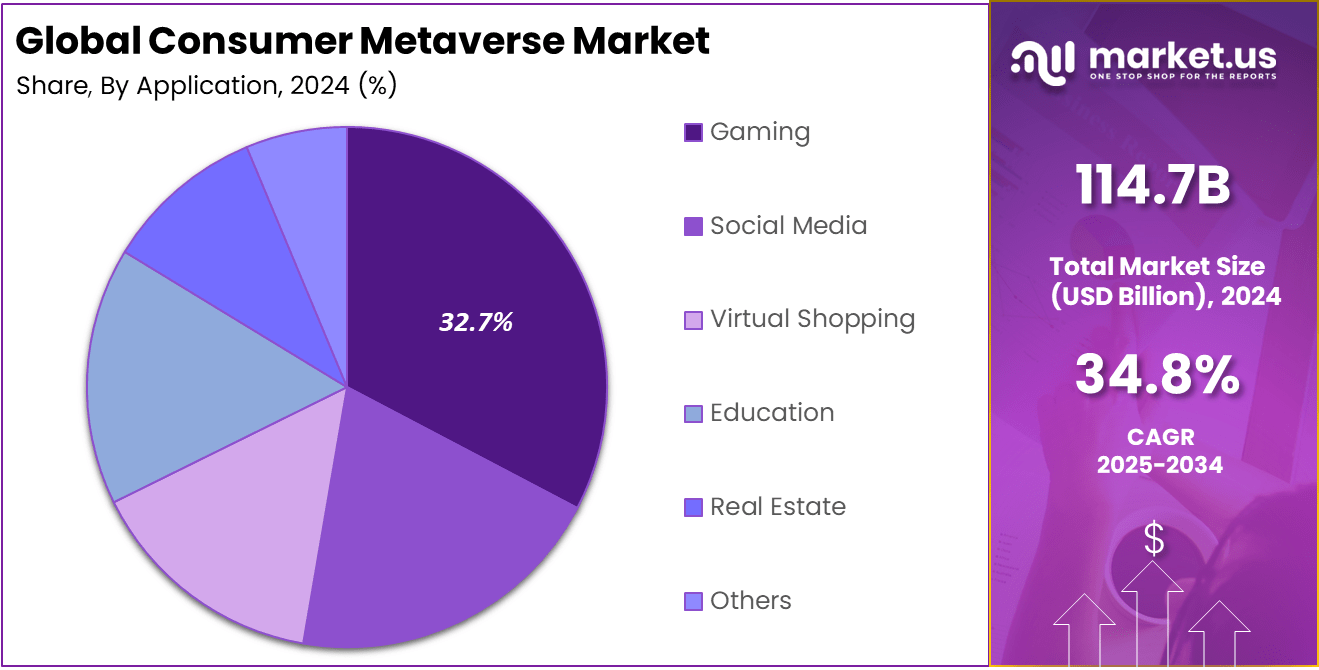
Gaming applications hold 32.7%, showcasing the metaverse’s strongest foothold in entertainment and interactive experiences.
Blockchain technology accounts for 38.8%, enabling secure transactions, digital assets, and decentralized ownership.
Enterprises dominate end-user adoption with 70.7%, using the metaverse for collaboration, training, and virtual commerce.
North America captures 37.3%, supported by strong innovation ecosystems and tech investments.
The US market reached USD 36.36 billion and is expanding at a rapid CAGR of 32.5%, positioning it as a global leader in metaverse adoption.
Quick Market Facts
In 2024, North America holds a substantial 37.3% share of the consumer metaverse market. This is driven by the region’s advanced digital infrastructure, widespread adoption of AR and VR devices, and strong investments from technology leaders. These factors enable immersive experiences and innovative applications that attract both consumers and enterprises.
By Component: Hardware
In 2024, Hardware dominates the consumer metaverse market with a strong share of 54.7%. This dominance is driven by the essential role hardware devices such as VR headsets, AR glasses, and haptic technology play in delivering immersive experiences. Improvements in display resolution, user comfort, and lightweight designs are continuously raising the bar for user engagement, making hardware the backbone of consumer adoption in the metaverse.
Growth in this segment is also propelled by technological investments focused on improving the quality and accessibility of hardware. As consumer expectations rise, manufacturers prioritize innovation to provide smooth, realistic interactions crucial to deepening metaverse engagement. This consistent evolution ensures that hardware will maintain its lead in the coming years.
By Application: Gaming
In 2024, Gaming constitutes 32.7% of the consumer metaverse market, firmly positioning itself as the primary use case. Its immersive and interactive design draws users into virtual worlds where they can play, socialize, and create. The rise of multiplayer online games and virtual economies underlines gaming’s role as a bridge between traditional entertainment and metaverse ecosystems.
Gaming’s continuous growth is supported by increasing investments in game mechanics, user customization, and monetization strategies. Many consumers enter the metaverse through gaming, making it a critical driver of overall market engagement and innovation within digital experiences.
By Technology: Blockchain
In 2024, Blockchain technology accounts for 38.8% of the market, acting as a core enabler for secure and transparent asset ownership within the metaverse. It supports NFT trading, decentralized finance, and various digital economic models, which enhance trust and user participation. By securing transactions and digital goods, blockchain ensures authenticity and value in the metaverse economy.
Consumer confidence in blockchain has fueled broader adoption of metaverse platforms, allowing users to engage safely and confidently with digital assets. As blockchain technology evolves, its applications within the metaverse will deepen, further stimulating user engagement and new business models.
By End-User: Enterprises
In 2024, the enterprise segment overwhelmingly leads with 70.7% of the consumer metaverse market share. Organizations are leveraging metaverse technologies for virtual events, training, marketing, and collaboration. The commercial interest is high due to the ability of immersive digital spaces to enhance communication, employee engagement, and customer experiences.
Enterprises drive much of the market innovation and adoption, pushing the boundaries of security, scalability, and usability. Their investment in metaverse solutions fosters the growth of robust ecosystems that benefit all end users, further accelerating market expansion.
Emerging Trends
Emerging trends in the consumer metaverse include the rise of immersive experiences driven by advancing hardware such as VR headsets and AR glasses alongside high-speed 5G connectivity. Gaming remains the dominant application with over 50% of metaverse revenue coming from interactive multiplayer games that offer social and economic engagement.
Virtual social platforms are redefining how users interact by enabling not just chatting but hosting events, co-creating content, and participating in shared experiences. Additionally, retail and fashion industries are leveraging digital avatars and virtual try-ons, especially among younger generations, who demand personalized and novel shopping experiences.
Growth Factors
Several key growth factors are driving the consumer metaverse market. These include the widening adoption of advanced AI technologies and blockchain for secure digital asset ownership. The demand for new forms of entertainment, socializing, and commerce in virtual worlds continues to rise, supported by widespread internet penetration and improvements in immersive technology interfaces.
Social gaming and esports communities contribute significantly to user engagement, alongside innovations in monetization models such as microtransactions and virtual goods sales. Statistics show a rapid global increase in metaverse users, with approximately 700 million active monthly users reported in 2025.
Key Market Segments
By Component
Hardware
Software
Services
By Application
Gaming
Social Media
Virtual Shopping
Education
Real Estate
Others
By Technology
Blockchain
Virtual Reality
Augmented Reality
Mixed Reality
Others
By End-User
Individual Consumers
Enterprises
Regional Analysis and Coverage
North America
US
Canada
Europe
Germany
France
The UK
Spain
Italy
Russia
Netherlands
Rest of Europe
Asia Pacific
China
Japan
South Korea
India
Australia
Singapore
Thailand
Vietnam
Rest of Latin America
Latin America
Brazil
Mexico
Rest of Latin America
Middle East & Africa
South Africa
Saudi Arabia
UAE
Rest of MEA
Driver
Growth in Immersive Technologies
The consumer metaverse market is primarily driven by advancements in immersive technologies such as virtual reality (VR) and augmented reality (AR). These technologies allow consumers to engage in highly interactive and realistic digital environments, leading to increased adoption for gaming, socializing, and shopping experiences.
Improvements in hardware like VR headsets and motion sensors deliver a more immersive and satisfying experience, encouraging more users to explore metaverse platforms. This development has expanded the consumer base, particularly in gaming, which remains the largest application segment.
Additionally, the growing integration of artificial intelligence (AI) enhances user interactions and personalization within these virtual worlds. Overall, immersive technologies provide the foundation necessary for sustained growth in the consumer metaverse market by making digital experiences more appealing and accessible.
Restraint
Security and Privacy Concerns
One significant restraint to the consumer metaverse market growth is the increasing threat of cyberattacks and data privacy issues. As metaverse environments become more complex and interconnected, they present new vulnerabilities that cybercriminals can exploit.
This leads to serious concerns about the security of personal data, user identity, and virtual assets, which can deter potential users from fully engaging with these platforms. Moreover, the complexity of safeguarding transactions and interactions within the metaverse raises regulatory and trust challenges.
The lack of widespread user awareness about security measures further limits market expansion. These privacy and security issues must be addressed effectively to gain user confidence and enable broader adoption.
Opportunity
Expansion of Virtual Commerce
The consumer metaverse offers a valuable opportunity for virtual commerce that is transforming how consumers shop and engage with brands. Virtual stores and marketplaces allow users to browse, try digital products, and make purchases within immersive environments using AR and VR. This creates a more engaging and personalized shopping experience than traditional online retail.
Additionally, the integration of blockchain technology supports safe ownership of digital assets like NFTs, boosting consumer confidence in virtual transactions. Brands can reach global audiences with innovative marketing and interactive campaigns, opening new revenue streams. This shift toward immersive digital commerce is expected to drive substantial market growth.
Challenge
Platform Interoperability
A major challenge for the consumer metaverse market is the lack of interoperability between different metaverse platforms. Currently, most virtual worlds operate as closed ecosystems, preventing users from moving seamlessly between environments or transferring digital assets across platforms. This fragmentation limits user experience and reduces the potential for a unified metaverse.
Achieving interoperability involves technical and regulatory hurdles, including standardizing protocols and ensuring security across platforms. Without solutions to these integration challenges, the consumer metaverse market may face slower adoption and limited scalability. Addressing platform interoperability is critical for long-term success and wider mainstream use.
Competitive Analysis
The Consumer Metaverse Market is led by major technology and gaming companies such as Meta Platforms, Apple, Microsoft, and Epic Games. Meta drives social interaction in virtual environments through Horizon Worlds, while Microsoft supports cross-platform engagement via Xbox, Mesh, and Minecraft integration. Apple strengthens the ecosystem through XR device development, and Epic Games enhances immersive experiences through Fortnite’s virtual economy and creator ecosystem.
Gaming and creative platform providers including Roblox Corporation, Animoca Brands/The Sandbox, Unity Technologies, and Niantic contribute significantly by offering open virtual environments, user-generated content tools, and AR-powered interactions. These companies enable creators, gamers, and developers to monetize digital assets, participate in virtual events, and engage in persistent online experiences across mobile, PC, and VR devices.
Hardware and infrastructure contributors such as HTC (VIVE), Samsung, Snap Inc., NVIDIA, and Mozilla/WebXR contributors provide XR headsets, 3D rendering platforms, browser-based entry points, and real-time graphics processing. Their technologies enable high-quality visuals, low-latency streaming, and accessibility across devices.
October 2025, Meta rolled out details of its new Horizon Engine designed for Meta Horizon Worlds. The engine supports infinite connected spaces, more realistic physics, and higher player capacities (five times more users, four times faster performance). It targets cloud-to-mobile scalability and familiar developer tools to boost content creation and platform evolution focused on user safety and scalability.
August 2025, HTC launched new VR headsets including the Vive Focus Vision and Vive Pro 2, featuring hybrid standalone/PC modes, high-res displays (5K resolution for Pro 2), and enhanced streaming options. These headsets cater to both business and education segments as well as versatile consumers, emphasizing comfort and advanced visual fidelity for metaverse experiences.
August 2025, Mozilla advanced its WebXR API to replace WebVR, expanding web-based mixed reality capabilities to enable easier creation and sharing of VR and AR experiences in browsers. WebXR improves input support (voice, gestures) and aims for wide platform support, empowering metaverse experiences accessible without dedicated hardware.
August 2025, Animoca Brands restructured The Sandbox, resulting in over 50% layoffs and co-founder role shifts as the firm focuses on AI-driven content deployment and operational efficiency. The co-founders moved to non-executive ambassador and chairman roles, reflecting a pivot to leverage AI to accelerate feature rollout with a leaner team.
June 2025, Apple is actively developing at least seven head-worn AR/VR devices across two distinct product families. This signals a dual strategy with one family likely focusing on high-end VR/AR (an evolution of Vision Pro) and another on more accessible smart glasses aimed at a broader mainstream audience. The company aims to release at least one of these devices by 2025, expanding its footprint in immersive consumer metaverse hardware.