

GPU Orchestration Platform Market
GPU Orchestration Platform Market By Component (Software, Hardware, Services), By Deployment Mode (On-Premises, Cloud-based), By Enterprise Size (Small and Medium Enterprises, Large Enterprises), By Application (AI and Machine Learning, High-Performance Computing, Other Applications), By End-User (BFSI, Healthcare, Other End-Users), By Regional Analysis, Global Trends and Opportunity, Future Outlook By 2025-2035
- Published date: Apr. 2026
- Report ID: 183855
- Number of Pages: 301
- Format:
- Overview
- Table of Contents
- Major Market Players
Quick Navigation
- Report Overview
- Top Market Takeaways
- Drivers Impact Analysis
- Restraints Impact Analysis
- By Component Analysis
- By Deployment Mode Analysis
- By Enterprise Size Analysis
- By Application Analysis
- By End-User Analysis
- Investor Type Impact Analysis
- Technology Enablement Analysis
- Key Challenges
- Emerging Trends
- Growth Factors
- Key Market Segments
- Regional Analysis
- Competitive Analysis
- Future Outlook
- Recent Developments
- Report Scope
Report Overview
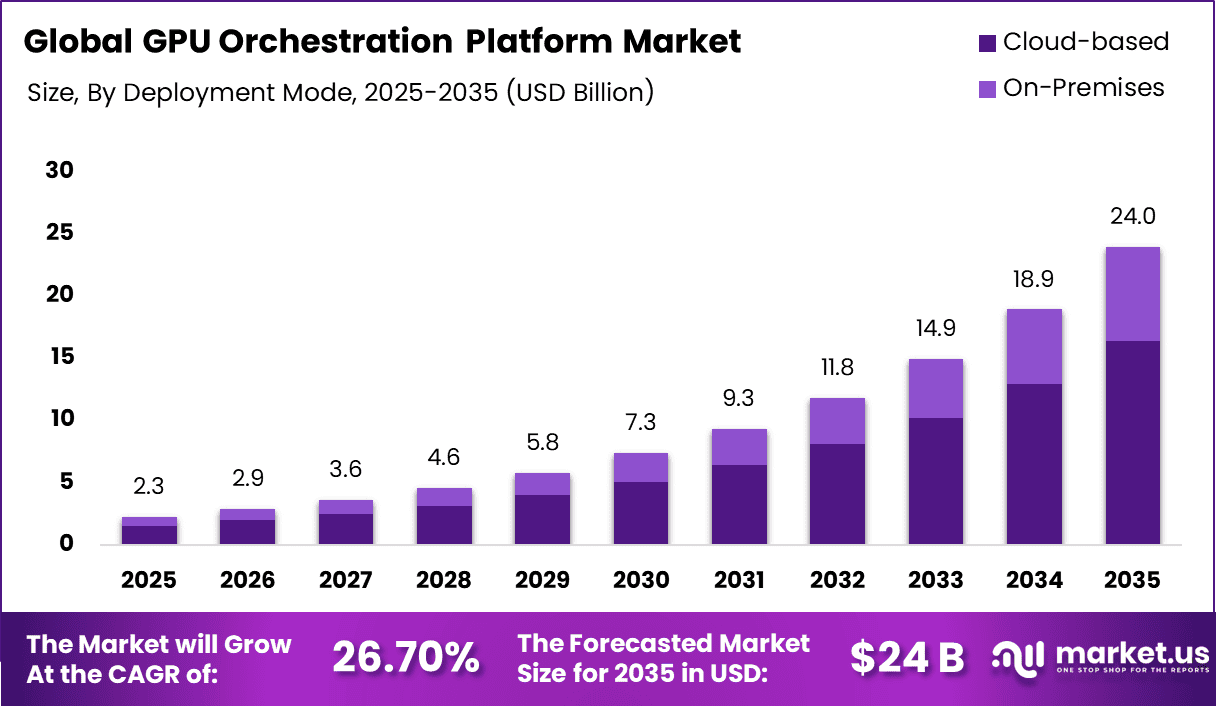
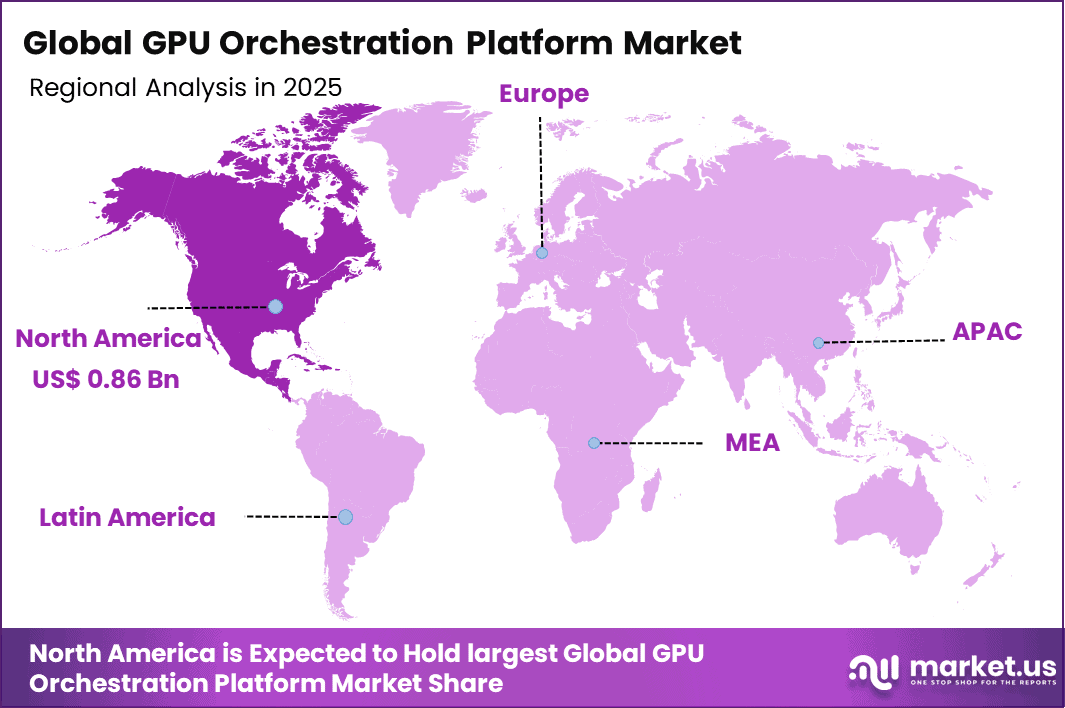
The Global GPU Orchestration Platform Market generated USD 2.3 billion in 2025 and is predicted to register growth from USD 2.9 billion in 2026 to about USD 24 billion by 2035, recording a CAGR of 26.70% throughout the forecast span. In 2025, North America held a dominant market position, capturing more than a 38.3% share, holding USD 0.86 Billion revenue.
Top Market Takeaways
- Software commands 54.2% market share, delivering dynamic workload scheduling, multi-GPU resource pooling, and containerized inference orchestration across hybrid environments.
- Cloud-based deployment captures 68.5%, enabling elastic scaling, pay-per-GPU economics, and seamless integration with hyperscaler AI platforms like AWS SageMaker and Azure ML.
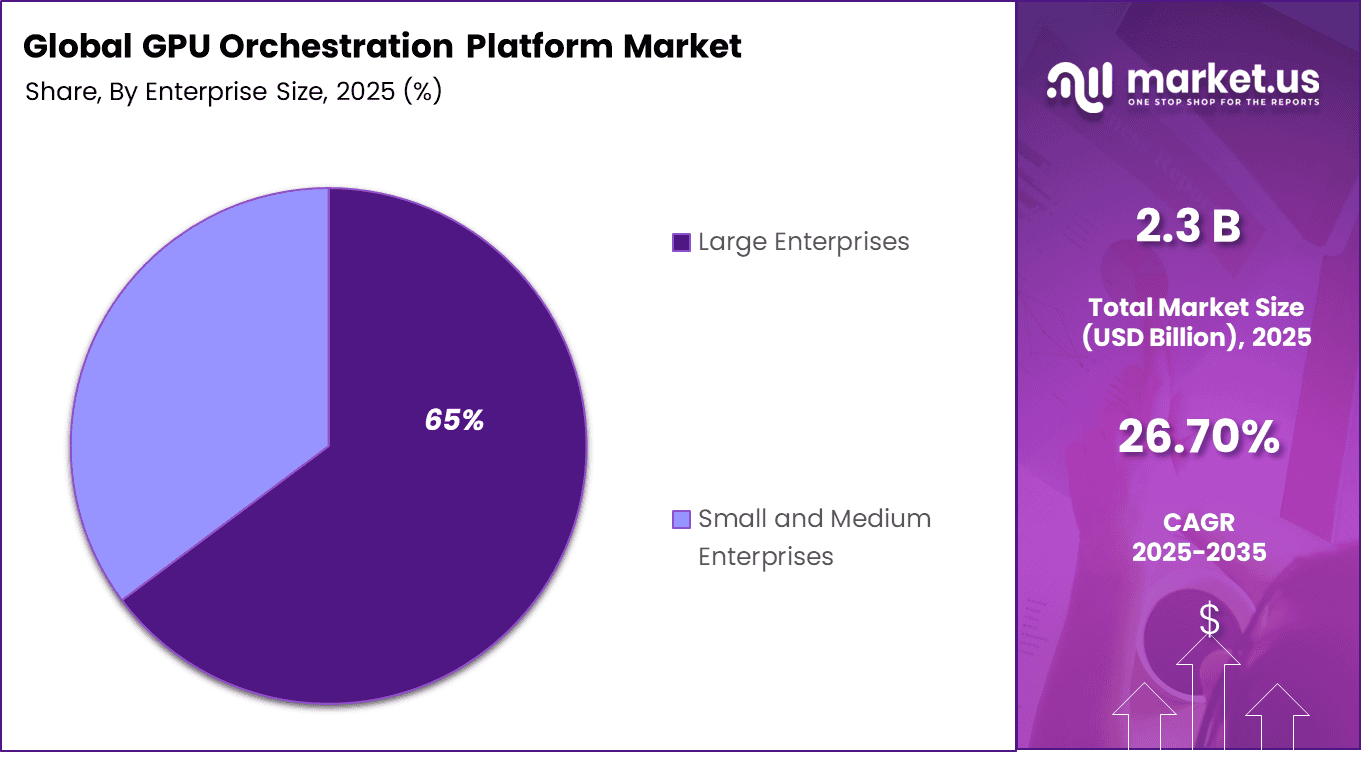
- Large enterprises hold 64.8%, leveraging enterprise-grade platforms for training LLMs, distributed deep learning, and real-time inference at petabyte scale.
- AI and machine learning applications claim 35.4%, powering transformer model training, computer vision pipelines, and recommendation engine optimization with automated hyperparameter tuning.
- IT & telecom sectors represent 25.9%, deploying GPU orchestration for 5G RAN analytics, network anomaly detection, and telco cloud AI services.
- North America drives 38.3% global value, with U.S. market at USD 0.78 billion and 24.8% CAGR, fueled by NVIDIA DGX clusters and hyperscaler GPU-as-a-Service expansions.
 nal complexity, and enhance overall system performance, supporting continued growth in this segment.
Investor Type Impact Analysis
Investor Type Growth Sensitivity Risk Exposure Geographic Focus Investment Outlook Venture capital firms Very high High US, China Investing in AI infrastructure startups Private equity firms High Moderate North America and Europe Scaling GPU and cloud infrastructure providers Corporate investors Very high Moderate Global Strategic investments in AI and cloud ecosystems Institutional investors Moderate to high Moderate Developed markets Focus on established tech and semiconductor firms Government and public funding bodies High Low US, EU, Asia Pacific Supporting AI infrastructure and computing capacity expansion Technology Enablement Analysis
Technology Impact on CAGR Forecast (~%) Geographic Relevance Impact Timeline Additional Insight Kubernetes-based GPU orchestration +5.3% Global Medium to long term Enables efficient containerized GPU management AI-driven workload scheduling +4.7% US, Europe, China Medium term Optimizes GPU allocation dynamically Multi-cloud and hybrid cloud orchestration +4.2% Global Medium to long term Enhances flexibility across environments GPU virtualization and partitioning technologies +3.8% Developed markets Medium term Improves resource sharing efficiency Edge AI and distributed computing integration +3.5% Global Long term Expands GPU usage beyond centralized data centers Key Challenges
- High cost of GPU infrastructure makes it expensive for many organizations to adopt.
- Complex setup and configuration require skilled technical teams.
- Difficulty in managing workloads across multiple GPUs and environments.
- Integration challenges with existing IT systems and cloud platforms.
- Limited availability of skilled professionals for GPU management and optimization.
- Performance issues due to improper resource allocation and scheduling.
- Data security and privacy concerns in shared or cloud environments.
- Lack of standardization across different platforms and vendors.
- High energy consumption increases operational costs.
- Dependence on continuous updates and maintenance for smooth operations.
Emerging Trends
The GPU orchestration platform market is moving toward more intelligent and flexible resource management as demand for high performance computing continues to rise. One of the key emerging trends is the shift toward automated workload scheduling that dynamically allocates GPU resources based on real time demand and priority levels. This helps organizations maximize utilization and avoid idle capacity. Another important trend is the integration of orchestration platforms with containerization and cloud native environments, allowing seamless deployment of AI and data intensive workloads across distributed systems.
There is also growing focus on multi tenant environments where multiple users or teams can share GPU infrastructure securely without performance conflicts. In addition, platforms are increasingly offering visibility tools that provide detailed insights into GPU usage, workload performance, and bottlenecks, helping teams optimize operations more effectively. Edge computing is also influencing this market, as orchestration capabilities are being extended beyond centralized data centers to support real time processing closer to data sources.
Growth Factors
The growth of this market is driven by the rapid expansion of AI, machine learning, and data analytics applications that require significant computing power. Organizations are looking for efficient ways to manage GPU infrastructure without overinvesting in hardware, which is increasing the need for orchestration solutions. The growing complexity of workloads and the need to scale computing resources quickly are also supporting adoption, especially in environments where demand fluctuates frequently.
Another major factor is the rising importance of cost optimization, as GPU resources are expensive and require careful allocation to ensure maximum return on investment. Enterprises are also focusing on improving productivity by reducing manual intervention in resource management, which is pushing the use of automated orchestration platforms. Furthermore, the increasing use of hybrid and multi cloud strategies is creating a need for unified platforms that can manage GPU resources across different environments, ensuring consistent performance and operational efficiency.
Key Market Segments
By Component
- Software
- Hardware
- Services
By Deployment Mode
- On-Premises
- Cloud-based
By Enterprise Size
- Small and Medium Enterprises
- Large Enterprises
By Application
- AI and Machine Learning
- High-Performance Computing
- Data Analytics
- Graphics Rendering
- Other Applications
By End-User
- BFSI
- Healthcare
- IT and Telecommunications
- Media and Entertainment
- Automotive
- Manufacturing
- Other End-Users
Regional Analysis
North America accounted for 38.3% of the GPU Orchestration Platform market, supported by strong demand for high-performance computing and rapid adoption of artificial intelligence workloads. The region has a well-established cloud ecosystem and advanced data center infrastructure, which enables efficient deployment and scaling of GPU resources.
Enterprises are increasingly using orchestration platforms to manage complex GPU workloads across hybrid and multi-cloud environments, improving utilization and reducing operational inefficiencies. The growing need for faster model training, real-time analytics, and large-scale data processing has further strengthened the adoption of GPU orchestration solutions across industries such as technology, healthcare, and finance.
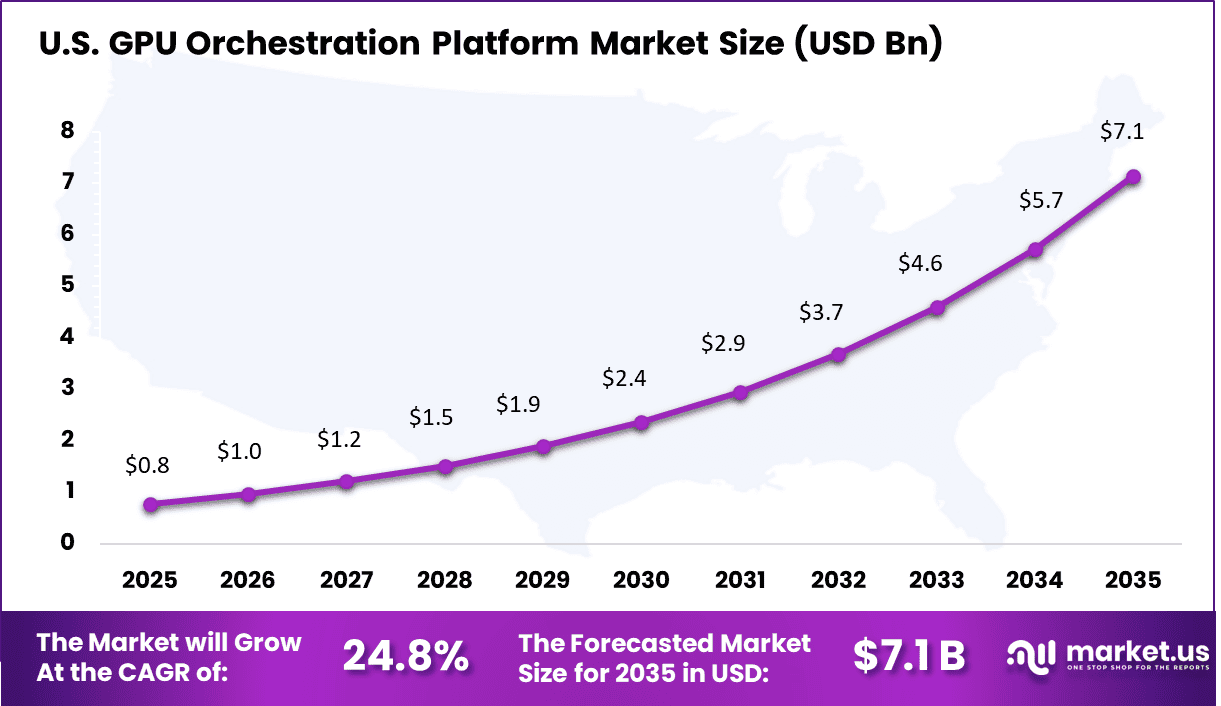
The U.S. market reached USD 0.78 Billion and is projected to grow at a CAGR of 24.8%, driven by expanding investments in AI, machine learning, and deep learning applications. Organizations are focusing on optimizing GPU usage to handle increasing computational demands while controlling infrastructure costs.
The rise of generative AI, autonomous systems, and advanced simulation workloads is encouraging companies to adopt orchestration platforms that provide better workload scheduling and resource allocation. In addition, strong presence of hyperscale data centers and continuous innovation in cloud-based GPU services are expected to support sustained growth in the US market over the coming years.
Key Regions and Countries
- North America
- US
- Canada
- Europe
- Germany
- France
- The UK
- Spain
- Italy
- Russia
- Netherlands
- Rest of Europe
- Asia Pacific
- China
- Japan
- South Korea
- India
- Australia
- Singapore
- Thailand
- Vietnam
- Rest of APAC
- Latin America
- Brazil
- Mexico
- Rest of Latin America
- Middle East & Africa
- South Africa
- Saudi Arabia
- UAE
- Rest of MEA
Competitive Analysis
The competitive landscape of the GPU Orchestration Platform Market is developing quickly, supported by strong participation from global cloud providers and AI infrastructure companies. Organizations such as Amazon Web Services Inc., Alibaba Group Holding Ltd, IBM Corporation, Hewlett Packard Enterprise Company, and Red Hat Inc. focus on integrating GPU orchestration into their cloud and hybrid platforms.
These players provide scalable environments for AI and machine learning workloads, with emphasis on automation, container-based deployment, and enterprise-level security. NVIDIA Corporation also holds a strong position by offering software that improves GPU utilization and enables efficient workload management across distributed systems.
At the same time, emerging players such as CoreWeave Inc., Crusoe Cloud Inc., RunPod Inc., Vast AI Inc., and DigitalOcean LLC are gaining attention by offering GPU-focused cloud platforms designed for high-performance computing needs. These companies focus on flexible infrastructure, faster deployment, and cost efficiency for AI workloads.
In addition, firms like Rafay Systems Inc., Anyscale Inc., OctoML Inc., Modal Labs Inc., Exostellar Inc., and Civo Limited are building developer-friendly orchestration tools that simplify scaling and workload optimization. Competition in this market is driven by innovation in GPU resource management, ease of integration, and the ability to support large-scale AI applications efficiently.
Top Key Players in the Market
- Alibaba Group Holding Ltd
- Amazon Web Services Inc.
- IBM Corporation
- NVIDIA Corporation
- Hewlett Packard Enterprise Company
- Red Hat Inc.
- Scale AI Inc.
- DigitalOcean LLC
- CoreWeave Inc.
- Crusoe Cloud Inc.
- RunPod Inc.
- Rafay Systems Inc.
- Anyscale Inc.
- OctoML Inc.
- Modal Labs Inc.
- Exostellar Inc.
- Vast AI Inc.
- Civo Limited
- Others
Future Outlook
The future outlook for the GPU Orchestration Platform Market looks very strong as demand for AI, machine learning, and high-performance computing continues to rise across industries. Companies are expected to increasingly rely on these platforms to manage complex GPU workloads, improve resource utilization, and reduce operational costs. The shift toward cloud-based and GPU-as-a-service models is also anticipated to make advanced computing more accessible and scalable for businesses of all sizes.
Recent Developments
- March, 2026 – Alibaba Cloud PAI adds GPU cluster federation across APAC regions and auto-scales Llama3 training. Serves e-commerce AI with cost-per-token billing model. Tongyi Qianwen integration boosts regional LLMs.
- February, 2026 – AWS ParallelCluster 3.8 boosts multi-region GPU bursting and EC2 P5 instances with InfiniBand. Trainium2 integration with SageMaker Pipelines native support. Project Amelia agentic orchestration live.