

Agricultural Machinery Market
Agricultural Machinery Market By Machinery Type (Tractors, Plowing & Cultivating Machinery, Planting Machinery, Harvesting Machinery, Haying and Forage Machinery, and Irrigation Machinery), By Automation Level (Manual, Semi-Automated, and Fully Automated), By Distribution Channel (OEM (Direct Sales), Dealers And Distributors, and Online Platforms), By End Users (Individual Farmers, Agricultural Contractors, and Others), By Region and Companies - Industry Segment Outlook, Market Assessment, Competition Scenario, Trends and Forecast 2026-2035
- Published date: May 2026
- Report ID: 185787
- Number of Pages: 301
- Format:
- Overview
- Table of Contents
- Major Market Players
Quick Navigation
- Report Overview
- Key Takeaways
- Machinery Type Analysis
- Automation Level Analysis
- End User Analysis
- By Distribution Channel Analysis
- Key Market Segments
- Drivers
- Restraints
- Opportunity
- Trends
- Geopolitical Impact Analysis
- Regional Analysis
- Key Players Analysis
- Key Developments
- Report Scope
Report Overview
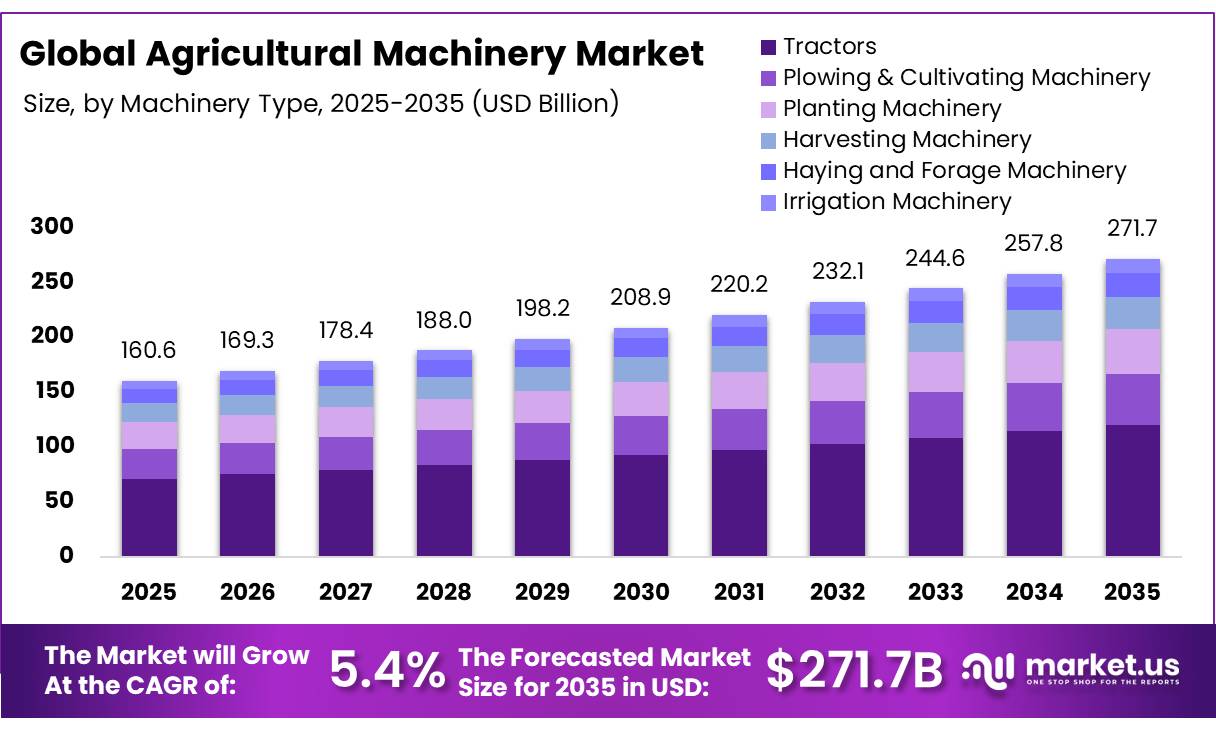
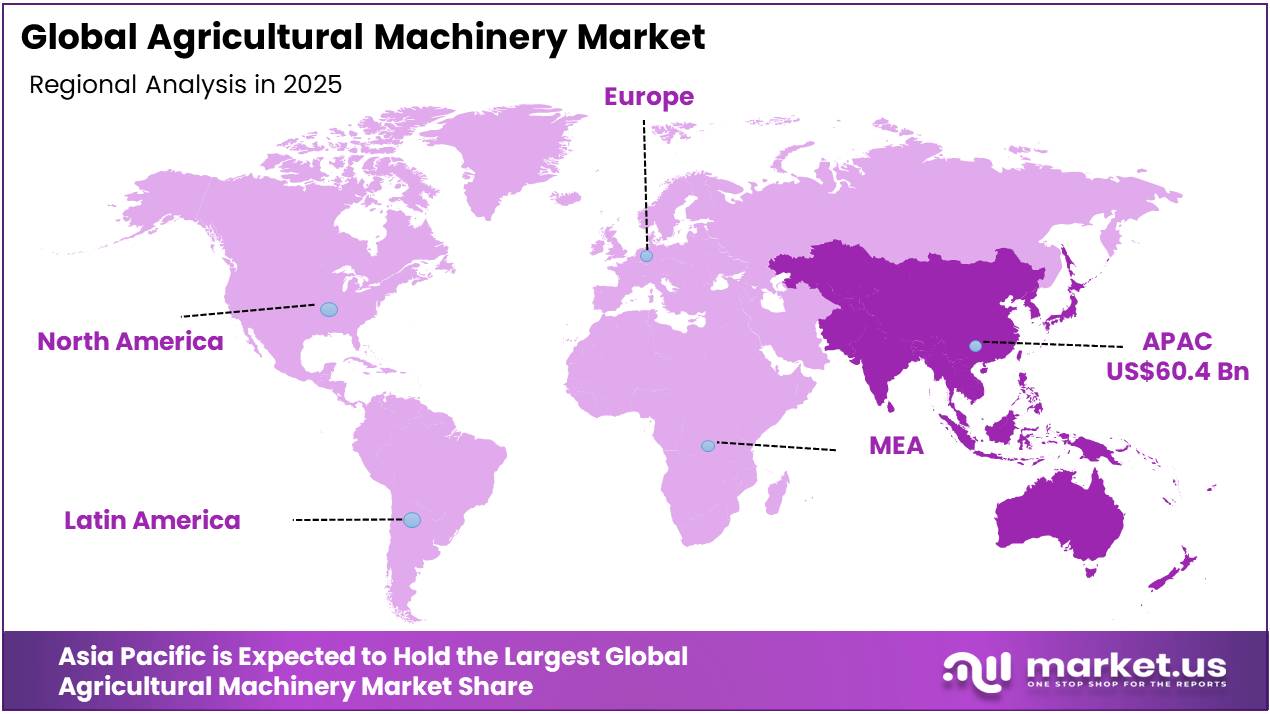
The Global Agricultural Machinery Market size is expected to be worth around USD 271.7 Billion by 2035, from USD 160.6 Billion in 2025, growing at a CAGR of 5.4% during the forecast period from 2026 to 2035. In 2025, Asia Pacific held a dominant market position, capturing more than a 37.6% share, holding USD 60.4 Billion revenue.
The agricultural machinery market is shaped by the gradual transition of farming systems from manual operations toward mechanized and technology-enabled production. Equipment usage spans land preparation, planting, crop protection, harvesting, irrigation, and post-harvest handling, with tractors forming a central component due to their multipurpose utility. Demand patterns vary significantly across regions, reflecting differences in farm size, labor availability, and access to capital. Semi-automated systems remain widely adopted as they balance affordability with operational efficiency, while fully automated solutions are gaining traction in larger and more organized farming operations.
 nitoring of soil moisture, nutrient levels, and crop health, enabling targeted input application and operational optimization. Research literature highlights that precision agriculture systems combine remote sensing, GIS, and GPS technologies with wireless sensor networks to improve decision-making accuracy and resource efficiency in field operations.
Government and institutional initiatives in digital agriculture emphasize the role of connected devices and analytics in improving productivity outcomes, particularly through real-time field data collection and automated advisory systems. Multi-sensor IoT frameworks are being used to transmit soil and weather parameters to centralized platforms, enabling rapid adjustments in irrigation and nutrient management practices.
Adoption of such systems is also supported by increasing use of drones and AI-based analytics in crop monitoring, with ongoing public research programs integrating these technologies into field-level experimentation for major crops such as wheat, rice, and soybean. Evidence from agricultural digitalization studies indicates that these technologies are increasingly embedded into machinery ecosystems, shifting equipment functionality from purely mechanical tasks toward adaptive, data-responsive systems capable of improving input efficiency and operational precision across farming cycles.
Geopolitical Impact Analysis
Geopolitical Disruptions Reshaping Trade Flows and Operational Stability in Agricultural Machinery Supply Chains.
Geopolitical tensions have increasingly reshaped the operating environment for agricultural machinery through trade restrictions, input supply disruptions, and shifts in equipment demand patterns. The Russia-Ukraine conflict has been particularly influential due to the combined role of both countries in global food and input markets. These disruptions have indirectly affected machinery deployment cycles by altering cropping decisions and delaying field operations in affected regions.
Sanctions and export controls have impacted machinery supply chains. Restrictions on financial transactions and trade flows involving Russia have constrained the movement of industrial inputs and components, while several Western manufacturers have curtailed or suspended shipments of agricultural equipment to sanctioned markets, contributing to localized machinery shortages and fleet aging pressures.
Energy market volatility linked to geopolitical instability has further influenced machinery utilization costs, particularly for fuel-intensive operations such as harvesting and irrigation. The disruptions in fertilizer and ammonia supply chains, including export restrictions by major producers during global tensions, have further affected input availability, indirectly influencing machinery usage intensity during planting seasons.
At the same time, geopolitical realignment is encouraging diversification of sourcing networks, with countries increasing procurement from alternative suppliers and expanding domestic manufacturing capabilities for agricultural equipment. This is gradually reshaping trade corridors for machinery and accelerating regionalization of supply chains, particularly in Asia and Latin America, where import substitution policies are gaining traction as a response to external volatility.
Regional Analysis
Asia Pacific Held the Largest Share of the Global Agricultural Machinery Market.
The Asia Pacific holds a dominant position in the global agricultural machinery ecosystem, supported by its large agrarian population base, diverse cropping systems, and accelerating mechanization intensity. The FAO data indicates that the region accounts for a substantial share of the world’s agricultural workforce, with agriculture still employing a significant portion of rural labor in countries such as India, China, and Indonesia, where farm mechanization levels vary widely across sub-regions. This structural heterogeneity sustains continuous demand for tractors, irrigation systems, planting, and harvesting equipment across both smallholder and large-scale farming models.
China and India act as primary demand centers, driven by extensive cultivated land and policy-backed mechanization programs. For instance, India’s mechanization initiatives under government schemes have supported the deployment of machines through subsidy-linked procurement and custom hiring models, directly improving access among small and marginal farmers. In China, mechanization coverage for major crops such as wheat and rice exceeds 80%, reflecting high penetration of modern farm equipment in large-scale production zones.
Key Regions and Countries
- North America
- The US
- Canada
- Europe
- Germany
- France
- The UK
- Spain
- Italy
- Russia & CIS
- Rest of Europe
- APAC
- China
- Japan
- South Korea
- India
- ASEAN
- Rest of APAC
- Latin America
- Brazil
- Mexico
- Rest of Latin America
- Middle East & Africa
- GCC
- South Africa
- Rest of MEA
Key Players Analysis
Manufacturers in the agricultural machinery sector prioritize continuous product innovation to improve efficiency, durability, and adaptability across diverse farming conditions. Significant emphasis is placed on integrating digital technologies such as GPS guidance, telematics, and sensor-based monitoring systems to enhance equipment precision and operational control. Expansion of distribution and after-sales service networks is another key focus, ensuring timely maintenance, spare parts availability, and reduced equipment downtime, which strengthens customer retention.
Companies further invest in localized manufacturing and assembly facilities to optimize supply chains, reduce costs, and align products with regional agronomic requirements. Strategic partnerships with technology providers and agricultural service platforms support the development of connected farming ecosystems. In addition, firms are increasingly adopting flexible access models such as leasing, rental support programs, and financing collaborations with banks to improve affordability. Strengthening dealer relationships and offering training programs for operators further enhances product utilization and brand loyalty across key agricultural markets.
The following are some of the major players in the industry
- Deere & Company
- CNH Industrial N.V.
- AGCO Corporation
- Mahindra & Mahindra Limited
- Kubota Corporation
- CLAAS KGaA mbH
- SDF S.p.A.
- Yanmar Co., Ltd.
- Bucher Industries AG
- Valmont Industries, Inc.
- Iseki & Co., Ltd.
- Argo S.p.A.
- JC Bamford Excavators Ltd (JCB Group)
- Lindsay Corporation
- TAFE Ltd (Amalgamations Group)
- Other Key Players
Key Developments
- In February 2026, John Deere extended the horsepower range of its 8R wheeled and 8RX tracked tractors with six new models offering power ratings of 440 hp, 490 hp, and 540 hp. These tractors are designed to be autonomous-ready, helping to unlock greater efficiency during tillage operations, and are equipped with the G5+ display for access to advanced precision agriculture technologies.
 nitoring of soil moisture, nutrient levels, and crop health, enabling targeted input application and operational optimization. Research literature highlights that precision agriculture systems combine remote sensing, GIS, and GPS technologies with wireless sensor networks to improve decision-making accuracy and resource efficiency in field operations.