

Agritech Market
Agritech Market Size, Share Analysis Report By Type (Biotechnology and Biotech, Big Data and Analytics, Robotics and Automation, Sensors and Connected Devices, Others), By Offering (Hardware, Software, Services), By Application (Broad Acre Applications, Livestock Farm Management, Indoor Farming, Agrochemicals, Aerial Data Collection, Weather Tracking and Forecasting, Supply Chain Management, Inventory Management, Others) , By Region and Companies - Industry Segment Outlook, Market Assessment, Competition Scenario, Trends and Forecast 2026-2035
- Published date: May 2026
- Report ID: 186690
- Number of Pages: 207
- Format:
- Overview
- Table of Contents
- Major Market Players
Quick Navigation
- Report Overview
- Key Takeaways
- By Type Analysis
- By Offering Analysis
- By Application Analysis
- Key Market Segments
- Emerging Trends
- Drivers
- Restraints
- Opportunity
- Regional Insights
- Key Players Analysis
- Recent Industry Developments
- Report Scope
Report Overview
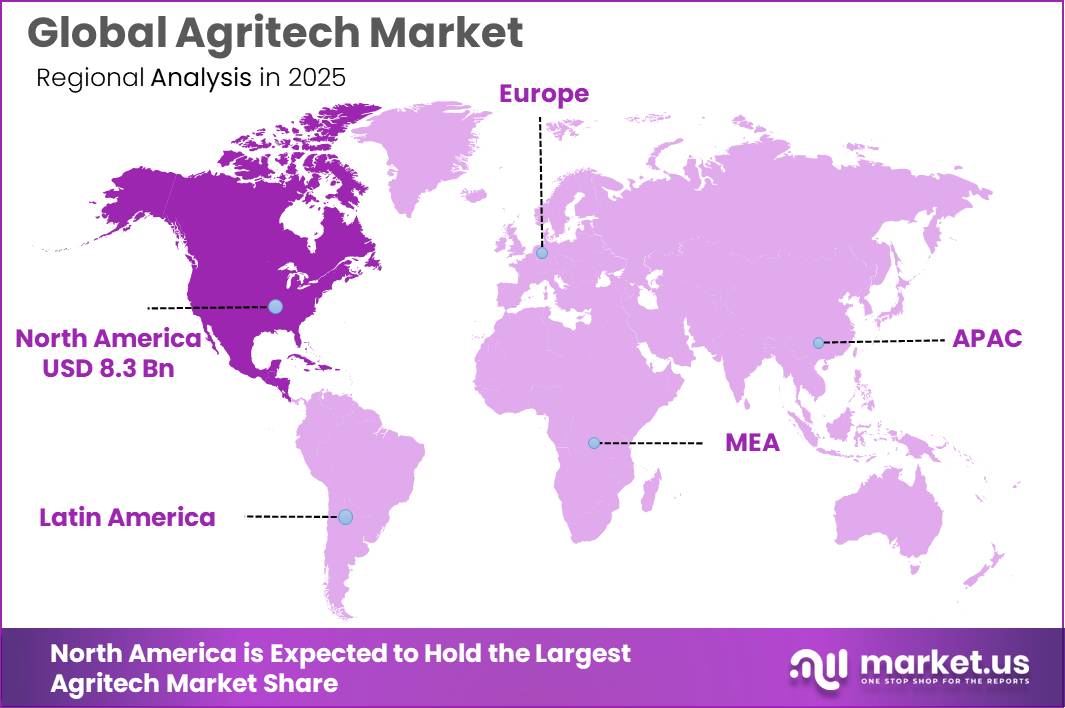
The Global Agritech Market size is expected to be worth around USD 71.2 Billion by 2035, from USD 21.4 Billion in 2025, growing at a CAGR of 12.8% during the forecast period from 2026 to 2035. In 2025, North America held a dominant market position, capturing more than a 39.2% share, holding USD 8.3 Billion revenue.
Agritech is entering a productivity-led growth phase as farms face higher food demand, climate risk, labour shortages and pressure to reduce input waste. Globally, the World Bank notes that food demand must rise to serve a projected 9.7 billion people by 2050, while agrifood systems already generate about one-third of global emissions. FAO reported agrifood-system emissions of 16.5 Gt CO₂e in 2023, equal to 32% of total emissions, creating demand for precision irrigation, robotics, digital monitoring and low-emission farm machinery.
Key Takeaways
- Agritech Market size is expected to be worth around USD 71.2 Billion by 2035, from USD 21.4 Billion in 2025, growing at a CAGR of 12.8%.
- Big Data and Analytics held a dominant market position, capturing more than a 28.6% share in the agritech market.
- Hardware held a dominant market position, capturing more than a 45.7% share in the agritech market.
- Broad Acre Applications held a dominant market position, capturing more than a 29.9% share in the agritech market.
- North America held a dominant position in the global agritech market, accounting for 39.2% of the total market share and reaching a valuation of nearly USD 8.3 Billion.
In 2025, Big Data and Analytics held a dominant market position, capturing more than a 28.6% share in the agritech market by type. The strong growth of this segment is mainly linked to the rising need for accurate farm data, weather tracking, crop monitoring, and yield forecasting across modern agriculture practices. Farmers and agribusiness companies are increasingly using analytics platforms to understand soil conditions, irrigation needs, and pest risks in real time. The availability of connected devices, farm sensors, drones, and satellite imagery has also increased the volume of agricultural data, creating higher demand for advanced analytics tools.
By Offering Analysis
Hardware dominates with 45.7% share due to rising adoption of smart farming equipment and connected agricultural devices.
In 2025, Hardware held a dominant market position, capturing more than a 45.7% share in the agritech market by offering. The segment gained strong momentum as farmers increasingly invested in physical technologies such as sensors, drones, GPS-enabled machinery, automated irrigation systems, and climate monitoring devices. These tools became essential for improving farm productivity, reducing manual labor, and supporting precision agriculture practices. The demand for reliable field equipment also increased as growers looked for better ways to monitor crops, livestock, and soil conditions in real time.
- According to the International Telecommunication Union (ITU), nearly 2.6 billion people around the world remained offline in 2023, with rural populations facing the largest connectivity gaps. This directly affects the adoption of cloud-based farm platforms, remote monitoring systems, and AI-powered agricultural tools.
In several developing countries, unstable internet networks and limited access to digital devices make it difficult for farmers to fully benefit from smart agriculture technologies. Even when governments launch digital agriculture programs, the lack of training and technical support often reduces long-term usage. Many older farmers also prefer conventional farming practices because they are more familiar and easier to manage. This digital divide creates a gap between large commercial farms and smaller rural farms in terms of technology adoption.
Opportunity
Expansion of Precision Farming is Creating Strong Growth Opportunities for Agritech Companies
One of the biggest growth opportunities in the agritech market is the rapid expansion of precision farming across global agricultural regions. Farmers are increasingly adopting technologies that help improve crop productivity while reducing water, fertilizer, and pesticide usage. According to the United States Department of Agriculture (USDA), more than 70% of U.S. corn-planted acreage and nearly 60% of soybean-planted acreage already use precision agriculture technologies such as yield monitoring and GPS mapping systems.
Precision farming is becoming highly important as climate change, labor shortages, and rising food demand continue to affect agricultural productivity. Technologies such as AI-based crop monitoring, automated irrigation systems, and drone-assisted field analysis are helping farmers make faster and more accurate decisions. Governments in several countries are also supporting digital agriculture programs through subsidies and smart farming initiatives.
Growing Demand for Sustainable Agriculture is Opening New Areas for Agritech Innovation
The global push toward sustainable agriculture is another major growth opportunity for the agritech market. Farmers and governments are under increasing pressure to reduce environmental impact while maintaining food production levels. According to the Food and Agriculture Organization (FAO), agriculture accounts for nearly 70% of global freshwater withdrawals. This has increased the demand for technologies that improve irrigation efficiency, monitor soil health, and reduce resource wastage during farming operations.
Agritech companies are responding by developing smart irrigation systems, climate monitoring platforms, and precision nutrient management tools that help farmers use resources more efficiently. Sustainable farming technologies are also gaining attention because they support lower carbon emissions and better land management practices. Governments across Europe, North America, and Asia are introducing sustainability-focused agricultural policies and funding programs to encourage technology adoption in farming communities.
Regional Insights
North America dominates the Agritech market with 39.2% share, reaching nearly USD 8.3 Billion due to strong precision farming adoption and advanced agricultural infrastructure.
North America held a dominant position in the global agritech market, accounting for 39.2% of the total market share and reaching a valuation of nearly USD 8.3 Billion. The region’s leadership is mainly supported by the widespread adoption of precision agriculture technologies, strong digital infrastructure, and the presence of large commercial farming operations across the United States and Canada.
The United States remains the largest contributor to regional growth due to strong investments in smart farming and agricultural automation. According to the United States Department of Agriculture (USDA), precision agriculture technologies are widely adopted across major crop farms, especially in corn and soybean production areas. Large-scale agricultural businesses are continuously investing in data-driven farming solutions to improve yield efficiency and resource management.
Key Regions and Countries Insights
- North America
- US
- Canada
- Europe
- Germany
- France
- The UK
- Spain
- Italy
- Rest of Europe
- Asia Pacific
- China
- Japan
- South Korea
- India
- Australia
- Rest of APAC
- Latin America
- Brazil
- Mexico
- Rest of Latin America
- Middle East & Africa
- GCC
- South Africa
- Rest of MEA
Key Players Analysis
Harvest Automation, Inc. focuses on agricultural robotics and automation systems designed for greenhouse and nursery operations. The company is recognized for developing mobile robots that automate plant spacing, transport, and material handling tasks. Its robotic systems help reduce labor dependency and improve operational efficiency for growers. The company’s automation technologies can lower manual labor requirements by more than 30% in some nursery applications.
AGCO Corporation is a major global agritech and agricultural equipment manufacturer known for brands such as Fendt, Massey Ferguson, and Valtra. In 2025, AGCO reported approximately USD 10.1 billion in annual revenue and employed nearly 22,000 workers globally. The company invests strongly in precision farming, autonomous machinery, smart planting technologies, and sustainable agricultural solutions. AGCO spent approximately USD 487.7 million on research and development activities in 2025, highlighting its focus on digital farming innovation and productivity improvement for modern agriculture operations.
International Business Machines Corporation (IBM) plays an important role in agritech through artificial intelligence, cloud computing, IoT, and weather analytics solutions. IBM’s agriculture-focused technologies help farmers improve crop forecasting, irrigation planning, and supply chain efficiency using real-time data analysis. In 2025, IBM generated annual revenue exceeding USD 62 billion globally. The company’s AI platforms support precision agriculture initiatives by enabling predictive farming models and climate-risk assessments.
Top Key Players Outlook
- Deere & Company
- Harvest Automation, Inc.
- AGCO Corporation
- Naïo Technologies SAS
- AgEagle Aerial Systems Inc.
- International Business Machines Corporation
- Corteva Agriscience
- Datacor, Inc
- Trimble Inc.
- CropX Technologies Ltd.
- Alltech Inc.
- Kubota Corporation
- Valmont Industries, Inc.
- Syngenta Group
Recent Industry Developments
In 2025, AgEagle Aerial Systems strengthened its agritech role through drone-based crop monitoring, mapping, soil analysis, water management, pest detection, and yield estimation. The company entered a strategic alliance with Vyom Drones to manufacture and sell eBee X drones in India, targeting over 345 million acres of arable land and a projected USD 631 million agriculture drone opportunity by 2030. It also advanced product development with eBee VISION software version 2.1.0, adding 2D/3D mapping, GNSS-denied operation, and NATO-standard video support.
In 2025, Corteva Agriscience strengthened its agritech work through seed technology, crop protection, biologicals, and digital farming solutions. The company reported USD 17.4 billion in full-year net sales, with Seed net sales of USD 9.9 billion and Crop Protection net sales of USD 7.5 billion. Its Crop Protection volume grew 5%, supported by demand for new products, herbicides, and biologicals. In partnership activity, Corteva formed a multi-million-dollar joint venture with Hexagon Bio in 2025 to develop nature-inspired crop protection products using AI, microbial genetics, and synthetic biology.