

Report Overview
The Global AI-powered Video Generator Market size is expected to be worth around USD 7,515.69 million by 2035, from USD 910.54 million in 2025, growing at a CAGR of 23.5% during the forecast period from 2025 to 2035. North America held a dominant market position, capturing more than a 34.9% share, holding USD 317.77 million in revenue.
AI-powered video generators change how people make videos by turning text ideas into full clips with smart tech. These tools handle editing, adding music, voices, and effects without needing cameras or crews. Now, anyone can create pro-looking videos fast, from short social posts to training clips. Users save hours since one person finishes what once took teams of days. Small shops use them for ads, while teachers make lessons quick. Viewers spend 17 hours weekly on online videos, so fresh content rules. This shift helps keep up with fast social feeds where clips grab eyes in seconds.
ntent efficiently, meeting diverse internal and external demands.
The dominance of large enterprises stems from their ability to leverage AI for enterprise-wide applications. They benefit from robust integration with CRM systems and analytics platforms, enhancing video performance tracking. Smaller businesses participate too, but large firms set the pace with their volume and innovation needs. This segment’s growth highlights how AI levels the playing field for large-scale operations while promising expansion to others.
For instance, in October 2025, Synthesia raised $200 million at a $4 billion valuation, led by GV. The funding supports scaling for enterprise clients, focusing on interactive video agents and global infrastructure. Large enterprises benefit from features tailored for team collaboration and high-volume content.
Source Analysis
In 2025, the Text to Video segment held a dominant market position, capturing a 42.4% share of the Global AI-powered Video Generator Market. It transforms written content like scripts, articles, or prompts into engaging visuals without needing cameras or crews. Marketers and creators value its speed, turning ideas into polished videos in minutes. This approach suits content-heavy strategies where text is already available, streamlining the entire production process.
Beyond convenience, text-to-video excels in adaptability across languages and styles, broadening its appeal. Users input descriptions, and AI generates matching footage, voiceovers, and music. While image or audio sources exist, text remains king for its simplicity and low entry barrier. Ongoing improvements in natural language processing make outputs more realistic, solidifying this segment’s position.
For instance, in October 2025, Pictory launched real-time collaboration in its AI Text-to-Video Generator with customizable templates for teams. This streamlines workflows for product demos and social campaigns, cutting production time while keeping videos polished and brand-aligned.
Application Analysis
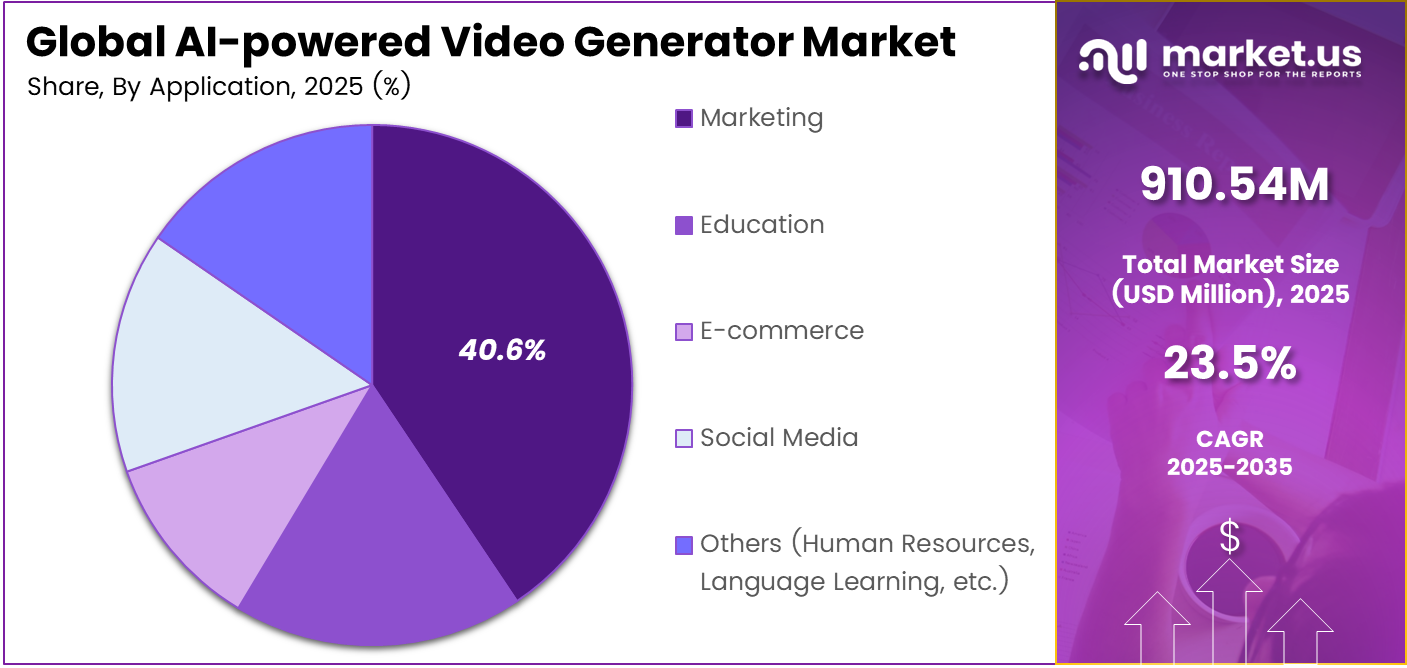
In 2025, the Marketing segment held a dominant market position, capturing a 40.6% share of the Global AI-powered Video Generator Market. Teams use these tools to build dynamic ads, social media clips, and email campaigns that resonate with audiences. The ability to test variations quickly helps optimize reach and conversions without heavy spending. This focus aligns with the shift toward video-first digital strategies in competitive markets.
Marketing’s lead comes from its need for frequent, targeted content at scale. AI enables personalized videos based on viewer data, boosting engagement rates significantly. Other uses, like education or entertainment, follow, but marketing drives innovation with A/B testing and trend-responsive features. As platforms prioritize short-form videos, this application continues to expand its influence.
For instance, in November 2025, Lumen5 announced dynamic transitions and new templates in its roadmap. Marketers gain AI-powered suggestions and real-time edits for engaging social videos, speeding up campaign production with brand-safe styles.
Emerging Trends
Personalized videos stand out as AI tailors clips to each viewer based on their likes. Platforms use data to swap faces or scenes in real time. 55% of users prefer these over plain ads, boosting watch times. Marketers grab attention with custom feels at low cost. This trend fits mobile habits where short bursts win.
Realistic motion and lifelike faces mark another advance in models. Tools now craft smooth actions for ads or training clips. Short-form focus matches TikTok-style needs on phones. 80% of teams test these for faster turnarounds. It blends human touch with machine speed for better results.
Growth Factors
High demand for daily fresh videos drives this space as platforms crave constant feeds. Businesses lean on AI to avoid slow manual work. Advances drop time by 50% while raising quality. Non-experts join in, widening the creator pool. Social growth adds millions of users yearly, all hungry for visuals.
Deep learning makes outputs feel real, pulling in more users. Teams cut costs and speed launches. With billions online, visuals beat text every time. AI lowers entry walls so anyone can craft sharp content. This keeps platforms buzzing without burnout.
Key Market Segments
By Component
- Solution
- Services
By Organization Size
- Large Enterprises
- SMEs
By Source
- Text to Video
- PowerPoint to Video
- Spreadsheet to Video
- Others
By Application
- Marketing
- Education
- E-commerce
- Social Media
- Others (Human Resources, Language Learning, etc.)
Market Dynamics
Drivers
Rising Video Content Demand
The growing need for visual communication across digital platforms drives the demand for video content. Social media and marketing teams now rely more on video to boost audience engagement and brand reach. AI-powered video generators simplify this process by converting text into polished videos, reducing production time and effort. This allows marketing teams to produce more high-quality content without adding new staff.
As platforms continue to prioritize video posts, the pressure to create consistent content rises. AI tools make this accessible to both small creators and large enterprises, enabling faster and easier video creation. This shift encourages companies to integrate AI video tools into daily operations, improving workflow efficiency and expanding creative capabilities.
For instance, in September 2025, Lumen5 launched AI Video Clip Maker to turn long videos into multiple short clips. The tool analyzes content for engaging moments and auto-edits for social platforms. Marketers generate platform-specific videos rapidly from existing footage. This supports the surge in short-form video needs. Creators boost output without manual editing.
Restraint
Dependence on Internet Access
AI-based video generators mostly operate through cloud platforms, requiring constant internet connectivity to function properly. In regions with unstable connections, users may face rendering delays or failed outputs, interrupting production schedules. This limits adoption, particularly for businesses in areas with weaker infrastructure.
Producing longer videos can intensify these connectivity challenges, as large data transfers often lead to performance issues. Some users turn back to traditional offline editing tools to avoid disruptions. While hybrid or offline capabilities could reduce dependency, the current reliance on stable internet access remains a major obstacle to smooth adoption.
For instance, in July 2025, FlexClip integrated new AI video models like Hailuo AI and Google Veo 3 for generation. Features require online access for model processing and rendering. Users in low-bandwidth regions experience slower previews and exports. This underscores cloud dependency challenges. Hybrid solutions are not yet available.
Opportunities
Personalized Marketing Videos
AI enables brands to tailor videos for specific audiences, improving the personal touch in marketing campaigns. Marketers can quickly adjust tone, visuals, or messaging to match audience segments, helping them stand out in a crowded digital environment. This flexibility leads to more engaging and relatable brand communication.
Personalized video creation also supports faster response to trends and customer feedback. It allows smaller teams to handle large volumes of content efficiently, making competitive marketing more accessible. As customers increasingly expect relevant, tailored content, these AI capabilities create strong opportunities for innovation in digital marketing strategies.
For instance, in July 2025, InVideo AI leveraged OpenAI models for idea-to-video production with personalization. Users prompt for tailored ads, demos, or explainers in specific tones. AI agents handle scripting, visuals, and voiceovers for audience segments. Brands create custom campaigns quickly. This enables small teams to match larger competitors.
Challenges
Copyright and Ethical Risks
AI video generation often raises ownership disputes because many tools are trained on publicly available media without clear consent. This creates uncertainty about who holds the rights to AI-generated content, discouraging some creators and businesses from full adoption. Legal clarity is still evolving, making intellectual property a sensitive issue.
Ethical concerns further complicate the market, especially around the misuse of AI for deceptive or harmful content such as deepfakes. The absence of well-defined regulations makes accountability difficult and increases reputational risk for users. Addressing these ethical and legal challenges is essential for wider acceptance and trust in AI-generated video technology.
For instance, in November 2025, Pictory rolled out AI Studio with text-to-image and prompt tools. The features spark talks on training data sources for generative AI. Users raise concerns over ownership of created visuals. Ethical use guidelines become key amid legal uncertainties. Pictory pushes for original content control in videos.
Key Regions and Countries
North America
- US
- Canada
Europe
- Germany
- France
- The UK
- Spain
- Italy
- Russia
- Netherlands
- Rest of Europe
Asia Pacific
- China
- Japan
- South Korea
- India
- Australia
- Singapore
- Thailand
- Vietnam
- Rest of APAC
Latin America
- Brazil
- Mexico
- Rest of Latin America
Middle East & Africa
- South Africa
- Saudi Arabia
- UAE
- Rest of MEA
Key Players Analysis
One of the leading players in April 2025, Adobe invested in Synthesia through its venture arm, forming a strategic partnership to blend AI video generation with Adobe’s creative tools. This move aims to speed up high-quality video production for businesses, positioning Synthesia as a key player in transforming content workflows globally.
Top Key Players in the Market
- Synthesia
- Lumen5
- Muse.ai
- Rephrase.ai
- Synths video
- Raw shorts
- Pictory
- FlexClip
- Designs.Ai
- InVideo
- Others
Recent Developments
- In July 2025, FlexClip integrated new AI video models like Hailuo, Kling, and Google Veo 3 into its generator, adding start/end frame control and multi-subject references. August brought AI Recreate and Photo Editor for effortless professional videos from templates and prompts.
- In February 2025, Microsoft unveiled Muse.ai, a generative AI for video game development that creates visuals and controller actions from gameplay footage. Partnering with Ninja Theory, it boosts game preservation and creation, available via Azure AI Foundry.