

Report Overview
The Global AI in Gaming Market size is expected to be worth around USD 28.0 Billion By 2033, from USD 2.3 Billion in 2023, growing at a CAGR of 28.40% during the forecast period from 2024 to 2033. The Asia-Pacific region held a dominant position in the AI in gaming market in 2023, capturing more than 45.1% of the market share, with revenue totaling USD 1.03 billion.
Artificial Intelligence (AI) in gaming refers to the simulation of human-like intelligence by computers to improve the gaming experience. This technology enables non-player characters (NPCs) to make decisions, respond to player actions, and exhibit complex behaviors, creating a more engaging and realistic gameplay environment. AI is also used in game design and development, helping to streamline processes like level design, game testing, and even content generation.
The AI in gaming market is witnessing rapid growth due to the increasing demand for immersive and interactive gaming experiences across the globe. Enhanced gaming technologies, powered by AI, are enabling more sophisticated game features, which attract both casual and hardcore gamers. The integration of AI is not just limited to game mechanics but also extends to user experience enhancements, such as voice recognition and personalized content delivery.

One of the major driving factors for the AI in gaming market is the relentless pursuit of more realistic and interactive gaming experiences. Gamers are seeking games that are not only visually spectacular but also smart enough to adapt to their playing styles and preferences. Additionally, the proliferation of mobile gaming platforms has opened new opportunities for AI applications, further driving market growth.
There is a strong market demand for AI-powered solutions in gaming to enhance player engagement and retention. Game developers are increasingly adopting AI to create dynamic game environments and intelligent behavior patterns. The demand is also driven by the growing popularity of online multiplayer games, where AI is crucial for managing large player ecosystems and providing personalized experiences.
The market opportunities for AI in gaming are vast. One significant area is in mobile gaming, where AI can optimize game performance and battery consumption, critical factors for mobile devices. Another opportunity lies in the use of AI for procedural content generation, which can automatically create diverse game levels and scenarios, reducing the time and cost of game development.
Technological advancements are continually shaping the AI in gaming market. Improved machine learning models and deep learning techniques are making it possible for games to include smarter AI without overwhelming the hardware capabilities. Cloud computing is also playing a pivotal role, as it allows for more complex AI processes to be handled off-device, enabling smoother and more intelligent gameplay on consumer-grade hardware.
Key Takeaways
- The Global AI in Gaming Market size is expected to reach USD 28.0 Billion by 2033, growing from USD 2.3 Billion in 2023, at a CAGR of 28.40% during the forecast period from 2024 to 2033.
- In 2023, the Action and Adventure segment dominated the AI in gaming market, holding more than 62.7% of the market share.
- The Game Development and Design segment was the leading segment in 2023, accounting for more than 41.3% of the AI in gaming market share.
- The Mobile segment was the largest contributor to the AI in gaming market in 2023, capturing more than 51.2% of the market share.
- In 2023, the Asia-Pacific region led the AI in gaming market, holding more than 45.1% of the market share, with revenue reaching USD 1.03 billion.
Game Genre Analysis
In 2023, the Action and Adventure segment held a dominant market position in the AI in gaming market, capturing more than a 62.7% share. This genre’s leading position can be attributed to its high demand among gaming audiences who seek immersive and complex narratives coupled with challenging gameplay.
Action and Adventure games typically require more advanced AI to create realistic interactions and environments, which enhance the player’s engagement and the overall gaming experience. As developers continue to push the boundaries of what AI can accomplish, this genre remains at the forefront of adopting innovative AI applications that significantly attract a broader demographic.
The popularity of the Action and Adventure segment is also driven by its ability to integrate AI seamlessly into core gameplay elements. AI technologies are employed to develop more dynamic and responsive game worlds where NPCs react intelligently to player actions, making each gameplay experience unique.
Furthermore, advancements in AI technology have enabled the creation of more detailed and expansive game environments within the Action and Adventure genre. These environments are capable of evolving in response to player decisions, powered by AI, thus enhancing the realism and replay value of the games.

Application Analysis
In 2023, the Game Development and Design segment held a dominant market position, capturing more than a 41.3% share of the AI in gaming market. This segment’s leadership is primarily due to its critical role in creating innovative and engaging gaming experiences.
AI technologies are increasingly employed to automate design processes, generate unique content, and enhance the aesthetic and functional elements of games. These tools enable developers to push the boundaries of creativity and efficiency, making the development process faster and potentially reducing costs while increasing appeal of games.
AI’s impact on gameplay optimization is also significant, though this segment captures a smaller portion of the market compared to Game Development and Design. AI in gameplay optimization involves refining game mechanics and dynamics to improve player engagement and satisfaction.
This includes adjusting game difficulty dynamically and tailoring in-game events to the player’s skills and preferences. While crucial, this application of AI often builds on the foundations laid by the game development and design phase, making it a subsequent priority in the industry’s investment.
Platform Analysis
In 2023, the Mobile segment held a dominant market position within the AI in Gaming market, capturing more than a 51.2% share. This prominence can be attributed to the widespread adoption of smartphones and tablets, which have made mobile gaming more accessible to a broader demographic worldwide.
As mobile devices become increasingly powerful, they are able to support sophisticated AI-driven applications, enhancing the gaming experience through improved graphics, personalized content, and adaptive gaming environments. These factors contribute significantly to the substantial market share of the Mobile segment.
Furthermore, the integration of AI in mobile gaming has revolutionized user engagement by enabling more immersive and interactive gaming experiences. AI technologies such as machine learning models and neural networks are being utilized to create adaptive gameplay and realistic NPC behaviors, which are pivotal in modern mobile games.
Additionally, the economic model of mobile gaming, primarily through freemium strategies, supports the rapid deployment and scaling of AI technologies. Developers are leveraging AI to analyze user data and optimize in-game offers and advertisements, thereby maximizing revenue potential.
Key Market Segments
By Game Genre
- Action and Adventure
- Role-playing games (RPGs)
- Simulation and Strategy
- Sports and Racing
- Puzzle and Casual Games
By Application
- Game Development and Design
- Gameplay Optimization
- Others
By Platform
- Mobile
- Console
- PC
Driver
Enhanced Player Engagement through Intelligent NPCs
Artificial intelligence (AI) has significantly transformed the gaming industry by enhancing player engagement through the development of intelligent non-player characters (NPCs). These AI-driven NPCs offer more realistic and adaptive interactions, creating immersive gaming experiences that respond dynamically to player actions.
By analyzing player behavior, AI enables NPCs to adjust their strategies and dialogues, providing personalized and challenging gameplay. This adaptability not only maintains player interest but also encourages longer playtimes and repeat engagement, as gamers encounter unique scenarios tailored to their playstyles.
Restraint
Ethical Concerns and Job Displacement
The incorporation of AI in gaming has raised ethical concerns, particularly regarding job displacement within the industry. As AI technologies advance, tasks traditionally performed by human artists, writers, and developers are increasingly automated, leading to workforce reductions.
Additionally, the use of AI-generated assets has sparked debates over intellectual property rights and the authenticity of creative works. These ethical dilemmas present significant restraints to the unbridled adoption of AI in gaming, necessitating a balanced approach that considers both technological advancement and the preservation of human creativity.
Opportunity
Procedural Content Generation for Infinite Gameplay
AI presents a substantial opportunity in procedural content generation (PCG), enabling the creation of vast and diverse game environments with minimal human intervention. Through AI-driven algorithms, games can generate levels, landscapes, and scenarios dynamically, offering players unique experiences with each playthrough.
This capability not only enhances replayability but also reduces development time and costs associated with manual content creation. Moreover, AI-generated content can adapt in real-time to player actions, ensuring that gameplay remains engaging and tailored to individual preferences.
The potential for AI in PCG opens new avenues for innovation, allowing developers to craft expansive and immersive worlds that captivate players and extend the lifecycle of games.
Challenge
Balancing AI Integration with Creative Integrity
While AI offers numerous benefits, integrating it into game development poses challenges in maintaining creative integrity. Industry professionals express concerns that reliance on AI could diminish the human touch in games, leading to experiences that lack emotional depth and originality.
Additionally, the automation of creative processes raises questions about the role of human designers and the preservation of unique artistic visions. Balancing AI integration with the need to retain human creativity remains a critical challenge for the gaming industry, requiring thoughtful implementation strategies that leverage AI’s capabilities without compromising the essence of artistic expression.
Emerging Trends
Artificial intelligence (AI) is reshaping the gaming industry, introducing several emerging trends that enhance player experiences and streamline game development.
One significant trend is the use of AI for procedural content generation. This technique allows developers to create expansive and intricate game worlds efficiently, increasing replayability by offering new content with each playthrough. AI assists in game design and testing by automating repetitive tasks, reducing development time, and allowing creators to focus on storytelling and character development.
Another advancement involves AI-driven non-player characters (NPCs). These characters exhibit more realistic and responsive behaviors, adapting to player actions and contributing to a more immersive gaming environment.
AI is also enhancing graphics through techniques like AI upscaling, which improves visual quality by transforming lower-resolution images into higher-resolution ones. This allows players to enjoy cutting-edge visuals, even on older hardware.
Business Benefits
- Cost and Time Efficiency: AI significantly reduces the time and resources required for game development. By automating tasks such as level design, character animation, and testing, AI enables developers to produce games faster and at a lower cost, making the development process more efficient and economically feasible.
- Enhanced Player Experience: AI technologies enrich the gaming experience by creating more immersive and engaging environments. Through intelligent non-player characters (NPCs) and adaptive game mechanics, AI can offer a more personalized and challenging experience to players. These smart NPCs learn from players’ actions to provide a realistic and dynamic gaming environment.
- Innovative Game Mechanics: AI is integral in evolving game mechanics, such as realistic traffic patterns in racing games or dynamic weather systems in adventure games. These advancements lead to more sophisticated and engaging gameplay that can adapt in real time to player behavior and preferences.
- Broadening Accessibility and Inclusivity: AI-driven personalization allows games to cater to a wide range of skill levels and preferences, making them accessible to a broader audience. This includes adaptive difficulty settings and personalized content that can help maintain player engagement and satisfaction over time.
- Operational Improvements: AI in gaming also extends to backend operations, including player data analysis and customer support. AI-driven analytics help developers understand player behavior and preferences, enabling them to make informed decisions about game design and marketing strategies. Additionally, AI can handle routine customer queries efficiently, improving service quality and operational efficiency.
Regional Analysis
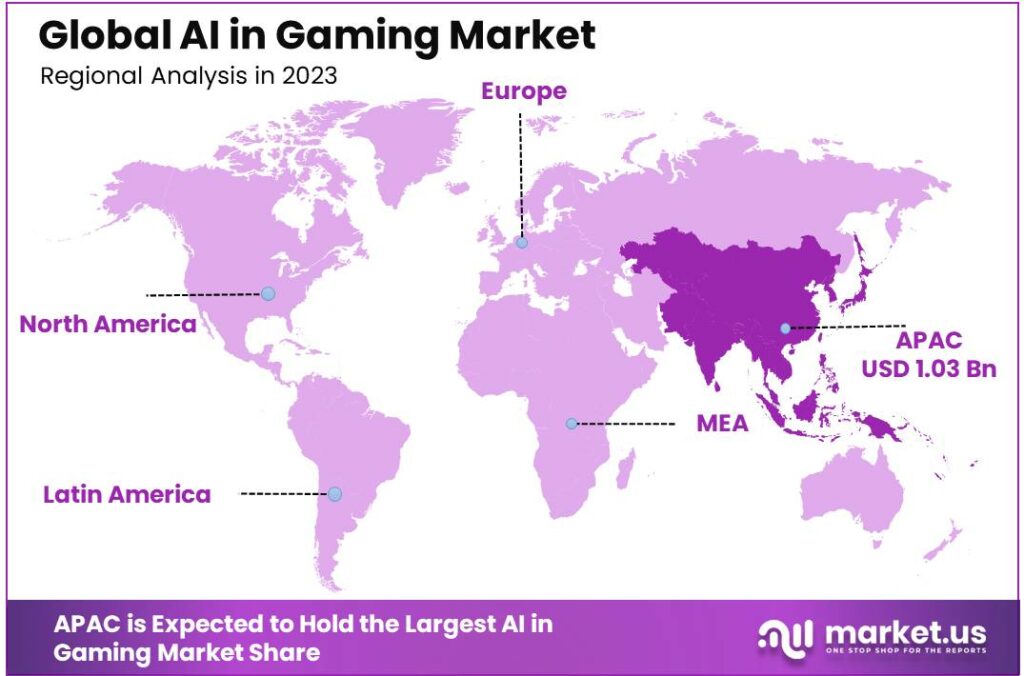
In 2023, the Asia-Pacific region held a dominant market position in the AI in gaming market, capturing more than a 45.1% share with revenue amounting to USD 1.03 billion. This significant market share can be attributed to several factors that underscore the region’s pivotal role in the global gaming landscape.
Asia-Pacific has a rapidly growing gamer population, driven by increasing smartphone use and internet access, offering a large user base for AI-powered gaming. The region also hosts major gaming companies in China, South Korea, and Japan, known for technological innovation. These companies are heavily investing in AI research, fueling the growth of advanced gaming technologies both locally and globally.
The strong cultural acceptance of gaming in Asia-Pacific drives the growth of AI in gaming. Gaming is deeply embedded in entertainment, leading to higher spending on video games. Additionally, the popularity of competitive gaming and e-sports in the region fuels demand for advanced AI-driven game mechanics that enhance both player and spectator experiences.
Government support for the technology sector in several Asia-Pacific countries provides additional incentives for AI advancements in gaming. Initiatives and funding aimed at fostering innovation hubs and tech startups have indirectly supported the development of more sophisticated gaming technologies, further solidifying the region’s leading position in the AI in gaming market.
Key Regions and Countries
- North America
- US
- Canada
- Europe
- Germany
- France
- The UK
- Spain
- Italy
- Rest of Europe
- Asia Pacific
- China
- Japan
- South Korea
- India
- Australia
- Singapore
- Rest of Asia Pacific
- Latin America
- Brazil
- Mexico
- Rest of Latin America
- Middle East & Africa
- South Africa
- Saudi Arabia
- UAE
- Rest of MEA
Key Player Analysis
The AI in gaming market is driven by several influential companies that leverage advanced technologies to enhance player experiences and expand their market share.
Activision Blizzard, Inc. holds a prominent position in the global gaming industry, renowned for integrating AI to elevate game design and player interaction. The company utilizes AI to create more dynamic and immersive environments in popular games like ‘Call of Duty’,etc.
IBM Corporation, traditionally known for its leadership in AI and computing, has also carved out a significant niche in the gaming sector. Through its powerful AI capabilities, such as Watson, IBM enhances gaming experiences by providing developers with tools to create more engaging content.
NetEase, Inc., a major player in the Asian gaming market, leverages AI to innovate within its vast portfolio of games. The company focuses on using AI to enhance game mechanics and player engagement, particularly in mobile gaming, where it holds a substantial market share. AI technologies at NetEase facilitate better user interaction models and more personalized content, which are crucial for maintaining player interest in highly competitive markets.
Top Key Players in the Market
- Microsoft Corporation
- Activision Blizzard, Inc.
- IBM Corporation
- NetEase, Inc.
- Google LLC
- Baidu, Inc.
- Intel Corporation
- Ubisoft Entertainment SA.
- Amazon Web Services, Inc.
- NVIDIA Corporation
- Epic Games, Inc.
- Tencent Holdings Limited
- Zynga Inc.
- Sony Interactive Entertainment
- Unity Technologies
- Other Key Players
Top Opportunities Awaiting for Players
The AI in Gaming market is burgeoning with numerous opportunities for developers and companies looking to capitalize on the latest technological advancements.
- AI-Enhanced Player Experience: Advanced AI is transforming non-player characters (NPCs) from simplistic, scripted entities to intelligent agents capable of dynamic interactions. This enhances the gaming experience, making virtual worlds more immersive and engaging.
- AI-Generated Game Assets: AI is increasingly used to generate game assets such as concept art, level designs, and character models. This not only speeds up development but also reduces costs, allowing for more creativity and variety in game design.
- Cloud-Streamed Gaming: AI is playing a crucial role in enhancing cloud-streamed gaming experiences, making games more accessible across different devices and platforms. This shift is expected to continue growing, increasing the consumer base and engagement levels.
- Blockchain and GameFi Innovations: AI-powered smart contracts and decentralized gaming models are opening new avenues in the blockchain and GameFi spaces. These technologies allow for more secure, transparent, and engaging gaming experiences, appealing especially to tech-savvy players.
- AI in Competitive Gaming and Esports: AI is elevating the competitive gaming landscape by providing more challenging AI-powered opponents. This not only improves player skills but also enhances spectatorship, driving the growth of the esports industry.
Recent Developments
- In January 2024, NVIDIA introduced generative AI models designed to bring lifelike characters to games and applications. These models aim to enhance the realism and interactivity of in-game characters, providing more engaging player experiences.
- In March 2024, AWS highlighted its commitment to generative AI in gaming during the Game Developers Conference (GDC). AWS showcased tools and services designed to help game developers incorporate AI into their games, aiming to streamline development processes and enhance game functionality.