

Report Overview
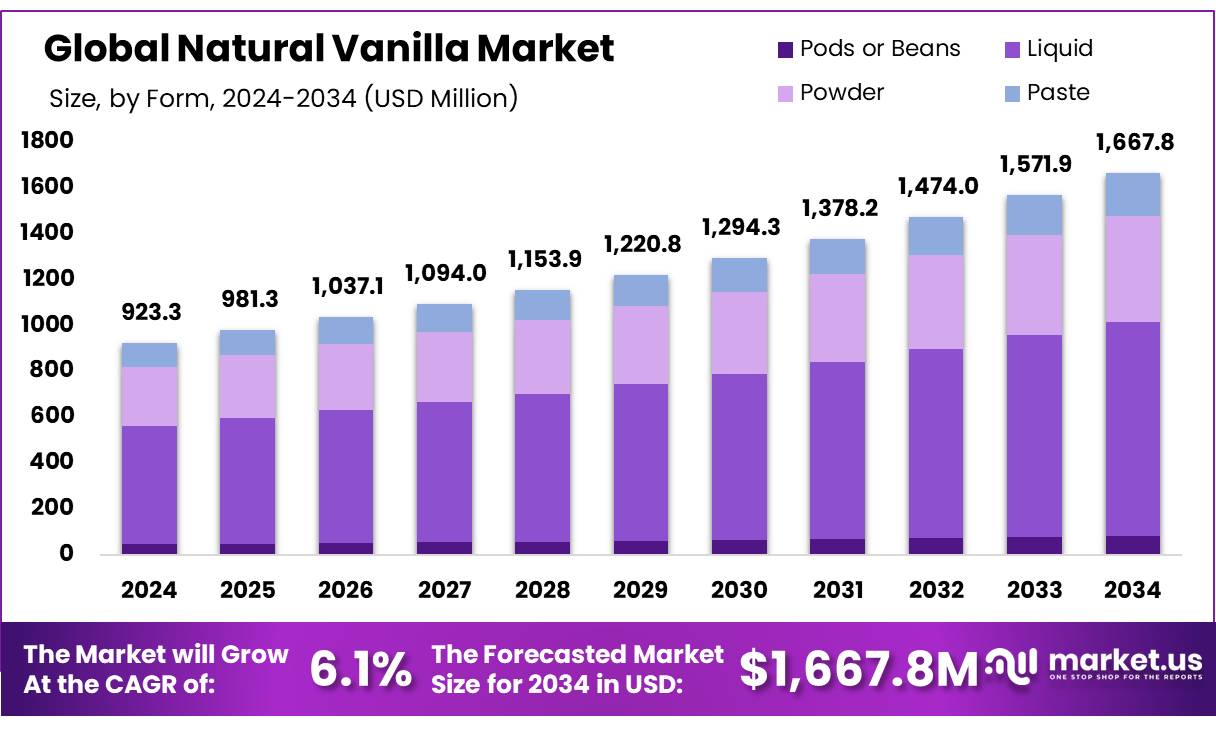
The Global Natural Vanilla Market size is expected to be worth around USD 1667.8 Mn Bn by 2034, from USD 923.3 Mn in 2024, growing at a CAGR of 6.1% during the forecast period from 2025 to 2034. Vanilla stands as the predominant natural flavoring used across various industries, such as food, beverage, pharmaceutical, cosmetic, and tobacco. The primary component of vanilla is vanillin (4-hydroxy-3-methoxy benzaldehyde).
Initially native to Mexico and a few Central American nations such as Costa Rica and Honduras, vanilla beans are now cultivated globally. Production figures include Madagascar, Indonesia, China, Tonga, and Comores, as well as Turkey and Guadeloupe. The global natural vanilla market is characterized by its high demand and limited supply, making it one of the most valuable spices in the world after saffron. Predominantly sourced from Madagascar, which accounts for about 80% of the world’s supply, global vanilla markets are also affected by production in Indonesia and Mexico. However, the market faces challenges such as fluctuating prices, climate vulnerability, and labor-intensive cultivation processes.
Key Takeaways
- The global natural vanilla market was valued at US$ 923.3 million in 2024.
- The global natural vanilla market is projected to reach US$ 1667.8 million by 2034.
- Among forms, liquid natural vanilla accounted for the largest market share of 56.0%.
- Among nature, organic accounted for the majority of the market share with 80.8%.
- Among applications, food and beverage held the majority of the market share of 52.0%.
- Among distribution channels, direct sales/B2B accounted for the largest market share 72.2%.
- North America is expected to hold the largest global natural vanilla market share with 38.8% of the market share.
- Asia-Pacific is anticipated to register the highest CAGR of 6.8% with a revenue share of 15.2% in 2024.
Form Analysis
Owing To Versatility and Wide Application Across Industries, Liquid Natural Vanilla Dominated the Market.
The natural vanilla market is segmented based on pods or beans, liquid, powder, and paste. In 2024, the segment of the natural vanilla market with a type of liquid held a significant revenue share of 56.0%. Liquid vanilla extract is the most commonly used form of vanilla across multiple industries, including food & beverages, pharmaceuticals, and cosmetics.
In the food sector, it is a staple ingredient in products such as bakery goods, ice creams, dairy products, chocolates, confectioneries, and desserts, where its liquid form makes it easy to mix and disperse uniformly. The beverage industry also relies heavily on liquid vanilla for flavored drinks, including coffee, tea, smoothies, alcoholic beverages, and soft drinks. Additionally, the cosmetic and personal care industry uses vanilla extract in perfumes, lotions, and skincare products due to its aromatic properties and natural appeal.
Unlike vanilla beans, powder, or paste, liquid vanilla extract is the most convenient and efficient form for large-scale production in the food industry. It easily dissolves in both hot and cold liquids, making it ideal for industrial food processing. Its consistent flavor profile, precise measurement, and extended shelf life make it a preferred choice for manufacturers. Several commercial bakeries, ice cream manufacturers, and beverage producers rely on liquid vanilla extract because it seamlessly integrates into recipes without altering the texture or requiring additional processing.
Global Natural Vanilla Market, By Form, 2020-2024 (USD Mn)
Distribution Channel Analysis
The distribution channels natural vanilla market is segmented based on direct sales/B2B and indirect sales/B2C. In 2024, direct sales/B2B accounted for a significant revenue share of 72.2% in the natural vanilla market. Due to several key factors that align with the way natural vanilla is sourced, traded, and utilized within industries. The B2B sales model, where manufacturers, wholesalers, and processors purchase vanilla in bulk directly from suppliers, plays a crucial role in the market dynamics.
The natural vanilla market is primarily driven by industrial-scale demand in various sectors, particularly the food and beverage industry. Companies that produce vanilla-containing products, such as ice creams, chocolates, baked goods, beverages, and dairy products, require large quantities of vanilla extract or vanilla beans. These manufacturers typically purchase vanilla in bulk through direct sales channels to meet their production needs. The scale of these transactions, often involving large orders, naturally makes B2B sales the dominant channel in the market.
B2B transactions typically offer suppliers the ability to negotiate large orders at discounted rates, which benefits both the vanilla producers and the industrial buyers. Direct B2B sales streamline the process, making it more efficient for both parties, as these buyers are looking for steady, high-volume supplies to fulfill ongoing production cycles. Thus, large-scale industrial demand for natural vanilla in the food, beverage, cosmetics, and pharmaceutical sectors is a major factor that contributes to the large share of B2B sales.
Global Natural Vanilla Market, By Distribution Channel, 2020-2024 (USD Mn)
Global Natural Vanilla Market, By Region, 2020-2024 (USD Mn)
| Region | 2020 | 2021 | 2022 | 2023 | 2024 |
|---|---|---|---|---|---|
| North America | 292.3 | 304.4 | 319.6 | 337.7 | 358.7 |
| Europe | 223.9 | 234.2 | 243.5 | 258.4 | 275.7 |
| Asia Pacific | 110.4 | 116.0 | 122.8 | 130.9 | 140.2 |
| Middle East & Africa | 52.7 | 54.7 | 57.3 | 60.3 | 63.9 |
| Latin America | 70.6 | 73.2 | 76.4 | 80.3 | 84.9 |
Key Regions and Countries Covered in this Report
- North America
- The US
- Canada
- Europe
- Germany
- France
- The UK
- Spain
- Italy
- Russia & CIS
- Rest of Europe
- APAC
- China
- Japan
- South Korea
- India
- ASEAN
- Rest of APAC
- Latin America
- Brazil
- Mexico
- Rest of Latin America
- Middle East & Africa
- GCC
- South Africa
- Rest of MEA
Market Share & Key Players Analysis
Strong Focus On Product Portfolio Expansion Through Various Strategies Maintain the Dominance of Industry Leaders
Industry leaders often engage in strategic partnerships and collaborations with key stakeholders in the vanilla supply chain. For example, companies may work with research institutions, NGOs, and local governments to improve agricultural practices, train farmers, and promote the economic sustainability of vanilla-growing regions. These partnerships enable companies to contribute to local communities while ensuring a steady, ethical supply of vanilla.
Collaborations with other premium brands, especially in the food and fragrance industries, also enhance a company’s visibility and brand equity. By leveraging these strategies sustainable sourcing, vertical integration, innovation, market expansion, R&D, transparency, and strategic partnerships leading companies in the natural vanilla market are positioning themselves for long-term growth and dominance. This allows them to not only meet current consumer demands but also shape the future of the vanilla industry in an increasingly competitive and environmentally conscious market.
Market Key Players
To stand out in a competitive market, industry leaders focus on product innovation. Many companies are investing in new product lines that feature natural vanilla in premium categories such as organic foods, clean-label products, and high-end fragrances and cosmetics. They are also diversifying the range of vanilla-based offerings to cater to niche markets, including gluten-free, dairy-free, and vegan consumers. Furthermore, some companies are experimenting with new extraction methods or enhanced processing techniques that improve the flavor profile or purity of natural vanilla, further distinguishing their products from competitors.
The following are some of the major players in the industry
- The Archer-Daniels-Midland Company
- International Fragrance and Flavors Inc.
- Kerry Group Plc
- Givaudan SA
- McCormick & Company Inc.
- Firmenich SA
- Symrise AG
- B&G Foods Inc.
- Sensient Technologies Corporation
- Takasago International Corporation
- Synthite Industries Private Ltd
- PROVA SAS
- Adams Flavours
- Nielsen-Massey Vanillas
- Sensate Pty. Ltd
- Tharakan and Company
- Other Key Players