

Report Overview
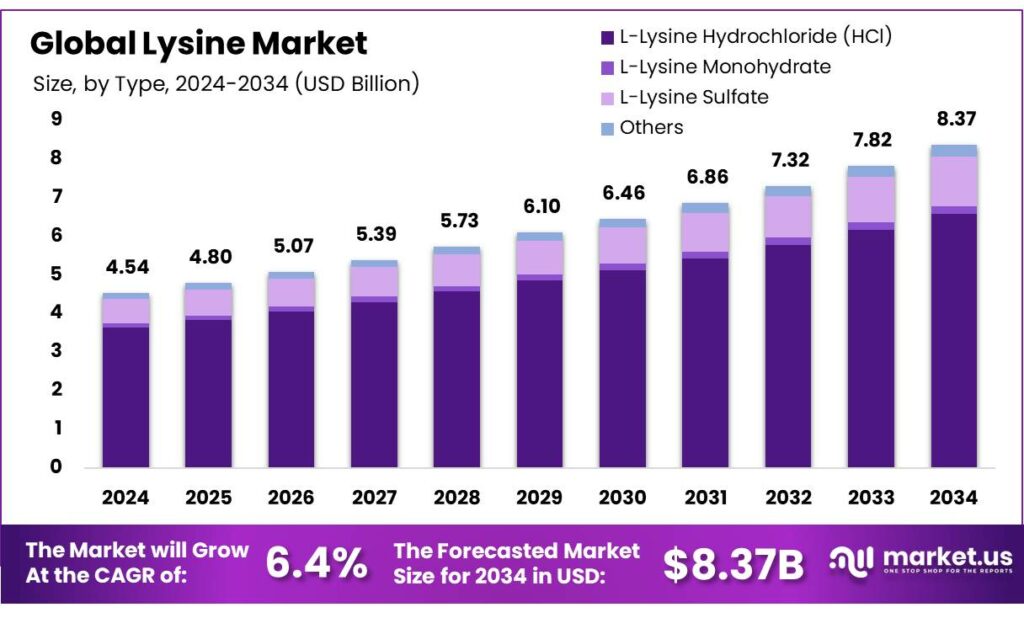
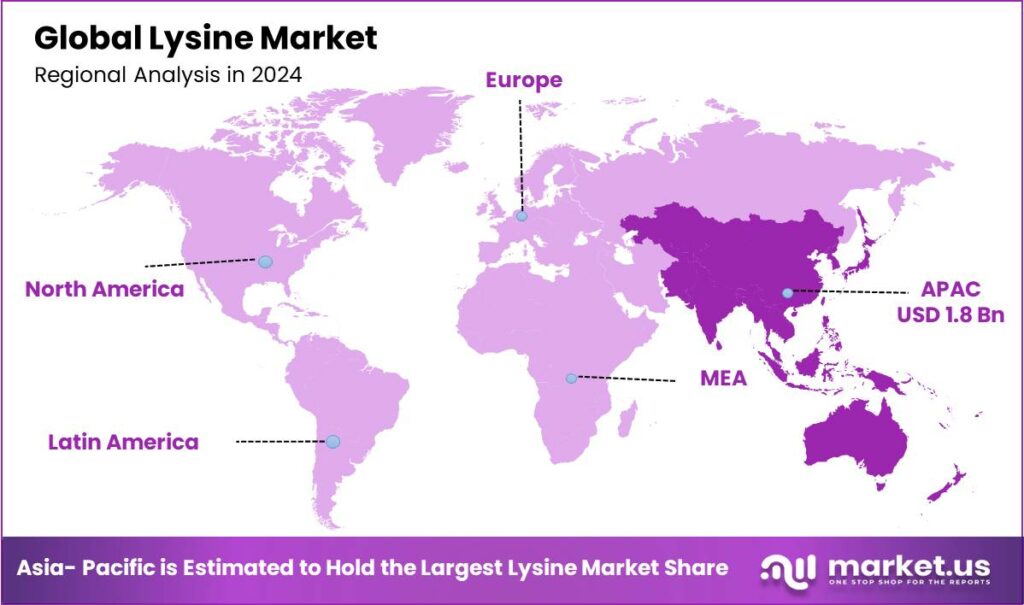
The Global Lysine Market size is expected to be worth around USD 8.37 Billion by 2034, from USD 4.54 Billion in 2024, growing at a CAGR of 6.4% during the forecast period from 2025 to 2034. In 2024 Asia Pacificheld a dominant market position, capturing more than a 40.0%share, holding USD 1.8 Billion in revenue.
The global lysine market is a critical segment of the amino acids industry, underpinned by its indispensable role in both animal nutrition and human health. Lysine, an essential amino acid, is widely used in animal feed formulations—particularly for poultry, swine, and aquaculture—where it enhances feed efficiency, promotes growth, and reduces nitrogen emissions, thereby aligning with global sustainability goals. Rising animal-protein consumption, especially in emerging economies across Asia-Pacific, Latin America, and Africa, is the primary growth driver, as demand for poultry and pork surges alongside income growth and urbanization.
Beyond feed, lysine’s applications span pharmaceuticals, nutraceuticals, and personal care, supporting functions such as collagen formation, immune regulation, and treatment of conditions such as herpes simplex virus, osteoporosis, and hypertension. Industrial applications also extend into hydrogels, nanoparticles, and biodegradable polymers.
- Highly Pathogenic Avian Influenza (HPAI) outbreaks have caused widespread mortality among wild and domestic birds, such as the 2021–2022 HPAI H5N1 strain which caused over 53 million bird deaths in the U.S. affected over 683 flocks in 47 states. This results in drastically reduced poultry production and feed inputs including lysine.
- During the African Swine Fever outbreak in China, a reduction of 9–34% in global swine production was estimated.
- Outbreak simulations in the U.S. project an ASF event could cause a 40–50% domestic hog price drop and an industry loss of $50 billion.
From a production standpoint, lysine is primarily manufactured via microbial fermentation, with Asia—especially China—dominating global supply. Despite its robust outlook, the market faces restraints such as livestock disease outbreaks, which reduce meat demand and consequently suppress lysine consumption, as seen with avian influenza and African swine fever.
Nevertheless, innovation in fermentation technologies, sustainable feed practices, and rising demand for nutrient-dense diets create strong opportunities. Overall, lysine remains a cornerstone of global food security, health, and industrial innovation, positioning the market for sustained long-term growth.
Key Takeaways
- The global lysine market was valued at USD 4.54 Billion in 2024.
- The global lysine market is projected to grow at a CAGR of 6.4% and is estimated to reach USD 8.37 Billion by 2034.
- Between types, L-Lysine Hydrochloride (HCl) accounted for the largest market share of 80.0%.
- Among forms, powder dominated the market with the largest share of 67.5%.
- Among applications, animal feed accounted for the majority of the market share at 75.1%.
- Asia-Pacific is estimated as the largest market for Lysine with a share of 40.0% of the market share.
- North America was estimated second largest growing market with a CAGR of 6.5%
Type Analysis
L-Lysine Hydrochloride (HCl) Domiantes The Global Market
Based on type, the market is further divided into L-Lysine Hydrochloride (HCl), L-Lysine Monohydrate, L-Lysine Sulfate, & Others. As of 2024, the L-Lysine Hydrochloride (HCl) dominated the Lysine market with an 80.0% share due to its superior stability, high bioavailability, and wide applicability in animal nutrition, particularly in poultry and swine feed. Lysine HCl contains a high concentration of lysine (approximately 78–80%), making it the most efficient and cost-effective form for balancing amino acid requirements in feed formulations. Its crystalline structure ensures longer shelf life and ease of transport, which is critical in large-scale global supply chains.
Additionally, its solubility and compatibility with other feed ingredients enhance absorption rates, directly improving animal growth performance and feed conversion ratios. The preference for Lysine HCl is also reinforced by established manufacturing infrastructure, cost efficiencies in large-scale production, and strong demand in rapidly growing livestock sectors across Asia-Pacific, North America, and Europe. These combined functional and economic advantages solidify Lysine HCl’s dominant position within the lysine market landscape.
Global Lysine Market, By Type, 2020-2024 (USD Mn)
| Type | 2020 | 2021 | 2022 | 2023 | 2024 | ||||||||||||||||||||||||||||||||||||||
|---|---|---|---|---|---|---|---|---|---|---|---|---|---|---|---|---|---|---|---|---|---|---|---|---|---|---|---|---|---|---|---|---|---|---|---|---|---|---|---|---|---|---|---|
| Application | 2020 | 2021 | 2022 | 2023 | 2024 | |||||||||||||||||||||||||||||||
|---|---|---|---|---|---|---|---|---|---|---|---|---|---|---|---|---|---|---|---|---|---|---|---|---|---|---|---|---|---|---|---|---|---|---|---|---|
| Region | 2020 | 2021 | 2022 | 2023 | 2024 |
|---|---|---|---|---|---|
| North America | 686.4 | 718.3 | 753.7 | 791.8 | 836.4 |
| Europe | 1,151.8 | 1,192.8 | 1,238.7 | 1,287.9 | 1,346.6 |
| Asia Pacific | 1,454.4 | 1,530.8 | 1,615.5 | 1,707.1 | 1,813.8 |
| Middle East & Africa | 198.7 | 206.8 | 215.9 | 225.6 | 237.1 |
| Latin America | 250.7 | 261.6 | 273.6 | 286.5 | 301.8 |
Key Regions and Countries
- North America
- The US
- Canada
- Europe
- Germany
- France
- The UK
- Spain
- Italy
- Russia & CIS
- Rest of Europe
- APAC
- China
- Japan
- South Korea
- India
- ASEAN
- Rest of APAC
- Latin America
- Brazil
- Mexico
- Rest of Latin America
- Middle East & Africa
- GCC
- South Africa
- Rest of MEA
Key Players Analysis
Innovation, Sustainability, and Expansion Are The Key Strategies Of Major Players Of the Lysine Market.
Major players in the global lysine market are pursuing a mix of capacity expansion, technological innovation, and strategic partnerships to strengthen and expand their market share. Leading producers are investing heavily in advanced fermentation technologies and biotechnology platforms to improve yield efficiency, reduce production costs, and minimize environmental impact, thereby ensuring competitiveness in a resource-intensive industry.
Geographic expansion is another key strategy, with companies establishing or scaling up production facilities in high-demand regions such as Asia-Pacific to secure proximity to livestock hubs and reduce logistics costs.
The major players in the industry
- Ajinomoto Co., Inc
- Evonik Industries AG
- CJ CheilJedang Corporation
- Meihua Holdings Group Co., Ltd.
- Global Bio-Chem Technology Group
- Archer Daniels Midland Co
- Juneng Golden Corn Co., Ltd.
- Alpspure Lifesciences Pvt Ltd
- Ningxia Eppen Biotech Co., Ltd. (Eppen)
- Daesang Corporation
- Fengchen Group Co.,Ltd
- PANGOO BIOTECH HEBEI CO., LTD.
- Fufeng Group Limited
- Xi’an Healthful Biotechnology Co.,Ltd
- Zhucheng Dongxiao Biotechnology Co.,Ltd
- Other Key Players
Key Development
In September 2024: Ajinomoto and Danone have formed a strategic partnership aimed at reducing greenhouse gas (GHG) emissions in the dairy supply chain. The collaboration utilizes Ajinomoto’s innovative AjiPro-L lysine formulation, which improves feed efficiency and reduces environmental impact. AjiPro-L helps cut CO₂ emissions from soybean meal by 20% and nitrous oxide emissions from manure by 25%. This initiative aligns with Danone’s “Partner for Growth” program, which seeks to enhance sustainability and farmer profitability in milk production. The solution is currently being implemented in several countries, including Spain, Brazil, and the U.S.
In July 2023: Evonik announced a price increase of 8-10% per kilogram for Biolys (L-lysine 62.4%, feed grade), effective immediately. Despite the price hike, all existing contracts and supply agreements will be honored. This price adjustment reflects the company’s ongoing efforts to maintain the quality and efficiency of its products in a dynamic market. Biolys remains a crucial product for the animal feed industry, providing essential amino acids to livestock such as swine and poultry.
In July 2025: Kyowa Hakko Bio Co., Ltd. completed the transfer of its Amino Acids and Human Milk Oligosaccharides business to a special purpose company under Meihua Holdings Group Co., Ltd., a leading Chinese bio-industry firm. This move, initially announced on November 22, 2024, marks a strategic shift in Kyowa Hakko Bio’s operational focus. The transaction is expected to influence the company’s performance and aligns with broader restructuring efforts under Kirin Holdings.