

Report Overview
The Global Snack Bar Market size is expected to be worth around USD 40.7 Bn by 2034, from USD 21.7 Bn in 2024, growing at a CAGR of 6.5% during the forecast period from 2025 to 2034.
A snack bar refers to a pre-packaged, ready-to-eat food product made for on-the-go consumption. Typically, snack bars are nutritious and compact, making them a convenient food choice for consumers seeking quick energy or a meal replacement. These products are available in various forms, including granola bars, energy bars, protein bars, and cereal bars, each tailored to meet specific dietary preferences or nutritional needs.
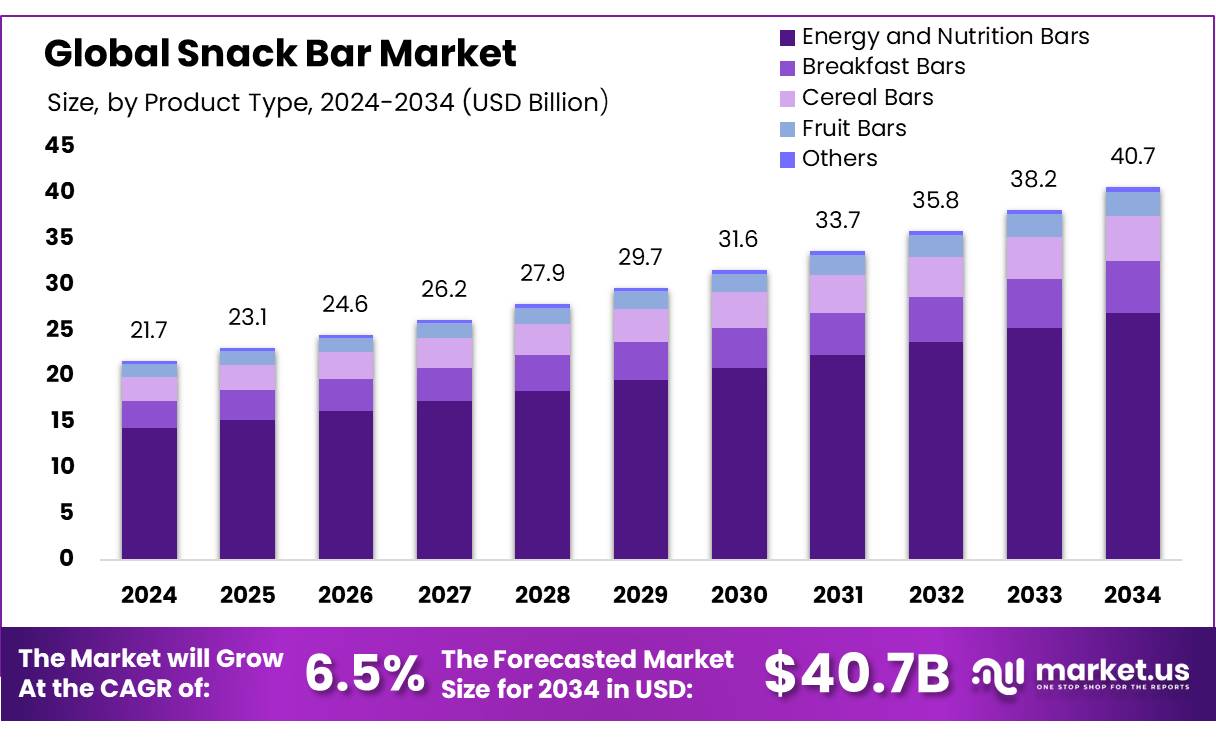
The global snack bar market has emerged as a dynamic segment within the food industry, driven by changing consumer lifestyles and dietary habits. The growth of this market can be attributed to an increasing demand for convenient and healthy snack options among the global population, especially among those with busy lifestyles who prioritize nutritional value without compromising on taste or convenience. The rising awareness of health and wellness, along with a growing preference for gluten-free, organic, and non-GMO products, has further fueled the expansion of the snack bar industry.
Key Takeaways
- The global snack bar market will be valued at USD 21.7 billion in 2024.
- The global snack bar market is projected to reach USD 40.7 billion by 2034.
- Among product types, energy and nutrition bars accounted for the largest market share of 66.2%.
- Among types, high protein snack bars accounted for the majority of the market share with 54.3%.
- Based on flavor type, chocolate is expected to account for the largest market share in 2024 with 32.0%.
- Among claims, the sugar-free snack bar is more popular among consumers, and thus, it holds a 36.5% revenue share.
- Based on the end-use, the adult segment is anticipated to account market share of 86.0%.
- Based on the distribution channel, the supermarkets/hypermarkets segment is anticipated to account market share of 57.2%.
Facts & Statistics
- According to a surveys, 61% of Spanish consumers believe that bars made with organic ingredients are worth paying extra for.
- The Organic Trade Association reported a rise in sales of organic snack foods, including bars, by 14% in 2020, indicating a consumer preference for products with organic certification.
- In the United States, over 60% of adults reported consuming snack bars as a meal replacement, indicating a significant shift in traditional meal patterns.
- Over 50% of consumers in the United Kingdom preferred snack bars that are high in fiber and low in sugar, reflecting a growing health consciousness.
- The Organic Trade Association stated that organic food sales in the United States reached $56.4 billion in 2020, up 12.8% from the previous year, with a noticeable increase in the demand for organic snack products, including bars.
- A study by the Plant Based Foods Association and The Good Food Institute highlighted a 27% increase in U.S. plant-based food sales in the year 2020, reaching a value of $7 billion. This reflects the growing consumer interest in sustainable diets and products that have a lower environmental footprint, such as plant-based snack bars.
Regulatory Frameworks
| Region/Country | Regulatory Body/ Regulation | Description | |||||||||||||||||||||||||||||||||||||||||
|---|---|---|---|---|---|---|---|---|---|---|---|---|---|---|---|---|---|---|---|---|---|---|---|---|---|---|---|---|---|---|---|---|---|---|---|---|---|---|---|---|---|---|---|
| Claims | 2020 | 2021 | 2022 | 2023 | 2024 | |||||||||||||||||||||||||||||||
|---|---|---|---|---|---|---|---|---|---|---|---|---|---|---|---|---|---|---|---|---|---|---|---|---|---|---|---|---|---|---|---|---|---|---|---|---|
| Region | 2020 | 2021 | 2022 | 2023 | 2024 |
|---|---|---|---|---|---|
| North America | 8,858.1 | 9,136.0 | 9,447.0 | 9,781.3 | 10,184.8 |
| Europe | 3,830.6 | 4,022.9 | 4,236.2 | 4,467.1 | 4,737.8 |
| Asia Pacific | 2,168.1 | 2,325.0 | 2,502.0 | 2,698.4 | 2,929.1 |
| Middle East & Africa | 1,311.5 | 1,377.7 | 1,450.9 | 1,530.1 | 1,622.7 |
| Latin America | 1,692.0 | 1,796.2 | 1,911.6 | 2,037.0 | 2,182.7 |
Key Regions and Countries
- North America
- The US
- Canada
- Europe
- Germany
- France
- The UK
- Spain
- Italy
- Russia & CIS
- Rest of Europe
- APAC
- China
- Japan
- South Korea
- India
- ASEAN
- Rest of APAC
- Latin America
- Brazil
- Mexico
- Rest of Latin America
- Middle East & Africa
- GCC
- South Africa
- Rest of MEA
Key Players Analysis
Strong Focus On Product Portfolio Expansion Through Various Strategies. Maintain the Dominance of Industry Leaders
Recognizing the growing consumer demand for healthier snack options, key players are prioritizing the development of snack bars with enhanced nutritional profiles. This includes formulating products with natural, organic, and clean-label ingredients, as well as fortifying bars with vitamins, minerals, and protein. Health-focused marketing messages emphasizing attributes like low sugar, high fiber, gluten-free, and non-GMO are also prevalent to appeal to health-conscious consumers.
Market Key Players
The global snack bar market is highly fragmented, with key players including Nestle SA, PepsiCo Inc., Abbott Laboratories, Mars, Incorporated, General Mills, Inc., Kellanova, The Hershey Company, Post Holdings Inc., Glanbia, Hain Celestial Group, & others These key players are investing in research and development to innovate and diversify their product portfolios. This includes introducing new flavors, formulations, and packaging formats to cater to evolving consumer preferences for variety, healthfulness, and convenience.
For example, there’s been a surge in the introduction of snack bars featuring plant-based ingredients, functional additives (such as probiotics or adaptogens), and reduced sugar or allergen-free formulations. With the increasing popularity of online shopping and the rise of direct-to-consumer (DTC) brands, key players are leveraging e-commerce channels to reach a broader audience and engage directly with consumers. This includes establishing robust online platforms, leveraging social media marketing, and implementing subscription-based models to drive sales and brand loyalty. Furthermore, some key players are investing in digital marketing strategies and personalized online experiences to enhance consumer engagement and retention.
The following are some of the major players in the industry
- Nestle SA
- PepsiCo Inc
- Abbott Laboratories
- Mars, Incorporated
- General Mills, Inc.
- Kellanova
- The Hershey Company
- Post Holdings Inc
- Glanbia
- Hain Celestial Group
- The Simply Good Foods Company
- Lotus Bakeries Corporate
- Other Key Players
Recent Development
- In May 2024, General Mills, Inc. Is expanding its Nature Valley brand with the introduction of Nature Valley salted nut cans. According to General Mills, the bars are the first delicious snack under the Nature Valley brand and are available in three flavors all baked, white cheddar, and smoky barbecue.
- In July 2024, Mars, Inc. the Kind Snacks brand is expanding its product line with three new products that contain plant-based ingredients and whole grains.
- PepsiCo, Inc. has acquired Health Warrior, Inc., the maker of plant-based nutrition bars and other products. This acquisition helps PepsiCo to increase its presence in the nutrition bar category, which is an attractive growth space.