Report Overview
The Global MSI-H/dMMR Market Size is expected to be worth around US$ 93.4 Billion by 2034, from US$ 8.9 Billion in 2024, growing at a CAGR of 26.6% during the forecast period from 2025 to 2034. North America held a dominant market position, capturing more than a 53.1% share and holds US$ 4.7 Billion market value for the year.
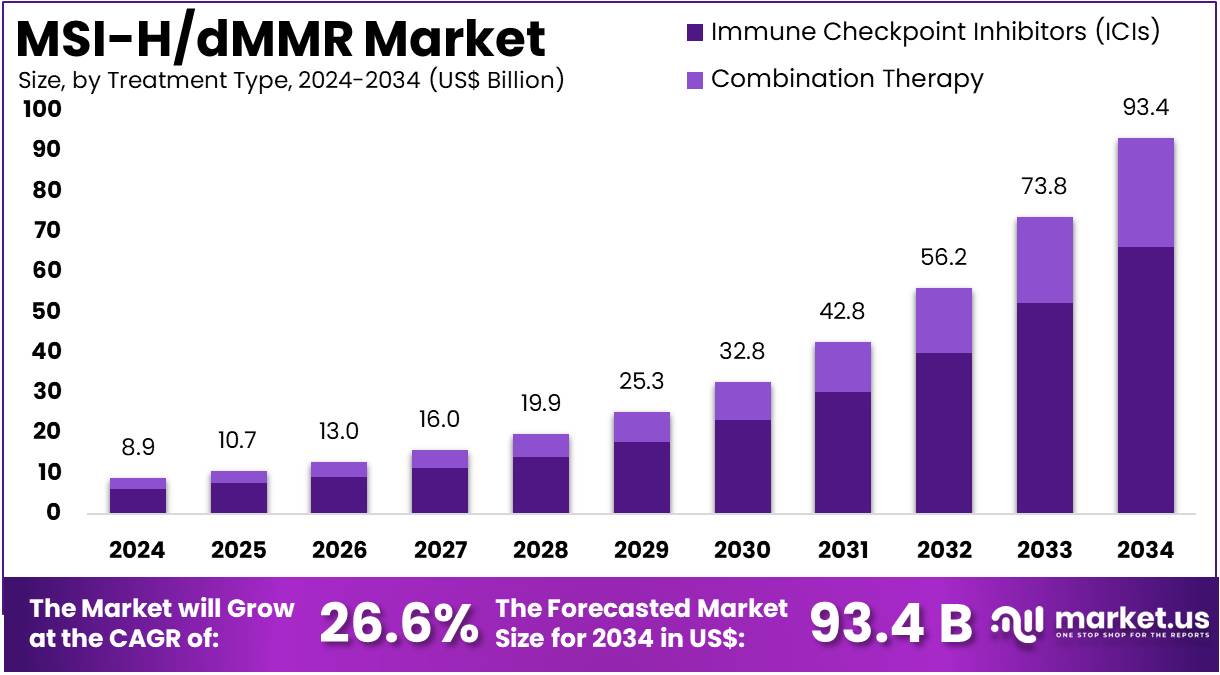
The global MSI-H/dMMR market is driven by the growing prevalence of MSI-H/dMMR cancers, particularly in colorectal, endometrial, and gastric cancers, where this genetic anomaly is a key biomarker for targeted therapies. Advances in precision medicine and the increasing adoption of immunotherapies, such as immune checkpoint inhibitors, have significantly contributed to market growth, offering promising treatments for patients with MSI-H/dMMR cancers.
Additionally, the expanding pipeline of drugs designed to specifically target MSI-H/dMMR tumors is further boosting market prospects. The rise in cancer awareness, improved diagnostic techniques, and personalized treatment options are also fueling market expansion. However, challenges such as high treatment costs, limited availability of specialized tests, and regulatory hurdles may impact market growth.
On the other hand, ongoing research and clinical trials to explore new therapeutic strategies and improve patient outcomes are expected to offer significant opportunities for growth in the coming years.
- In 2020, the PMDA approved nivolumab for the treatment of MSI-H/dMMR colorectal cancer as well, making it one of the first checkpoint inhibitors authorized for this indication. This approval was based on the CheckMate-142 trial, which showed that nivolumab significantly improved survival rates in patients with MSI-H/dMMR colorectal cancer.
MSI-H/dMMR Market, Global Analysis, 2020-2024 (US$ Billion)
| Country/Region | 2020 | 2021 | 2022 | 2023 | 2024 |
|---|---|---|---|---|---|
| U.S. | 2.5 | 2.6 | 2.8 | 3.1 | 3.6 |
| Europe | 1.6 | 1.6 | 1.7 | 2.0 | 2.3 |
| Japan | 0.6 | 0.6 | 0.6 | 0.7 | 0.8 |
Key Regions and Countries
- North America
- US
- Canada
- Europe
- Germany
- France
- The UK
- Spain
- Italy
- Russia
- Netherland
- Rest of Europe
- Asia Pacific
- China
- Japan
- South Korea
- India
- New Zealand
- Singapore
- Thailand
- Vietnam
- Rest of APAC
- Latin America
- Brazil
- Mexico
- Rest of Latin America
- Middle East & Africa
- South Africa
- Saudi Arabia
- UAE
- Rest of MEA
Key Players Analysis
The competitive landscape of the MSI-H/dMMR market is marked by the dominance of large pharmaceutical players such as Merck, Bristol-Myers Squibb, and Roche, who are leveraging their immune checkpoint inhibitors to target MSI-H/dMMR cancers.
However, competition is intensifying as smaller biotech companies and innovative therapies such as CAR-T cell therapy, neoantigen vaccines, and oncolytic viruses enter the market. With expanding indications and ongoing clinical trials, the landscape is expected to evolve rapidly, with combination therapies and personalized treatments becoming central strategies to address unmet needs in MSI-H/dMMR cancers.
Top Key Players in the MSI-H/dMMR Market
- Pfizer Inc.
- Merck & Co.
- AstraZeneca
- F. Hoffmann-La Roche Ltd
- Bristol-Myers Squibb Company
- Eli Lilly and Company
- GSK plc.
- BeiGene LTD.
- Summit Therapeutics Inc.
- Sanofi
- Novartis AG
- AbbVie Inc.
- Amgen Inc.
- Johnson & Johnson Services, Inc.
Recent Developments
- In March 2020, The KEYNOTE-177 trial, demonstrated that Pembrolizumab (Keytruda) significantly improved progression-free survival in patients with MSI-H colorectal cancer compared to standard chemotherapy. The trial showed that PFS was nearly doubled, with 12.5 months of median progression-free survival in the Pembrolizumab group compared to 7.1 months in the chemotherapy group. These studies underscore the significant role that advancements in targeted immunotherapy, particularly PD-1 inhibitors, are playing in reshaping the treatment landscape for MSI-H dMMR cancers.
- In April 2022, Merck announced that the European Commission has approved KEYTRUDA, Merck’s anti-PD-1 therapy, as monotherapy for the treatment of microsatellite instability-high (MSI-H) or deficient mismatch repair (dMMR) tumors in adults with unresectable or metastatic colorectal cancer after previous fluoropyrimidine-based combination therapy; advanced or recurrent endometrial carcinoma.