

Report Overview
The Global Lipase Market size is expected to be worth around USD 1,607.6 million by 2034, from USD 744.6 million in 2024, growing at a CAGR of 7.9% during the forecast period from 2025 to 2034.
Lipase is an enzyme that catalyzes the breakdown of triglycerides into glycerol and free fatty acids by hydrolyzing the ester bonds within the triglyceride structure. Naturally occurring in various living organisms, including plants, animals, and microorganisms, lipases play a critical role in lipid metabolism by breaking down triglycerides into free fatty acids and glycerol. This enzymatic action is essential for the digestion and absorption of dietary lipids in the body.
Beyond their physiological function, lipases have gained significant industrial relevance due to their diverse catalytic capabilities, including hydrolysis, esterification, alcoholysis, and transesterification. These catalytic functions make lipases highly valuable for numerous applications, ranging from food processing and pharmaceuticals to biodiesel production and wastewater treatment.
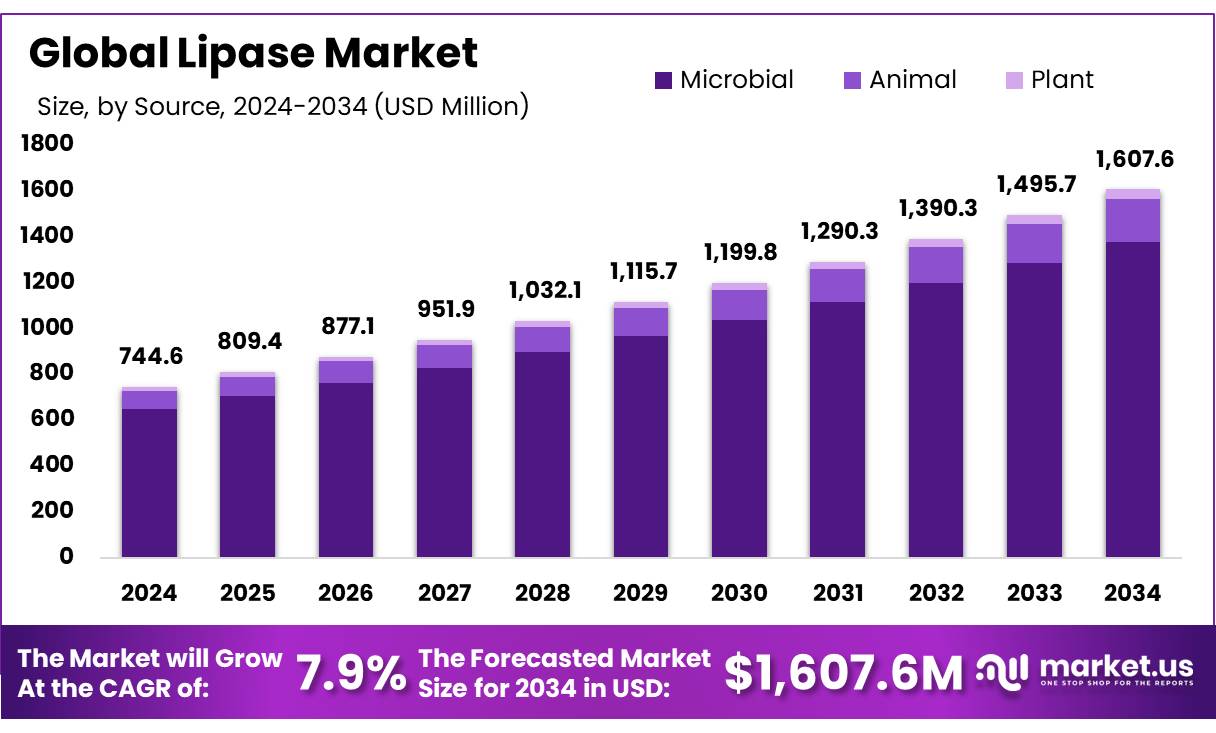
The global lipase market is witnessing substantial growth driven by its expanding applications in food processing, pharmaceuticals, biodiesel production, and cleaning products. The enzyme’s versatility, specificity, and environmental benefits make it an attractive alternative to conventional chemical catalysts, particularly in industries seeking sustainable and eco-friendly processing solutions. As technological advancements continue to improve enzyme stability and production efficiency, the demand for lipase enzymes is expected to rise across diverse sectors, positioning it as a critical component in the transition towards greener industrial processes.
Key Takeaways
- The global lipase market was valued at USD 744.6 million in 2024.
- The global lipase market is projected to grow at a CAGR of 7.9% and is estimated to reach USD 1,607.6 million by 2034.
- Among sources, microbial accounted for the largest market share of 87.1%.
- Among formulations, powder lipase led the market with a largest share of 67.7%.
- Based on application, food & beverages accounted for the majority of the market share 40.8%.
- North America is estimated as the largest market for lipase with a share of 36.4% of the market share.
Source Analysis
Microbial Lipases Dominated the Market, Owing to Its Superior Efficiency
The lipase market is segmented based on source as microbial, animal, and plant. In 2024, the microbial segment held a significant revenue share of 87.1% in the global lipase market due to its superior efficiency, scalability, and cost-effectiveness in industrial applications. Microbial lipases—produced mainly from bacteria and fungi offer advantages such as high enzyme yield, faster growth cycles, and the ability to be cultivated under controlled fermentation conditions. These enzymes are highly stable across a broad range of pH and temperature levels, making them ideal for use in pharmaceuticals, food processing, animal feed, and biofuels.
Additionally, microbial sources can be genetically engineered to enhance enzyme activity, specificity, and resistance to harsh processing environments, providing customized solutions for different industries. In comparison, plant and animal-derived lipases are limited by raw material availability, extraction complexities, and variability in enzyme composition. The growing demand for sustainable and non-animal-derived enzymes, especially in vegetarian and vegan product formulations, has further increased reliance on microbial lipases. Moreover, regulatory bodies are more inclined to approve microbial enzymes due to their consistent quality and safety profile.
Global Lipase Market, By Source, 2020-2024 (USD Mn)
| Type | 2020 | 2021 | 2022 | 2023 | 2024 | ||||||||||||||||||||||||||||||||||||||
|---|---|---|---|---|---|---|---|---|---|---|---|---|---|---|---|---|---|---|---|---|---|---|---|---|---|---|---|---|---|---|---|---|---|---|---|---|---|---|---|---|---|---|---|
| Formulation | 2020 | 2021 | 2022 | 2023 | 2024 | |||||||||||||||||||||||||||||||
|---|---|---|---|---|---|---|---|---|---|---|---|---|---|---|---|---|---|---|---|---|---|---|---|---|---|---|---|---|---|---|---|---|---|---|---|---|
| Region | 2020 | 2021 | 2022 | 2023 | 2024 |
|---|---|---|---|---|---|
| North America | 196.90 | 213.65 | 231.46 | 250.40 | 271.21 |
| Europe | 180.25 | 196.15 | 208.28 | 226.02 | 245.56 |
| Asia Pacific | 106.98 | 117.35 | 128.55 | 140.61 | 153.99 |
| Middle East & Africa | 25.05 | 27.09 | 29.26 | 31.55 | 34.06 |
| Latin America | 29.42 | 31.78 | 34.26 | 36.89 | 39.77 |
Key Regions and Countries
- North America
- The US
- Canada
- Europe
- Germany
- France
- The UK
- Spain
- Italy
- Russia & CIS
- Rest of Europe
- APAC
- China
- Japan
- South Korea
- India
- ASEAN
- Rest of APAC
- Latin America
- Brazil
- Mexico
- Rest of Latin America
- Middle East & Africa
- GCC
- South Africa
- Rest of MEA
Key Players Analysis
In The Lipase Market, Companies Sustain Their Competitive Edge Through A Combination Of Product Innovation, Strategic Partnerships, Regulatory Compliance, And Expansion Into High-Growth Sectors.
R&D investment plays a central role, enabling firms to develop advanced lipase formulations with improved temperature and pH stability, higher catalytic efficiency, and application-specific functionality particularly for use in food processing, pharmaceuticals, and biofuels. Several leading players are focused on enzyme engineering and fermentation optimization to reduce production costs and increase enzyme yields.
Companies maintain competitiveness by forming partnerships with food manufacturers, pharmaceutical firms, and biofuel producers, allowing them to tailor lipase solutions for specific industrial needs and ensure long-term supply agreements. Additionally, compliance with global food safety and pharma-grade regulations (such as GRAS status in the U.S. or EFSA approval in the EU) strengthens brand reliability and enables product access to regulated markets.
The following are some of the major players in the industry
- Novonesis Group
- DSM-Firmenich AG
- Advanced Enzyme Technologies
- Amano Enzyme Inc.
- Kerry Group
- Antozyme Biotech Pvt Ltd
- RENCO
- Sacco System
- Creative Enzymes
- AB Enzymes
- International Flavors & Fragrances Inc.
- BRAIN Biotech Group
- Aumgene Biosciences
- Meito Sangyo Co., Ltd
- Other Key Players
Key Development
- In September 2024, Biocatalysts Ltd, announced the launch of Lipomod™ 70MDP, a unique lipase formulated specifically to optimize the hydrolysis of plant-based oils. This newest addition to Biocatalysts Ltd.’s specialty enzyme portfolio is set to offer enhanced efficiency and versatility across various industries, including food processing and industrial manufacturing.
- In April 2023, Firmenich International SA announced the successful completion of its merger with DSM, forming DSM-Firmenich AG — the leading innovation partner in the fields of nutrition, health, and beauty. This milestone was achieved following the fulfillment of all customary conditions, completion of the share exchange offer, and the contribution of Firmenich shares into DSM-Firmenich AG.