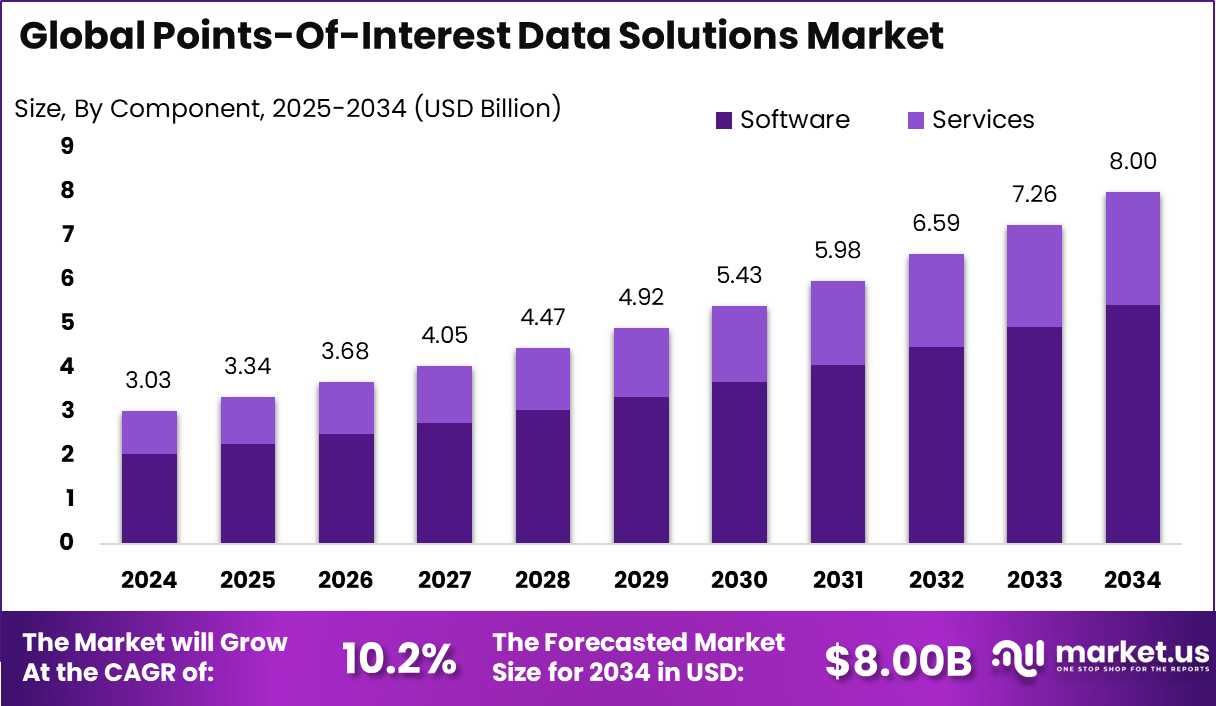
The Global Points-Of-Interest (POI) Data Solutions Market size is expected to be worth around USD 8.00 billion by 2034, from USD 3.03 billion in 2024, growing at a CAGR of 10.2% during the forecast period from 2025 to 2034. In 2024, North America held a dominant market position, capturing more than a35% share, holding USD 1.06 billion in revenue.
The POI Data Solutions market encompasses tools and platforms that collect, process, and deliver location‑based information about physical venues and landmarks. These solutions are utilized across industries including retail, transportation, logistics, and urban planning to support mapping, navigation and location‑driven decision making. The market has recently exhibited steady expansion, in alignment with growth in mobile usage and spatial analytics.
The expansion of this market is being propelled by growing consumer and enterprise reliance on location‑based services. The widespread use of smartphones, proliferation of IoT devices, and demand for hyper‑personalized interactions have intensified the need for accurate, real‑time geospatial data. Advanced analytics like AI and machine learning enrich this data with context, driving precision and relevance
For instance, in April 2025, Astronics announced the launch of its innovative SkyShow Server, setting a new standard in in-cabin moving map technology. This new solution leverages real-time location-based data and points of interest (POI) information to enhance the in-flight passenger experience, providing passengers with dynamic maps of their journey and surrounding points of interest.
Organizations are adopting these technologies to achieve better customer targeting, operational efficiency, and strategic advantage. Personalized, location‑aware experiences enhance engagement and loyalty. Real‑time data enables agile decision‑making and resource allocation. In smart infrastructure, responsive systems improve traffic flow and urban sustainability.
Market Scope and Forecast
In 2024, North America held a dominant market position in the Global Points-Of-Interest (POI) Data Solutions Market, capturing more than a 35% share, holding USD 1.06 billion in revenue. The advanced digital infrastructure, widespread use of smartphones, and early adoption of location-based technology are the key factors driving this market forward.
There is a significant presence of technology companies in the area, and there is also considerable demand for point of interest data in various fields such as retailing, real estate, or business analytics. North America’s market leadership is strengthened by the continued focus on smart cities and personalized experiences for customers.
For instance, In October 2024, Ampeco and ChargeHub formed a strategic partnership to enable EV roaming across North America. This collaboration integrates location-based services and POI data solutions, allowing drivers to seamlessly access and locate charging stations from both networks. The initiative enhances convenience and supports broader EV adoption by improving charging infrastructure accessibility.
Component Analysis
In 2024, The Software segment held a dominant market position, capturing a 68% share of the Global Points-Of-Interest (POI) Data Solutions Market. This dominance is due to the increasing demand for advanced analytics, real-time data processing, and seamless integration with mapping and navigation applications.
The use of software solutions enables companies to manage POI data productively, providing customers with better insights and making more informed decisions. Additionally, the growth of cloud-based systems and AI-driven analytics has boosted adoption, as businesses increasingly turn to versatile tools to access location intelligence.
For Instance, in December 2024, in a recent collaboration, DataPlor has partnered with Esri to enhance location intelligence solutions for global businesses. This partnership integrates Esri’s advanced geospatial capabilities with DataPlor’s comprehensive POI data, enabling businesses to leverage real-time, accurate location information for various applications.
Application Analysis
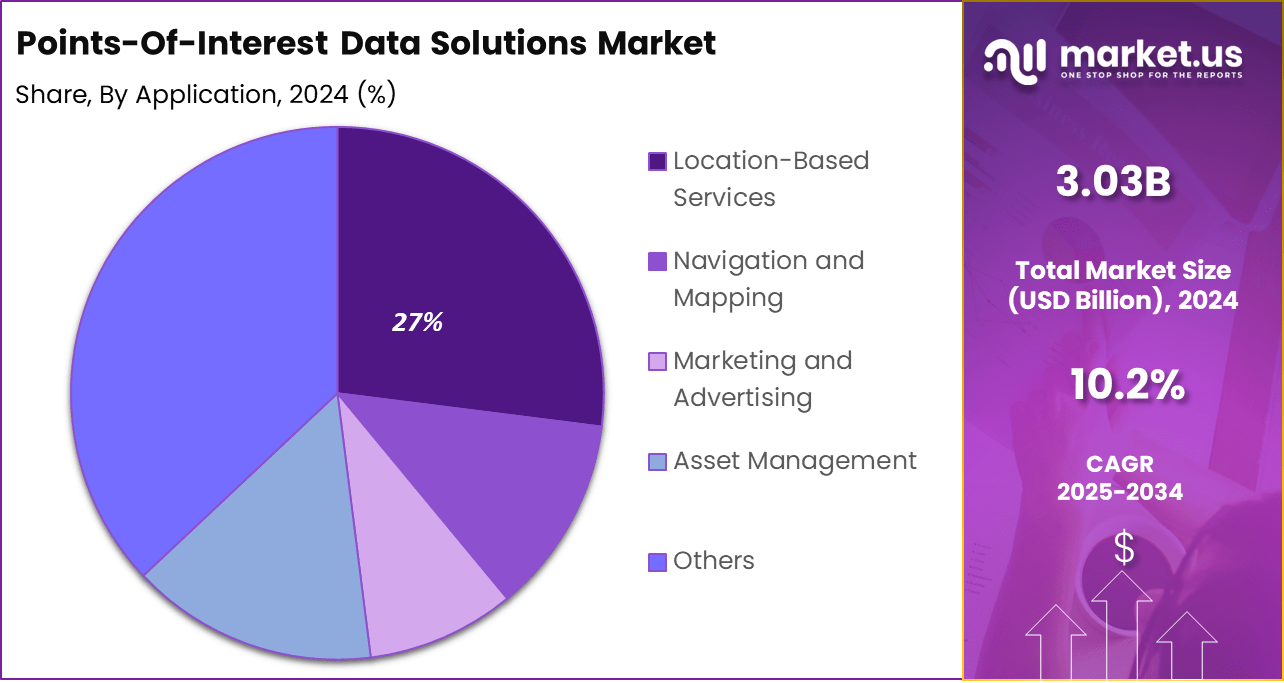
In 2024, the Location-Based Services segment held a dominant market position, capturing a 27% share of the Global Points-Of-Interest (POI) Data Solutions Market. This sector’s growth can be attributed primarily to the rapid proliferation of smartphones and mobile devices, which demand precise, real-time POI information for navigation, mapping, and tailored marketing.
The use of location-based services is increasingly being utilized by businesses in retail, transportation, and tourism to enhance user experience, streamline operations, or offer targeted content, leading to significant growth in this application sector.
For instance, in March 2025, Esri recently introduced the ArcGIS Platform Places Service, a powerful tool that integrates places data into applications, enabling businesses and developers to enhance their location-based services. This service provides seamless access to high-quality Points-of-Interest (POI) data, allowing for the development of more dynamic, location-aware apps.
End-User Industry Analysis
In 2024, The Automotive & Transportation segment held a dominant market position, capturing a 29% share of the Global Points-Of-Interest (POI) Data Solutions Market. Due to the increasing use of POI information in navigation systems, on-board entertainment, and route planning in both private and commercial vehicles, this prevalence is at its height.
The need for self-driving cars, intelligent traffic control, and instantaneous location monitoring is heightened by the importance of precise POI data in enhancing driver experience, safety, or transportation system operational effectiveness.
For Instance, in April 2025, HERE Technologies showcased its advanced Software-Defined Vehicle (SDV) solutions at the Auto Shanghai 2025 event, marking a significant milestone in its collaboration with Chinese automakers. By providing high-precision mapping and location services tailored to electric and autonomous vehicles, HERE aims to revolutionize the connected vehicle ecosystem.
Key Market Segments
By Component
Software
Services
By Application
Location-Based Services
Navigation and Mapping
Marketing and Advertising
Asset Management
Others
By End-User Industry
Automotive & Transportation
Retail & E-commerce
Telecommunications
Travel and Hospitality
Others
Key Regions and Countries
North America
The US
Canada
Europe
Germany
France
The UK
Spain
Italy
Russia
Netherland
Rest of Europe
APAC
China
Japan
South Korea
India
Australia & New Zealand
ASEAN
Rest of APAC
Latin America
Brazil
Mexico
Rest of Latin America
Middle East & Africa
GCC Countries
South Africa
Rest of MEA
Drivers
Rising Demand for Location-Based Services
The increasing use of smartphones, wearable technology, and connected devices is causing a surge in demand for real-time and accurate point of interest data. In sectors such as retail, transportation, logistics, and digital advertising, location data is being increasingly used to provide tailored, context-based services.
Location-based services are now essential components of consumer navigation applications, searches for local businesses, ride-hailing services, and focused mobile advertising. For instance, in June 2025, the Maharashtra government’s initiative to geo-tag all public infrastructure projects with a unique ID exemplifies the rising demand for location-based services (LBS).
This move to digitally map assets such as hospitals, schools, and power stations with precise geospatial data reflects the growing reliance on POI data solutions for better planning, transparency, and resource management. By integrating this data into government platforms like PM Gati Shakti and Gram Manchitra, the initiative aims to optimize costs, avoid duplication, and streamline inter-departmental coordination.
Restraint
Data Privacy and Regulatory Hurdles
The implementation of data protection legislation such as the General Data Protection Regulation (GDPR) in Europe, the California Consumer Privacy Act (CCPA), and other international standards introduces significant operational limitations.
These laws restrict the ways in which POI data, particularly linked to user activity, is collected, managed, and stored. The consequences of non-compliance, which may result in monetary penalties and reputational damage, make data governance a top priority for POI service providers.
For instance, in August 2023, Xmap.ai discussed the growing challenges of data privacy and regulatory hurdles in the POI data industry. As laws like GDPR and CCPA continue to evolve, businesses collecting and sharing location-based data face increasing pressure to ensure compliance. The need to balance the use of real-time POI data for personalization and location-based services with strict privacy regulations has become a key concern for industry leaders.
Opportunities
Integration with Emerging Technologies
The integration of POI data with augmented reality (AR), the Internet of Things (IoT), and AI-driven analytics presents significant opportunities for improving user engagement and operational insights. POI data is crucial for navigational AR overlays, location-based IoT asset monitoring, and AI-optimized retail analytics.
The user experience is enhanced by these integrations, which also expose new revenue streams in sectors like tourism, smart retail, urban mobility, and industrial automation. For instance, in May 2024, Google unveiled new geospatial augmented reality (AR) features at the Google I/O 2024 event.
These enhancements aim to improve user interaction with the physical world through digital overlays, making navigation and location-based experiences more immersive. The new capabilities, designed to leverage real-time POI data, promise to revolutionize applications such as tourism, retail, and urban exploration, further cementing Google’s position as a leader in AR and location-based technologies.
Challenges
Data Quality and Accuracy
Maintaining the integrity of POI databases is inherently complex. Fixed datasets become outdated as cities, commercial listings, and communal areas experience rapid changes. Errors or stale POI data can harm user confidence, undermine service standards, and restrict future analytics and applications. Maintaining consistent formats and reconciling sources poses a significant technical difficulty across the dispersed POI supply chain.
For instance, In June 2025, Trimble Applanix introduced advanced GPS and IMU solutions to tackle data quality and accuracy issues in mobile mapping and POI data. These technologies enable precise positioning and mapping, addressing challenges of keeping POI databases current in dynamic environments with frequent changes in locations and infrastructure.
Latest Trends
The integration of POI data with Internet of Things (IoT) technologies is a significant advancement in smart city development. The integration of IoT-supported infrastructure with real-time POI data can aid municipalities in improving critical urban systems such as traffic management, parking enforcement, and public transit.
The collaboration improves efficiency, reduces traffic congestion, and enhances urban living. For instance, in December 2024, Mapbox released its Year-in-Review, reflecting on significant developments and innovations in its mapping and location-based services.
The company highlighted the launch of new AI-powered navigation features, including MapGPT – an intuitive voice assistant – and Mapbox for EV, an intelligent route planner designed specifically for electric vehicles. These advancements underscore Mapbox’s commitment to pushing the boundaries of geospatial technology and real-time location services, reinforcing its leadership in the industry.
Key Players Analysis
Foursquare Labs Inc., Google LLC, and HERE Technologies have been leading the Points-Of-Interest (POI) data solutions market by offering highly accurate and dynamic location datasets. These companies invest significantly in real-time data analytics and AI integration to enhance the precision of location-based services. Their focus on geospatial intelligence and targeted advertising enhances enterprise customer engagement and operational insights.
TomTom NV, SafeGraph, and Mapbox Inc. are actively expanding their POI data offerings to support navigation, mobility, and retail analytics. These players prioritize partnerships with app developers and logistics firms to enhance delivery optimization and foot traffic analysis. Continuous efforts to improve data freshness and scalability are observed, enabling clients to access actionable intelligence for strategic decision-making and personalized customer experiences in competitive environments.
Precisely, OpenStreetMap, PlaceIQ, CARTO, and other emerging players are contributing to market diversification through customizable POI datasets and open-source platforms. They emphasize cost-effective and flexible solutions for SMEs and public sector organizations. Innovations in spatial data visualization, crowd-sourced mapping, and contextual insights are driving adoption.
Top Key Players in the Market
Foursquare Labs Inc.
HERE Technologies
Google LLC
TomTom NV
SafeGraph
Mapbox Inc.
Precisely
OpenStreetMap
PlaceIQ
CARTO
Others
Recent Developments
In February 2025, DataPlor released a comprehensive foot traffic analysis highlighting trends among America’s top fast food restaurants. By leveraging Points-of-Interest (POI) data solutions, the analysis revealed valuable insights into customer behavior, including peak traffic times, popular locations, and regional preferences.
In December 2024, TomTom released its end-of-year review, highlighting key advancements and milestones in its mapping and navigation solutions. The company showcased its expanded POI data coverage, enhanced real-time traffic information, and new features designed to support autonomous driving and electric vehicle (EV) applications.