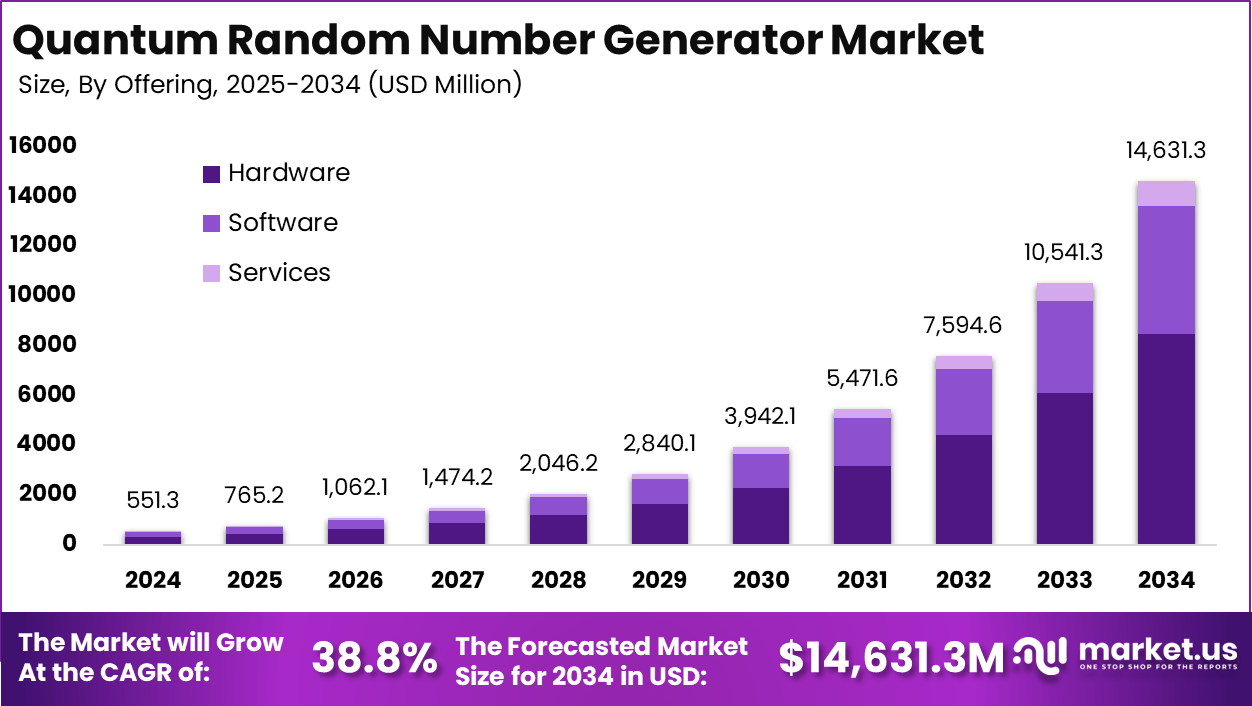
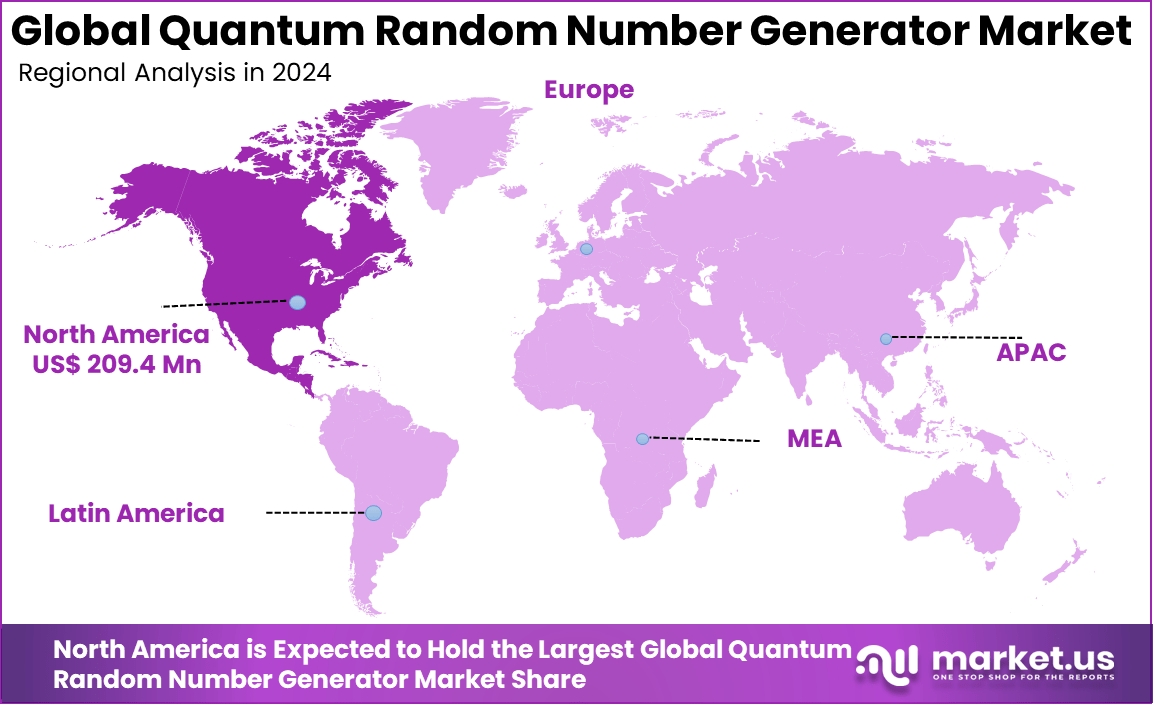
The Global Quantum Random Number Generator Market size is expected to be worth around USD 14,631.3 Million by 2034, from USD 551.3 million in 2024, growing at a CAGR of 38.8% during the forecast period from 2025 to 2034. In 2024, North America held a dominant market position, capturing more than a38% share, holding USD 209.4 million in revenue.
The Quantum Random Number Generator (QRNG) market represents a growing segment within the cryptography and cybersecurity landscape. QRNGs are devices that use inherent quantum mechanical phenomena, such as photon behavior, to generate truly random numbers. These numbers are critical for applications in secure communications, cryptographic key generation, and simulation.
The top driving factors for QRNG market growth stem from a growing awareness of quantum computing’s potential to compromise existing cryptographic protocols. As data breaches and cyberattacks become more sophisticated, critical industries are accelerating the adoption of quantum-secure systems. QRNGs offer a foundational layer of defense by generating unrepeatable keys for encryption and authentication.
Scope and Forecast
In 2024, North America held a dominant market position in the Global Quantum Random Number Generator (QRNG) Market, capturing more than a 38% share, holding USD 209.4 million in revenue. This market is driven by high demand for advanced cybersecurity solutions and a strong technology infrastructure.
The rapid adoption of QRNG has been facilitated by significant investments in quantum research and the participation of prominent companies in sectors such as semiconductors, defense, and finance. Due to its focus on achieving quantum supremacy, adherence to regulatory requirements, and a rapid increase in the adoption of advanced security measures.
For instance, In December 2023, Qrypt partnered with Los Alamos National Laboratory to advance Quantum Random Number Generation (QRNG) technology. This collaboration aims to strengthen data protection by combining Los Alamos’ research expertise with Qrypt’s quantum encryption capabilities.
Offering Analysis
In 2024, the hardware segment held a leading position in the quantum random number generator (QRNG) market, contributing approximately 58% share. This dominance is attributed to the growing reliance on dedicated physical devices capable of generating truly unpredictable numbers using quantum phenomena.
Hardware-based QRNGs are preferred for their higher security, better performance, and independence from conventional computational limitations. The rising adoption of quantum-secure encryption in sensitive applications has reinforced the demand for robust and tamper-proof hardware solutions.
For Instance, in December 2024, Synergy Quantum announced that it would provide the world’s most advanced Quantum Random Number Generator (QRNG) to the Centre for Development of Advanced Computing (C-DAC) in India. This hardware-based QRNG solution will play a key role in advancing India’s quantum readiness.
Organization Size Analysis
Large enterprises accounted for nearly 67% of the QRNG market in 2024, making them the leading organizational segment. The prominence of this segment can be attributed to the significant investments large enterprises are making in advanced cryptography and secure communication.
These organizations, particularly in sectors dealing with critical infrastructure and high-value data, have shown a strong inclination toward integrating quantum-grade randomness to fortify their security frameworks. The availability of resources and expertise in these enterprises has supported faster adoption of QRNG technologies.
For instance, in July 2025, Krown Technologies and Quantum Emotion partnered with Esposito Intellectual Enterprises to accelerate the commercialization of quantum-secure wallets, branded as Qastle. This collaboration aims to enhance the security of digital wallets with cutting-edge quantum technologies, targeting large enterprises that require robust solutions to safeguard sensitive data and financial transactions.
Vertical Analysis
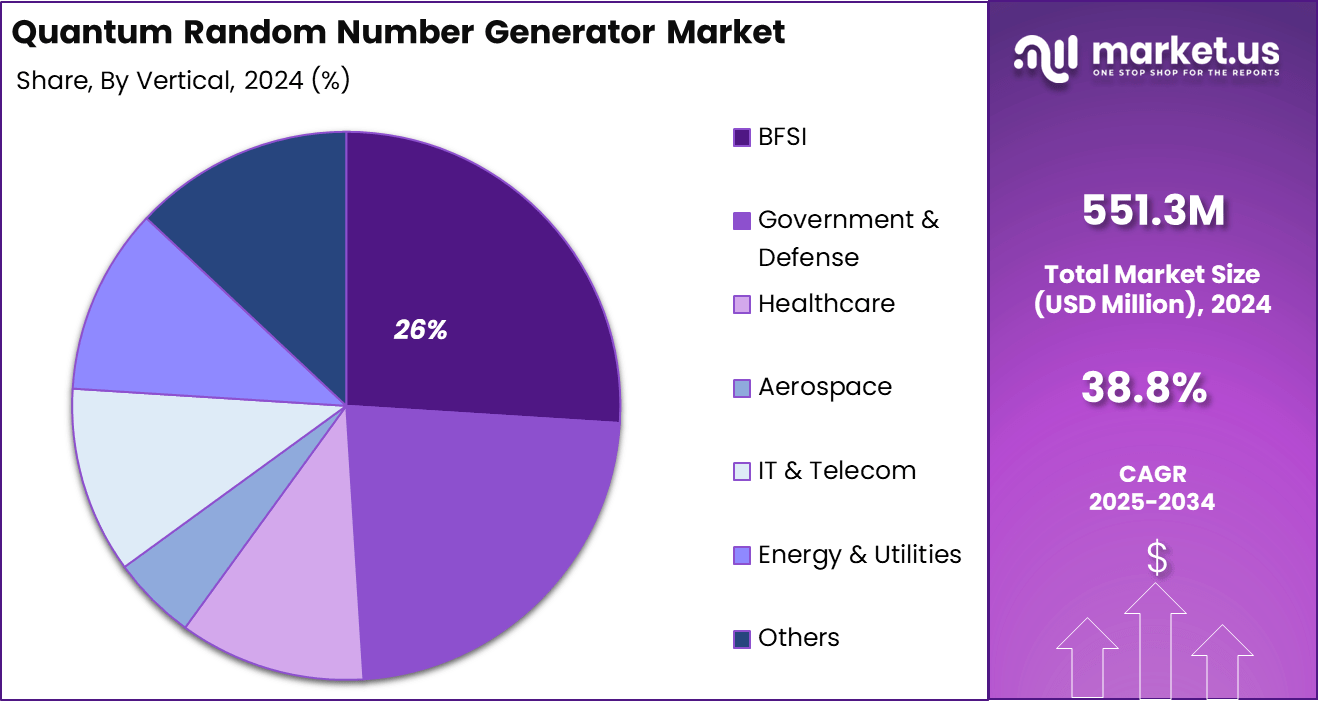
The BFSI sector led the vertical segmentation, representing about 26% share in 2024. The leadership of the BFSI sector is driven by its heightened sensitivity to data privacy, transaction integrity, and regulatory compliance.
Quantum random number generators are increasingly deployed in financial services to enhance encryption protocols, safeguard digital transactions, and mitigate risks from emerging cyber threats. As financial institutions continue to prioritize quantum-safe strategies, QRNGs have become a vital component in strengthening their digital security posture.
For Instance, in July 2025, Qnu Labs launched two new products, QConnect and QVerse, to strengthen quantum-safe cybersecurity. These innovations are designed to provide enhanced protection against the evolving threats posed by quantum computing, particularly in sectors like BFSI (Banking, Financial Services, and Insurance).
Key Market Segments
By Offering
Hardware
Chips
USD Devices
Others
Software
Services
By Organization Size
Small & Medium Enterprises
Large Enterprises
By Vertical
BFSI
Government & Defense
Healthcare
Aerospace
IT & Telecom
Energy & Utilities
Others
Key Regions and Countries
North America
US
Canada
Europe
Germany
France
The UK
Spain
Italy
Russia
Netherlands
Rest of Europe
Asia Pacific
China
Japan
South Korea
India
Australia
Singapore
Thailand
Vietnam
Rest of Latin America
Latin America
Brazil
Mexico
Rest of Latin America
Middle East & Africa
South Africa
Saudi Arabia
UAE
Rest of MEA
Drivers
Rising Demand for Cybersecurity and Encryption
The surge in cyberattacks and data breaches has heightened the demand for more secure encryption methods. Quantum Random Number Generators (QRNGs) offer unparalleled unpredictability, providing strong protection for confidential data.
By producing genuinely random numbers, QRNGs enhance the production of cryptographic keys, providing improved security in finance, online commerce, and national security. As data privacy worries grow, organizations are increasingly relying on QRNGs to protect their information from new cyber threats.
For instance, in December 2024, Synergy Quantum provided the world’s most advanced QRNG to the C-DAC in India, a step that aligns with the rising demand for enhanced cybersecurity and encryption. As cyber threats continue to evolve, traditional encryption methods are increasingly vulnerable, necessitating the integration of more secure and unpredictable solutions.
Restraint
Technological Complexity and Integration Issues
Quantum technology remains intricate and requires specialized expertise for successful integration into existing systems. The implementation of quantum random number generators (QRNGs) necessitates a thorough understanding of quantum mechanics, which poses ambiguity for organizations interested in utilizing them.
Technical personnel may face difficulties due to the challenging learning curve and extensive training required, which can impede their acceptance. Furthermore, the unique setup required for QRNG systems may impede entry to many businesses and delay market access.
For instance, in January 2025, Palo Alto Networks announced the launch of a QRNG Open API to promote quantum-safe cybersecurity, aiming to integrate Quantum Random Number Generators (QRNGs) into enterprise security frameworks. However, the technological complexity and integration challenges associated with QRNGs remain a restraint.
Opportunities
Expansion into Consumer Electronics and Cloud Solutions
Quantum-based random number generators, such as smartphones and cloud-driven systems, are becoming more prevalent in consumer electronics, providing more secure, quantum-powered randomness generators (QRNGs).
The use of QRNGs on everyday devices like mobiles can enhance the security of personal data by providing advanced encryption capabilities. With the rise of cloud-based QRNG offerings, it becomes less necessary to purchase specialized hardware, making it easier for individuals and companies to experience quantum randomness without incurring high initial costs.
For instance, in September 2024, SK Telecom partnered with ID Quantique to integrate advanced Quantum Random Number Generator (QRNG) technology into the Samsung Galaxy Quantum 5 smartphone. This collaboration aims to enhance the security of mobile devices by providing true quantum randomness for encryption processes, making it more difficult for cybercriminals to predict or replicate encryption keys.
Challenges
Competition from Classical RNG Technologies
Although QRNGs have security benefits, they are still favored over traditional pseudo-random number generators due to their low cost and easy deployment. PRNGs are widely used in many applications, providing a straightforward means of generating random numbers.
The adoption of QRNGs should be accompanied by noticeable improvements in security and efficiency, as conventional RNG technology still meets the needs of many applications, making it more challenging to transition to this method.
For instance, in June 2025, the National Institute of Standards and Technology (NIST), along with its partners, announced advancements in using quantum mechanics to generate factory-grade random numbers, providing a more secure alternative to classical Random Number Generators (RNGs).
Key Players Analysis
ID Quantique, QuintessenceLabs, and Quantum Dice lead the quantum random number generator market by offering secure, high-performance solutions for critical sectors like defense, finance, and government. They focus on reliability, hardware integration, and miniaturization to meet rising cybersecurity needs. Their technologies enhance encryption by delivering truly random numbers.
Qrypt, Crypta Labs, and QuantumCtek develop scalable and portable QRNG solutions tailored for enterprise, IoT, and cloud security applications. They emphasize low power use, easy integration, and broader accessibility through partnerships and data center deployments. Their strategies align with growing demand for quantum-safe security.
MagiQ Technologies, Qutools, Nucrypt, NXP Semiconductors, and Toshiba offer both specialized and mainstream QRNG products. While MagiQ and Qutools target research and niche markets, NXP and Toshiba embed QRNGs in semiconductors and consumer devices. Other players focus on innovative designs and regional growth to expand quantum cryptography adoption worldwide.
Top Key Players in the Market
ID Quantique
QuintessenceLabs
Quantum Dice
Qrypt
Crypta Labs
QuantumCtek
MagiQ Technologies
Qutools
Nucrypt
NXP Semiconductors
Toshiba
Others
Recent Developments
In January 2025, ID Quantique partnered with Elmos Semiconductor to develop the world’s smallest Quantum Random Number Generator (QRNG) solution. This collaboration aims to create a compact and highly efficient QRNG module, measuring just 2mm x 2mm.
In November 2024, QuintessenceLabs announced a partnership with Equinix to protect organizations in the quantum era. This collaboration involves deploying QuintessenceLabs’ Trusted Security Foundation® key and policy manager appliance within Equinix’s data centers.