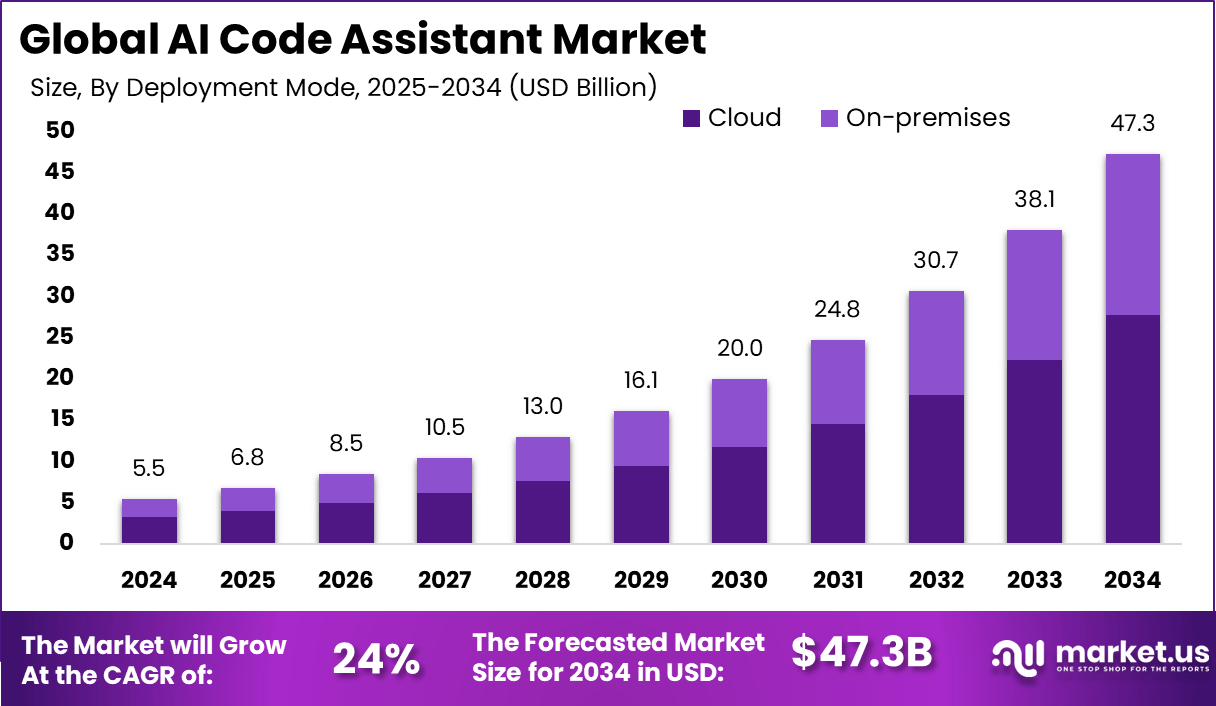
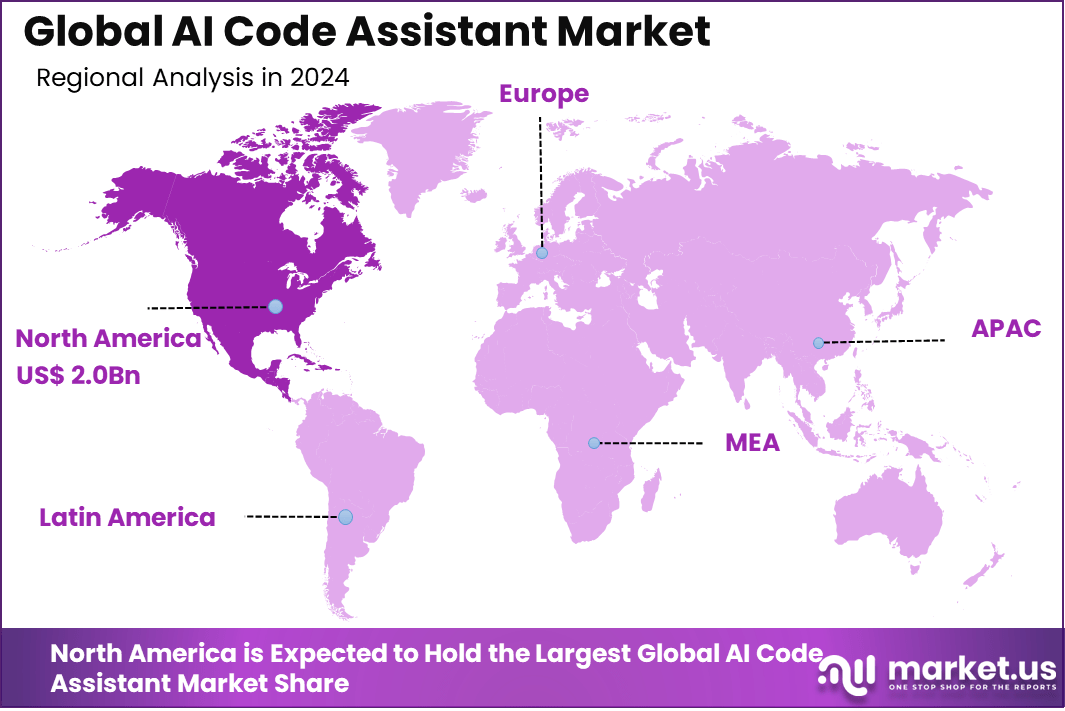
The Global AI Code Assistant Market size is expected to be worth around USD 47.3 Billion By 2034, from USD 5.5 billion in 2024, growing at a CAGR of 24% during the forecast period from 2025 to 2034. In 2024, North America held a dominant market position, capturing more than a 38% share, holding USD 2.0 Billion revenue.
The AI Code Assistant market is defined by technologies that assist software development through features such as code generation, debugging, autocompletion, and natural language explanations. These smart tools are built on advanced AI and machine learning models trained on large codebases. Their primary role is to streamline development workflows, improve code quality, and reduce manual effort, enabling developers to achieve more with less time.
As per the latest insights from codesignal, 81% of surveyed developers now use AI-powered coding assistants. Developers use AI-powered coding assistants to learn new tech skills. ChatGPT is the most popular assistant among developers. 49% of developers use AI-powered coding assistants daily.
Market Scope and Forecast
In 2024, North America held a dominant market position, capturing more than a 38% share, holding USD 2.0 billion in revenue. This leadership can be attributed to the widespread integration of AI technologies across software engineering workflows in the region.
A well-established digital infrastructure, combined with early-stage AI adoption by enterprises and startups, has accelerated the deployment of AI code assistants among developers. The presence of highly funded AI research institutions and supportive policy frameworks has further enhanced the speed of innovation, enabling continuous upgrades in code generation and autocompletion capabilities.
The region’s dominance is also driven by the concentration of leading tech companies and cloud providers actively investing in developer productivity tools. A high rate of open-source project contributions and large developer communities has fueled the testing and refinement of AI code assistants.
Moreover, increasing demand for DevOps automation and real-time coding suggestions in agile development environments has encouraged broader acceptance of these tools across sectors such as fintech, e-commerce, and cybersecurity. As a result, North America continues to act as a first-mover in scaling the commercial adoption of AI-driven development environments.
By Function Analysis
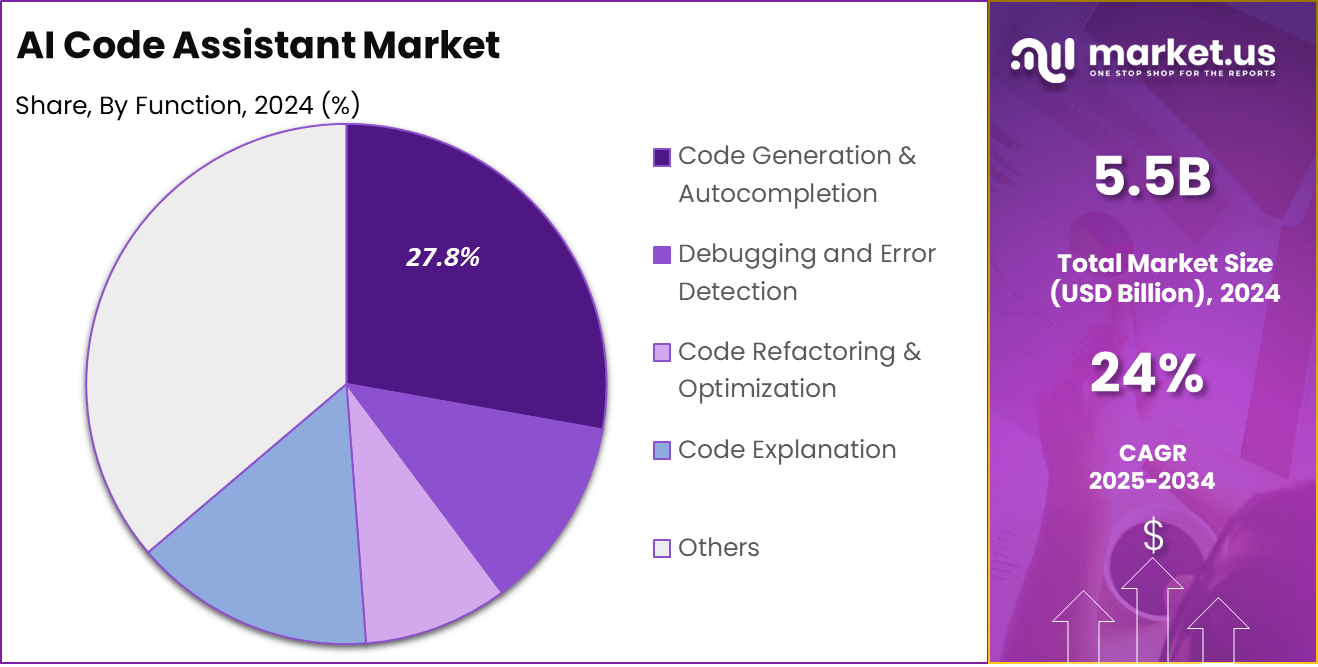
In 2024, the Code Generation & Autocompletion segment held a dominant market position, capturing more than a 27.8% share. This leadership can be attributed to its critical role in improving developer efficiency by providing real-time suggestions and auto-completing code based on context. These tools significantly reduce manual typing, accelerate prototyping, and help maintain code quality by minimizing syntactic errors.
As programming complexity increases, this function is being widely adopted to streamline workflows, especially among individual developers and fast-scaling teams. The segment’s dominance is further supported by its strong integration within popular integrated development environments (IDEs) and version control platforms.
Developers benefit from faster turnaround times and reduced debugging efforts. Small and medium enterprises, in particular, are leveraging these tools to optimize productivity without expanding team sizes. The increasing availability of cloud-based coding assistants has also played a pivotal role in extending this function’s reach, enabling seamless usage across devices and collaboration platforms.
By Deployment Analysis
In 2024, Cloud segment held a dominant market position, capturing more than a 58.7% share. This supremacy can be attributed to its unparalleled scalability and flexibility, which align well with the growing requirements of AI code assistant platforms.
Cloud-based deployment enables seamless resource scaling, on-demand infrastructure, and collaborative environments – features especially vital for generative AI models that demand substantial compute power and continuous updates. The cloud segment’s leadership is also driven by its operational advantages.
By adopting a pay-as-you-go expenditure model, organizations benefit from reduced upfront capital requirements and enhanced cost transparency. Development teams and remote collaborators gain the ability to access advanced coding tools anytime, anywhere on various devices.
Cloud delivery further ensures rapid integration of AI features, such as real-time code suggestions, versioned deployments, and automatic updates. These technical and operational conveniences account for cloud’s position as the preferred deployment model among small and medium enterprises as well as individual developers.
By Application Analysis
In 2024, Individual Developers & Freelancers segment held a dominant market position, capturing more than a 38.4% share. This leadership reflects its strong alignment with the unique needs of solo practitioners, hobbyists, and independent contributors who prioritize rapid feedback, cost-effective tools, and seamless onboarding.
These users benefit from intuitive, low-barrier interfaces and accessible pricing tiers, enabling them to adopt AI-powered coding assistants swiftly and effectively. As reported, solo developers have long embraced generative coding tools for tasks like scaffolding, prototyping, and education, which enhances their productivity and accelerates time-to-insight.
The prominence of this segment can also be attributed to the individualized nature of freelance programming workflows. Without rigid team structures or enterprise protocols, freelancers can experiment with diverse AI features – such as context-aware suggestions and personal code libraries – without extensive integration hurdles.
The immediate benefits are reflected in reduced development time and improved code quality, satisfying both client expectations and project timelines. Moreover, the availability of trial modes and flexible subscriptions ensures that developers can scale tool usage without worrying about long-term commitments.
Key Market Segments
By Function
Code Generation & Autocompletion
Debugging and Error Detection
Code Refactoring & Optimization
Code Explanation
Others
By Deployment
Cloud
On-premises
By Application
Individual Developers & Freelancers
Small and Medium-sized Enterprises (SMEs)
Large Enterprises
Educational Institutions & Students
Others
Key Regions and Countries
North America
US
Canada
Europe
Germany
France
The UK
Spain
Italy
Russia
Netherlands
Rest of Europe
Asia Pacific
China
Japan
South Korea
India
Australia
Singapore
Thailand
Vietnam
Rest of Latin America
Latin America
Brazil
Mexico
Rest of Latin America
Middle East & Africa
South Africa
Saudi Arabia
UAE
Rest of MEA
Emerging Trend
Shift Toward Multi-Modal, Context-Aware AI Code Assistants
A prominent trend in the AI Code Assistant market is the advancement of multi-modal and context-aware systems. These tools are no longer limited to simple autocompletions but are increasingly trained to understand a developer’s intent through natural language prompts, code history, documentation, and project architecture.
By interpreting context from various inputs, modern assistants are now capable of delivering higher-quality suggestions that closely match what a human developer would write. This trend is further reinforced by the integration of real-time collaboration features and adaptive learning.
AI assistants are being designed to learn continuously from user behavior, refining recommendations as they interact with different environments. The movement toward this dynamic, context-sensitive model is expected to transform the role of AI tools from passive helpers into active collaborators in the software development lifecycle.
Driver
Growing Demand for Faster and Scalable Software Development
The increasing pressure to reduce time-to-market is a major driver fueling the adoption of AI Code Assistants. Enterprises and startups alike are seeking ways to accelerate product development while maintaining code quality. AI tools assist by generating boilerplate code, testing scripts, and even entire modules, thereby allowing developers to focus on strategic tasks such as architecture and user experience.
Additionally, as businesses scale, the need for consistency across teams becomes crucial. AI Code Assistants help standardize code practices across distributed developer teams by adhering to coding guidelines and style preferences. This automation not only improves efficiency but also reduces human error, making the software development process more reliable and predictable at scale.
Restraint
Risk of Code Vulnerabilities and Overdependence
Despite their growing utility, AI Code Assistants present a significant risk related to the quality and security of the code they generate. In many cases, the AI models are trained on public datasets that include poor coding practices, outdated libraries, or unpatched security flaws. When developers unknowingly integrate these outputs, it can introduce vulnerabilities into production systems without adequate review.
Moreover, the ease of code generation can lead to over-reliance, particularly among junior developers. With repeated use, developers may skip foundational learning and critical thinking steps, assuming that the AI’s suggestions are always correct. This creates a long-term challenge for maintaining high-caliber engineering teams and sustaining innovation that demands deep technical skills.
Market Opportunity
Rise of Prompt Engineering and Developer Enablement
An emerging opportunity lies in the professionalization of prompt engineering for AI Code Assistants. As the accuracy of AI tools depends on the clarity and structure of user prompts, teams are investing in training developers to write more effective prompts. This new skillset is becoming essential, bridging the gap between what the AI can generate and what the developer intends to build.
This opportunity also expands into developer onboarding and upskilling. Organizations are using AI tools not just to accelerate coding but also to educate new team members. By offering suggestions, explanations, and real-time learning support, these assistants are serving as built-in mentors, reducing ramp-up time and empowering non-traditional or self-taught developers to contribute more effectively.
Challenge
Unregulated Usage and IP Uncertainty
One of the most pressing challenges is the lack of clear governance over AI-generated code. In many organizations, developers are using AI tools without IT approval, creating security, licensing, and compliance risks. These unsanctioned deployments often go unmonitored, resulting in shadow IT that is difficult to manage and audit.
Further complicating the issue is the ambiguity around intellectual property ownership. When AI generates code based on pre-trained models, it is unclear whether the output is entirely original or derivative. This raises legal concerns about who owns the code and whether it can be commercially used without infringing on third-party rights. Without clear regulations, businesses face significant legal and operational uncertainties.
Key Player Analysis
Amazon Web Services (AWS), Github, and Google LLC are key players in the AI code assistant market, leveraging strong cloud platforms and advanced AI tools to streamline coding workflows. Their focus on integrating AI into existing developer environments and supporting enterprise-scale deployments has strengthened their market presence.
JetBrains, GitLab, and Replit are notable for offering specialized and user-focused solutions. JetBrains integrates AI into its professional IDEs, while GitLab enhances its DevOps platform with AI-driven code suggestions. Replit emphasizes real-time, collaborative coding with AI support, appealing to diverse developer segments.
Emerging players like CodeComplete, CodiumAI, Sourcegraph, and Tabnine are growing by delivering niche, innovative offerings. CodeComplete and CodiumAI focus on code testing and reliability, while Sourcegraph provides intelligent code navigation. Tabnine specializes in predictive code completion with machine learning. These firms cater to smaller teams and freelancers through affordable, targeted solutions, and ongoing competition from other regional players supports market diversification.
Top Key Players Covered
Amazon Web Services (AWS)
CodeComplete
CodiumAI
Github
GitLab
Google LLC
JetBrains
Replit
Sourcegraph
Tabnine
Others
Recent Developments
In August 2024, Harness expanded its strategic partnership with Google Cloud, introducing new integrations built on generative AI to enhance the software development lifecycle. This collaboration aims to improve the developer experience by embedding AI-driven support across engineering workflows, enabling faster, smarter, and more intuitive code delivery processes.
Earlier, in October 2023, IBM introduced Watsonx Code Assistant, a generative AI tool designed to assist enterprise developers and IT teams in writing code more efficiently using natural language prompts. Powered by IBM’s Granite foundation models, the solution supports trusted and secure code generation on the Watsonx platform, reinforcing IBM’s focus on compliant and scalable AI integration in enterprise environments.