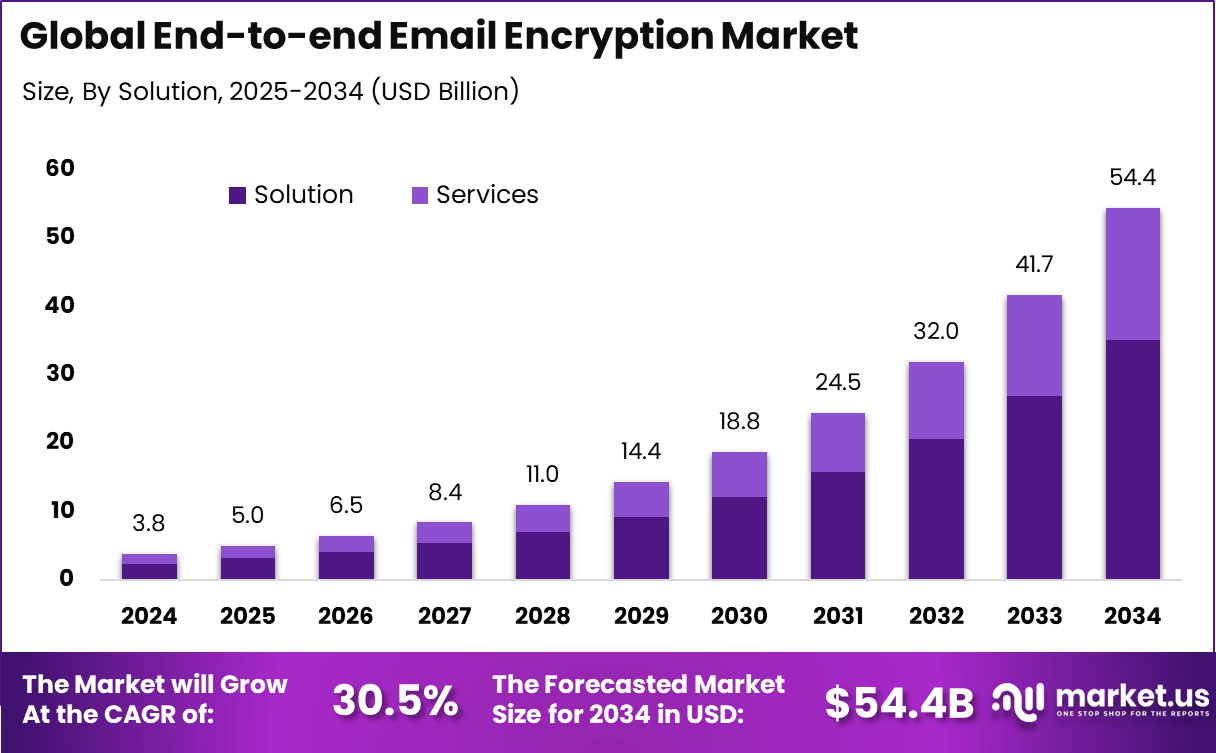
The Global End-to-end Email Encryption Market size is expected to be worth around USD 54.4 billion by 2034, from USD 3.8 billion in 2024, growing at a CAGR of 30.5% during the forecast period from 2025 to 2034. In 2024, North America held a dominant market position, capturing more than a37.6% share, holding USD 1.42 billion in revenue.
End-to-end email encryption stands as a critical safeguard in the global landscape of digital communication. It works by encrypting the content of emails on the sender’s device, ensuring it remains unreadable to all except the designated recipient. This approach to security responds to growing concerns about privacy and cyber threats, making encrypted communication an essential best practice for organizations of all sizes.
A major factor fueling the adoption of end-to-end email encryption is the sharp increase in sophisticated cyber threats. These range from spear-phishing and ransomware to complex man-in-the-middle attacks. Such incidents have heightened the risk awareness of organizations, prompting swift action towards adopting advanced encryption technologies.
For instance, In April 2025, Google introduced end-to-end encryption in Gmail for all Workspace Enterprise users, securing email content and attachments so only intended recipients can access them. This step meets growing demand for privacy-focused communication and reinforces Gmail’s standing as a secure, enterprise-grade email service.
Scope and Forecast
In 2024, North America held a dominant market position in the Global End-to-end Email Encryption Market, capturing more than a 37.6% share, holding USD 1.42 billion in revenue. Due to a robust cybersecurity system, early technological advancements, and stringent regulations like HIPAA, GLBA, or CCPA, North America retained resolute positions in the global end-to-end email encryption market.
High levels of cyberattacks and growing public concern about data privacy have led to the extensive use of sophisticated encryption technologies in this area. Also, the presence of prominent tech firms and substantial spending on cloud solutions have bolstered North America’s role in this evolving security environment.
For instance, in February 2025, Check Point Software Technologies and Wiz formed a strategic partnership to offer end-to-end cloud security solutions. This collaboration reinforces North America’s leadership in cloud security by enhancing data protection and providing robust email encryption to safeguard communications against evolving cyber threats.
Solution Analysis
In 2024, Solution segment held a dominant market position, capturing a 64.5% share of the Global End-to-end Email Encryption Market. This dominance is due to a growing demand for combined encryption methods that balance both high security and ease of use, as well as the functionality of today’s email systems.
Companies are increasingly opting for automated key management, AI-controlled threat detection, and flexibility with cloud and mobile computing. Additionally, rising regulatory compliance demands and the need to safeguard confidential communications from sophisticated cyber threats are resulting in more widespread adoption of end-to-end email encryption across various industries.
For Instance, in June 2025, Forrester released its latest Wave report on Email Messaging and Collaboration Security Solutions, highlighting key players advancing end-to-end encryption capabilities. The report emphasized the growing need for integrated security frameworks that combine email protection, encryption, and collaboration tools. Vendors were evaluated on criteria such as encryption strength, ease of deployment, and regulatory compliance.
Deployment Mode Analysis
In 2024, the On-Premises segment held a dominant market position, capturing a 58.6% share of the Global End-to-end Email Encryption Market. On-premise deployment has become necessary due to the need for organizations with high data security and compliance standards, particularly in government, finance, and healthcare sectors that require complete control over their encryption frameworks.
On-premises solutions enable greater customization, direct management of encryption keys, and adherence to regulatory standards that limit cloud data storage. In addition, concerns about data sovereignty and the need to comply with legacy IT systems have fueled the adoption of internal encryption implementations.
For instance, in April 2022, Tresorit, known for its end-to-end encrypted cloud services, expanded its offerings to include on-premises end-to-end email encryption solutions tailored for enterprise clients. This move allowed organizations to retain full control over their encryption infrastructure and data, addressing concerns related to data sovereignty and regulatory compliance.
Enterprise Size Analysis
In 2024, The Large Enterprises segment held a dominant market position, capturing a 70.8% share of the Global End-to-end Email Encryption Market. This dominance is due to the increasing need for major corporations to safeguard significant amounts of sensitive information across multiple departments and globally.
Due to the increased vulnerability of cyber attacks and strict legal requirements, these companies must now prioritize investing in scalable, high-efficiency encryption systems. With their ample IT budgets and infrastructure, they can effortlessly integrate sophisticated end-to–end encryption approaches to guarantee complete email security in line with the operational complexity of their organizations.
For Instance, In November 2024, Echoworx introduced a Google Add-On to enhance email encryption for enterprise Gmail users. Designed for seamless integration with Google Workspace, it enables secure communication while maintaining workflow efficiency. This launch addresses corporate compliance and data protection needs, strengthening Echoworx’s role as a provider of scalable and user-friendly encryption solutions.
Vertical Analysis
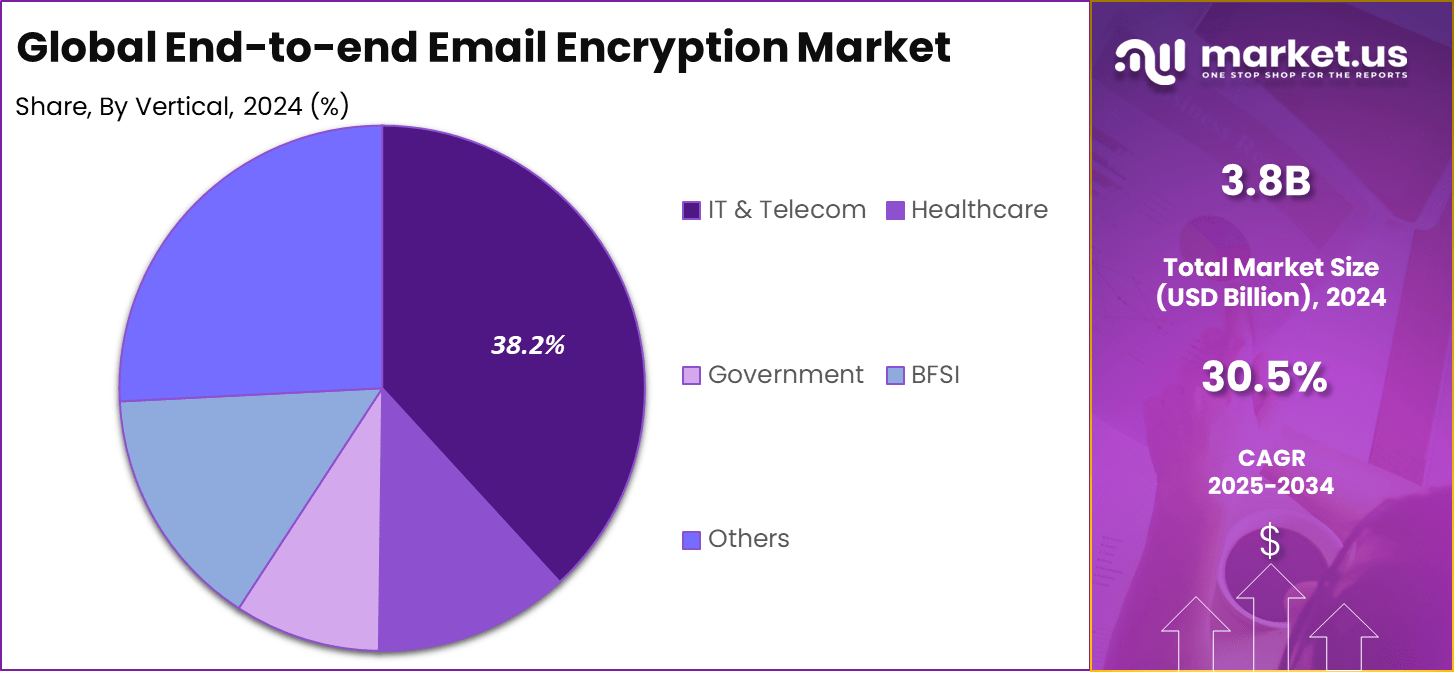
In 2024, The IT & Telecom segment held a dominant market position, capturing a 38.2% share of the Global End-to-end Email Encryption Market. This dominance is due to the industry’s high data sensitivity, frequent cyber threats, and reliance on secure digital communication.
As a technology-intensive sector, IT & Telecom firms handle large volumes of proprietary and client data, making robust email encryption essential. Additionally, the sector’s early adoption of advanced technologies and stringent data protection standards has further reinforced its leadership in implementing secure communication solutions.
For Instance, in December 2024, the U.S. Cybersecurity and Infrastructure Security Agency (CISA) urged telecom providers and government agencies to adopt Signal-like encrypted messaging and email solutions following a series of telecom-targeted cyberattacks. These incidents exposed vulnerabilities in traditional communication channels, reinforcing the need for end-to-end encryption to protect sensitive data.
Key Market Segments
By Solution
Solution
Services
Professional Services
Services
By Deployment Mode
Cloud-Based
On-Premises
By Enterprise Size
Large Enterprises
Small & Medium Enterprise Size
By Vertical
BFSI
Healthcare
Government
IT & Telecom
Others
Key Regions and Countries
North America
US
Canada
Europe
Germany
France
The UK
Spain
Italy
Russia
Netherlands
Rest of Europe
Asia Pacific
China
Japan
South Korea
India
Australia
Singapore
Thailand
Vietnam
Rest of Latin America
Latin America
Brazil
Mexico
Rest of Latin America
Middle East & Africa
South Africa
Saudi Arabia
UAE
Rest of MEA
Emerging Trend
Seamless, AI-Powered Encryption
The landscape of end-to-end email encryption is evolving quickly, with a major trend being the integration of artificial intelligence to simplify and strengthen email security. Organizations are now seeking to automate threat detection, risk assessment, and encryption deployment in real time, all without disrupting user experience.
The goal is to make encryption effortless, running quietly in the background so users don’t have to worry about technical hurdles or extra steps. This seamless approach, strengthened by AI, helps businesses keep up with new threats without any decrease in the speed or fluidity of their communication.
Key Driver
Escalating Cybersecurity Threats
A primary driver fueling the adoption of end-to-end email encryption is the sharp rise in cyber-attacks targeting email communication. As cybercriminals become more sophisticated and launch more frequent phishing and spoofing attempts, organizations feel increasing pressure to protect sensitive information shared over email.
Privacy regulations and a growing consensus on the importance of data security are boosting demand for reliable end-to-end encryption, ensuring that only the sender and intended recipient can read confidential emails. This heightened risk awareness and regulatory push give businesses a strong reason to prioritize advanced encryption solutions.
Notable Restraint
Implementation Complexity
While the benefits are clear, adopting end-to-end email encryption can be complicated, especially for organizations with limited IT expertise. Many businesses struggle with the process, which often involves managing encryption keys, coordinating system integration, and ensuring compatibility across different platforms or devices.
The need for both sender and receiver to use compatible encryption protocols, alongside potential recurring costs for maintenance and support, creates additional hurdles. This complexity can delay or even prevent some organizations from fully securing their email communication, particularly for those with older IT environments or smaller budgets.
Market Opportunity
Growth of Remote and Hybrid Work
One of the standout opportunities for end-to-end email encryption providers is the expansion of remote and hybrid work arrangements. As more employees connect from outside traditional office networks, companies are recognizing the need to secure communications that span multiple devices and locations.
This shift toward flexible work has increased the urgency to protect sensitive data against interception, making robust and user-friendly encryption solutions highly attractive. Providers that deliver intuitive, cloud-friendly encryption stand to benefit most from this transformation in how organizations work and communicate.
Major Challenge
Interoperability and Integration Gaps
Despite progress, a significant challenge remains in making end-to-end encryption solutions work smoothly across diverse email systems and IT setups. Compatibility issues frequently arise when different organizations use varying encryption tools or standards, frustrating users and IT teams alike.
Smaller businesses, in particular, can find it overwhelming to establish secure email protocols that also connect seamlessly with existing workflows and security measures. These gaps can lead to disruptions in communication, reduce productivity, and even open up new vulnerabilities if workarounds are used.
Key Players Analysis
ProtonMail, Zix Corporation, and Virtru lead the end-to-end email encryption market with privacy-focused and compliant solutions for healthcare, finance, and government sectors. Barracuda Networks and Proofpoint strengthen their positions by integrating encryption into comprehensive email security suites, offering scalability and ease of use for enterprises.
Egress, Fortinet, and Cisco deliver enterprise-grade encryption with centralized management and threat intelligence, while Trend Micro and Sophos blend encryption with broader email security to address evolving threats. Their innovation keeps them competitive among large organizations.
Echoworx, Tutanota, and Mailfence cater to SMEs and privacy-conscious users with affordable, user-friendly options. Hushmail, RMail, and NeoCertified offer niche, industry-specific solutions, while Posteo and PrivateMail appeal to ethical data users. Regional players add localized, tailored services, enriching global market diversity.
Top Key Players in the Market
ProtonMail
Zix Corporation
Virtru
Barracuda Networks
Proofpoint, Inc.
Egress
Fortinet
Cisco Systems, Inc.
Trend Micro
Sophos
Echoworx
Tutanota
Mailfence
Hushmail
RMail
NeoCertified
Posteo
PrivateMail
Others
Recent Developments
In July 2024, CryptPad gained attention for its innovative approach to secure digital collaboration by balancing accessibility with strong privacy protections. The platform offers end-to-end encrypted tools like document editing and file sharing without requiring user registration, ensuring anonymity and data sovereignty.
In July 2024, Proton introduced “Proton Scribe,” an encrypted AI writing assistant that enables premium users to compose secure emails directly on their devices. Designed with privacy in mind, Proton Scribe operates locally to ensure that user data remains protected, aligning with Proton’s broader mission to offer secure, privacy-first communication tools.