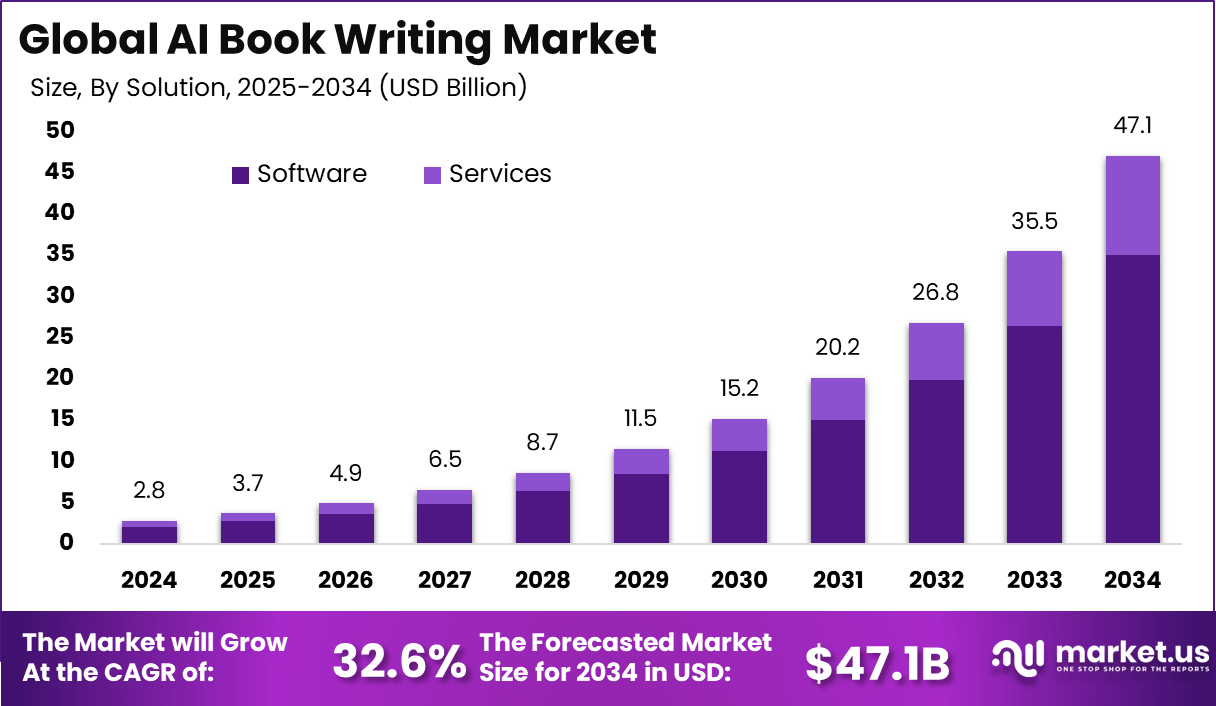
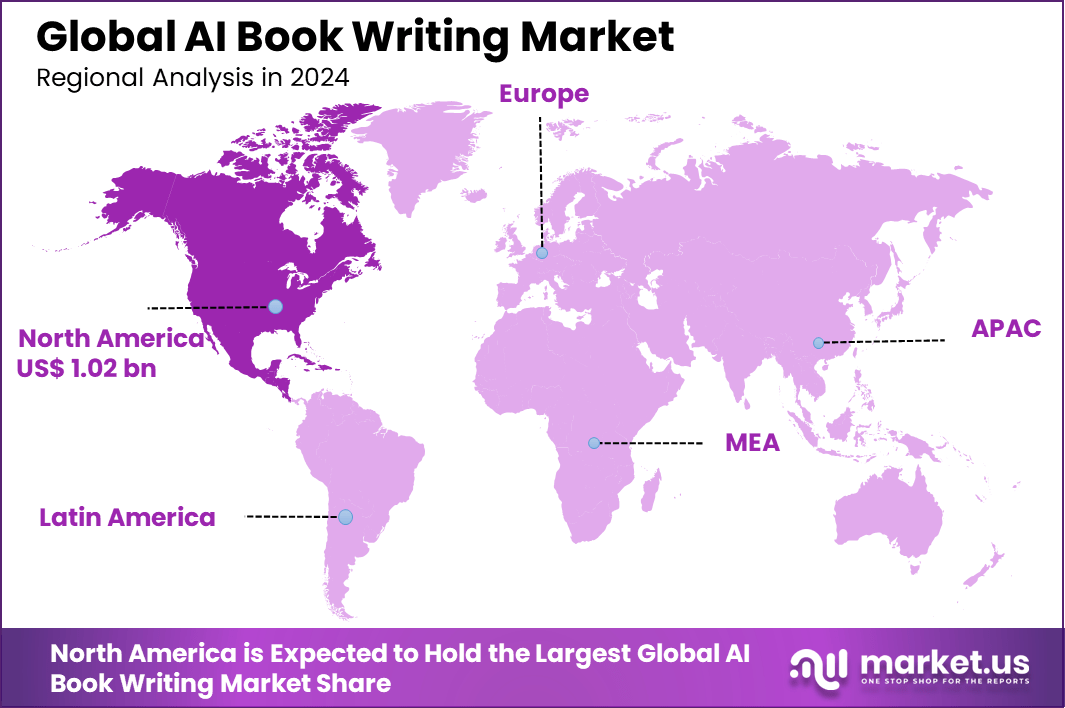
The Global AI Book Writing Market size is expected to be worth around USD 47.1 billion by 2034, from USD 2.8 billion in 2024, growing at a CAGR of 32.6% during the forecast period from 2025 to 2034. In 2024, North America held a dominant market position, capturing more than a36.7% share, holding USD 1.02 billion in revenue.
The AI book writing market has been transforming the publishing landscape by introducing advanced tools that assist with every aspect of content creation, from conception and drafting to editing and publishing. Artificial intelligence applications in this sector enable authors and publishers to streamline tasks like grammar checks, proofreading, and content formatting, which previously required substantial human effort.
The primary forces behind the rapid evolution of the AI book writing market are the growing need for efficiency and the demand for personalized, engaging content. AI helps automate repetitive tasks, freeing up writers to focus on storytelling while ensuring accuracy and style consistency. Publishers are also drawn to the predictive power of AI, as these systems provide valuable insights into readers’ preferences.
For instance, In October 2024, Amazon launched the Kindle Scribe with built-in generative AI features, marking a significant step in AI-assisted book writing. This device enables users to write, edit, and enhance manuscripts directly on-screen with real-time AI suggestions. The technology supports idea generation, content refinement, and improved narrative structure, streamlining the creative process for writers.
Scope and Forecast
In 2024, North America held a dominant market position in the Global AI Book Writing Market, capturing more than a 36.7% share, holding USD 1.02 billion in revenue. The dominance is due to advanced technological infrastructure and early adoption of AI, especially in the U.S. and Canada.
The region benefits from significant investments in AI research by leading tech companies and startups, driving innovation in writing tools. A skilled workforce in AI and machine learning, along with strong educational investments, supports the development of advanced AI solutions. Economic incentives and a thriving creative sector further enhance North America’s leadership in AI-driven content creation.
For instance, in June 2025, North America’s dominance in the AI book writing market was further reinforced by Anthropic’s advancements in AI training. The company unveiled its new AI model specifically designed for creative content generation, including books, highlighting the region’s leadership in developing cutting-edge AI technologies.
Solution Analysis
In 2024, the Software segment held a dominant market position, capturing a 74.4% share of the Global AI Book Writing Market. This dominance is due to the increasing adoption of AI-powered writing tools. These software solutions offer authors, publishers, and content creators an efficient way to generate, edit, and refine content, significantly reducing time and costs.
The rise of user-friendly, scalable platforms powered by advanced natural language processing and generative AI technologies has made these tools highly accessible. Additionally, the continuous innovation in AI software, combined with seamless integration into existing workflows, further bolsters its market dominance.
For Instance, In February 2025, Sudowrite, an AI-powered writing tool, attracted significant attention in the AI book writing market. The platform supports authors by offering real-time suggestions to improve narrative flow and structure. By using advanced machine learning, Sudowrite helps generate ideas, plot developments, and character insights, making the writing process faster and more efficient while easing creative blocks
Deployment Analysis
In 2024, the Cloud-Based segment held a dominant market position, capturing a 62.6% share of the Global AI Book Writing Market. The dominance is due to the growing demand for flexible, scalable, and accessible solutions. Cloud-based platforms enable authors and publishers to access AI writing tools from anywhere, promoting collaboration and real-time content updates.
The reduced need for local infrastructure, along with cost-efficiency and ease of integration with existing workflows, has driven widespread adoption. Additionally, the increasing reliance on cloud technology for data storage, security, and seamless updates further fuels the growth of this segment.
For instance, In April 2025, Google Cloud expanded its AI capabilities by launching Vertex AI, a cloud-based platform tailored to support AI-powered writing tools. Vertex AI enables developers and businesses to integrate advanced writing features into their workflows with ease. Its scalable and accessible design allows authors and content creators to use AI-driven tools remotely, simplifying writing, editing, and publishing tasks across various platforms
Technology Analysis
In 2024, The Natural Language Processing (NLP) segment held a dominant market position, capturing a 38.6% share of the Global AI Book Writing Market. This dominance is due to its ability to enhance the quality and coherence of AI-generated content.
By utilizing Natural Language Processing, AI applications can comprehend, interpret, and create texts that are in close contact with the natural language of humans, which is essential for producing exceptional literature. Advancements in NLP technology have boosted the overall quality and innovation of AI writing aids, leading to their widespread adoption in book production and publishing sectors.
For Instance, in September 2024, researchers introduced a groundbreaking inference pattern called “Writing in the Margins” (WIM) to optimize the handling of long input sequences in large language models. This advancement in Natural Language Processing (NLP) is particularly relevant for AI writers, as it enhances the ability of AI models to manage and generate coherent, contextually accurate content from extensive data.
End User Analysis
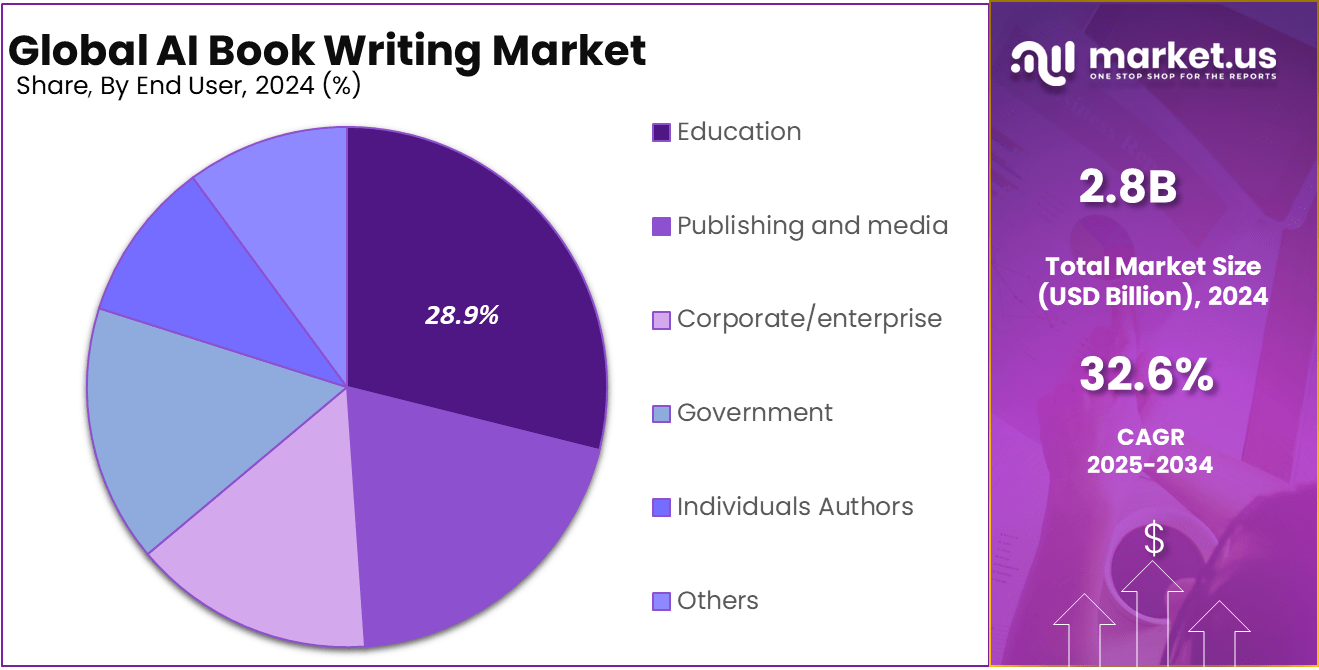
In 2024, The Education segment held a dominant market position, capturing a 28.9% share of the Global AI Book Writing Market. This dominance is due to the increasing demand for educational content and personalized learning materials. AI-driven tools are being widely adopted to create textbooks, e-learning resources, and study guides more efficiently.
These tools enable the rapid generation of tailored educational content, enhancing accessibility and customization for diverse student needs. Additionally, increasing investments in EdTech and the emphasis on inclusive education leveraging AI-assisted content creation fuel strong market growth in the education sector.
For Instance, in April 2024, the Goethe-Institut organized workshops focusing on the use of generative AI and machine translation in German language teaching. These workshops were designed to equip educators with the tools to incorporate AI into their teaching methods, enhancing the learning experience and embracing technological advancements in education.
Key Market Segments
By Solution
Software
Services
Implementation & Integration Services
Consulting & Training Services
Support & Maintenance Services
By Deployment
Cloud-Based
On-Premises
By Technology
Natural Language Processing (NLP)
Deep learning
Machine learning
Others
By End User
Education
Publishing and media
Corporate/enterprise
Government
Individuals Authors
Others
Key Regions and Countries
North America
US
Canada
Europe
Germany
France
The UK
Spain
Italy
Russia
Netherlands
Rest of Europe
Asia Pacific
China
Japan
South Korea
India
Australia
Singapore
Thailand
Vietnam
Rest of Latin America
Latin America
Brazil
Mexico
Rest of Latin America
Middle East & Africa
South Africa
Saudi Arabia
UAE
Rest of MEA
Emerging Trend
The Rise of AI as an Author’s Creative Partner
AI is moving from a simple automation tool to a true creative partner for writers. Instead of just speeding up editing or producing drafts, AI-powered book writing tools are now used to generate story ideas, suggest themes, and refine narrative tone in a way that amplifies human creativity.
Writers who combine their own experience with AI’s power can brainstorm faster, structure their stories with more confidence, and experiment with narrative styles. Rather than threatening the art of writing, this trend points to a future where authors and intelligent systems create together in new, exciting ways.
Key Driver
Demand for Faster and More Efficient Book Production
The demand for speed and efficiency is a major force pushing AI into the book writing process. Authors, publishers, and independent creators want to overcome writer’s block, meet tight deadlines, and reduce the time spent editing.
AI helps by handling repetitive tasks like basic editing, layout suggestions, and marketing materials. This allows writers to focus more on their core message and storytelling, while publishers can get books to market faster and with greater consistency.
Main Restraint
Ongoing Concerns About Authenticity and Creativity
Despite impressive advances, many in the literary world remain concerned that AI cannot capture the unique voice, life experiences, and creative spark of a human author. Some readers and writers see AI-generated books as lacking emotional depth or originality, often finding them formulaic or uninspired. This skepticism can slow the acceptance of AI-written books, especially among those who value storytelling that feels truly personal and meaningful.
Opportunity
Personalization of Content for Specific Audiences
A major opportunity lies in using AI to understand reader preferences and personalize both content and marketing. AI analyzes reader behavior, reviews, and trends to help authors write stories that better match what audiences want.
This means writers and publishers can not only tailor their books to specific genres but also directly recommend stories to readers who are most likely to connect with them. The ability to deliver more relevant, targeted reading experiences is opening doors for greater reader satisfaction and stronger community bonds around books.
Industry Challenge
Quality Control Amid Rapid Content Flood
The biggest challenge facing AI book writing is preventing a flood of low-quality content. With tools making it easy and cheap to produce books quickly, digital marketplaces are being overwhelmed with titles that are poorly written or offer little value.
This over-saturation makes it harder for well-crafted works to stand out and raises concerns about ethics, copyright, and fair compensation for human creativity. The industry must find a way to balance the benefits of AI speed and scale with quality standards and integrity in publishing.
Key Players Analysis
In the AI book writing market, Publishing.ai, Goethe-Institut, and PublishDrive are advancing tools that automate book creation. These platforms help authors generate, structure, and refine content using AI. Their focus on speed, multilingual support, and digital publishing has attracted a wide base of users. With rising demand for fast content production, these companies continue to expand their AI capabilities to support diverse writing needs.
Companies like Squibler, Zapier Inc., and Bookwiz are integrating automation to improve the writing process. Squibler focuses on quick drafts, while Zapier enhances workflow by connecting apps. Bookwiz simplifies self-publishing using AI-driven writing aids. These firms support users with tools for editing, content flow, and genre-specific writing, helping both new and experienced authors streamline their publishing journey.
Novelcrafter, WRITER, and Rytr are enhancing storytelling through personalized AI writing. These platforms help authors maintain tone, style, and structure across genres. They offer features like character building, plot assistance, and narrative consistency. With AI enabling faster manuscript development, these tools are gaining popularity among individual writers and publishing houses aiming for scalable book production.
Top Key Players in the Market
Publishing.ai.
Goethe-Institut
PublishDrive
Squibler
Zapier Inc.
Bookwiz
Novelcrafter
WRITER
Rytr
Others
Recent Developments
In April 2025, Novelcrafter continued to enhance its browser-based platform for novelists, offering advanced tools to help authors plan and organize their stories. The platform provides features for tracking character arcs, plot development, and other key elements, ensuring consistency throughout the creative process.
In October 2024, PublishDrive sponsored Author Nation, a premier event aimed at advancing authors’ careers through technology and networking. The event showcased the latest AI-driven solutions, including PublishDrive’s Publishing Assistant, which helps authors optimize metadata and cover designs to improve book discoverability and sales.