

Report Overview
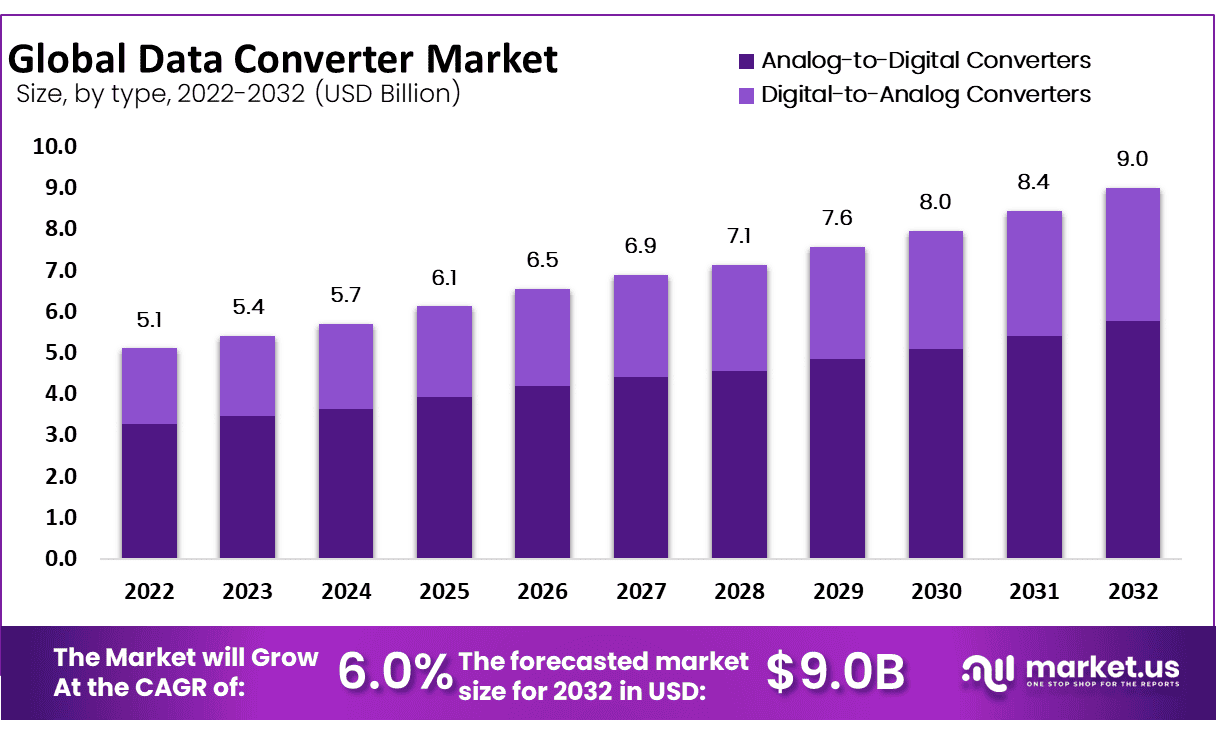
The Global Data Converter Market is anticipated to expand from USD 5.7 billion in 2024 to around USD 9 billion by 2032, reflecting a CAGR of 6.0% during the forecast period from 2023 to 2032. The market’s growth is primarily driven by the increasing demand for high-speed data conversion in communications, consumer electronics, industrial automation, and automotive applications.
Rising integration of smart sensors, IoT devices, and AI-based systems is accelerating the adoption of advanced analog-to-digital and digital-to-analog converters. Additionally, the transition toward 5G and the expansion of connected ecosystems are further stimulating demand for precision data converters across industries.
Note: Actual Numbers Might Vary In The Final Report
Key Takeaways
- Market Growth: The global Data Converter Market is expected to reach USD 9 billion by 2032, growing at a CAGR of 6.00% from 2023 to 2032.
- Definition: Data converters play an essential role in converting analog signals to digital formats for use by industries like consumer electronics, healthcare, and telecommunications.
- Driving Factors: Increasing automation in manufacturing and the demand for data converters in telecommunications and automotive sectors are propelling market growth.
- Challenges: High costs of high-resolution converters and a shortage of skilled professionals are hindering market expansion, particularly in consumer electronics.
- Opportunities: Advances in communication technology and the increasing adoption of data converters in healthcare are creating growth opportunities.
- Trends: Data converter adoption in healthcare, driven by remote monitoring and telemedicine, is a significant trend. AI and machine learning are enhancing converter performance in calibration and error correction.
- Regional Dominance: Asia Pacific leads the market due to automation adoption in manufacturing and the rapid growth of IT and telecommunications sectors.
- Key Players: Major companies include Texas Instruments, Analog Device Inc., Maxim Integrated Products Inc., and Microchip Technology Inc.
- Segment Analysis: Market segments covered include Analog-to-Digital Converters (ADC), Digital-to-Analog Converters (DTC), High Speed Data Converters and General Purpose Data Converters aimed at various industry verticals.
Driving Factors
Increasing Automation in Manufacturing Industries Fueling the Market Growth
The demand for high-speed and high-resolution data converters is increasing in various industries such as telecommunication, healthcare, and automotive industries, which is the primary factor driving the market growth. Data converters play an important role in the automotive industry. They perform the function of identifying different engine statuses to radar/LIDAR, which enables Automotive Driver Assistance Systems (ADAS). Analog-to-digital and digital-to-analog systems provide an interface for a multitude of analog sensors to automotive systems-on-chips (SoCs). Data converters rely on the collection, transformation, and analysis of information to ensure the working of supply chains.
Increasing adoption of wireless technologies such as 5G, the Internet of Things (IoT), and Artificial Intelligence (AI) is propelling the demand for data converters to support technologies. The rising adoption of automation in various industries, such as energy manufacturing and transformation, also drives the demand for data converters that enables faster and more accurate data processing. Consumers worldwide are shifting towards the adoption of renewable energy sources such as solar and wind power. Data converters help in efficient power conversion and management, fueling the market growth.
Restraining Factors
High Costs and Lack of Skilled Professionals Hampering the Market Growth
The costs of data converters that offer high resolution and the sampling rate are very high, which limits the adoption of data converters in consumer electronics. Data converters that offer high-speed sampling and resolution rate consumes more electricity. Also, data converters are complex devices that require significant design expertise and engineering resources to develop. Thus the lack of skilled professionals and the complexity of data converters restrain market growth.
Growth Opportunities
Developments in Advanced Communication Technologies Expected to Fuel Market Growth in Forecast Period
Factors such as the increasing demand for high-quality audio & video, rising growth of wireless communication networks, adoption of automation, and the Internet of Things are expected to drive the market in the forecast period. The rising adoption of smartphones with the emergence of 5G network services is driving the demand for ADAs that can handle data rates of several gigabits per second. Increasing concerns regarding energy efficiency and sustainability, the demand for data converters with low power consumption is increasing.
Thus, manufacturers in the market are focusing on the development of low-power ADAs and DACs that can operate on low voltage and consumes less power. Rising demand for autonomous vehicles’ advanced driver assistance systems boosts the demand for data converters that can handle high-bandwidth data streams generated by these systems. Thus increasing demand for high-speed data processing, growth of IoT, and developments in advanced communication technologies are expected to create lucrative growth opportunities in the market during the forecast period.
Latest Trends
Increasing Adoption in Healthcare Sector is a Current Trend in Market
Advancements in electronic technologies have made many innovations in the healthcare industry. The adoption of data converters is increasing in healthcare industries due to rising demand for remote monitoring, telehealth, and telemedicine. The use of AI and machine learning is increasing to improve the accuracy and performance of data converters, commonly in areas such as calibration and error correction.
By Type Analysis
Analog-to-Digital Converters Segment is Dominant in the Market Owing to High Accuracy Rate
Based on type data converter market is classified as analog-to-digital converters and digital-to-analog converters. The analog-to-digital converters segment was dominant in the market, with the largest market revenue share of 64% in 2022. This system plays an important role in control and monitoring applications because most of the sensors, such as temperature sensors, force sensors, and pressure sensors, produce analog output voltages that cannot be read by a microcontroller without analog-to-digital converters.
This converter requires low supply voltage, low power consumption, high sampling rate, circuit, and easy integration on chip thus, and they have high demand in the electronics and automotive industries. This system has high conversion efficiency and requires less power as compared to other data converters. The digital-to-analog converters are expected to grow at the fastest CAGR during the forecast period. DAC helps to improve audio quality by converting digital audio files into analog sound waves. This method is one of the fastest methods of conversion, which allows the conversion of binary inputs into an analog form easily.
By Sampling Rate Analysis
High-Speed Data Converters Segment is Dominant in Market Due to Its High Sampling Rate
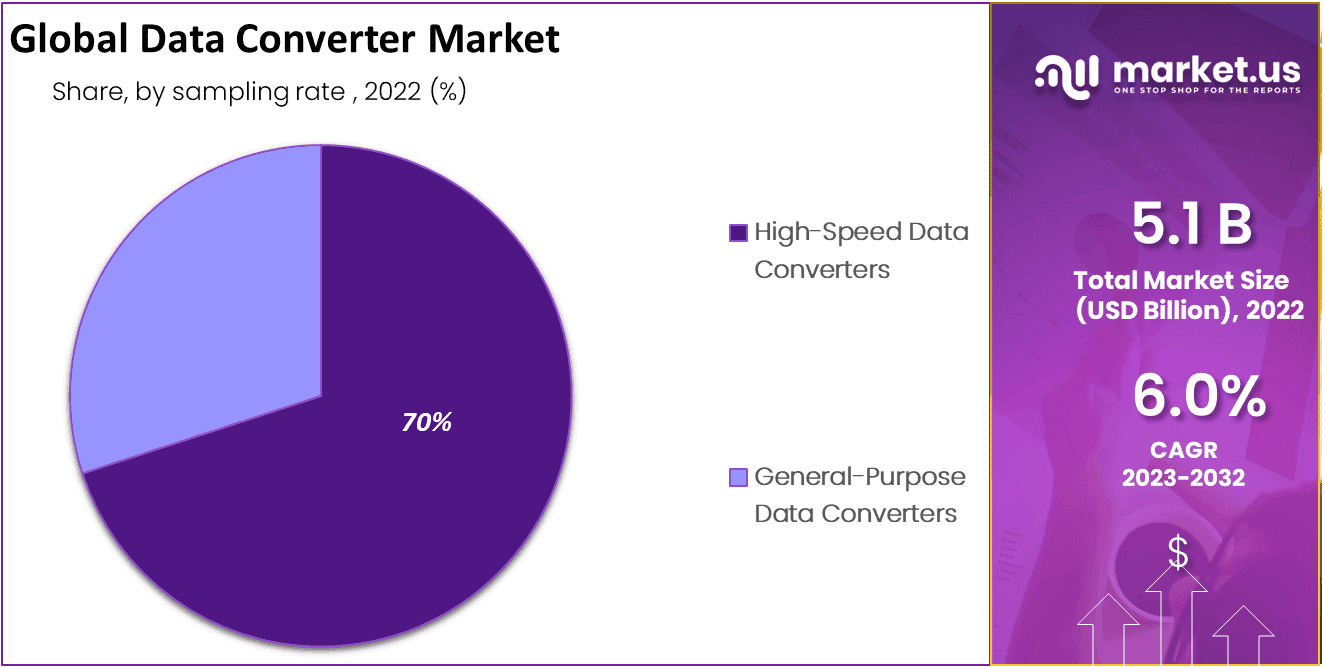
On the basis of sampling rate, the data converter market is segmented into high-speed data converters and general-purpose data converters. The high-speed data converters segment was dominant in the market, with the largest market revenue share of 70% in 2022. The growth of this segment is attributed to a high sampling rate, higher performance, low power consumption, and better integration in fine lithography CMOS processes. High-speed data converters are capable of handling signals with bandwidths of 10MHz to more than 1GHz. The analog-to-digital converters offer a high-speed sampling rate. The general-purpose data converters segment is expected to grow at the fastest CAGR during the forecast period.
Note: Actual Numbers Might Vary In The Final Report
By Industry Vertical Analysis
The consumer Goods & Electronics Segment is Dominant in the Market
On the basis of industry verticals, the data converter market is classified into IT & Telecommunications, manufacturing, consumer goods & electronics, media & entertainment, test & measurement, healthcare & life sciences, and other industry verticals. The Consumer goods & electronics segment was dominant in the market, with the largest market share of 32% in 2022.
Data converters are increasingly adopted for consumer electronic devices such as tablets, laptops, and mobiles for the functions such as image processing, network signal processing, video calling, and others. The IT & telecommunication segment is expected to grow at the fastest CAGR during the forecast period due to the increasing adoption of digital-to-analog data converters in the telecommunication industry.
Key Market Segments
By Type
- Analog-to-Digital Converters
- Digital-to-Analog Converters
By Sampling Rate
- High-Speed Data Converters
- General-Purpose Data Converters
By Industry Vertical
- IT & Telecommunications
- Manufacturing
- Consumer Goods & Electronics
- Media & Entertainment
- Test & Measurement
- Healthcare & Life Sciences
- Other Industry Verticals
Regional Analysis
Asia Pacific Region is Dominant in the Market with Largest Market Revenue Share
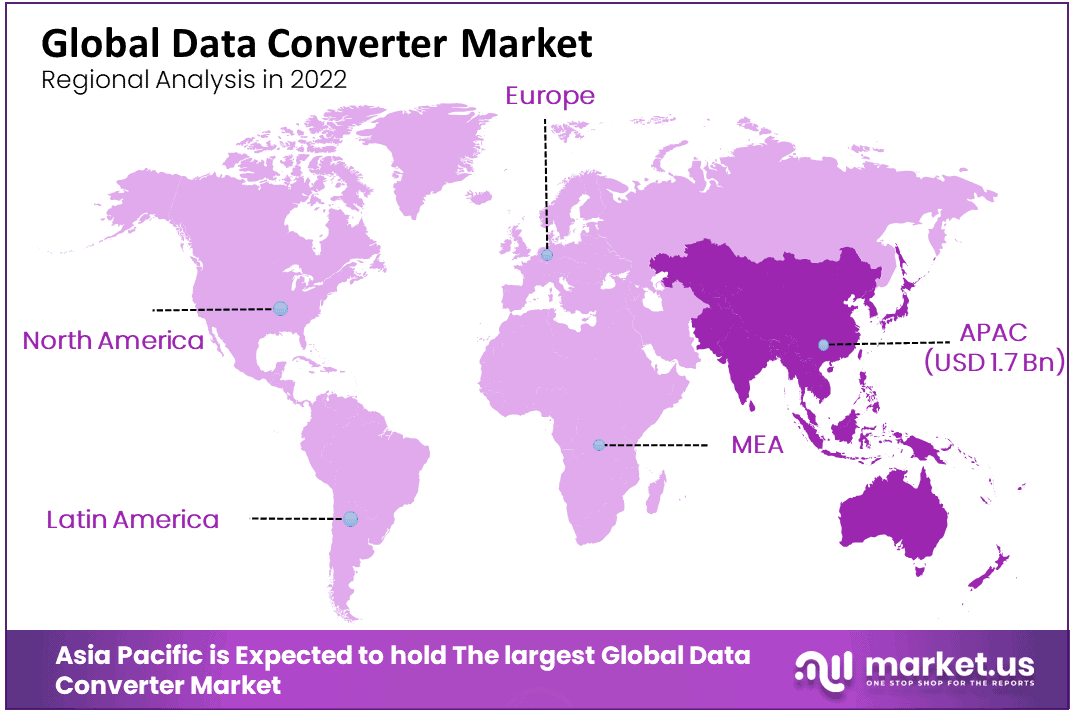
Asia Pacific region was dominant in the market, with the largest market revenue share of 35% in 2022. The growth of the region is propelled by the increasing adoption of automation in manufacturing industries. IT & telecommunication industries are increasingly adopting analog-to-digital data converters propelling the market growth.
Also, technological advancements in telecommunication services boost the market growth. The rising evolution of IT industries and expansion of automotive industries with the emergence of AI and IoT in emerging economies such as China, India, and Japan are driving the regional growth of the market. North America is expected to grow at the fastest CAGR during the forecast period due to increasing demand for data converters in healthcare industries.
Note: Actual Numbers Might Vary In The Final Report
Key Regions and Countries Covered in this Report:
- North America
- The US
- Canada
- Europe
- Germany
- France
- The UK
- Spain
- Italy
- Russia
- Netherland
- Rest of Europe
- APAC
- China
- Japan
- South Korea
- India
- Australia
- New Zealand
- Singapore
- Thailand
- Vietnam
- Rest of APAC
- Latin America
- Brazil
- Mexico
- Rest of Latin America
- Middle East & Africa
- South Africa
- Saudi Arabia
- UAE
- Rest of MEA
Key Players Analysis
Texas Instrument (TI) is the leading key player in the data converter market, which is one of the largest semiconductor manufacturers in the market known for its analog and mixed-signal integrated systems. Analog Device Inc. is another leading semiconductor company that offers a broad portfolio of data convertors for different markets.
The major key players in the data converter market are focusing on manufacturing energy-efficient, cost-effective analog devices to obtain a competitive edge in the market. The top key players in the global data converter market include Maxim Integrated Products Inc., Microchip Technology Inc., STMicroelectronics N.V., and Cirrus Logic Inc.
Top Key Players in Data Converter Market
- Analog Device Inc.
- Texas Instruments Inc.
- Maxim Integrated Products Inc.
- Microchip Technology Inc.
- STMicroelectronics N.V.
- Cirrus Logic Inc.
- Renesas Electronics Corporation
- NXP Semiconductors N.V.
- ON Semiconductor Corporation
- ROHM Semiconductor
- Other Key Players
Recent Developments
- In July 2020, Analog Devices Inc. acquired Maxim Integrated Products Inc., which is a leading company in the manufacturing of analog devices.
- In October 2020, Microchip Technology announced the acquisition of New Zealand-based Tekron International Limited.