

AI Laptop Market Size
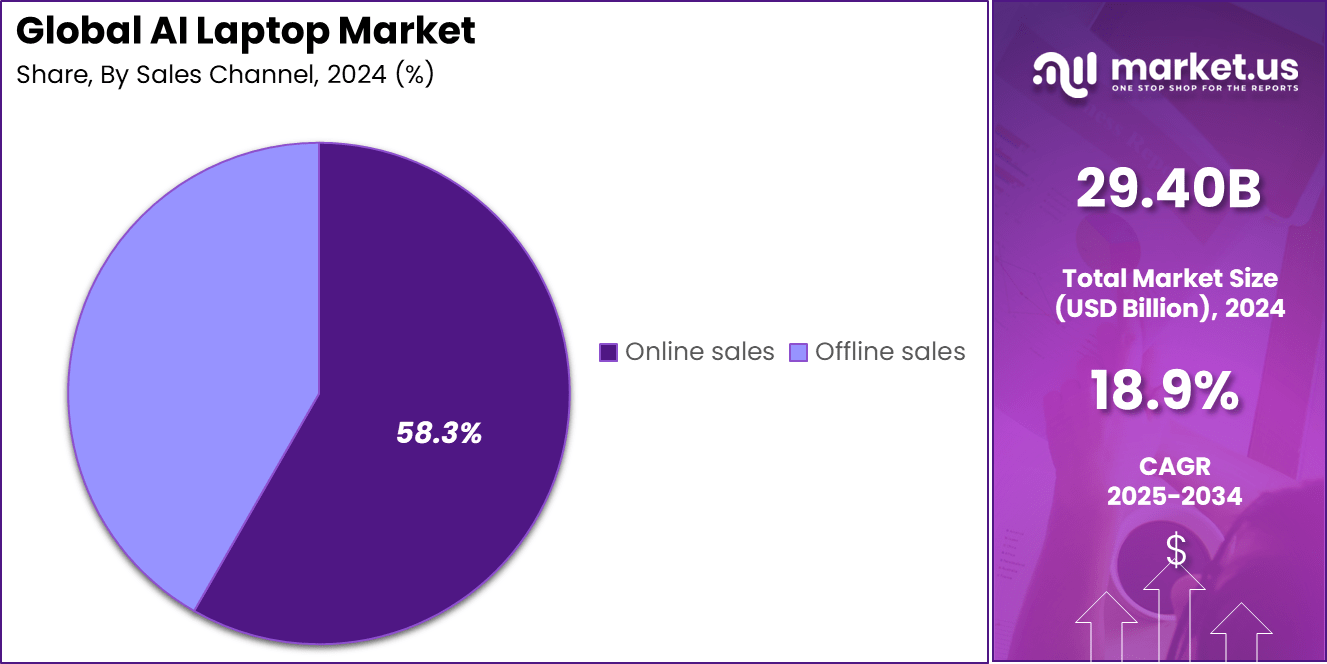
The Global AI Laptop Market size is expected to be worth around USD 166.02 Billion By 2034, from USD 29.40 billion in 2024, growing at a CAGR of 18.9% during the forecast period from 2025 to 2034. In 2024, North America held a dominant market position, capturing more than a 32.9% share, holding USD 9.6 Billion revenue.
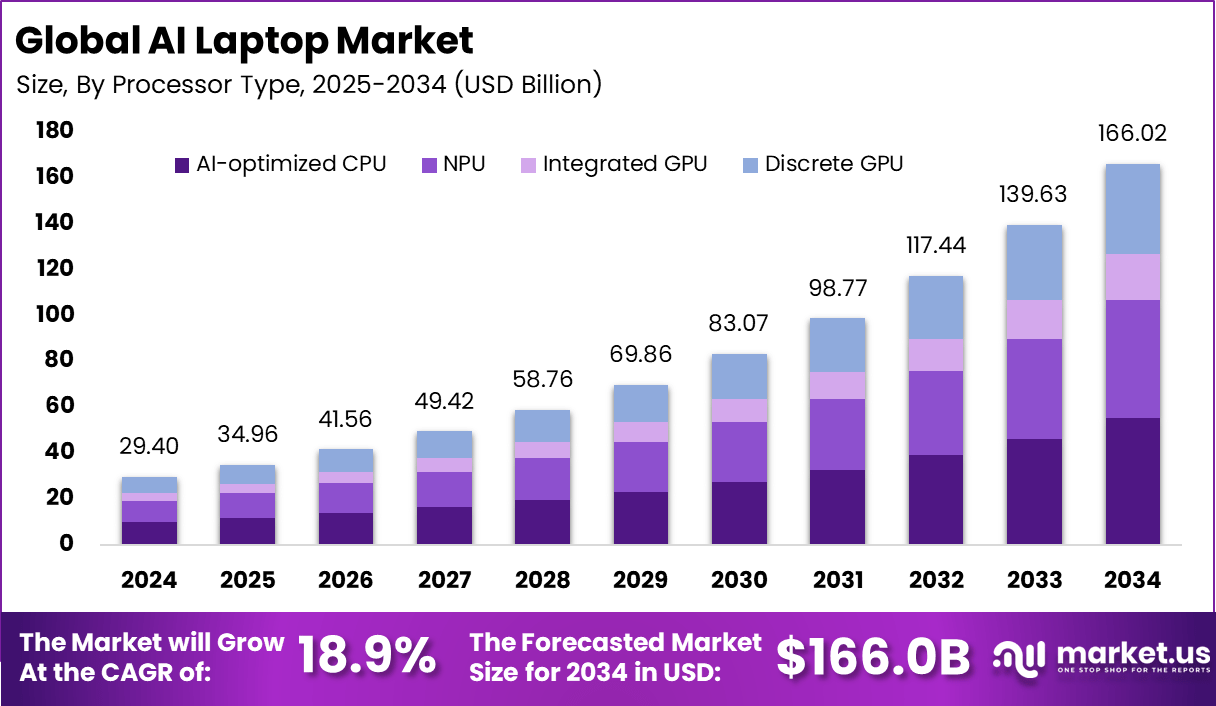
The AI laptop market refers to portable computers with built‑in artificial intelligence capabilities. These systems include specialized processors and software designed to run machine learning, natural language processing, or predictive analytics directly on the device. It can be stated with clarity that this segment is growing rapidly as overall PC demand evolves toward smarter, locally processing devices that enhance performance and efficiency.
Scope and Forecast
| Driver | Details |
|---|---|
| Enhanced performance | Users demand higher speed and efficiency for AI tasks like natural language processing, image recognition, and data analysis. |
| AI-driven personalization | Laptops adapt to user behavior and preferences for a more tailored user experience. |
| Security and privacy | AI enhances security via adaptive facial recognition and advanced biometric authentication. |
| Advancements in hardware | Introduction of NPUs and AI-optimized CPUs (e.g., Intel Core Ultra, Apple M4) for faster AI processing. |
| Integration with tech | Combining AI with 5G and edge computing enables real-time processing and better collaboration. |
Key Features and Trends
| Feature/Trend | Details |
|---|---|
| NPUs as core components | Dedicated processors accelerate AI tasks, supporting CPUs and GPUs. |
| Hybrid computing designs | Integration of CPUs, GPUs, and NPUs for optimal performance across all workloads. |
| Edge AI/on-device AI | Real-time AI processing on-device reduces latency and reliance on the cloud, improving privacy. |
| App compatibility | AI laptops support immersive experiences in apps (e.g., Microsoft Copilot). |
| Power-efficient AI | Enhanced power management for longer battery life during AI-accelerated workloads. |
| Performance optimization | AI dynamically allocates resources for demanding tasks, balancing performance and battery use. |
| AI-powered personalization | Systems adapt to individual users (e.g., voice, facial recognition). |
| Increased security | AI-driven authentication improves accuracy and reliability of biometrics and facial recognition. |
Key Market Segments
By Processor Type
- AI-optimized CPU
- NPU
- Integrated GPU
- Discrete GPU
Sales Channel
- Online sales
- Offline sales
Key Regions and Countries
- North America
- US
- Canada
- Europe
- Germany
- France
- The UK
- Spain
- Italy
- Russia
- Netherlands
- Rest of Europe
- Asia Pacific
- China
- Japan
- South Korea
- India
- Australia
- Singapore
- Thailand
- Vietnam
- Rest of Latin America
- Latin America
- Brazil
- Mexico
- Rest of Latin America
- Middle East & Africa
- South Africa
- Saudi Arabia
- UAE
- Rest of MEA
Key Player Analysis
Apple Inc. and Microsoft lead the AI laptop market with strong integration of AI features in their devices. Apple uses its own Neural Engine chips, while Microsoft enhances Windows laptops with Copilot and AI-driven productivity tools. Their focus on seamless AI performance supports high user demand across creative and professional segments.
Lenovo, HP India, and Dell Inc. hold key positions by offering AI-powered laptops with global availability. These brands invest in smart thermal designs, AI chipsets, and enterprise-ready models. Their widespread reach helps them cater to both consumer and business users effectively.
ASUSTeK, Acer, Samsung, Razer, and Google bring innovation in specific niches. ASUS and Acer target gamers and creators with AI-boosted performance. Samsung focuses on ecosystem-based AI features. Razer builds AI-ready laptops for content creators, while Google enhances AI learning on Chromebooks, expanding access in education and low-cost segments.
Top Key Players Covered
- Apple Inc.
- Microsoft
- Lenovo
- HP INDIA SALES PRIVATE LIMITED
- Dell Inc.
- ASUSTeK Computer Inc.
- Acer Inc.
- SAMSUNG
- Razer Inc.
- Google LLC
Recent Developments
- Apple Inc.
- March 2024: Apple released the M3-powered MacBook Air (13-inch and 15-inch). The M3 chip excels at power-efficient performance and supports advanced AI workloads natively, a major step for on-device intelligence.
- October 2024: Apple officially launched Apple AI, expanding AI features across devices and setting a new standard for user-friendly, integrated intelligence.
- March 2024: Acquisition of Canadian AI calendar startup Mayday Labs, enhancing productivity tools with machine learning for personal scheduling.
- Microsoft
- February 2025: Launch of Surface Copilot+ PCs for Business, including the Surface Pro and Surface Laptop. Powered by Intel Core Ultra (Series 2) and Snapdragon options, these devices stand out for best-in-class AI, battery life, and integrated Copilot productivity experience.
- Throughout 2025: The Surface portfolio has expanded to include more Windows Copilot+ features, tailored for professionals working in hybrid and mobile settings, with cellular 5G connectivity promised later this year.
- Lenovo
- March 2025 (MWC): Announced a ThinkBook “Flip” AI PC Concept – one of the most visible signs of AI hardware experimentation. This device features a folding OLED, AI-powered multitasking, and intelligent workspace adaptation.
- March 2025: Introduction of upgrades to ThinkPad and ThinkBook AI PCs, including models qualifying as Copilot+ PCs. Innovations focus on security, AI acceleration, and modularity for business users.
- MWC 2025: Release of Yoga and IdeaPad AI laptops, showcasing expanded Copilot+ access and NVIDIA GPU options for creative tasks, targeting both creators and corporate segments.