

Report Overview
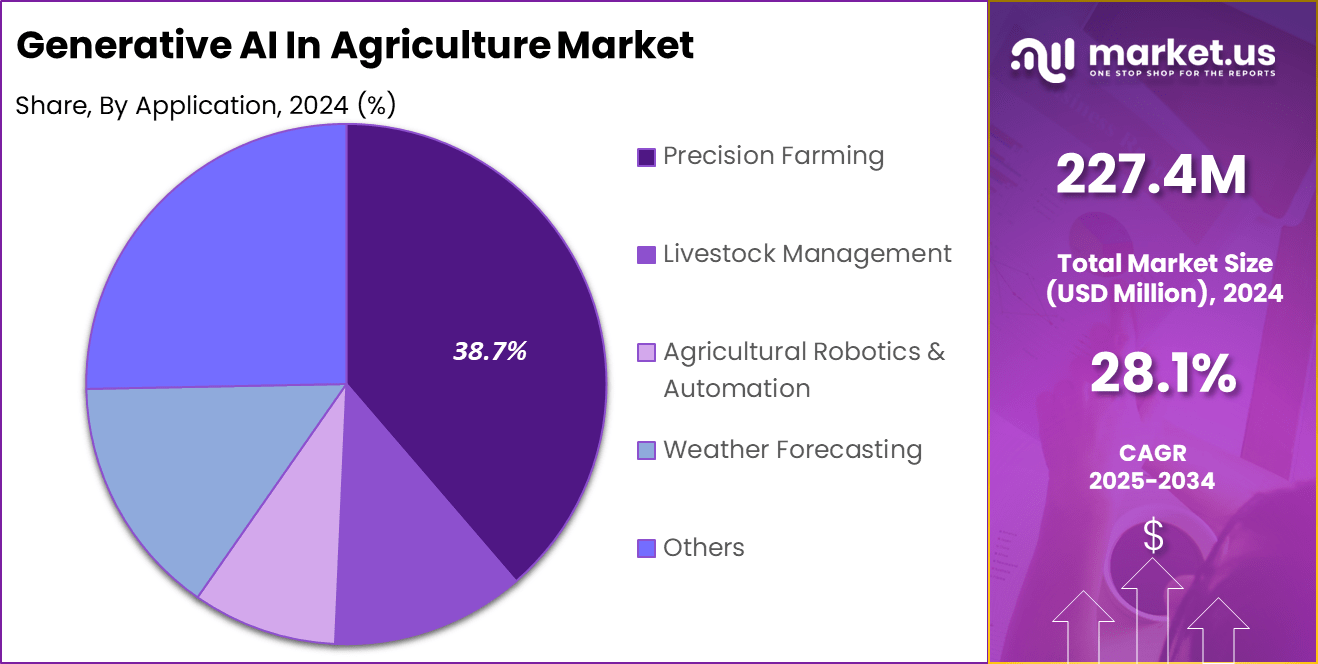
The Generative AI In Agriculture Market size is expected to be worth around USD 2,705.7 Million By 2034, from USD 227.40 Million in 2024, growing at a CAGR of 28.1% during the forecast period from 2025 to 2034. In 2024, North America held a dominant market position, capturing more than a 37.5% share, holding USD 85.27 Million revenue.
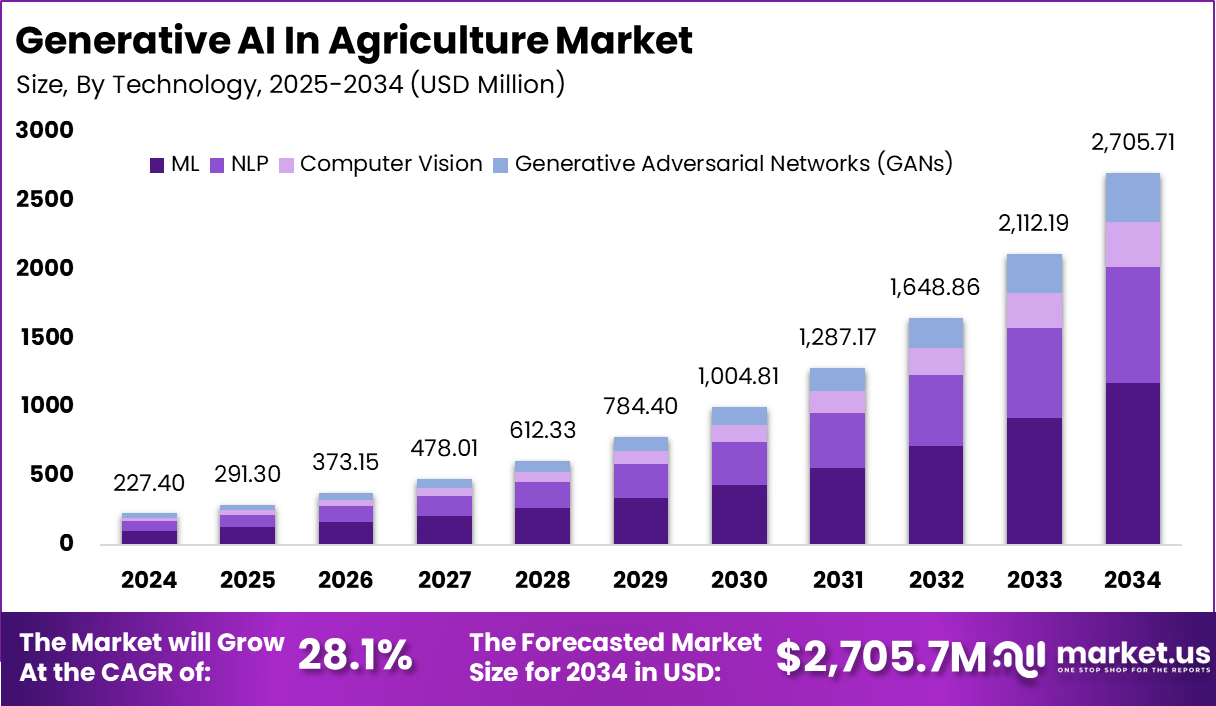
The Generative AI in Agriculture market can be characterized as an emerging segment within the broader digital agriculture domain. It centers on the use of generative artificial intelligence models to simulate new data, inform predictions, and deliver adaptive advisory for farm operations. These systems are layered upon established analytical AI, satellite imagery, drone‐based sensing, and IoT infrastructure to drive precision farming, autonomous robotics, yield forecasting, and climate‑sensitive planning.
One of the top driving factors accelerating the use of generative AI in agriculture is the urgent need for food security in the face of climate change, population growth, and depleting natural resources. Farmers and agribusinesses seek solutions that optimize yields, adapt to unpredictable weather, and use water and fertilizers more efficiently. The drive for sustainable farming and efficiency has made generative AI a key tool in achieving these goals.
According to Market.us research, The Global Generative AI Market is projected to reach approximately USD 255.8 Billion by 2033, rising sharply from around USD 13.5 Billion in 2023. This growth reflects a robust compound annual growth rate of 34.2% between 2024 and 2033. The increasing demand for creative automation, personalized content generation, and AI-driven productivity tools continues to drive this expansion across multiple industries.
Scope and Forecast
| Driver | Details |
|---|---|
| Crop yield optimization | Increasing demand to optimize yields with data-driven insights, scenario analysis, and precision farming. |
| Labor shortages | Need for automation and robotics (e.g., autonomous tractors, drones) to address workforce gaps. |
| Climate adaptation | Pressure to adapt to extreme weather and climate uncertainty, using AI for prediction and planning. |
| Integration with digital agriculture | AI models combined with IoT, satellite/drone imagery, and management systems for improved decisions. |
| Smallholder farmer inclusion | Move toward localized, low-resource, and multilingual AI tools for underserved regions. |
| Demand for sustainability | Industry and societal push for more resource-efficient, sustainable farming practices. |
| Technological advancement | Fast progress in machine learning, computer vision, GANs, and cloud infrastructure. |
Key Features & Trends
| Feature/Trend | Details |
|---|---|
| Precision agriculture | Real-time, data-driven management and recommendation systems for irrigation, fertilization, etc. |
| Predictive analytics | AI models forecast yields, pest outbreaks, and environmental impacts, helping minimize losses. |
| Computer vision integration | Enhanced image analysis automates crop health monitoring and disease detection via drones/satellites. |
| Generative models (GANs) | Creation of synthetic data for training robust AI models, especially where real data is scarce. |
| Edge computing | Use of on-device or field-level AI to reduce latency and reliance on connectivity/cloud. |
| Robotics & automation | AI-driven machines for planting, spraying, harvesting, and weeding, enhancing operational efficiency. |
| Multilingual, adaptive tools | Development of AI solutions tailored for local contexts, smallholder needs, and various languages. |
| Cloud-based collaboration | Cloud platforms enhance data sharing, processing, and value-chain partnerships. |
| Power/battery optimization | Generative AI optimizes resource use, leading to improved energy and input efficiencies. |
Challenge Analysis
| Challenge | Details |
|---|---|
| High implementation cost | Upfront investment for hardware, software, sensors, and connectivity can be prohibitive for some farmers. |
| Data quality and compatibility | Fragmented, variable, or inaccessible agricultural data limits AI performance and scalability. |
| Connectivity gaps | Lack of reliable internet in rural areas hinders adoption of cloud/AI-powered services. |
| Privacy and data ownership | Concerns about data sharing, security, and ownership among farmers and stakeholders. |
| Resistance to change | Hesitation or lack of trust among farmers to adopt new technologies and change traditional practices. |
| Shortage of skilled workforce | Need for AI/data science expertise in agriculture for development and operation of AI systems. |
| Model generalizability | Diverse microclimates and farm contexts challenge the transferability of AI models across regions/crops. |
| Ethical and regulatory concerns | Issues around fair access, transparency, job displacement, and data governance. |
Key Market Segments
By Technology
- Machine Learning
- Natural Language Processing
- Computer Vision
- Generative Adversarial Networks (GANs)
By Application
- Precision Farming
- Livestock Management
- Agricultural Robotics & Automation
- Weather For ecasting
- Others
Key Regions and Countries
- North America
- US
- Canada
- Europe
- Germany
- France
- The UK
- Spain
- Italy
- Russia
- Netherlands
- Rest of Europe
- Asia Pacific
- China
- Japan
- South Korea
- India
- Australia
- Singapore
- Thailand
- Vietnam
- Rest of Latin America
- Latin America
- Brazil
- Mexico
- Rest of Latin America
- Middle East & Africa
- South Africa
- Saudi Arabia
- UAE
- Rest of MEA
Key Player Analysis
In the Generative AI in Agriculture Market, key players such as Bayer AG, Syngenta Group, and Deere & Company have been pivotal in integrating AI into crop management and precision agriculture. Their efforts are focused on boosting productivity, improving seed traits, and reducing resource usage.
Bayer’s digital farming tools and Syngenta’s crop intelligence systems have allowed farmers to make faster and data-driven decisions. Meanwhile, John Deere’s investments in autonomous tractors and AI-powered equipment have positioned it as a leader in agricultural automation. Technology firms like Microsoft, IBM Corporation, and Agmatix are enhancing AI capabilities across agricultural workflows.
Microsoft’s cloud platforms are being used to analyze field data in real time, while IBM’s Watson Decision Platform supports pest prediction and weather forecasting. Agmatix has focused on harmonizing agronomic data for better insight generation. These companies are enabling smarter farming practices through scalable digital infrastructure and AI-powered platforms that reduce the complexity of agricultural data.
Startups such as Carbon Robotics, DeepAgro, KissanAI, and AgroScout are driving innovation at the ground level. Carbon Robotics uses AI-guided lasers for weed control, reducing the need for herbicides. DeepAgro applies computer vision to detect crop health. KissanAI focuses on Indian farming challenges using localized generative models, and AgroScout offers remote field scouting using drone technology.
Major players
Leading companies in the Generative AI In Agriculture market include:
- AgroScout
- Bayer AG
- Carbon Robotics
- Deere & Company (John Deere)
- DeepAgro
- IBM Corporation
- KissanAI
- Microsoft
- Agmatix
- Syngenta Group
Recent Developments
- In March 2025, Agmatix partnered with BASF through the AgroStart platform to create a digital tool for detecting and predicting Soybean Cyst Nematode (SCN) risks. By combining Agmatix’s AI engine Axiom with BASF’s agronomic knowledge, the solution delivers real-time, scalable forecasts tailored to growers’ needs.
- In April 2024, ITC Limited and Microsoft introduced the Krishi Mitra app using Microsoft Copilot. The AI tool aims to offer personalized agricultural insights to farmers. Initially launched for 300,000 users, it targets a wider rollout to 10.1 million farmers across India, enhancing access to timely crop guidance.
- In September 2024, Syngenta Group launched Cropwise AI, a generative AI system built on 20 years of agronomic data. It provides natural-language crop recommendations to improve yields and sustainability. Available in the U.S. and Brazil, the platform supports multilingual use, with plans to expand into Europe.