

Report Overview
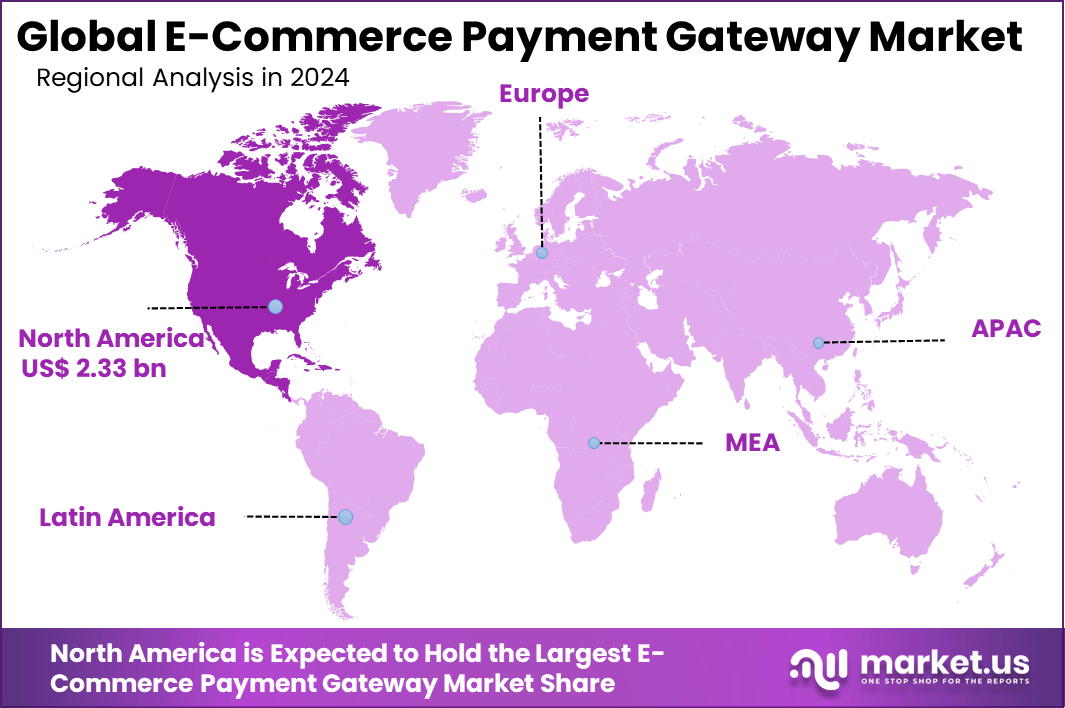
The Global E-Commerce Payment Gateway Market size is expected to be worth around USD 44.62 billion by 2034, from USD 6.21 billion in 2024, growing at a CAGR of 21.8% during the forecast period from 2025 to 2034. In 2024, North America held a dominant market position, capturing more than a37.6% share, holding USD 2.33 billion in revenue.
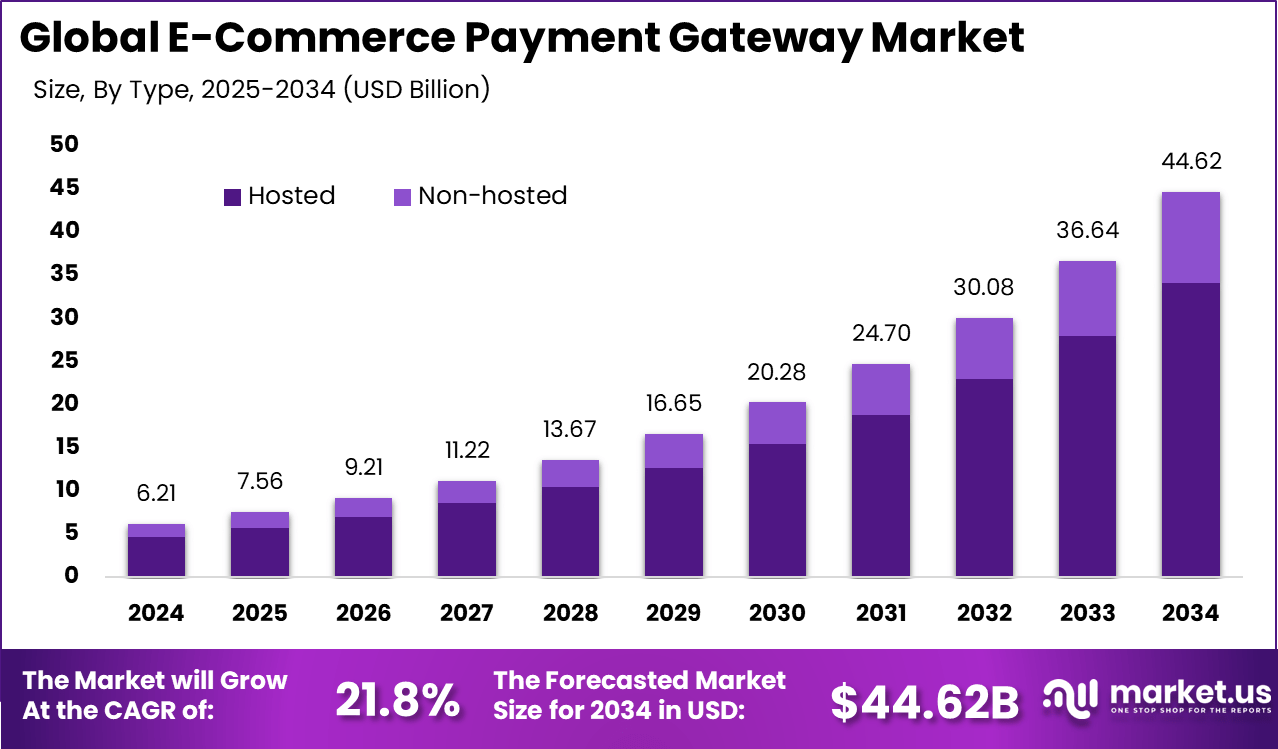
The e‑commerce payment gateway market refers to the infrastructure and services that enable online merchants to accept payments securely. This sector mediates transactions between buyers and sellers by processing card, wallet, bank transfer and other digital payments in real time. Its significance has grown as online retail expanded, requiring secure, compliant gateways to manage payment flows efficiently.
The primary driver of this market is the rapid growth of online commerce and mobile shopping. Consumer preference for fast and contactless transactions compels merchants to implement seamless gateway solutions. In addition, regulatory requirements for secure digital payments and fraud prevention are pushing adoption of advanced gateway technologies. Governments promoting cashless economies also play a role in energizing demand.
For instance, in December 2024, Worldline announced its strategic move to empower global online businesses by enhancing its payment gateway solutions in the United Arab Emirates (UAE). By expanding its services in this key market, Worldline aims to help merchants navigate the growing e-commerce sector in the UAE, offering advanced, secure, and scalable payment processing solutions.
Demand for e-commerce payment gateways continues to rise sharply because businesses now recognize the necessity of offering efficient, reliable payment methods. The pandemic served as a catalyst for digitally reluctant enterprises to go online and invest in robust payment solutions. Whether it’s small retail stores or major e-commerce brands, everyone needs a payment gateway to manage growing volumes and ensure seamless international transactions.
Scope and Forecast
| Segment | Sub-Segment | Share (%) |
|---|---|---|
| By Type | Hosted | 76.4% |
For Instance, In November 2024, MyFatoorah partnered with Mastercard to enhance e-commerce payments in the Middle East through advanced hosted payment gateway solutions. This collaboration integrates Mastercard’s global network with MyFatoorah’s platform to deliver secure, scalable, and seamless transactions. It aims to improve checkout experiences, strengthen fraud detection, and broaden available payment options for consumers.
Enterprise Size Analysis
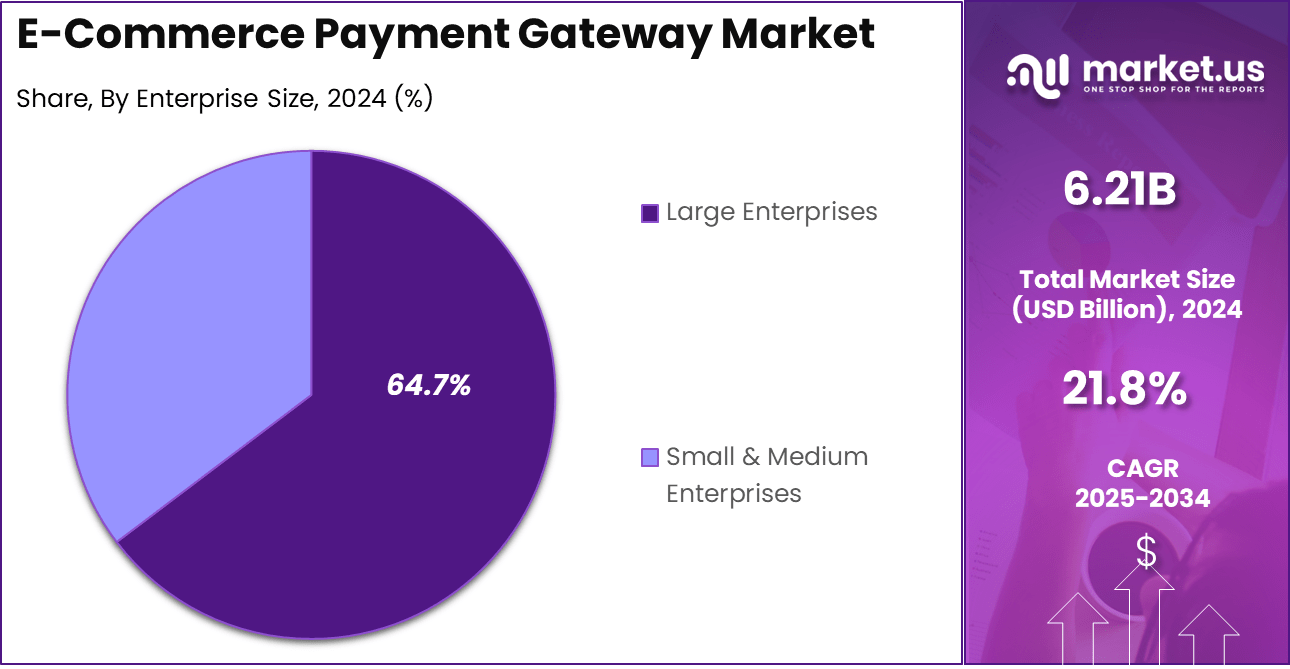
In 2024, the Large Enterprises segment held a dominant market position, capturing a 64.7% share of the Global E-Commerce Payment Gateway Market. This demand stems from the need for secure, scalable payment solutions capable of handling high transaction volumes and complex global operations. Large enterprises require advanced features like multi-currency support, customizable payment options, and enhanced fraud protection.
Their capacity to invest in innovative payment technologies and compliance ensures their preference for comprehensive, enterprise-level solutions. With vast client bases and diverse industry needs, they further drive the demand for tailored, secure payment gateways that optimize operations and streamline transaction processes worldwide.
| Segment | Sub-Segment | Share (%) |
|---|---|---|
| By Enterprise Size | Large Enterprises | 64.7% |
For instance, In November 2024, City Bank partnered with Compass Plus Technologies to deploy the TranzAxis Payment Gateway for its e-commerce acquiring services. This integration enables the bank to deliver secure, scalable, and efficient payment solutions tailored for large enterprises. TranzAxis supports various payment methods, including mobile wallets and cards, allowing City Bank to handle high transaction volumes and meet diverse customer demands.
Key Features and Trends
| Feature/Trend | Details |
|---|---|
| Omnichannel Integration | Unified payments across desktop, mobile, in-app, point-of-sale (POS), and more. |
| Multiple Payment Methods | Support for cards, digital wallets (Apple Pay, Google Pay), UPI, BNPL, cryptocurrencies, etc. |
| Contactless & Mobile Payments | Growth in NFC/contactless and QR-code driven payments, especially in Asia-Pacific. |
| AI & ML Security | AI-driven fraud detection, risk scoring, voice/biometric authentication for transaction safety. |
| Open Banking & API Connectivity | Streamlined banking integration and data sharing for instant payments and financial services. |
| Subscription/Recurring Billing | Automated recurring payment capabilities for SaaS, memberships, and digital subscriptions. |
| Real-time Analytics | Enhanced reporting tools to track, analyze, and optimize payment flows and customer trends. |
Key Market Segments
By Type
- Hosted
- Non-hosted
By Enterprise Size
- Large Enterprises
- Small & Medium Enterprises
Key Regions and Countries
- North America
- US
- Canada
- Europe
- Germany
- France
- The UK
- Spain
- Italy
- Russia
- Netherlands
- Rest of Europe
- Asia Pacific
- China
- Japan
- South Korea
- India
- Australia
- Singapore
- Thailand
- Vietnam
- Rest of Latin America
- Latin America
- Brazil
- Mexico
- Rest of Latin America
- Middle East & Africa
- South Africa
- Saudi Arabia
- UAE
- Rest of MEA
Drivers
Mobile and Digital Payments Demand
As people use mobile devices and the internet more frequently, their payment preferences for goods and services have been on the rise. Online shopping is becoming more popular among shoppers who use digital wallets, credit or debit cards, and other options like buy-now-pay-later plans.
Due to this, businesses are now utilizing increasingly flexible payment methods that operate across multiple channels. New markets that are thriving in the mobile device shopping experience show a marked change. Companies that offer payment services are profiting from this shift in behavior, which enhances digital systems and simplifies payment transactions for consumers globally.
For instance, In May 2025, PYMNTS’ Money Mobility Tracker® reported a surge in mobile and digital payment demand, driven by consumer expectations for speed, security, and convenience. Rising smartphone use and mobile wallet adoption are accelerating the shift toward real-time, secure transactions.
Restraint
Regulatory Compliance
Changing financial regulations pose a challenge for payment services. Compliance with regulations such as PCI-DSS, money laundering laws, and local licenses leads to increased costs and complexity. Additionally, traditional banking systems hinder efficiency in transactions and obstruct innovative ideas.
Due to the increasing regulations on digital payments by governments, businesses are finding themselves unable to expand and may face difficulties in entering the market, as new and smaller businesses depend on legal support, risk management, or secure systems.
For instance, In March 2025, PCI Compliance was identified as a key challenge for e-commerce merchants, according to recent card processing FAQs. As data security regulations evolve, meeting PCI-DSS standards remains costly and complex, requiring continuous investments in security, staff training, and audits to guard against fraud and breaches.
Opportunities and Challenges
| Category | Highlights |
|---|---|
| Opportunities | – Rapid growth in emerging markets (mobile internet, digital wallets) – Fintech innovation (AI, blockchain, BNPL, voice) – Expanding global trade and cross-border services – SMEs adopting digital payment acceptance platforms |
| Challenges | – Cybersecurity risks; need for constant upgrades – Regulatory complexity across jurisdictions – Global payment system fragmentation (currency, standards) – High integration/setup costs for small businesses – Competition and fee pressure in commoditized markets |
Key Players Analysis
In the E-Commerce Payment Gateway Market, Adyen, Amazon Payments Inc., and Authorize.Net continue to maintain strong market influence due to their vast global integrations and stable transaction systems. Adyen’s omnichannel capabilities support both online and in-store payments, strengthening its partner ecosystem. Amazon Payments leverages its strong consumer base to deliver seamless checkout experiences.
Bitpay, Braintree, and PayPal Holdings, Inc. are fostering greater payment flexibility by focusing on digital currencies and mobile commerce. Bitpay is advancing cryptocurrency acceptance across global merchants, attracting tech-savvy buyers. Braintree, a PayPal service, supports scalable payments for mobile-first platforms. PayPal continues to lead with its massive user base and buyer protection policies.
PayU Group, Stripe, Verifone Holdings, Inc., and WePay, Inc. are driving innovation through region-specific strategies and enterprise partnerships. Stripe leads in developer adoption, offering custom checkout tools and strong fraud protection. PayU focuses on high-growth emerging markets with tailored financial services. Verifone emphasizes secure hardware-software combinations for omnichannel payments. WePay, backed by a leading financial institution, integrates with crowdfunding and SaaS platforms.
Top Key Players in the Market
- Adyen
- Amazon Payments Inc.
- Net
- Bitpay, Inc.
- Braintree
- PayPal Holdings, Inc.
- PayU Group
- Stripe
- Verifone Holdings, Inc.
- Wepay, Inc.
- Others
Recent Developments
- In January 2025, PayU became the first payment gateway in Colombia to integrate Google Pay, allowing Android users to make fast and secure online transactions. This integration enhances the user experience by offering a seamless checkout process and boosting PayU’s reach in the Latin American market.
- In October 2024, Mastercard announced the acquisition of Minna Technologies, a provider of subscription management solutions. This acquisition enhances Mastercard’s ability to support recurring payments, streamlining the management of subscriptions for both merchants and consumers