

Report Overview
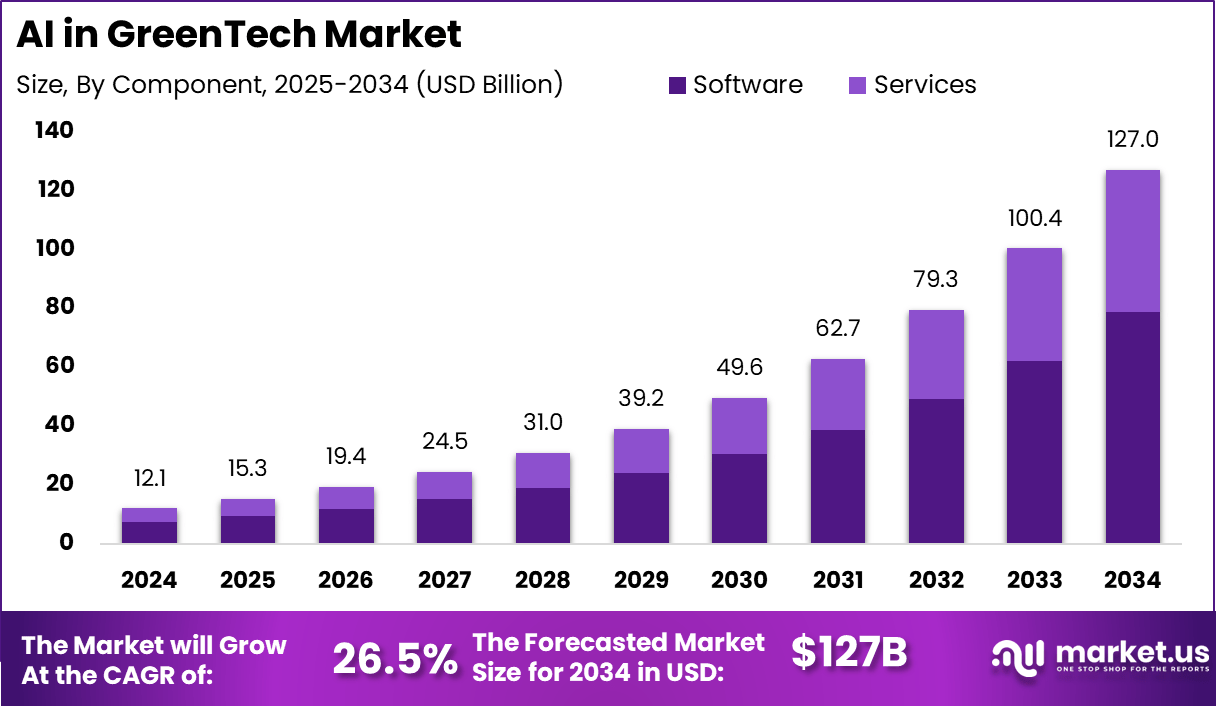
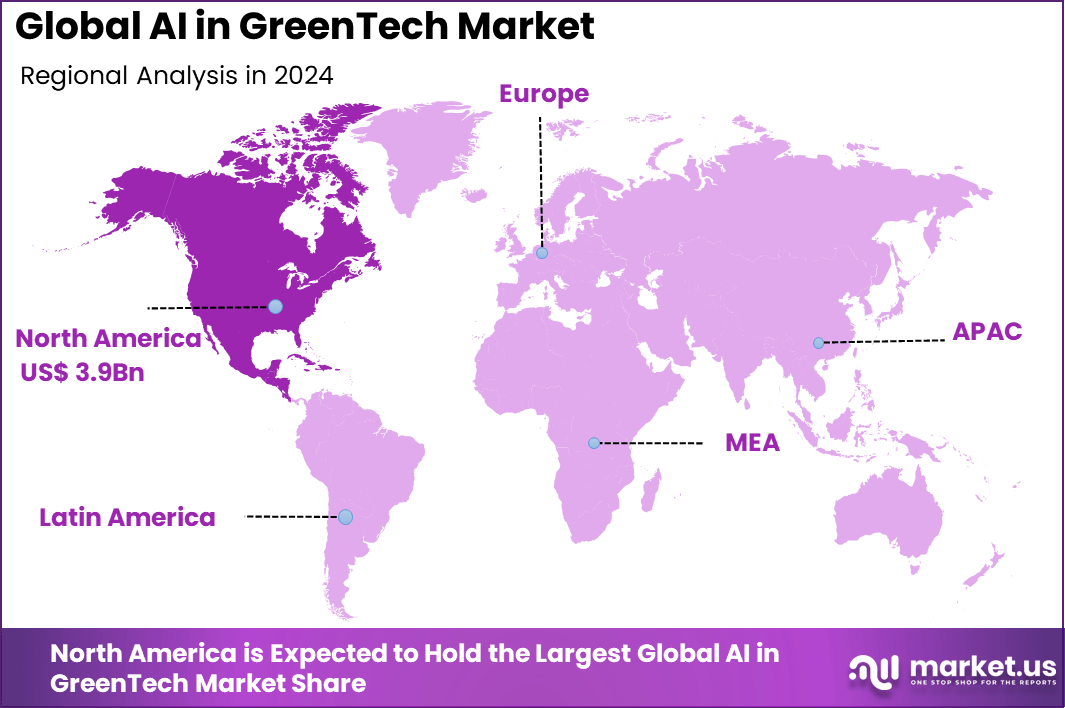
The Global AI in GreenTech Market size is expected to be worth around USD 127 Billion By 2034, from USD 12.1 billion in 2024, growing at a CAGR of 26.5% during the forecast period from 2025 to 2034. In 2024, North America held a dominant market position, capturing more than a 33% share, holding USD 3.9 Billion revenue.
Artificial intelligence is increasingly integrated in GreenTech to optimize energy use, manage renewable systems, improve waste processing, and support sustainable agriculture. It enables real‑time environmental monitoring, predictive control for grid stability, and data‑driven decisions in resource management. Smart grid systems and precision agriculture solutions are key areas where AI functions as the intelligence layer driving GreenTech performance.
The primary drivers of AI adoption in GreenTech include heightened regulatory emphasis on ESG compliance, growing investor demand for transparent sustainability reporting, and operational pressures to improve energy efficiency and resilience. Advanced machine learning systems are also being deployed to manage renewable energy intermittency and reduce downtime via predictive maintenance.
Demand for AI‑via‑GreenTech applications is rooted in the need for reliable grid operation amidst surging renewable capacity and infrastructure constraints. AI is being used to expedite energy project interconnections, manage grid bottlenecks, and streamline approval workflows. Utilities are increasingly seeking AI‑powered tools to avoid costly outages, forecast loads, and mitigate infrastructure stress amplified by climate volatility.
According to Market.us, In 2024, the AI in ESG and Sustainability Market was valued at USD 1.24 billion, and it is projected to grow to USD 14.87 billion by 2034, with a CAGR of 28.20%. This surge is driven by rising demand for real-time ESG data, automated reporting, and climate risk analysis powered by AI tools. Companies are adopting AI to meet strict regulations and to enhance their sustainability impact with greater accuracy and speed.
Meanwhile, the ESG Consulting Market stood at USD 8.12 billion in 2024 and is expected to reach USD 39 billion by 2034, growing at a CAGR of 16.90%. The expansion is supported by increasing global pressure for transparent sustainability practices. Organizations are turning to consultants to navigate evolving ESG standards, improve governance structures, and design net-zero strategies.
Market Size and Growth
| Key Factor | Description |
|---|---|
| Regulatory push for ESG/sustainability | Regulatory mandates and climate goals (e.g., net zero targets, ESG reporting) are driving adoption of AI-powered solutions for tracking and reducing carbon emissions, waste, and other environmental impacts. |
| Investments in digital and frontier tech | Continued investment in AI, IoT, and related digital technologies to enhance efficiency, productivity, and sustainability in operations—even during challenging economic times. |
| Real-time data analytics and optimization | AI and IoT enable real-time tracking of resource use, carbon footprints, emissions, and waste, allowing for dynamic optimization and rapid response to inefficiencies. |
| Need for cost savings and resource efficiency | Companies adopt AI to highlight inefficiencies, reduce costs, and optimize resource management—key for energy, logistics, and manufacturing. |
| Consumer and stakeholder expectations | Growing consumer awareness and stakeholder demands for eco-friendly business practices increase investments in predictive analytics for green strategies. |
| Circular economy models | AI enables advanced waste management, recycling, and supply chain transparency to support circular economic practices and sustainability certification. |
Emerging Trends
| Key Points | Description |
|---|---|
| Integration of Generative AI | Gen AI is used for rapid prototyping of green solutions, code optimization, carbon footprint visualization, and real-time decision support — accelerating innovation in eco-friendly applications. |
| Applied/Analytical AI | Machine learning, computer vision, and NLP are deployed in predictive maintenance, energy optimization, environmental monitoring, and supply chain management for sustainability. |
| Edge AI & IoT | Edge AI and IoT sensors enable local, real-time data processing for smart energy grids, precision agriculture, and smart city infrastructure, enhancing scalability and responsiveness of green solutions. |
| AI-powered compliance & reporting | Automated monitoring and reporting on ESG and carbon emissions for transparency, accuracy, and regulatory compliance, powered by AI and blockchain-based platforms. |
| Climate risk prediction | Gen AI and predictive analytics forecast weather extremes and climate change impacts, supporting infrastructure resilience, risk management, and policymaking. |
| Sectoral and personalized solutions | AI-driven tools for industry-specific needs (e.g., e-mobility, agriculture, energy, manufacturing) and individualized carbon reduction plans for consumers and businesses. |
| Focus on green AI itself | Efforts to ensure that AI development and deployment consume less energy and are themselves sustainable, minimizing the environmental footprint of advanced algorithms and hardware. |
By Component Analysis
In 2024, the Software segment held a commanding 62% share in the AI in GreenTech Market. This dominance is due to the widespread use of AI-powered platforms for analyzing environmental data, forecasting emissions, and optimizing energy systems. Software solutions enable organizations to integrate real-time data from multiple sources, allowing smarter resource planning and efficient carbon footprint tracking.
Their modularity and compatibility with existing systems have made them the preferred choice over hardware. Additionally, the rise of SaaS-based sustainability tools and open-source AI frameworks has expanded access for small and medium enterprises. These platforms not only assist in operational efficiency but also help meet regulatory reporting requirements, further strengthening the demand for software-led solutions.
By Deployment Mode Analysis
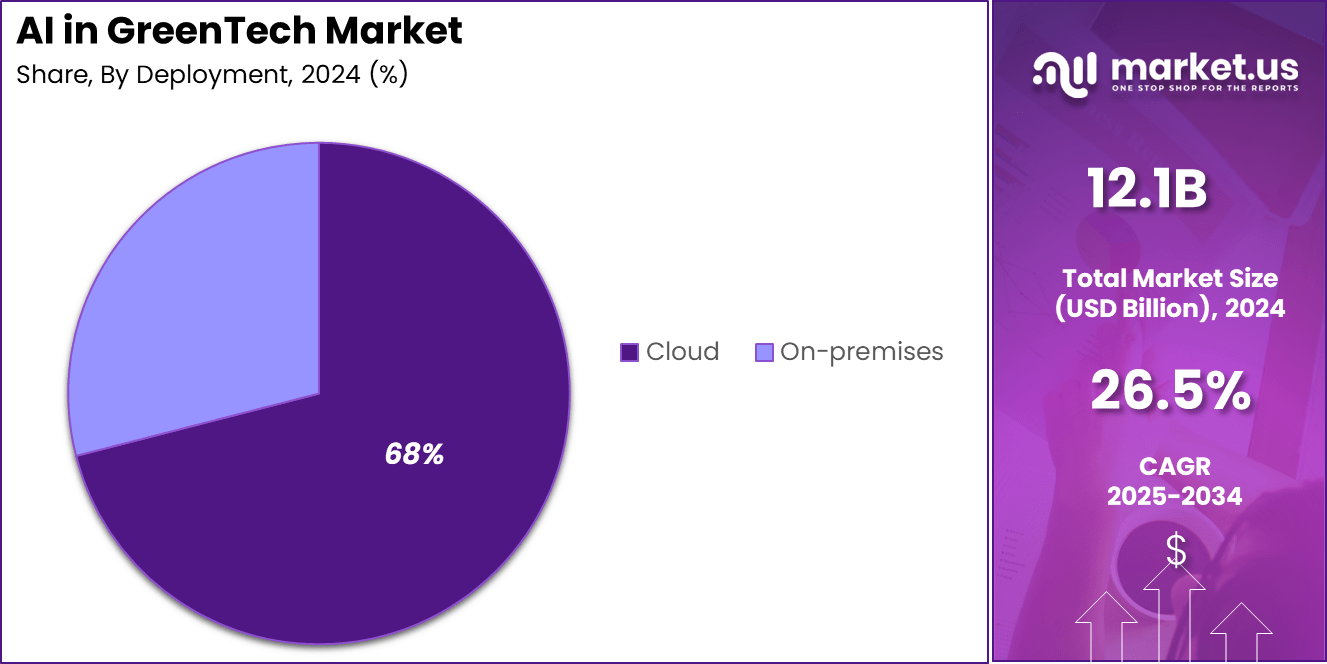
In 2024, Cloud-based solutions led the market with a strong 68% share, reflecting the need for scalable, flexible, and cost-effective deployment models. Cloud platforms enable real-time monitoring, seamless data integration, and remote accessibility, which are critical for GreenTech operations spread across diverse geographies.
Organizations prefer cloud solutions for their lower upfront costs and quick AI deployment in areas such as energy prediction and waste management. Furthermore, the cloud model supports large-scale environmental simulations and high-speed data processing, essential for climate modeling and smart grid optimization.
By Technology Analysis
In 2024, Machine Learning accounted for 31% of the technology segment in 2024, emerging as the most widely adopted AI technique in GreenTech. Its strength lies in analyzing complex environmental patterns, forecasting energy demand, and identifying anomalies in pollution levels. ML models are trained using historical data to automate sustainability tasks such as water usage optimization, predictive maintenance of renewable energy assets, and climate risk assessments.
Machine learning is also being used to support autonomous decision-making in smart buildings and agriculture. As data availability grows through sensors and IoT systems, machine learning algorithms will become increasingly vital in accelerating the transition to sustainable energy and resource practices.
By Application Analysis
In 2024, Energy Management emerged as the leading application, contributing 27% of the market share. AI technologies are being actively used to balance electricity supply and demand, enhance grid efficiency, and integrate renewable energy sources like solar and wind. Smart energy systems powered by AI enable real-time tracking of consumption, allowing households and industries to optimize usage patterns and reduce energy waste.
This application is especially relevant in urban infrastructure and commercial facilities where energy costs and emissions need to be minimized. AI-driven tools such as automated thermostats, load forecasting software, and distributed energy resource management systems are key contributors to this segment’s strength.
By Industry Analysis
In 2024, The Energy & Utilities sector accounted for 35.8% of the market in 2024, making it the most prominent end-user of AI in GreenTech. This industry’s heavy carbon footprint and growing regulatory pressure to decarbonize have accelerated the adoption of intelligent solutions. From optimizing power generation to forecasting grid fluctuations, AI helps utility companies reduce operational costs and meet clean energy targets.
The sector also uses AI for fault detection, infrastructure monitoring, and predictive maintenance, improving both safety and efficiency. As countries invest in smart grids and renewable energy infrastructure, the integration of AI tools across utility networks is expected to expand further.
Key Market Segments
By Component
- Software
- AI Platforms
- Analytics Tools
- Predictive Maintenance Software
- Services
- Managed Services
- Professional Services
By Deployment Mode
- On-Premise
- Cloud-Based
By Technology
- Machine Learning
- Natural Language Processing
- Computer Vision
- Context-Aware Computing
- Deep Learning
- Others
By Application
- Energy Management
- Sustainable Agriculture
- Climate Monitoring & Carbon Footprint Management
- Smart Waste Management
- Water Management
- Green Building and Smart Cities
- Other Applications
By Industry
- Energy & Utilities
- Agriculture
- Manufacturing
- Transportation & Logistics
- Government & Public Sector
- Construction
- Waste Management
- Water Treatment
- Others
Key Regions and Countries
- North America
- US
- Canada
- Europe
- Germany
- France
- The UK
- Spain
- Italy
- Russia
- Netherlands
- Rest of Europe
- Asia Pacific
- China
- Japan
- South Korea
- India
- Australia
- Singapore
- Thailand
- Vietnam
- Rest of Latin America
- Latin America
- Brazil
- Mexico
- Rest of Latin America
- Middle East & Africa
- South Africa
- Saudi Arabia
- UAE
- Rest of MEA
Driver Analysis
Real-Time Data Analysis and Resource Optimization
A major driver accelerating AI adoption in GreenTech is its powerful ability to analyze massive datasets from sensors, satellites, and smart devices. AI enables energy grids and urban systems to adapt to real-time changes, cuts waste, and helps predict demand without human intervention. This shift toward data-driven automation and optimization allows businesses and communities to make better decisions, save resources, and move closer to environmental goals with increased efficiency.
Restraint Analysis
High Energy Demands of AI Systems
Despite its promise, the energy consumption of advanced AI systems is a significant restraint. Training and deploying large AI models require huge amounts of electricity, often putting a strain on power grids and potentially outweighing some of the environmental benefits AI is supposed to bring. There is a growing debate about balancing the eco-friendly tools AI offers with the need to ensure its development does not add to carbon emissions or deplete finite resources.
Opportunity Analysis
Smarter Cities and Circular Economy
An exciting opportunity lies in the creation of AI-powered smart cities and support for circular economy initiatives. By continuously monitoring waste, energy, and environmental conditions, AI can help guide city management toward lower emissions, optimized recycling, and better urban planning. This opens doors for tailored solutions that maximize resource reuse, cut pollution, and enable cities and organizations to hit tightening green targets more effectively.
Challenge Analysis
Managing the Environmental Footprint of AI
One of the toughest challenges is finding ways to maximize the positive effect of AI on the environment while minimizing its own resource consumption. This means not only making algorithms more energy-efficient but also designing hardware with a longer life cycle, ensuring recyclability, and promoting transparency in measuring environmental impacts. Achieving this balance will require cross-sector collaboration, innovative public policies, and a focus on both the immediate and long-term consequences of AI deployment in the green sector.
Key Player Analysis
In the AI in GreenTech Market, major technology firms like Microsoft Corporation, IBM Corporation, and Google LLC (Alphabet Inc.) are playing a central role. These companies are investing in AI-powered sustainability platforms, carbon emission tracking, and smart grid management. Their global presence and extensive R&D capabilities enable them to support climate-conscious digital transformation across industries.
Hardware and chip design leaders such as Intel Corporation are also shaping the AI in GreenTech ecosystem. Their energy-efficient processors and edge computing platforms support green AI applications, including water management and precision agriculture. Alongside them, cloud-based CRM and analytics provider Salesforce offers climate-centric data tools and sustainability dashboards that help businesses track environmental KPIs.
Emerging players like STACC, Xeven Solutions, and established industrial giants such as Schneider Electric and General Electric (GE) are reinforcing this market’s diversity. STACC and Xeven Solutions are focusing on AI for environmental data analysis and smart resource planning. Meanwhile, Schneider Electric and GE are integrating AI into building automation, grid intelligence, and eco-industrial solutions.
Leading companies in the AutoML market include:
- Microsoft Corporation
- IBM Corporation
- Google LLC (Alphabet Inc.)
- Intel Corporation
- Salesforce
- STACC
- Xeven Solutions
- Schneider Electric
- General Electric (GE)
- Others
Recent Developments
- November 2024: IBM, in collaboration with Sustainable Energy for All at COP29, publicly launched AI-powered tools for sustainable urban development. Their “Open Building Insights” platform leverages AI models to optimize building usage and plan greener infrastructure, focusing on developing regions.
- May 2024: Microsoft signed a $10 billion partnership with Brookfield Asset Management to secure 10.5 gigawatts of renewable energy globally, making it the largest corporate renewable energy agreement in history. This ambitious move will fuel Microsoft’s AI-powered data centers worldwide, supporting both its rapid AI scaling and carbon-negative commitment.