

Report Overview
The global Cognitive Assessment and Training market size accounted for USD 7.50 billion in 2024 and is predicted to increase from USD 11.80 billion in 2025 to approximately USD 169.00 billion by 2034, expanding at a CAGR of 30.50% from 2025 to 2034.
Cognitive assessment and training refers to a domain in which structured tools are employed to evaluate, monitor and enhance cognitive abilities such as memory, attention, perception and problem‑solving. Assessments may be delivered via pen‑and‑paper, computerized interfaces or mobile apps, while training modules often leverage gamified exercises or adaptive tasks.
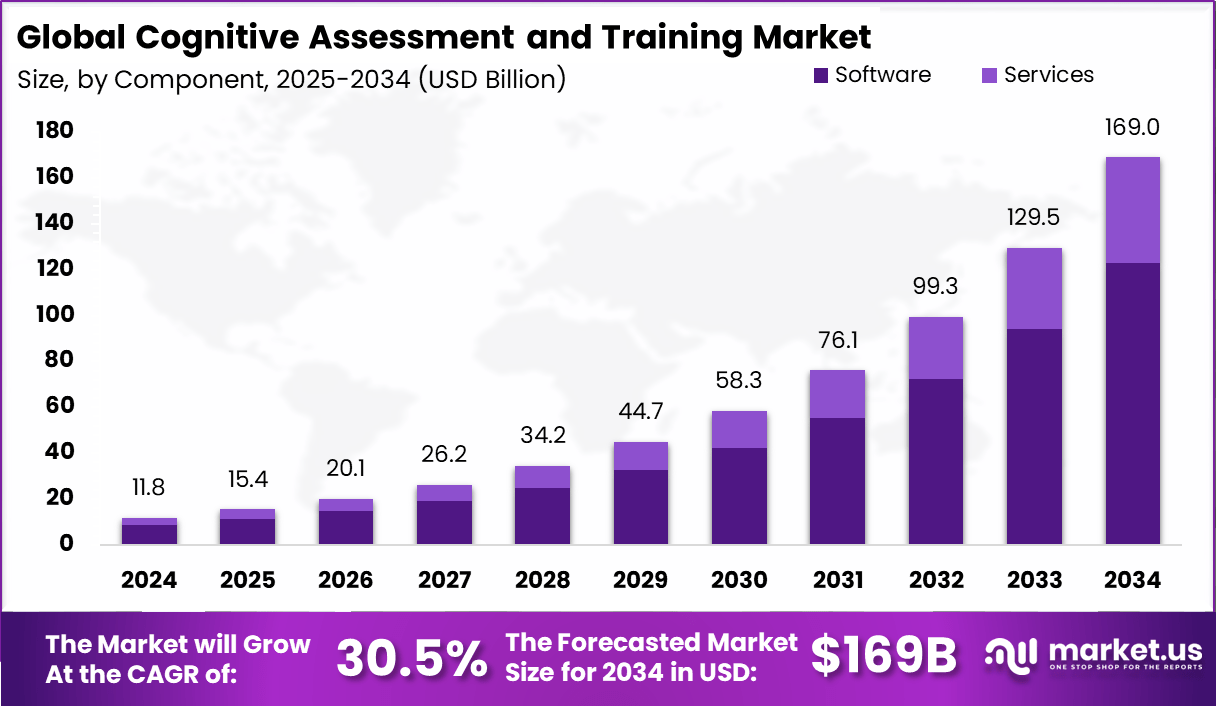
The top driving factors in this market include the ageing global population and increasing prevalence of cognitive disorders such as dementia and mild cognitive impairment, which has triggered a rising need for early detection and intervention tools. Growing awareness regarding mental fitness across younger demographics and institutions has further stimulated demand.
Demand for cognitive assessment and training continues its upward climb, especially in environments where cognitive well-being directly impacts performance and outcomes. In the workplace, companies see clear benefits from assessing cognitive strengths among their employees, resulting in improved productivity, lower turnover, and a more agile workforce.
Market Size and Growth
| Key Role/Function | Details and Impact |
|---|---|
| Personalized Assessment & Training | AI adapts training/challenges to each user’s ability, providing a tailored experience. |
| Advanced Data Analytics | AI processes vast datasets for accurate, real-time feedback and adaptive learning. |
| Scalability & Accessibility | Digital AI-powered tools allow large-scale, remote, and on-demand assessment. |
| Clinical Diagnostics | AI helps early detection of cognitive decline using imaging, biomarkers, and medical data. |
| Engagement & Gamification | AI integration boosts user engagement in training apps through gamified, interactive formats. |
Growth Factors
| Key Factors | Description |
|---|---|
| Aging Population | Rising global elderly demographic drives demand for dementia and cognitive decline detection and management. |
| Digital & Mobile Platform Adoption | Widespread use of smartphones and digital tech enables scalable cognitive assessment and training. |
| Health & Wellness Consumer Trends | Greater public awareness of mental fitness and brain health integrates cognitive solutions into wellness routines. |
| Education Technology Expansion | Integration of adaptive learning and assessment tools in schools and universities boosts market penetration. |
| Corporate Training Investments | Companies are investing in employee mental health, cognitive skills, and productivity improvement initiatives. |
Component Analysis
In 2024, the Software segment held a dominant market position, capturing more than a 72.7% share of the Global Cognitive Assessment and Training Market, driven by the growing demand for digital, accessible, and personalized cognitive solutions.
Software-based platforms are widely used in healthcare, education and corporate environment, which is due to interactive and scalable cognitive assessment and their ability to give training modules. These platforms provide features such as real-time progress tracking, adaptive learning algorithms and remote access, which make them suitable for users of all ages and needs.
For instance, educational institutions are integrating cognitive software into their curriculum to help students improve attention, memory, and problem-solving skills. In healthcare, clinicians use software to monitor and management cognitive decline in conditions such as dementia and painful brain injury.
The rise of mobile applications and cloud-based tools has further enhanced the software, which provides convenience and cost-defense. As technological innovation continues, software is expected to remain a leading component in cognitive evaluation and training, which provides multi -faceted and user -friendly solutions globally.
Application Analysis
In 2024, the Employee Training & Development Programs segment held a dominant market position, capturing more than a 38.5% share of the Global Cognitive Assessment and Training Market, driven by growing recognition of the role cognitive skills play in workplace productivity, decision-making, and adaptability.
Organizations of various industries are rapidly investing in cognitive training equipment to increase the memory, meditation, problem-solution skills and emotional intelligence of employees. These programs are particularly valuable in high-demonstration environments such as finance, healthcare and IT, where mental agility is important.
For instance, Fortune 500 companies have adopted digital cognitive training platforms to boost employee engagement and mental resilience. These solutions also help in identifying cognitive strengths and areas for improvement, allowing for personalized training paths. Moreover, the rise of remote work has accelerated demand for cognitive tools that support virtual learning and professional development.
As companies prioritize employee well-being and performance, the integration of AI-driven, gamified cognitive assessments into corporate training ecosystems has become a key strategy, reinforcing this segment’s leadership in the global market.
End-Use Vertical Analysis
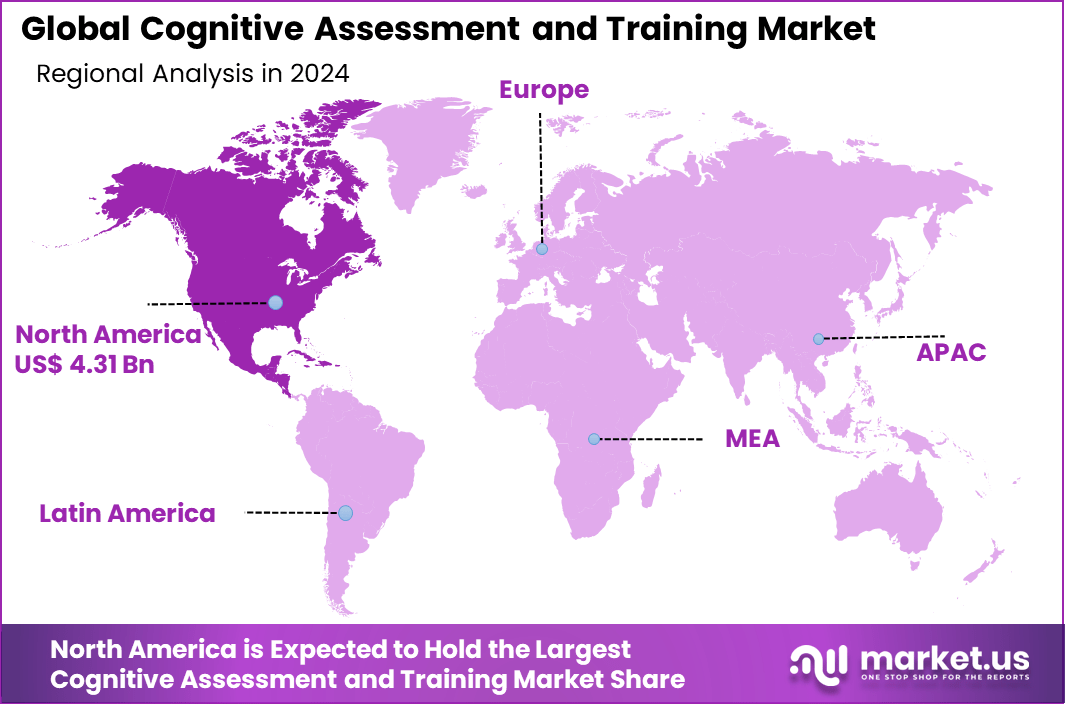
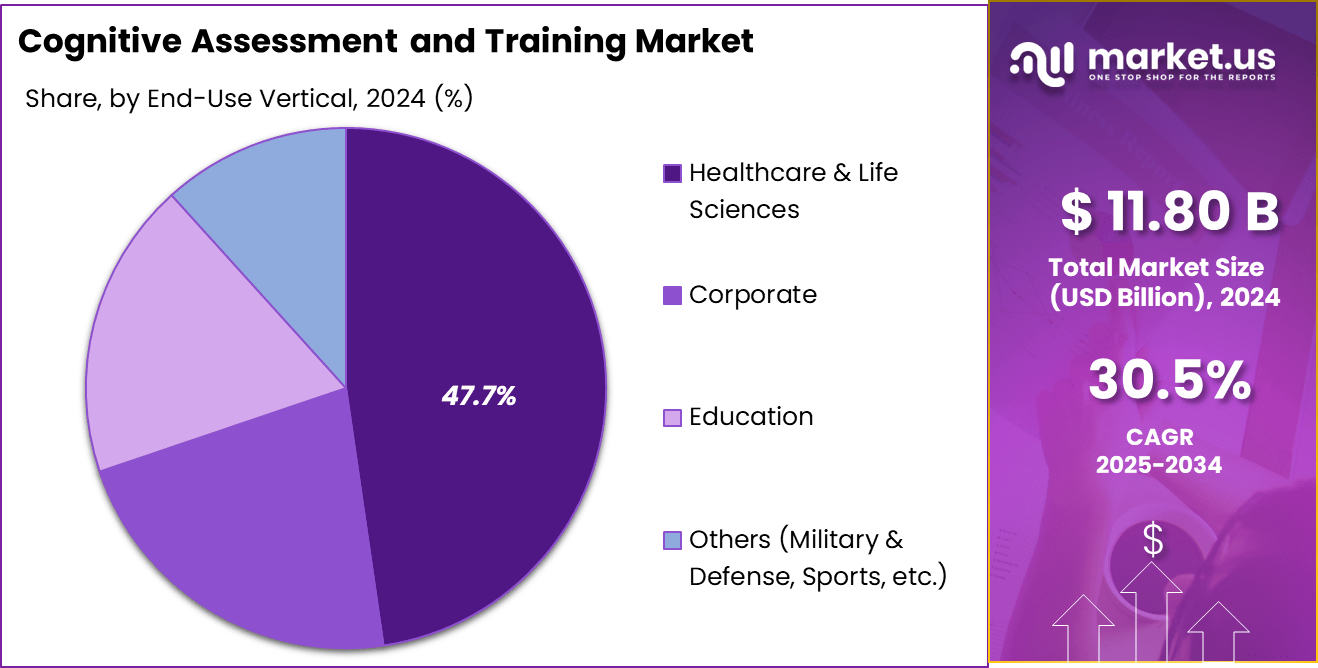
In 2024, the Healthcare & Life Sciences segment held a dominant market position, capturing more than a 47.7% share of the Global Cognitive Assessment and Training Market, driven by the rising prevalence of neurological disorders and the growing need for early diagnosis and intervention.
This segment benefits significantly from cognitive assessment tools used to detect, monitor, and manage conditions such as Alzheimer’s disease, dementia, ADHD, and traumatic brain injuries. For instance, healthcare providers increasingly rely on digital cognitive testing platforms for accurate, non-invasive assessments of mental functions like memory, attention, and executive functioning.
The life sciences sector is also leveraging cognitive tools in clinical trials to measure the cognitive side effects of new pharmaceutical compounds. With the population of aging in regions such as North America and Europe, the demand for cognitive health monitoring continues to increase. The integration of AI and neurocycical analytics further enhances clinical accuracy.
Latest Trends
| Trend/Innovation | Description |
|---|---|
| AI and Machine Learning Integration | AI drives smarter, personalized, and faster cognitive testing and training experiences. |
| Gamification | Interactive, game-based platforms improve engagement and adherence. |
| Mobile & Remote Accessibility | Mobile apps and cloud-based tools make assessments widely available and convenient. |
| Early Detection & Preventive Focus | Increasing focus on prevention (especially dementia/Alzheimer’s) with proactive screening tools. |
| Corporate and Educational Uptake | Expanded adoption as employers and teachers use cognitive platforms for productivity and learning outcomes. |
Key Market Segments
By Component
- Software
- Cloud
- On-Premises
- Services
- Training & Support
- Consulting
- Implementation & Integration Services
By Application
- Clinical Trials
- Screening & Diagnostics
- Employee Training & Development Programs
- Academic Learning
- Others
By End-Use Vertical
- Healthcare & Life Sciences
- Corporate
- Education
- Others (Military & Defense, Sports, etc.)
Key Regions and Countries
- North America
- US
- Canada
- Europe
- Germany
- France
- The UK
- Spain
- Italy
- Russia
- Netherlands
- Rest of Europe
- Asia Pacific
- China
- Japan
- South Korea
- India
- Australia
- Singapore
- Thailand
- Vietnam
- Rest of APAC
- Latin America
- Brazil
- Mexico
- Rest of Latin America
- Middle East & Africa
- South Africa
- Saudi Arabia
- UAE
- Rest of MEA
Drivers
Rising Prevalence of Cognitive Disorders
Increasing global phenomena of cognitive losses such as Alzheimer’s, dementia, ADHD, and mild cognitive loss is a major driver for cognitive evaluation and training market. An aging global population-especially in developed countries, is becoming more common in developed countries, leading to an increasing need for early diagnosis and long-term cognitive support.
Cognitive assessment tools allow physicians to detect early signs of mental decline, which enable time intervention that can slow down the progression of the disease. For example, digital platforms such as cogstate and cambridge cognition provide clinically valid equipment to assess memory and executive functions in aging adults.
Additionally, cognitive training exercises help patients to maintain brain function and freedom for a long time. This demand is not limited to old adults; Children and teenagers with ADHD or learning difficulties also benefit from targeted cognitive training. The need to manage these diverse conditions in all age groups keeps cognitive solutions as an important part of modern healthcare, which increases the increase in market continuously.
Restraint
High Cost of Cognitive Assessment Tools and Programs
Many cognitive assessment and training solutions, especially used in clinical and institutional settings, come with high licensing fees, expensive hardware requirements and ongoing membership costs. This adopting financial obstruction, especially in developing countries and small healthcare or educational facilities.
Institutions often hesitate to invest in cognitive platforms that require special personnel, expensive software updates, or sewn implementation. Additionally, individual cognitive training programs increase overall costs developed for individual requirements. While the price proposal is strong, upfronts and maintenance expenses act as important preventers, especially for small scale providers.
Opportunities
Integration of Artificial Intelligence (AI) and Digital Platforms
The integration of artificial intelligence (AI) and and digital platforms represents one of the most transformative opportunities in the global cognitive evaluation and training market. Traditional cognitive testing methods often rely on static assessment administered in clinical settings. However, AI enables dynamic, real -time evaluation that is compatible with the user’s performance, making the assessment more accurate, individual and attractive.
The AI algorithm can detect micro pattern in the user’s behavior and cognitive responses that can be remembered by traditional devices. It is particularly valuable in cognitive decline or initial detection of neurological disorders. For example, machine learning models can analyze speech patterns, response, and decision -making tendency, which flagged possible cognitive issues before the symptoms are clear.
Digital platforms- especially mobile apps and cloud-based software- Furthar users expand accessibility at any time, anytime, anywhere, allowing or evaluating access to accessibility. It is important for distance healthcare, education and workplace welfare programs. Additionally, AI-operated dashboard can provide immediate analysis to physicians, teachers or employers, by making decisions and increasing results.
Key Players Analysis
In the Cognitive Assessment and Training Market, Brain Check, Inc. and Cambridge Cognition Ltd. are leading innovators. Brain Check focuses on remote cognitive screening tools, enabling early detection of cognitive decline. Cambridge Cognition is recognized for its neuropsychological testing software used in clinical research. Cognetivity Neurosciences has gained visibility for its AI-based solutions that detect early-stage dementia.
CogniFit, Cogstate Ltd., and Koninklijke Philips N.V. are actively advancing the digital cognitive testing landscape. CogniFit provides gamified training programs for cognitive skills enhancement. Cogstate supports pharmaceutical trials with its validated cognitive tests, especially in neurology. Philips, through its healthcare division, offers integrated cognitive monitoring within broader digital health ecosystems.
Lumos Labs, Inc., known for the Lumosity platform, emphasizes consumer-facing cognitive training. MeritTrac contributes through its psychometric and assessment solutions used in education and corporate recruitment. Pearson’s Clinical Assessment Group continues to lead in publishing trusted tools for clinical psychology, like the WAIS and MMPI series. SonderMind (Total Brain) integrates mental health services with cognitive tracking.
Top Key Players in the Market
- Brain Check, Inc.
- Cambridge Cognition Ltd
- Cognetivity Neurosciences
- CogniFit
- Cogstate Ltd
- Koninklijke Philips N.V. (Philip Group)
- Lumos Labs, Inc.
- MeritTrac
- Pearson’s Clinical Assessment Group
- SonderMind (Total Brain)
- Other Key Players
Recent Developments
- In November, 2024, Nuix, announced exciting new enhancements to its award-winning Discover platform. With launch of additional AI capabilities in Discover (to add to the continuous learning features already in place) such as Cognitive AI capabilities, customers will soon be able to dramatically accelerate the speed, accuracy and efficiency for identifying relevant documents and information that is critical to their case.
- In June 2024, Cambridge Cognition Holdings plc (AIM: COG), the brain health software group specialising in digital products that advance brain health research and treatment, is pleased to announced the launch of its in-house Rater Training service. Rater training is an important component of successful Central Nervous System (CNS) clinical studies that ensure customers’ clinical trial staff collect reliable CNS study data.
- In May 2024, CogniFit Launched Groundbreaking Platform for Fast and Easy Development of Digital Cognitive Health Solutions. This powerful tool allows developers to seamlessly integrate CogniFit’s scientifically validated cognitive training and assessments into their own applications, enhancing user experiences across various industries, including healthcare, education, gaming, sports, research and corporate wellness.