

Report Overview
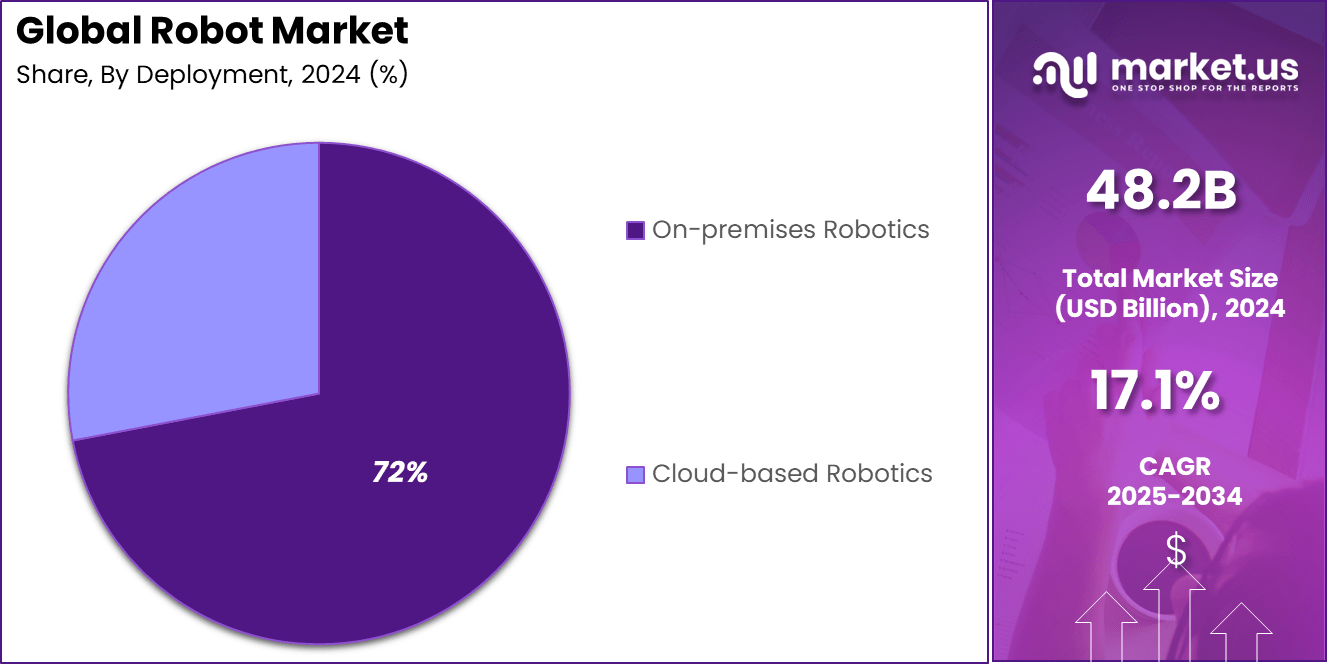
The Global Robot Market size is expected to be worth around USD 233.7 Billion By 2034, from USD 48.2 billion in 2024, growing at a CAGR of 17.1% during the forecast period from 2025 to 2034. In 2024, APAC held a dominant market position, capturing more than a 62.2% share, holding USD 29.98 Billion revenue.
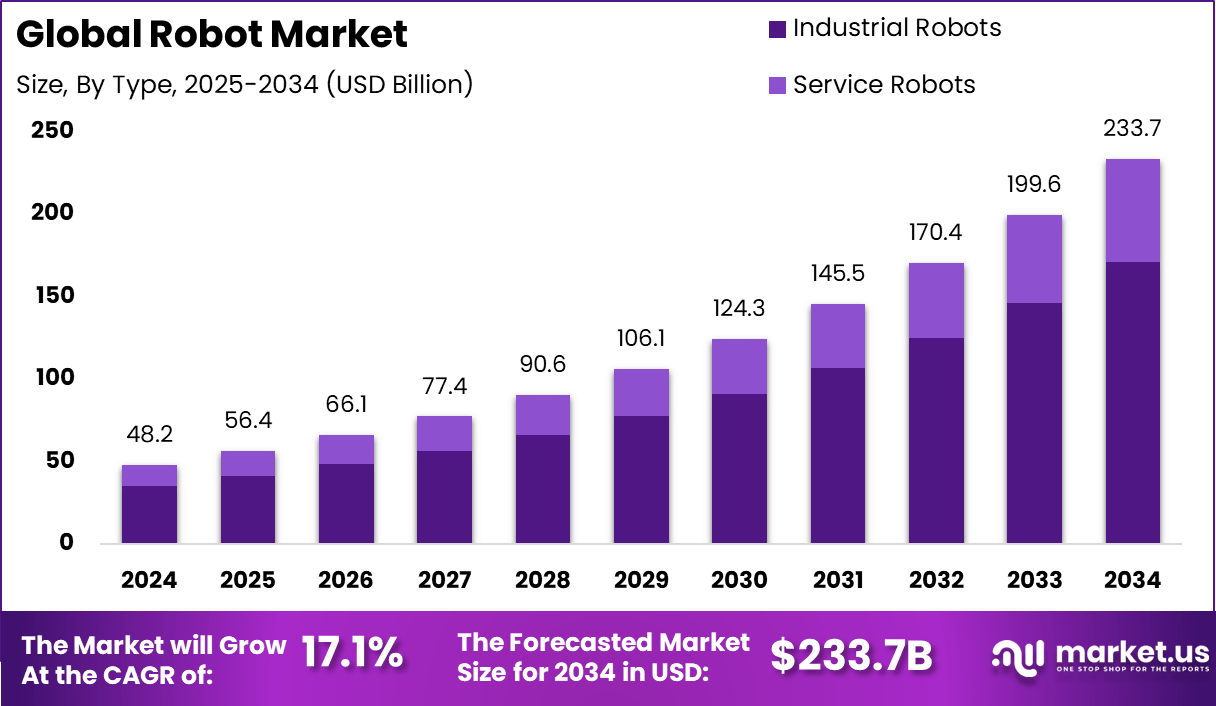
The robot market encompasses a broad range of mechanical and intelligent machines designed to perform tasks autonomously or semi‑autonomously. It spans industrial robots, service robots (including humanoids, quadrupeds, rescue units), and robotic process automation systems. The market is characterised by rapid innovation, integration with artificial intelligence, and deployment across diverse sectors.
According to Exploding Topics, Asia contributes over one-third of the global robotics industry’s revenue, highlighting its dominant role in the sector. Currently, there are over 3.4 million industrial robots operating worldwide, and the robot-to-human ratio in manufacturing stands at 1:71. Industrial companies are expected to allocate 25% of their capital to automation within the next five years, while 14% of workers have already lost jobs due to robotic integration.
Data from Zippia reinforces this trend, reporting that 88% of companies plan to adopt robotics in their operations. An estimated 3 million robots are in use globally, with approximately 400,000 new units entering the market each year. The global industrial robotics industry holds a market value of $43.8 billion by revenue, with the North American robotics sector growing at a CAGR of 11.70% through 2026
The top driving factors can be attributed to a growing need for automation and operational efficiency in industries such as manufacturing, logistics, healthcare, and emergency response. Rapid improvements in sensor technologies, artificial intelligence, machine learning, and cloud‑based infrastructure have accelerated robotic capabilities. Governments and large economies are funding R&D and deploying incentive programs to support robotics adoption.
Market Size and Growth
| Trend/Innovation | Description |
|---|---|
| Collaborative & Mobile Robots | Cobots and AMRs for flexible, safe use alongside people in dynamic, non-traditional settings |
| AI-Driven Adaptive Robotics | Use of generative AI, reinforcement learning, and multi-agent systems for more flexible, capable robots |
| Modular & Customizable Platforms | Robots with swappable hardware/software for multiple tasks, industries, and payloads |
| Human-Like Interaction | Advances in NLP, facial expression, gesture, and emotional intelligence for more natural engagement |
| Green & Energy-Efficient Robots | Low-power motors, sustainable materials, and circular life cycles to reduce operational costs/emissions |
Key Market Segments
By Type
- Industrial Robots
- Articulated Robots
- SCARA Robots
- Cartesian Robots
- Delta Robots
- Collaborative Robots (Cobots)
- Parallel Robots
- Service Robots
- Personal Service Robots
- Professional Service Robots
By Component
- Hardware
- Controllers
- Sensors (e.g., LiDAR, Cameras)
- Actuators
- End Effectors
- Software
- Services
- Integration Services
- Maintenance and Support
By Deployment
- Cloud-based Robotics
- On-premises Robotics
By Mobility
- Fixed Robots
- Mobile Robots
- Humanoid Robots
By Application
- Assembly & Production
- Inspection & Quality Control
- Material Handling
- Welding & Soldering
- Packaging & Palletizing
- Others
By End Use Industry
- Manufacturing & Industrial
- Automotive
- Electronics & Semiconductor
- Food & Beverage
- Pharmaceuticals
- Metal & Machinery
- Healthcare
- Defense
- Agriculture
- Others
Key Regions and Countries
- North America
- US
- Canada
- Europe
- Germany
- France
- The UK
- Spain
- Italy
- Russia
- Netherlands
- Rest of Europe
- Asia Pacific
- China
- Japan
- South Korea
- India
- Australia
- Singapore
- Thailand
- Vietnam
- Rest of Latin America
- Latin America
- Brazil
- Mexico
- Rest of Latin America
- Middle East & Africa
- South Africa
- Saudi Arabia
- UAE
- Rest of MEA
Driver Analysis
Rising Demand for Automation in Industries
One significant driver propelling the robot market is the growing demand for automation across various industries. Many sectors such as manufacturing, logistics, and healthcare are increasingly adopting robotic systems to enhance operational efficiency and productivity. Robots can perform repetitive and precise tasks faster and more accurately than human labor, which helps companies reduce production time and lower costs.
Additionally, the integration of smart technologies like artificial intelligence and machine learning in robots enables more adaptive and intelligent systems, further increasing their appeal. This trend is reinforced by labor shortages and the need to reduce workplace accidents, making robots a crucial solution for modern industrial challenges. The adoption of robotics not only streamlines processes but also improves product quality and consistency, which is vital in competitive markets.
Moreover, technological advancements continuously expand the capabilities of robots, opening new application areas and driving broader market acceptance. Innovations such as low-code programming platforms simplify robot deployments, making automation accessible to small and medium enterprises who previously lacked the resources or skills.
Restraint Analysis
Skill Gap and Integration Challenges in SMEs
Despite the robust growth prospects, the robot market faces a major restraint in the form of a persistent skill gap, especially among small and medium-sized enterprises (SMEs). Many SMEs struggle to find or train engineers and technicians skilled enough to deploy, operate, and maintain robotic systems effectively. This shortage extends payback periods on investments and leads to under-utilization of robotic assets, limiting the market’s full potential.
The concentration of expert integrators in urban hubs leaves many regional and smaller firms underserved. Without accelerated skill development programs or more turnkey robotics solutions, a considerable portion of the potential demand remains untapped, slowing market growth. Additionally, the integration of robots into existing operations is complicated by technical and organizational challenges.
Companies must align robotics with their workflows, supply chains, and IT infrastructure, which can be costly and time-consuming. For many businesses, especially in developing markets, this integration complexity acts as a barrier to robotics adoption. Until solutions that simplify deployment and provide comprehensive support become widely available, these restraints will continue to dampen enthusiasm among smaller players in the market.
Opportunity Analysis
Expansion of Robotics in Emerging Markets
The expanding adoption of robotics in emerging economies presents a key opportunity for market growth. Countries in Asia-Pacific, Latin America, and parts of the Middle East are witnessing rising demand as they accelerate industrialization and modernization. In these regions, robotics can address labor shortages and improve manufacturing quality and throughput in sectors such as automotive, electronics, and logistics.
Governments in many emerging markets are actively promoting automation and smart manufacturing through policies, incentives, and investment in skill development. This supportive environment creates fertile ground for robotics companies to expand their footprint.
Furthermore, the increasing affordability of robots due to declining prices and innovations such as RaaS business models makes robotics accessible to smaller enterprises and startups that previously could not afford automation. This democratization of robotics technology enables new users across diverse sectors to benefit from automation, unlocking vast unrealized demand.
Challenge Analysis
High Costs and Complexity of Robot Deployment
A major challenge facing the robot market is the high cost and complexity associated with purchasing, integrating, and programming advanced robotic systems. The upfront procurement expenses, combined with the need for specialized accessories and software, can be prohibitive for many potential buyers.
Additionally, implementing robots often requires significant changes to existing workflows, staff training, and infrastructure upgrades, which complicates deployment and prolongs return on investment timelines. For industries with fluctuating demand or limited capital, these factors create hesitation to adopt robotics broadly.
Moreover, the technological sophistication of modern robots, including AI and sensor integration, demands skilled personnel and robust cybersecurity measures, adding layers of complexity and cost. Supply chain disruptions and component price volatility, such as for rare-earth magnets used in robot motors, also affect market stability and increase project risks.
Competitive Landscape
In the global robot market, ABB Ltd. has maintained a strong foothold due to its versatile portfolio in industrial automation. The company is known for its advanced robotic arms used across automotive, electronics, and logistics industries. ABB has been investing in collaborative robots to strengthen its presence in human-machine interaction spaces.
Fanuc Corporation is widely recognized for its high-performance automation systems and robust industrial robots. The company’s strength lies in its precision control, reliability, and energy-efficient models, which are widely used in manufacturing and assembly lines. Fanuc has emphasized artificial intelligence integration in recent years, enhancing productivity through smart diagnostics and predictive maintenance.
KUKA AG, Universal Robots, and Boston Dynamics are reshaping the competitive dynamics of the robot industry. KUKA focuses on intelligent automation for smart factories, while Universal Robots dominates the collaborative robot segment due to its compact and flexible designs. These robots are widely adopted by small and medium enterprises. Boston Dynamics has disrupted the market with its agile, mobile robots tailored for logistics, defense, and construction sectors.
Top Key Players in the Market
- ABB Ltd.
- Fanuc Corporation
- KUKA AG
- Universal Robots
- Boston Dynamics
Recent Developments
- In July 2025, ABB expanded its robot portfolio further by introducing three new families tailored for the Chinese mid-market, aiming to address growing automation demand among mid-sized businesses. These new robots offer flexible payload handling and high-speed operations, supporting sectors from electronics to food and beverage with an expected 8% annual growth in the Chinese market over the next few years.
- Fanuc Corporation, despite a challenging global economic landscape, has maintained resilience. Their industrial robot sales saw a slight dip of around 16% for the fiscal period ending March 2025, impacted mostly by weaker demand in China, Europe, and the Americas automotive sectors.