

Report Overview
The AI In Packaging Design Market was valued at USD 2,917.10 Million in 2024 and is projected to rise to USD 3,243.82 Million in 2025, growing at a CAGR of 11.2% to reach USD 8,433.3 Million by 2034. In 2024, North America held a dominant market position, capturing more than a 35.8% share, holding USD 1,044.3 Million revenue.
The AI in Packaging Design Market is characterized by a growing integration of artificial intelligence tools that assist in creating packaging which meets evolving consumer preferences, regulatory demands, and operational efficiency standards. The sector is marked by innovation in generative design techniques, machine learning–driven simulations, and sustainability‑oriented frameworks.
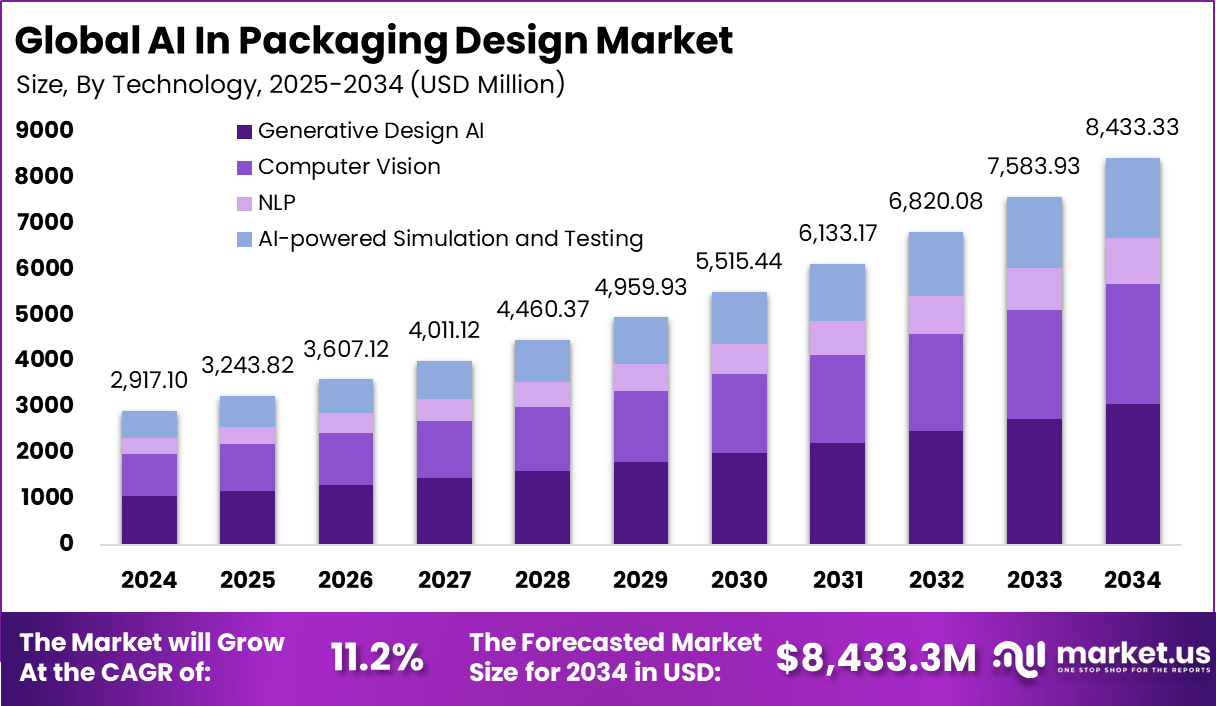
Top driving factors for AI adoption in packaging design include growing demand for customization, operational efficiency, and sustainability. As brands compete in a crowded marketplace, the push for personalized packaging that resonates with consumer preferences is stronger than ever. AI allows companies to analyze big data sets, rapidly create localized variations, and modify designs in real time based on market trends.
The emphasis on environmental responsibility and smart packaging solutions, especially in sectors like food, beverage, electronics, and pharmaceuticals, accelerates this transformation by making it easier to select eco-friendly materials and reduce waste at scale. Demand for AI in packaging design is growing as manufacturers, retailers, and e-commerce platforms recognize its ability to increase speed-to-market and reduce costs.
Market Size and Growth
| Trend/Innovation | Description |
|---|---|
| Generative AI for Automated Design | Tools generating multiple design options based on brand, cost, and material constraints |
| AI-Driven Sustainability & Material Selection | Focus on minimizing environmental impact with optimized material consumption and eco-friendly alternatives |
| Personalized & Dynamic Packaging | Packaging customized at scale with AI-powered user data, allowing on-demand and locale-specific designs |
| Virtual and Augmented Reality in Design | Enhanced visualization, immersive consumer interaction, and digital storytelling using VR/AR |
| AI Agents & Robotics for Packaging Workflow | Autonomous AI agents automate design, quality control, labelling, and integrate consumer feedback for continuous improvement |
Key Market Segments
By Technology
- Generative Design AI
- Computer Vision
- Natural Language Processing
- AI-powered Simulation and Testing
By Industry Vertical
- Food and Beverage
- Healthcare and Pharmaceuticals
- Consumer Electronics
- Personal Care and Beauty
By End Use
- Packaging Design Agencies
- Manufacturers and Packaging Companies
- E-commerce and Retail
Regional Analysis and Coverage
- North America
- US
- Canada
- Europe
- Germany
- France
- The UK
- Spain
- Italy
- Russia
- Netherlands
- Rest of Europe
- Asia Pacific
- China
- Japan
- South Korea
- India
- Australia
- Singapore
- Thailand
- Vietnam
- Rest of Latin America
- Latin America
- Brazil
- Mexico
- Rest of Latin America
- Middle East & Africa
- South Africa
- Saudi Arabia
- UAE
- Rest of MEA
Driver Analysis
One of the key drivers in the AI packaging design market is the rising demand for sustainability and waste reduction. AI technologies help companies optimize packaging structure to use fewer materials without compromising product protection, fulfilling stricter environmental regulations and appealing to eco-conscious consumers.
Additionally, the growing e-commerce sector demands visually striking and functional packaging that withstands logistics challenges, which AI facilitates by tailoring designs for shipping efficiency and end-user interaction.
AI-powered data analytics allow brands to understand consumer behavior and market trends better, enabling more personalized packaging that enhances brand loyalty and visibility. These advantages collectively push companies to adopt AI solutions as strategic assets to remain competitive.
Restraint Analysis
Despite its benefits, the adoption of AI in packaging design faces several challenges. High initial investment costs and the complexity of integrating AI technologies into existing workflows pose significant barriers, especially for smaller companies. Moreover, AI lacks the ability to fully replicate human creativity, emotional insight, and brand essence, requiring human oversight for final design decisions.
Data privacy and security concerns also limit adoption, as AI systems depend heavily on the collection and processing of sensitive information, which must comply with increasing regulatory constraints. These factors cause hesitation among some businesses in fully embracing AI-driven packaging design solutions.
Opportunity Analysis
AI opens promising opportunities to innovate packaging beyond aesthetics. It enables the creation of sustainable designs that reduce environmental impact through material optimization and recycling-friendly solutions.
Integration of AI with augmented reality offers immersive consumer experiences and new revenue streams by enhancing brand engagement through interactive packaging. The ability to generate unique, market-specific packaging rapidly supports product differentiation and faster go-to-market strategies.
Furthermore, AI can streamline production by minimizing waste and inefficiencies, which aligns with rising industry and consumer expectations for responsible manufacturing practices. Growing interest in smart packaging with real-time freshness and supply chain tracking also presents new frontiers for AI-enabled advancements.
Challenge Analysis
The primary challenge lies in balancing AI’s efficiency with ethical and practical considerations. While AI improves speed and customization, it may lead to over-reliance on data-driven processes, risking loss of human-centered creativity and brand storytelling.
Ensuring transparent AI operations, respecting consumer privacy, and maintaining regulatory compliance require ongoing efforts. Additionally, finding skilled professionals capable of deploying and managing AI tools in packaging design remains a hurdle for widespread adoption.
Companies must also carefully manage transitions to AI-enhanced workflows to avoid operational disruptions. Ultimately, aligning AI capabilities with long-term sustainability goals and creating trusted consumer experiences are critical for overcoming these hurdles.
Competitive Analysis and Coverage
Autodesk Inc. has been recognized for integrating AI into its packaging design software, enabling enhanced 3D modeling and automated layout optimization. AWS plays a crucial role in offering scalable cloud infrastructure that supports AI algorithms for material simulation and design analysis. ABB applies industrial AI to streamline packaging processes, using robotics and predictive analytics.
Adobe Inc. continues to improve generative design capabilities in its creative tools, aiding designers in creating packaging mockups with AI-based customization that shortens the product development lifecycle. Esko-Graphics BV. has adopted AI for smart prepress tools and packaging workflow automation, enhancing file preparation and color accuracy.
Kongsberg Precision Cutting Systems is contributing through AI-enhanced digital cutting solutions for prototyping and short-run production. SAP SE integrates AI in supply chain design, assisting packaging designers in material selection and sustainability modeling. These companies focus on enabling intelligent packaging systems that are data-driven and user-centric.
Siemens AG brings AI-based simulation and digital twin capabilities into packaging design, helping manufacturers visualize and test packaging performance virtually. Transcontinental Inc. invests in AI to optimize flexible packaging processes with a focus on efficiency and sustainability. Sourceful Ltd uses AI-powered tools to offer real-time design suggestions and carbon impact assessments, aligning with the demand for eco-conscious packaging.
Top Key Players in the Market
- Autodesk Inc.
- AWS
- ABB
- Adobe Inc.
- Esko-Graphics BV.
- Kongsberg Precision Cutting Systems
- SAP SE
- Siemens AG
- Transcontinental Inc.
- Sourceful Ltd
Recent Developments
- Autodesk has been particularly active, acquiring Wonder Dynamics in 2024 to augment their cloud-based AI offerings. This acquisition enhances Autodesk’s ability to empower creatives with AI tools that accelerate 3D content creation without replacing artistic input, ensuring faster and more efficient workflows.
- ABB strengthened its AI and software capabilities with the acquisition of Meshmind in early 2024. This move focuses on developing AI-powered solutions including machine learning and vision systems- critical for packaging operations requiring automation and intelligent inspection tools.