

Report Overview
The Global AI in Virtual Reality Training Sports Market size is expected to be worth around USD 14,495.3 million by 2035, from USD 1,171.7 million in 2025, growing at a CAGR of 28.6% during the forecast period from 2025 to 2035. North America held a dominant market position, capturing more than a42.3% share, holding USD 495.6 million in revenue.
The AI in virtual reality training sports market refers to the use of artificial intelligence combined with virtual reality to enhance sports training and performance development. These solutions simulate real-game environments and analyze athlete movements, reactions, and decision-making in immersive settings. AI-driven VR training is used by professional teams, sports academies, coaches, and athletes. The technology supports skill development, tactical training, and performance assessment.
Adoption improves training realism and data-driven coaching. Market development has been influenced by the growing need for advanced and safe training methods. Traditional sports training often requires physical repetition and live opponents. VR environments allow athletes to train without injury risk or logistical constraints. AI enhances these simulations by adapting scenarios to individual performance levels. As sports become more data-focused, intelligent VR training gains importance.
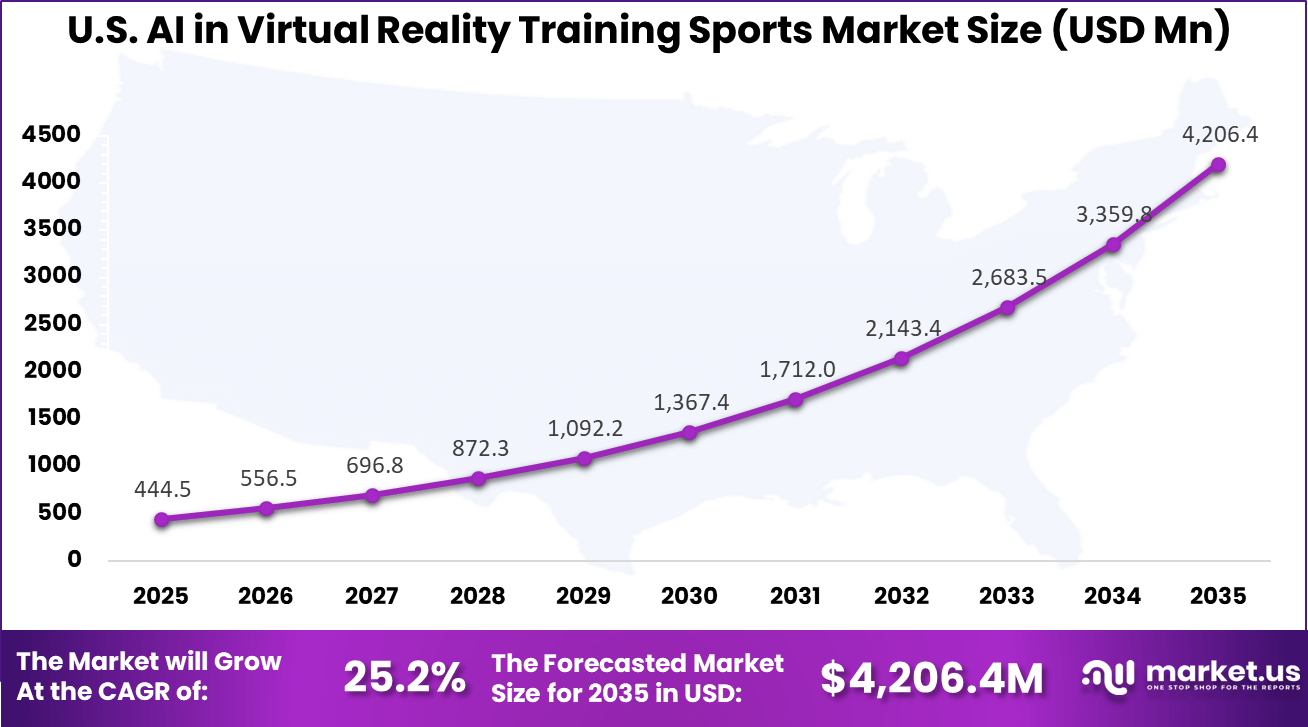
Teams use VR to supplement physical training and tactical preparation. The ability to simulate complex scenarios improves readiness. This is especially valuable during recovery periods or congested match schedules. As competition intensifies, professional teams continue to adopt innovative training tools. Long-term performance development drives sustained investment. This positions teams and clubs as the primary end users. North America accounts for 42.3% of the AI in virtual reality training sports market, supported by early technology adoption and strong investment in sports innovation. Professional teams across the region actively integrate AI and VR to enhance training efficiency and player performance. Advanced infrastructure and access to skilled technology providers further support market development. For instance, in Sportsbox AI, at the 2025 U.S. Open, Sportsbox AI analyzed fans’ golf swings in 15 seconds using AI-powered 3D motion capture, providing instant pelvis and chest rotation metrics. This fan engagement initiative highlights North American dominance in VR/AI sports analytics, bridging professional training tech with consumer experiences. A CAGR of 25.2% indicates strong growth momentum across the region. Increasing competition, higher performance expectations, and continued digital transformation support expansion. North America remains a leading region for innovation and adoption in AI-driven VR sports training. For instance, in June 2025, Strivr Advanced enterprise VR adoption with custom training modules for sports and the workforce, achieving high retention rates. NFL teams and retailers use Strivr for immersive scenarios, solidifying U.S. leadership in AI-VR sports performance training. Specialized sports and skill training providers such as Sense Arena, Beyond Sports, and Sportsbox AI emphasize biomechanics and technique improvement. WIN Reality and Golf+ address sport-specific needs. These solutions help athletes train remotely with consistent feedback. Growth is supported by rising investment in athlete performance analytics and personalized coaching tools. Platform and ecosystem driven players such as META support hardware and developer infrastructure for sports VR training. HOLOFIT and Mobalytics extend AI driven insights into hybrid training models. Emerging vendors add innovation in motion learning and analytics. Other players strengthen regional adoption. This competitive landscape supports steady innovation and expanding use of AI powered VR training across professional and amateur sports.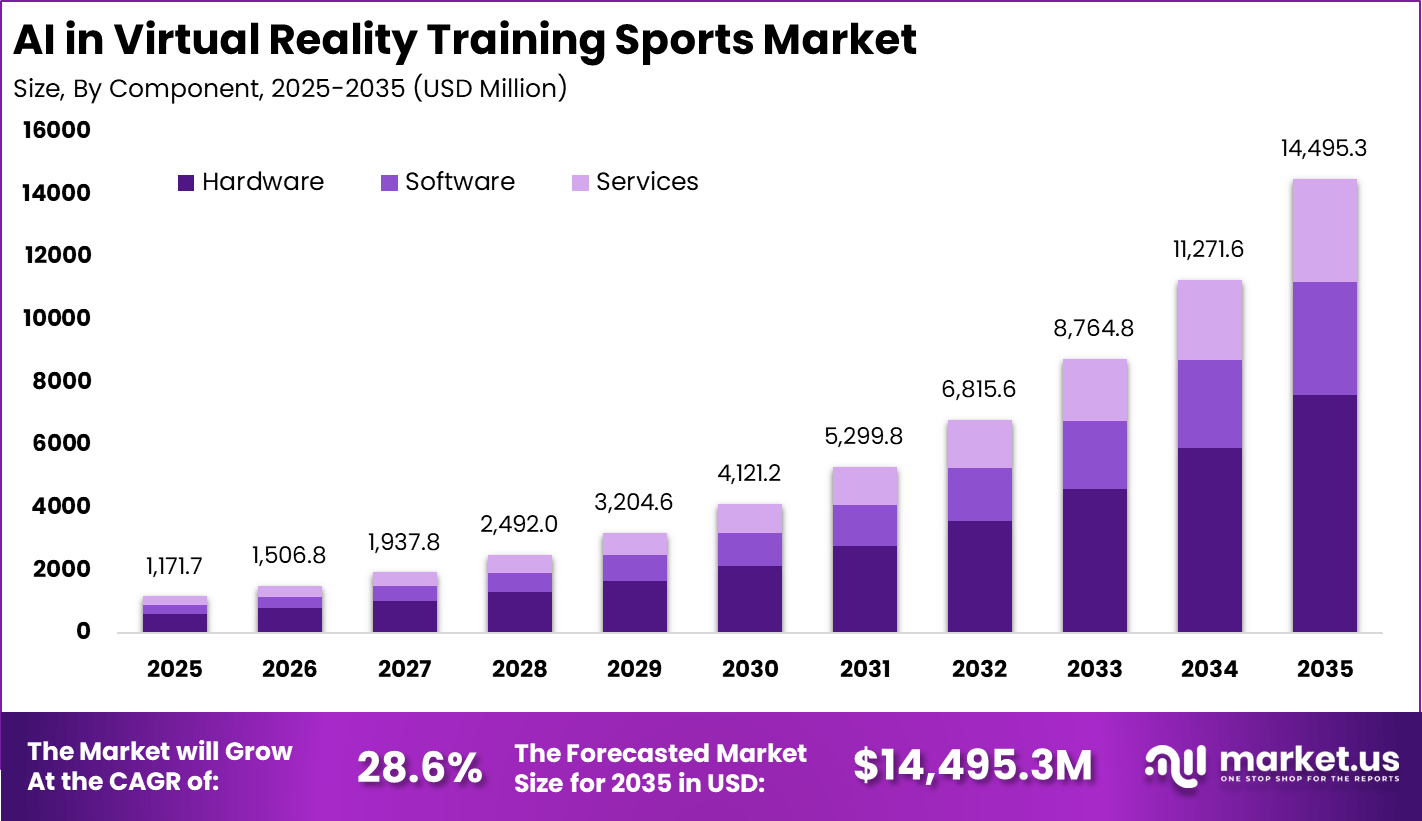
Regional Analysis
Market Share 42.3% | United States USD 444.5 Million | CAGR 25.2%
Region Primary Growth Driver Regional Share (%) Regional Value (USD Mn) Adoption Maturity North America Advanced sports technology adoption 34.8% USD 407.7 Mn Advanced Europe Professional football training innovation 29.6% USD 346.8 Mn Advanced Asia Pacific Expansion of elite sports academies 23.7% USD 277.7 Mn Developing to Advanced Latin America Football focused training investments 6.8% USD 79.7 Mn Developing Middle East and Africa Early adoption by professional clubs 5.1% USD 59.8 Mn Early 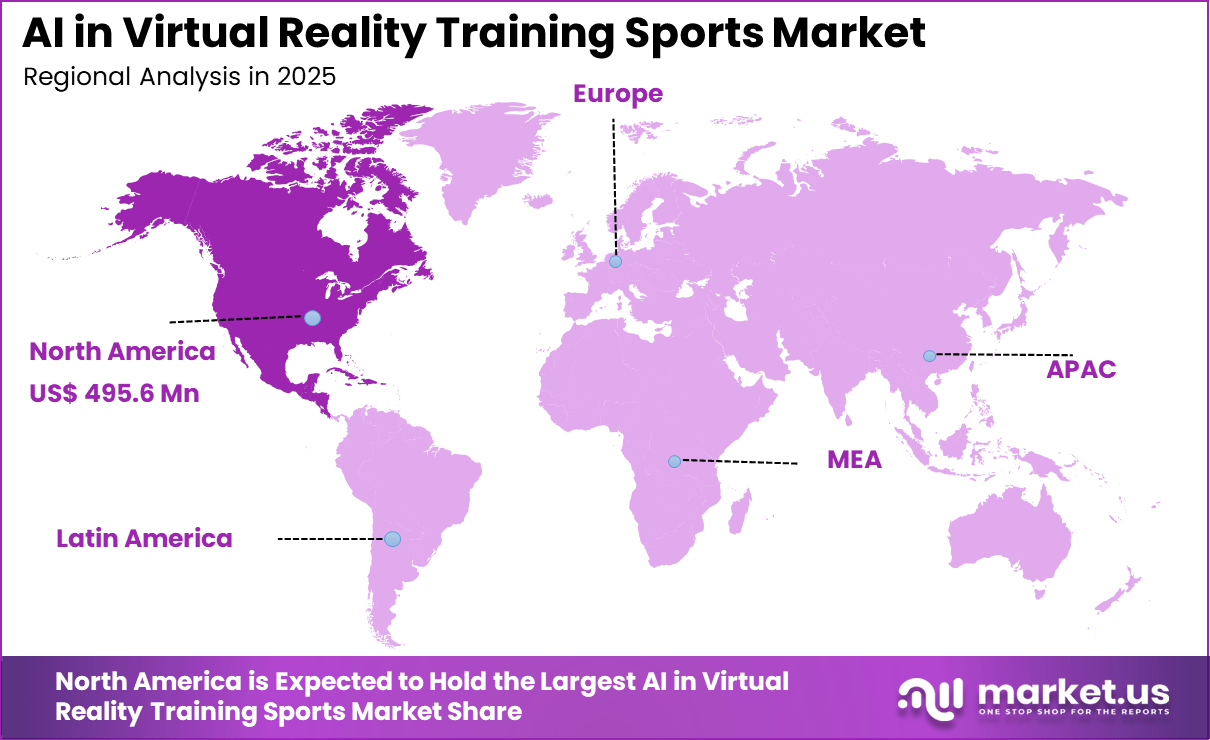
Top Key Players in the Market
Recent Developments