

Report Overview
The Global AI Sports Scheduling Optimization Market size is expected to be worth around USD 3,918.6 million by 2035, from USD 441.5 million in 2025, growing at a CAGR of 24.4% during the forecast period from 2025 to 2035. North America held a dominant market position, capturing more than a42.6% share, holding USD 188.0 million in revenue.
The AI sports scheduling optimization market refers to software solutions that use artificial intelligence to design, adjust, and manage sports schedules efficiently. These platforms consider multiple factors such as team availability, venue capacity, travel distance, rest periods, and broadcast requirements. AI-based scheduling tools are used by sports leagues, federations, tournament organizers, and broadcasters. They help reduce conflicts and improve schedule fairness. Adoption supports smoother competition planning and execution.
Demand for AI sports scheduling optimization solutions is influenced by expansion of professional leagues and tournaments. More teams and matches increase scheduling complexity. Organizers require scalable tools to manage this growth. AI systems handle large datasets efficiently. Expansion drives demand. Software accounts for 64.7% of the AI sports scheduling optimization market, reflecting its central role in automating complex scheduling tasks. Scheduling platforms process large datasets related to teams, venues, travel, and broadcast requirements. AI-driven software helps reduce manual planning effort and scheduling conflicts. Sports organizations rely on software solutions to simulate multiple scheduling scenarios. These systems optimize fixture allocation while considering operational constraints. The ability to adjust schedules dynamically improves planning accuracy. As leagues expand and competition formats become more complex, demand for advanced scheduling software continues to grow. Software flexibility supports customization for different sports and formats. This sustains its leading position in the market. Cloud-based deployment holds a 70.3% share, driven by the need for scalability and collaboration. Cloud platforms allow multiple stakeholders to access scheduling systems in real time. This supports coordination among leagues, teams, and broadcasters. Cloud deployment enables rapid updates and centralized data management. Scheduling changes can be implemented efficiently without system downtime. This improves responsiveness during season planning and live events. The preference for cloud-based systems is also influenced by cost efficiency. Organizations avoid heavy infrastructure investments. Cloud deployment remains the dominant model for AI scheduling solutions. Professional sports leagues account for 53.8% of application demand, making them the primary users of scheduling optimization tools. Leagues manage large numbers of teams, fixtures, and venues across long seasons. AI helps balance competitive fairness and logistical efficiency. Scheduling optimization improves travel planning and reduces player fatigue. AI systems consider rest periods, venue availability, and broadcast requirements. This supports smoother season execution. As leagues seek operational efficiency and fan engagement, AI-based scheduling becomes essential. Professional leagues continue to invest in optimization tools. This drives sustained adoption in this segment. Football represents 41.5% of market adoption by sports type. The sport’s global scale and dense competition calendars create complex scheduling challenges. AI tools help manage domestic leagues, international tournaments, and club competitions. Football scheduling requires coordination across multiple stakeholders. AI systems optimize match timing to balance competitive integrity and commercial value. This reduces scheduling conflicts and delays. The high volume of matches supports strong demand for automation. Football organizations prioritize efficient scheduling solutions. This keeps football as a leading sport type in the market. Large enterprises account for 76.2% of market demand, reflecting their capacity to adopt advanced AI solutions. Major leagues and organizations manage extensive schedules and operational complexity. AI helps them streamline planning and decision-making. Large organizations require systems that handle high data volumes and multiple constraints. AI scheduling platforms meet these needs effectively. Integration with other sports management systems further enhances value. As competition and operational scale increase, large enterprises continue to invest in optimization technologies. Their resource availability supports early adoption. This segment remains dominant. Tournament organizers and leagues represent 42.9% of end-user demand. These entities are responsible for event planning, match sequencing, and venue coordination. AI scheduling tools help ensure efficient tournament execution. AI systems enable organizers to adapt schedules based on unforeseen changes. This improves event reliability and stakeholder coordination. Reduced planning time supports cost control. As tournament formats evolve, demand for intelligent scheduling increases. Organizers seek tools that improve accuracy and flexibility. This supports steady adoption in this end-user segment. North America holds a 42.6% share of the AI sports scheduling optimization market, supported by advanced sports management practices. Professional leagues in the region adopt AI to improve operational efficiency. Digital infrastructure supports rapid technology integration. For instance, in May 2025, AWS expanded its collaboration with the NFL, using Amazon EC2–powered algorithms and machine learning to evaluate hundreds of thousands of schedule scenarios and optimize the 2025–26 season calendar for competitiveness, travel, and broadcast priorities, reinforcing North America’s lead in AI-driven sports scheduling optimization.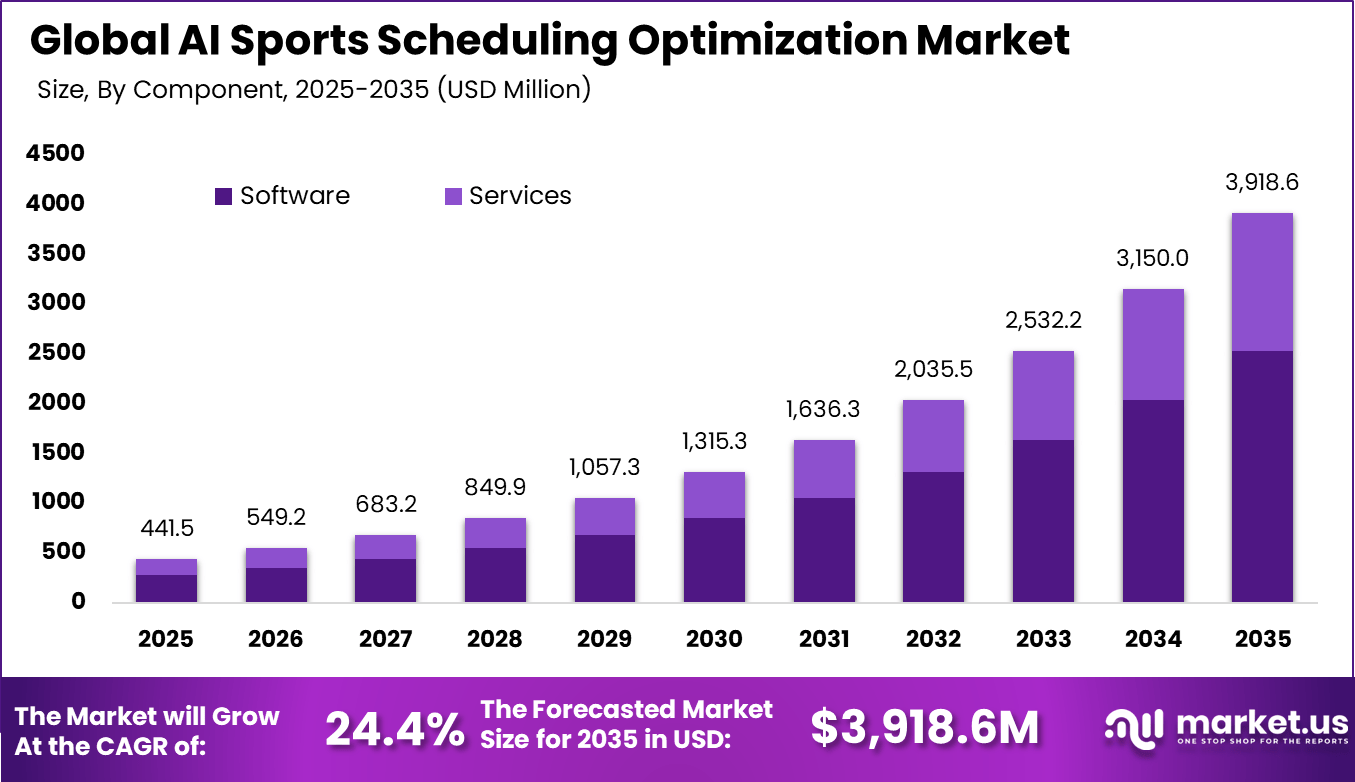
Key Takeaway
Efficiency and Operational Statistics
Drivers Impact Analysis
Driver Category Key Driver Description Estimated Impact on CAGR (%) Geographic Relevance Impact Timeline Expansion of professional sports leagues Complex multi venue scheduling needs ~6.7% North America, Europe Short Term Growth in broadcast and media rights Optimized fixtures for viewership ~5.8% Global Short Term Adoption of AI optimization algorithms Reduced scheduling conflicts ~4.9% Global Mid Term Increase in international tournaments Cross border calendar coordination ~4.1% Global Mid Term Focus on cost and logistics efficiency Travel and venue optimization ~2.9% Global Long Term Risk Impact Analysis
Risk Category Risk Description Estimated Negative Impact on CAGR (%) Geographic Exposure Risk Timeline Data dependency Inaccurate team or venue data ~4.6% Global Short Term Integration complexity Alignment with league management systems ~3.9% Global Short to Mid Term Algorithm transparency concerns Limited trust in AI decisions ~3.2% Global Mid Term High customization requirements League specific rule complexity ~2.7% Global Mid Term Vendor concentration Limited specialized solution providers ~2.1% Global Long Term Restraint Impact Analysis
Restraint Factor Restraint Description Impact on Market Expansion (%) Most Affected Regions Duration of Impact High initial deployment cost Enterprise grade optimization platforms ~5.1% Emerging Markets Short to Mid Term Limited SME adoption Budget constraints for smaller leagues ~4.2% Global Mid Term Change management resistance Manual scheduling preferences ~3.5% Global Mid Term Interoperability issues Legacy scheduling tools ~2.8% Global Long Term Unclear ROI for smaller events Lower scale benefits ~2.2% Global Long Term Component Analysis
Deployment Analysis
Application Analysis
Sports Type Analysis
Organization Size Analysis
End-User Analysis
Regional Analysis
Region Primary Growth Driver Regional Share (%) Regional Value (USD Mn) Adoption Maturity North America Large scale professional leagues 42.6% USD 188.1 Mn Advanced Europe Dense football league calendars 31.8% USD 140.4 Mn Advanced Asia Pacific Expansion of regional sports leagues 18.9% USD 83.5 Mn Developing to Advanced Latin America Growth in domestic tournaments 4.1% USD 18.1 Mn Developing Middle East and Africa Early sports infrastructure digitization 2.6% USD 11.5 Mn Early 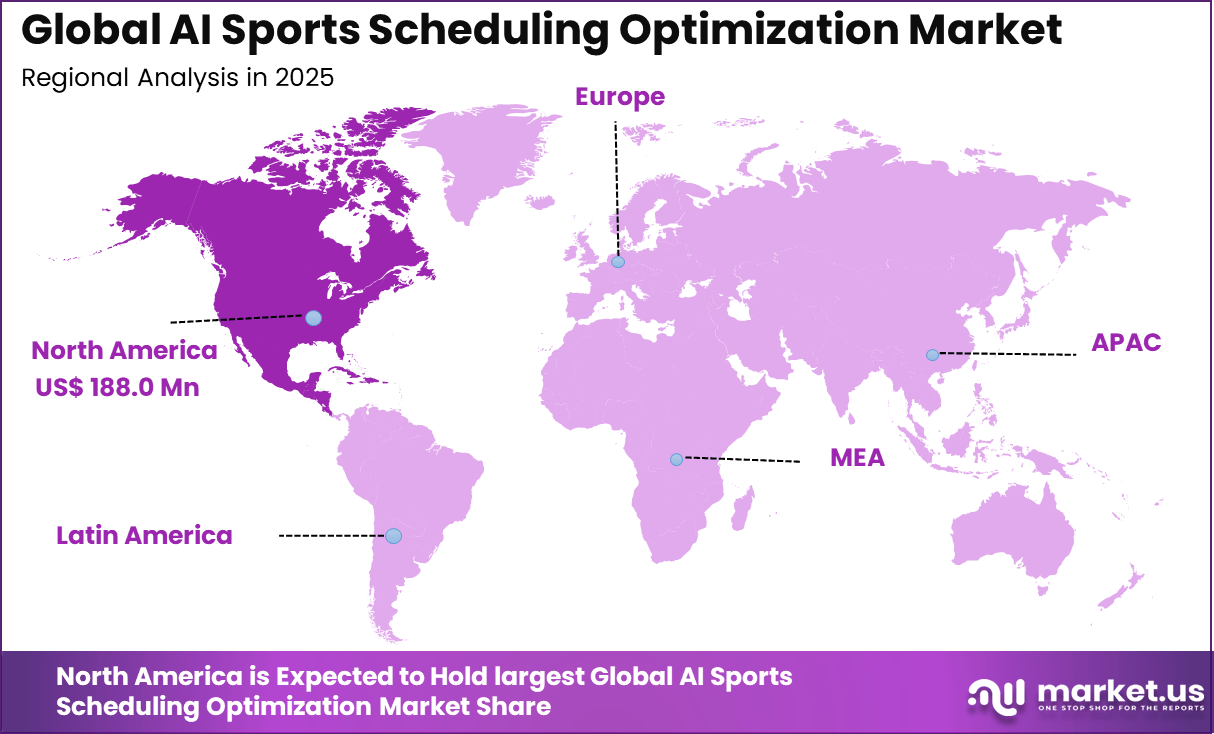
Top 5 Companies
Company Core Solution Focus AI & Analytics Strength Primary Customer Base Role in Fraud Detection Competitive Positioning Sportradar AG Sports integrity and betting monitoring Advanced AI pattern recognition, real time anomaly detection Sportsbooks, leagues, regulators Detects match manipulation and suspicious betting patterns Market leader with deep league partnerships Genius Sports Betting data and integrity services Machine learning for odds movement and fraud signals Betting operators, sports leagues Monitors abnormal wagering behavior Strong global sportsbook integration Stats Perform Sports data intelligence and analytics AI driven statistical modeling and risk analysis Sportsbooks, federations, media Identifies data anomalies and betting risks Trusted analytics provider with Opta data Amazon Web Services, Inc. Cloud infrastructure and AI services Scalable AI, real time data processing Betting platforms, analytics vendors Enables large scale fraud detection systems Dominant cloud backbone for AI deployment IBM Corporation Enterprise AI and governance solutions Explainable AI, predictive risk analytics Regulators, large betting operators Supports compliance and fraud investigation Strong enterprise and regulatory credibility Top Key Players in the Market
Recent Developments