

Report Overview
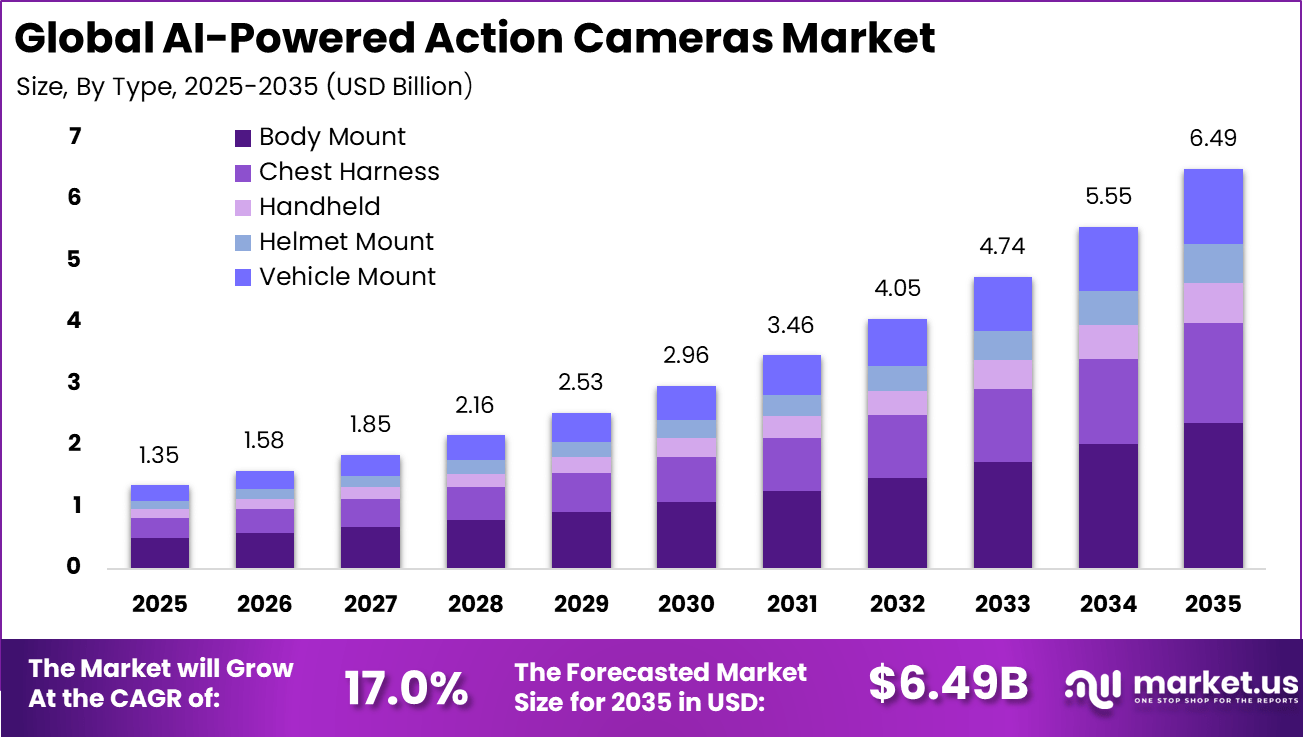
The Global AI-Powered Action Cameras Market size is expected to be worth around USD 6.49 billion by 2035, from USD 1.35 billion in 2025, growing at a CAGR of 17.0% during the forecast period from 2025 to 2035. North America held a dominant market position, capturing more than a36.5% share, holding USD 0.49 billion in revenue.
AI-Powered Action Cameras Market refers to advanced wearable and mountable camera systems that integrate artificial intelligence to enhance video capture, processing, and user experience. These cameras use on-device intelligence to automate functions such as scene recognition, stabilization, subject tracking, and highlight generation.
The market has evolved from basic recording devices into intelligent imaging tools that adapt to movement, environment, and user intent. This evolution reflects broader adoption of AI at the edge, where processing happens directly on the device. The market is driven by demand for smarter content creation tools across sports, travel, outdoor recreation, and professional field use.
Investor Type Impact Matrix
| Investor Type | Adoption Level | Contribution to Market Growth (%) | Key Motivation | Investment Behavior |
|---|---|---|---|---|
| Action camera manufacturers | Very High | ~63.9% | Expanding product portfolio with AI features | Long term strategic development |
| AI and software solution providers | High | ~22.5% | Enhancing camera functionality and user experience | R and D focused |
| Sports and adventure companies | High | ~15.1% | Improving product offerings for content creators | Strategic product integration |
| Retail investors | Moderate | ~5.6% | Supporting emerging tech for personal use | Early stage funding |
| Tech and electronics firms | Moderate | ~3.7% | Exploring AI for competitive advantage in cameras | Innovation driven investments |
Technology Enablement Analysis
| Technology Layer | Enablement Role | Impact on Market Growth (%) | Adoption Status |
|---|---|---|---|
| AI driven image stabilization | Smoothing video and improving recording quality | ~7.2% | Growing |
| Deep learning algorithms | Enhancing video quality and content recognition | ~6.1% | Growing |
| Wearable technology integration | Embedding AI into action cameras for portability | ~5.5% | Mature |
| 4K video recording | High quality video capture for content creators | ~4.2% | Mature |
| Edge computing for real time processing | Efficient on device AI processing for instant results | ~3.8% | Developing |
Driver Analysis
The AI-powered action cameras market is expanding due to the increasing demand for smarter video capture solutions that enhance content creation and simplify use during dynamic activities. Users in sports, travel, adventure, and livestreaming rely on action cameras that can handle rapid movement, changing lighting, and unpredictable environments.
AI-powered cameras offer features like real-time image enhancement, automatic subject tracking, scene recognition, and adaptive exposure control. These capabilities improve video quality without the need for manual adjustments, making them attractive to both consumers and professionals.
Restraint Analysis
A key restraint in the AI-powered action camera market is the higher cost compared to standard action cameras. The integration of AI technologies, such as on-device neural processing and advanced sensors, increases the price point of these cameras. For casual users, the premium cost may not justify the added benefits, especially when other devices like smartphones can offer satisfactory performance for less money. Additionally, compatibility with various accessories and mounts can create complexity for users.
Opportunity Analysis
The AI-powered action camera market holds several opportunities, particularly in expanding use cases beyond traditional action sports into areas like professional content creation, remote monitoring, security, and immersive experiences. AI features like intelligent editing, automatic highlight extraction, and object recognition can enhance productivity for content creators.
Integration with mobile apps and cloud platforms for easy sharing and editing also increases the appeal. There is potential for specialised solutions in niche markets, such as wildlife observation, scientific research, and extreme sports.
Challenge Analysis
A major challenge for this market is balancing the power consumption and processing power of AI technologies with battery life and device heat management. Running complex AI tasks in real time requires significant processing power, which can drain batteries quickly and produce excess heat.
Ensuring that AI-enhanced features run efficiently without negatively affecting performance or longevity is a critical challenge. Additionally, user trust in AI’s automated decisions, such as selecting subjects or interpreting scenes, must be carefully managed to avoid user frustration.
Emerging Trends
One trend in the AI-powered action camera market is the development of advanced subject tracking that allows the camera to follow athletes or moving objects automatically. This reduces the need for manual adjustments while capturing footage.
Another trend is AI-assisted editing tools that create highlight reels or summarised clips directly from the footage, making post-production quicker. Additionally, cameras are incorporating multiple input modes, such as audio and motion data, to improve scene interpretation and automatic capture adjustments. Improved connectivity for live streaming with real-time AI adjustments is also gaining popularity.
Growth Factors
The AI-powered action camera market is growing as digital video content becomes more popular. Users want tools that simplify production and elevate the quality of their footage. Advancements in AI, sensor technology, and real-time processing allow action cameras to perform at a high level in challenging conditions.
The increased demand for interactive, social media-friendly video content further drives growth in this market, with AI-powered cameras becoming a preferred choice for capturing dynamic moments in high quality.
Key Market Segments
By Type
- Body Mount
- Chest Harness
- Handheld
- Helmet Mount
- Vehicle Mount
By Sensor
- CCD
- CMOS
By Resolution
- 4K & Above
- Up to 1080P
By Price Range
- Economy
- Mid Range
- Premium
By Application
- Travel &Vlogging
- Extreme Sports
- Motorsports
- Underwater
- Wildlife
- Others
Key Regions and Countries
North America
- US
- Canada
Europe
- Germany
- France
- The UK
- Spain
- Italy
- Russia
- Netherlands
- Rest of Europe
Asia Pacific
- China
- Japan
- South Korea
- India
- Australia
- Singapore
- Thailand
- Vietnam
- Rest of APAC
Latin America
- Brazil
- Mexico
- Rest of Latin America
Middle East & Africa
- South Africa
- Saudi Arabia
- UAE
- Rest of MEA
Key Players Analysis
One of the leading players in January 2026, GoPro CEO Nick Woodman announced the GP3 processor debut across new flagship action cameras, promising breakthrough AI features like advanced computational photography and real-world video content licensing. After a quiet 2025, this positions GoPro in a strong position for a strong comeback with smarter stabilization and editing tools that creators have been waiting for.
Top Key Players in the Market
- GoPro, Inc.
- SZ DJI Technology Co., Ltd.
- Shenzhen Arashi Vision Technology Co., Ltd.
- Sony Group Corporation
- Garmin Ltd.
- Hangzhou YI Technology Co., Ltd.
- Xiaomi Corporation
- Canon Inc.
- Shenzhen Aurora Innovation Technology Co., Ltd.
- Ricoh Imaging Company, Ltd.
- Others
Recent Developments
- In October 2024, Insta360 launched the Ace Pro 2, co-engineered with Leica for 8K/30fps video, dual AI chip for gesture control and auto-editing, plus PureVideo low-light mode. The tougher design and smarter features make it a game-changer for adventurers wanting pro-level AI without the hassle.
- In September 2025, Sony showcased AI-integrated camcorders like the PXW-Z300 at IBC with dedicated AI units for human recognition and auto-framing. These developments highlight Sony’s focus on seamless AI for action and live production, bridging professional video workflows.