

Report Overview
The Global High Fiber Feed Market size is expected to be worth around USD 615.7 million by 2034, from USD 392.7 million in 2024, growing at a CAGR of 4.6% during the forecast period from 2025 to 2034.
The High Fiber Feed Market represents a fast-expanding segment of the global animal nutrition industry, driven by rising demand for gut-health-oriented feed solutions and sustainable ingredient sourcing. It includes feed products formulated with fiber-rich ingredients such as citrus pulp, beet pulp, soy hulls, and crop residues. These formulations aim to enhance digestive efficiency, improve rumen health, and support animal well-being across dairy, beef, poultry, and swine categories.
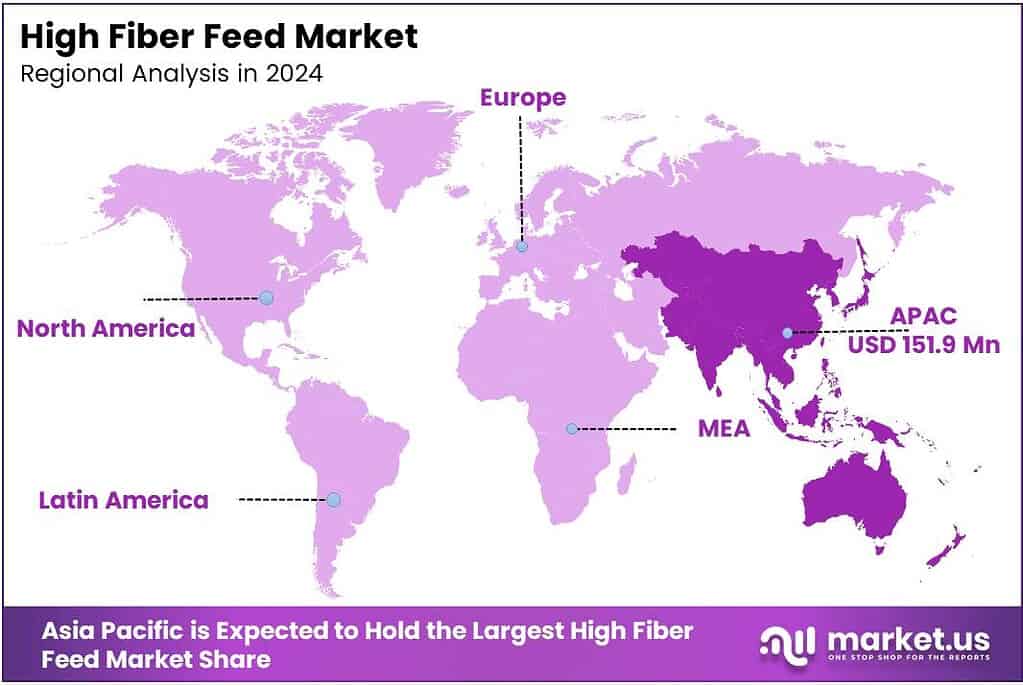
Growing awareness about livestock digestive health is one of the strongest drivers of the high fiber feed market. Farmers now understand that fiber-rich feed helps animals maintain a healthy gut and better absorption of nutrients, which improves overall performance and reduces veterinary costs. This shift is encouraging producers to include more natural fiber sources in feed formulations. The increasing global pressure to improve feed sustainability. High-fiber feed often uses agricultural by-products like beet pulp and soy hulls, which reduces waste and supports circular agriculture. This makes fiber-based feed more attractive in markets seeking sustainable and low-cost nutrition strategies. The rising demand for high-quality dairy and meat products also pushes farmers to adopt high-fiber feed. Good fiber levels promote stable rumen function in cattle and support consistent milk yield and growth rates. As livestock populations grow across developing economies, demand for such feed solutions is expanding steadily. One of the major restraints for the high fiber feed market is the inconsistent supply of high-quality raw materials. The availability of crops like alfalfa, oats, and beet pulp varies by season and region, making it difficult for feed manufacturers to maintain stable production levels. This creates supply fluctuations and affects pricing stability. Another challenge relates to the high transportation and processing costs. Fiber-rich ingredients require careful handling, drying, and storage to maintain nutritional quality. This increases production expenses, especially for small and medium feed producers, limiting wide-scale adoption in cost-sensitive regions. A major growth opportunity lies in the increasing use of agricultural by-products as cost-effective fiber sources. Materials like rice bran, wheat bran, soybean hulls, and sugar beet pulp provide affordable fiber while supporting sustainability goals. This strengthens the market potential for high fiber feed among value-focused farmers. Growing demand for natural and chemical-free feed ingredients also presents strong opportunities. Consumers are increasingly choosing meat and dairy from animals fed cleaner, plant-based diets. This pushes producers to adopt fiber-rich feed blends made from natural sources, fueling growth in premium livestock segments. The rise of commercial livestock farming across the Asia-Pacific opens large-scale market opportunities. Countries like India, China, and Vietnam are expanding dairy and poultry operations, which increases demand for balanced high fiber feed to improve productivity and health outcomes. The Asia Pacific region leads the High Fiber Feed Market, holding a dominant share of 38.7%, equivalent to a valuation of USD 151.9 million. This leadership is driven by the region’s expanding livestock population, rising awareness of gut-health-focused feed, and government support for sustainable animal nutrition. Countries such as China, India, and Australia continue increasing the adoption of high-fiber feed formulations to enhance animal productivity and reduce dependency on antibiotic-based feed. North America shows steady growth due to its strong focus on precision nutrition, advanced feed technology, and growing demand for natural dietary fiber in animal feed. The United States remains the primary contributor, driven by higher spending capacity, commercial dairy and poultry expansion, and stringent quality regulations. Increasing adoption of fiber-rich feed for digestive health optimization continues to strengthen regional demand. Europe’s market performance is shaped by strict regulatory frameworks supporting sustainable and fiber-enhanced feed ingredients. The region’s mature livestock sector, especially in Western Europe, has seen rising use of plant-based fiber sources as part of welfare-driven feed programs. Growing consumer preference for clean-label animal products further encourages the use of nutritional fiber in feed formulations. Asia Pacific remains a fast-growing market fueled by expanding livestock farming, higher feed production volumes, and increased awareness among small and mid-scale farmers. Improvements in feed manufacturing infrastructure and the gradual transition toward functional feed additives support long-term market acceleration across emerging economies. North America Europe Asia Pacific Latin America Middle East & Africa In 2025, Cargill, Incorporated will remain a heavyweight in high-fiber feed because it can source fiber-rich raw materials at scale and keep formulations consistent across regions. Its broad animal nutrition footprint also helps it respond quickly to dairy and beef producers seeking better rumen health and cost control. ADM is well-positioned as high-fiber rations become more common in value-focused feeding programs, especially where producers want stable energy release and improved digestion. With deep capabilities in grain processing and co-products, ADM can keep a strong pipeline of fiber ingredients suited to ruminant and some monogastric applications. Bunge Limited benefits from its large oilseed and grain handling network, which supports the steady availability of fiber co-products used in feed. In 2025, its advantage is reliability—moving ingredients efficiently and supporting feed customers with a predictable supply during seasonal price swings. Wilmar International Limited remains influential in Asia-led feed demand, where integrated agri-processing helps secure feed inputs and manage costs. Its scale and regional reach support wider adoption of high-fiber feed solutions in fast-growing livestock and dairy systems, particularly where producers need economical diets without compromising gut function.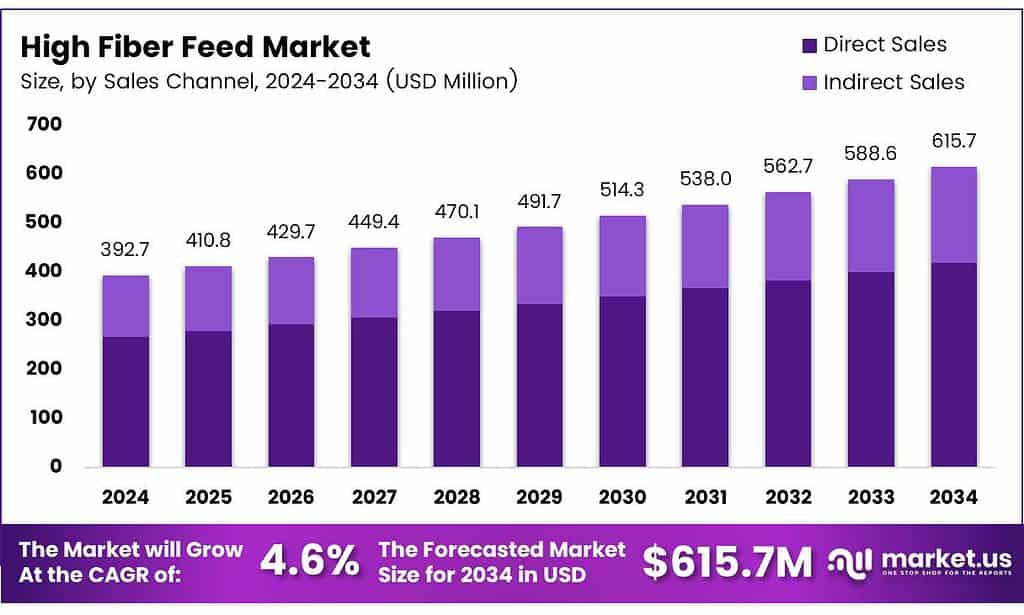
Drivers
Rising Focus on Animal Digestive Health Drives Market Growth
Restraints
Limited Availability of Quality Raw Materials Restrains Market Growth
Growth Factors
Expanding Use of By-Products in Feed Formulations Creates New Opportunities
Regional Analysis
Asia Pacific Dominates the High Fiber Feed Market with a Market Share of 38.7%, Valued at USD 151.9 Million
Key Regions and Countries
Key Players Analysis
Top Key Players in the Market
Recent Developments