

Report Overview
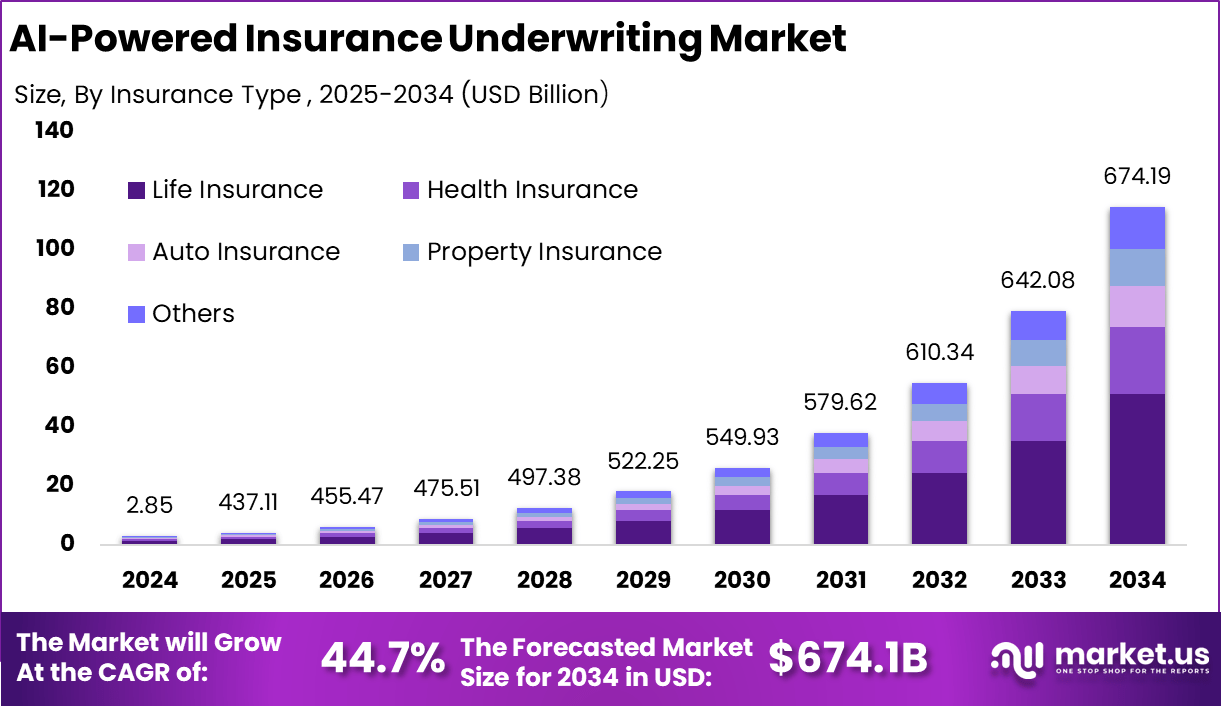
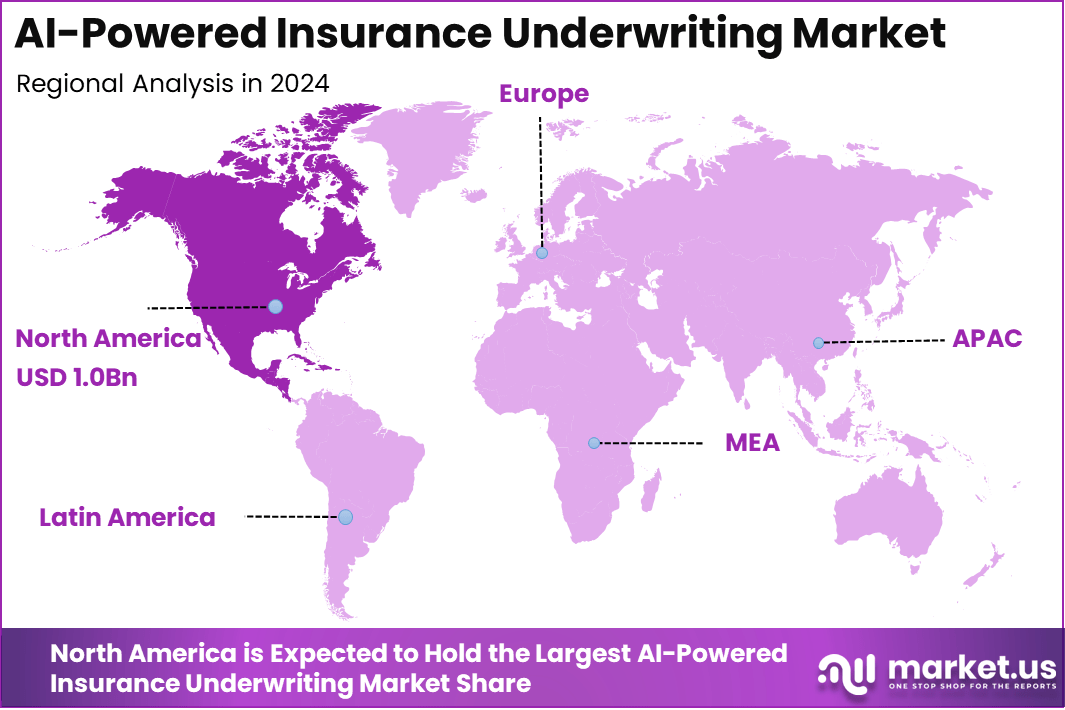
The Global AI-Powered Insurance Underwriting Market size is expected to be worth around USD 674.1 Billion By 2034, from USD 2.85 billion in 2024, growing at a CAGR of 44.7% during the forecast period from 2025 to 2034. In 2024, North America held a dominan market position, capturing more than a 38.2% share, holding USD 1.0 Billion revenue.
The AI‑Powered Insurance Underwriting market has been developing steadily, with adoption of intelligent systems becoming common across underwriting workflows. These systems allow insurers to assess risk more swiftly and consistently by drawing on rich data sources, both internal historical claims and external environmental or behavioural indicators. The technology is now seen as a mainstream tool for improving underwriting decisions rather than a futuristic experiment.
The expansion of AI in underwriting can be attributed to several key influences. Increasing demand for operational efficiency has encouraged insurers to replace manual data processing with automated algorithms. Improved risk precision has been facilitated by advanced analytics capable of combining diverse datasets. Heightened expectations for customer experience have also compelled insurers to speed decision making while maintaining high accuracy.
The top driving factors behind this market include the need to streamline underwriting workflows, improve risk prediction accuracy, reduce operational costs, and meet rising customer expectations for faster policy issuance. AI’s ability to handle complex data sets from diverse sources like telematics, IoT devices, and unstructured documents enables more precise risk evaluation and pricing.
Based on data from coinlaw, By 2025, 91% of insurance companies have adopted AI technologies, transforming the industry’s operations and customer engagement. AI-powered claims automation is reducing processing time by up to 70%, generating savings of around $6.5 billion annually for insurers. Chatbots and virtual assistants are now handling 42% of customer service interactions, improving both efficiency and customer satisfaction.
Predictive analytics has boosted fraud detection rates by 28%, enabling insurers to prevent or recover hundreds of millions in losses each year. Machine learning in underwriting has improved accuracy by 54%, supporting more reliable and data-driven risk assessments. In addition, 47% of insurers are using AI-driven pricing models in real time, strengthening pricing precision and overall profit margins.
Key Insight Summary
- By Component, AI Solutions dominated with a 76.8% share, reflecting strong adoption of AI-driven underwriting platforms.
- By Insurance Type, Life Insurance led with a 44.5% share, as AI tools streamline policy approvals and risk analysis.
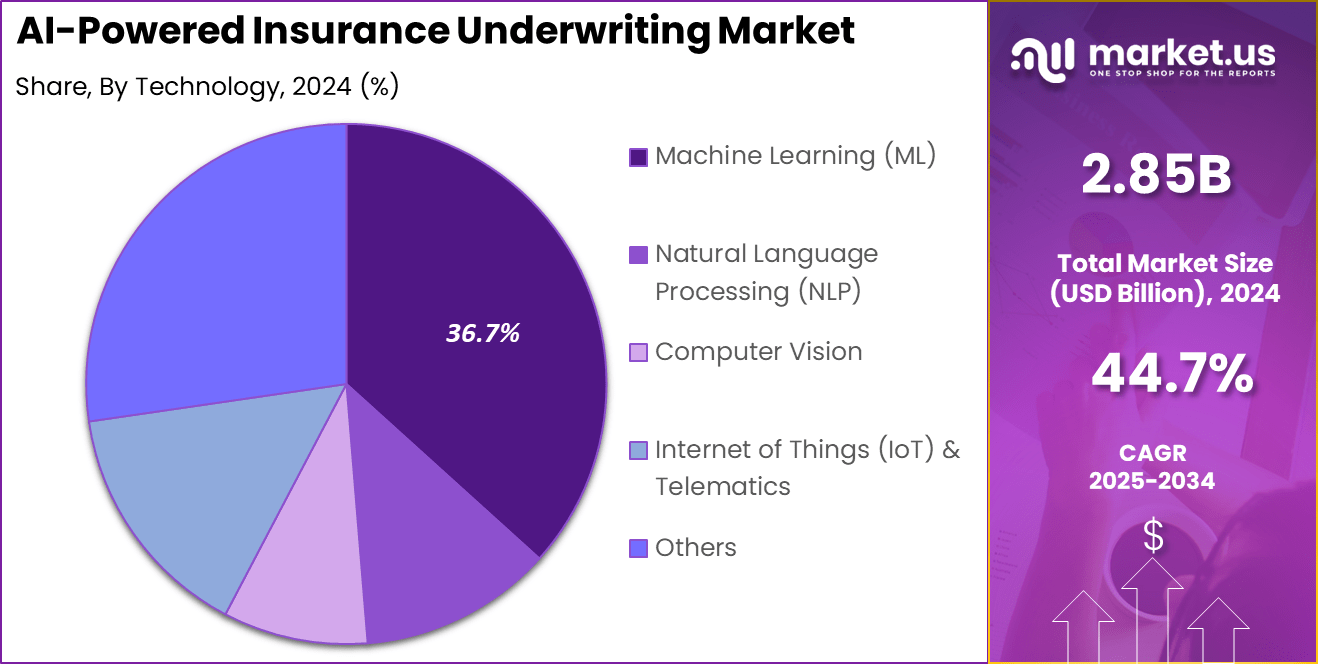
- By Technology, Machine Learning (ML) captured 36.7% share, driving predictive modeling and fraud detection in underwriting processes.
- By Application, Automating Risk Assessments accounted for 32.8% share, highlighting the efficiency gains from AI-enabled decision-making.
- By Region, North America led with 38.2% share of the global market.
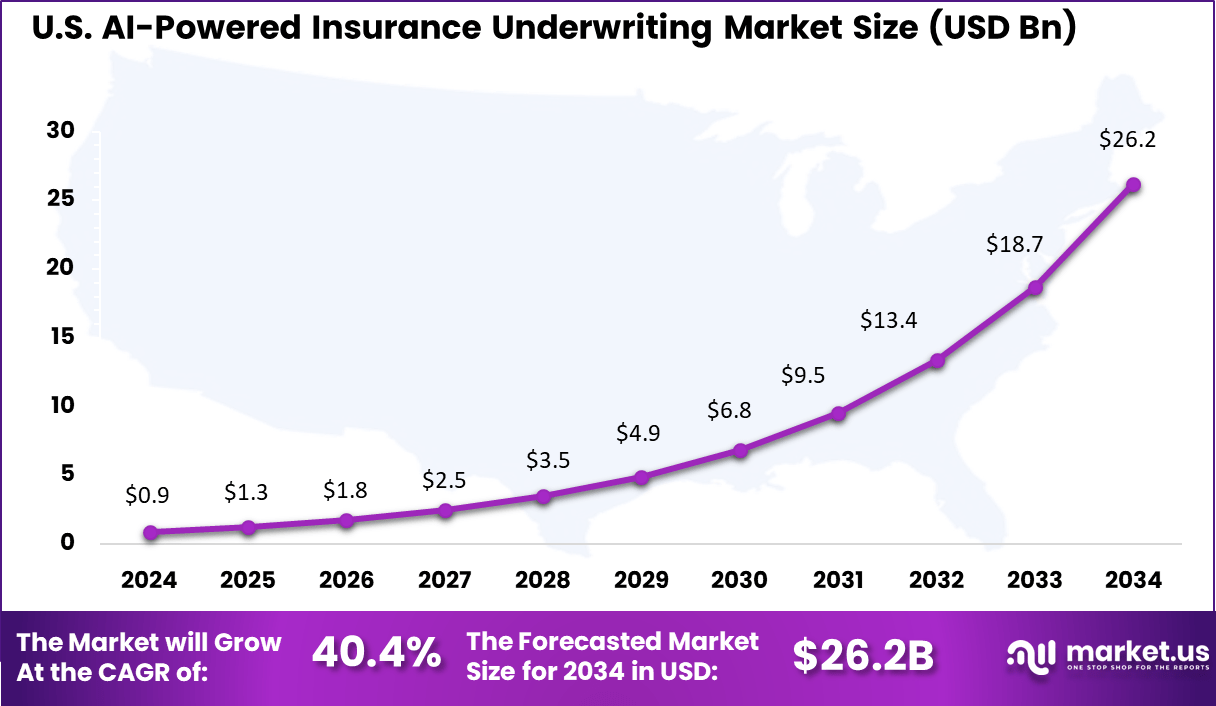
- The U.S. market was valued at USD 0.92 Billion in 2024, projected to grow at a strong CAGR of 40.4%, underscoring rapid enterprise adoption.
Role of AI in Underwriting Workflow
| Function | Description |
|---|---|
| Submission Ingestion | AI extracts and normalizes data from diverse formats, reducing manual errors and accelerating quote processing |
| Risk Modeling | Continuous learning models improve risk identification and segmentation dynamically |
| Decision Support | AI offers underwriters actionable insights, augmenting rather than replacing human judgment |
| Fraud Detection | Pattern recognition flags potential fraud early |
| Customer Engagement | AI speeds up interactions via chatbots and virtual assistants for queries |
Economic Impact & Benefits
| Aspect | Details |
|---|---|
| Cost Savings | Up to 80% reduction in policy issuance times (Deloitte study) |
| Improved Accuracy | Risk assessments 25%-43% more accurate than traditional methods |
| Operational Efficiency | Increased policy volume and faster quote turnaround |
| Customer Satisfaction | Faster approvals and personalized policies enhance loyalty |
US Market Size
The U.S. AI-Powered Insurance Underwriting Market was valued at USD 0.9 Billion in 2024 and is anticipated to reach approximately USD 26.2 Billion by 2034, expanding at a compound annual growth rate (CAGR) of 40.4% during the forecast period from 2025 to 2034.
In 2024, North America held a dominant market position, capturing more than 38.2% share and generating USD 1.0 billion revenue in the AI-powered insurance underwriting market. The region’s leadership is supported by the early adoption of advanced technologies and the strong presence of insurance providers investing heavily in artificial intelligence.
A large customer base demanding personalized policies, coupled with regulatory support for digital transformation in financial services, has driven the rapid uptake of AI underwriting platforms. Insurers across the United States and Canada have increasingly deployed predictive analytics and machine learning to improve risk assessment accuracy, reduce operational costs, and enhance customer experience.
The growth of North America is also attributed to the availability of robust data infrastructure and the widespread integration of digital channels in the insurance sector. High awareness of the benefits of AI in streamlining underwriting processes, such as faster claim settlement and fraud detection, has pushed insurers to modernize their systems.
Key Technologies
| Technology | Role and Benefits |
|---|---|
| Machine Learning (ML) | Improves risk prediction accuracy by analyzing vast datasets |
| Natural Language Processing (NLP) | Automates extraction and understanding of unstructured data (medical/legal documents) |
| Computer Vision | Assesses images for property damage, medical scans, etc. |
| IoT & Telematics | Real-time data on customer behavior reduces claim losses |
Top Use Cases
| Use Case | Description |
|---|---|
| Automated Risk Assessment | Faster and more precise evaluation of insurance risks |
| Fraud Detection | Identifies fraudulent applications and policies |
| Document Processing | Speeds up data entry by automating document analysis |
| Real-Time Decision Making | Reduces underwriting time from days to minutes |
| Personalized Pricing | Behavior-based pricing and policy customization |
By Component
AI solutions dominate the insurance underwriting market segment, accounting for 76.8% of overall adoption. These advanced systems leverage data analytics and machine learning algorithms to automate and optimize underwriting processes, significantly increasing speed and accuracy.
AI solutions enable insurers to analyze vast quantities of structured and unstructured data, thereby improving risk assessment precision and enabling faster policy issuances. This widespread adoption reflects insurers’ focus on harnessing AI to reduce operational costs while offering personalized pricing and underwriting decisions.
The integration of AI solutions allows insurers to transition from traditional manual underwriting methods to scalable, data-driven operations. By reducing human intervention in routine evaluations, AI enhances workflow efficiency and frees underwriters to concentrate on complex cases, boosting productivity and reducing policy processing times from weeks to minutes.
By Insurance Type
Life insurance represents 44.5% of the AI-powered underwriting market, highlighting its prominent role in adopting AI technologies to refine risk classifications and pricing models. Accurate longevity predictions, enabled by AI-driven data analysis, allow life insurers to develop more tailored policy offerings and competitive premium structures.
AI facilitates comprehensive evaluations that incorporate clinical data, lifestyle information, and historical trends, enhancing underwriting reliability. The life insurance segment benefits significantly from AI’s ability to streamline application processing and detect potential fraud, improving overall customer experience and reducing financial risks.
By Technology
Machine learning technology holds a 36.7% share within the AI technologies used in insurance underwriting, underscoring its essential role in transforming traditional practices. ML algorithms continuously learn from new data, improving the accuracy of risk prediction models and enabling dynamic adjustment of underwriting criteria based on emerging trends. This adaptability allows insurers to respond more effectively to fluctuating market conditions and individual customer profiles.
The deployment of ML supports advanced applications such as behavior-based pricing and predictive risk management, providing insurers with a competitive edge. Its capacity to analyze complex datasets enhances fraud detection capabilities, operational efficiencies, and premium optimization, driving rapid adoption across the insurance sector.
By Application
Automating risk assessments accounts for 32.8% of AI applications in insurance underwriting, reflecting a key use case for AI technologies. Automated models analyze diverse data inputs – including medical records, financial history, and external factors – to identify risk patterns swiftly and accurately. This reduces reliance on manual evaluation, minimizing errors and biases while accelerating decision-making processes.
AI-driven automation not only improves underwriting quality but also enables real-time policy approvals, benefiting insurers through higher throughput and reduced processing costs. The ability to scale risk assessments efficiently is especially valuable in handling growing volumes of insurance applications and meeting customer expectations for faster service.
Key Market Segments
By Component
- AI Solutions
- Services
- Implementation & Integration Services
- Consulting & Training
- Support & Maintenance
By Insurance Type
- Life Insurance
- Health Insurance
- Auto Insurance
- Property Insurance
- Others
By Technology
- Machine Learning (ML)
- Natural Language Processing (NLP)
- Computer Vision
- Internet of Things (IoT) & Telematics
- Others
By Application
- Automating Risk Assessments
- Enhancing Data Collection and Analysis
- Fraud Detection in Underwriting
- Real-Time Decision Making
- Personalizing Insurance Policies for Customers
- Others
Regional Analysis and Coverage
- North America
- US
- Canada
- Europe
- Germany
- France
- The UK
- Spain
- Italy
- Russia
- Netherlands
- Rest of Europe
- Asia Pacific
- China
- Japan
- South Korea
- India
- Australia
- Singapore
- Thailand
- Vietnam
- Rest of Latin America
- Latin America
- Brazil
- Mexico
- Rest of Latin America
- Middle East & Africa
- South Africa
- Saudi Arabia
- UAE
- Rest of MEA
Driver Factor
Demand for Faster and More Accurate Risk Assessment
A key driver for AI-powered insurance underwriting is the growing demand for faster and more precise processing of large volumes of insurance data. Insurers face pressure to evaluate risk and price policies quickly without compromising accuracy. AI technology, especially machine learning and natural language processing, allows underwriting systems to analyze complex datasets in real time, significantly speeding up the evaluation process.
This rapid processing reduces turnaround times for policy approvals, improving operational efficiency and customer satisfaction. The shift toward digital-first experiences and data-driven models fuels this demand, making AI adoption a priority for insurers aiming to stay competitive. This demand is rooted in the need to handle increasingly diverse and vast data sources beyond traditional information like credit scores and claims history.
AI enables the integration of alternative data such as telematics, wearable health indicators, and social media insights, providing a more comprehensive picture of risk. This capability helps insurers create fairer, more personalized policies and better predict potential losses. As digital transformation accelerates in the industry, this driver continues to push investment in AI solutions to enhance underwriting speed and accuracy.
Restraint Factor
High Implementation Costs and Data Quality Issues
One significant restraint slowing the growth of AI in insurance underwriting is the high cost of adopting and integrating AI technologies. The implementation requires substantial investment in advanced software, infrastructure, and skilled personnel. Many insurance companies, especially smaller ones, find these upfront costs prohibitive.
Additionally, integrating AI systems with existing legacy underwriting platforms can be complex, resulting in increased expenses and operational disruptions. These financial and technical challenges can make insurers hesitant to fully embrace AI-driven underwriting solutions. Another critical restraint relates to data quality. AI systems rely heavily on large, accurate datasets to function properly, but inconsistent or poor-quality data can lead to errors and inaccurate risk assessments.
This issue reduces trust in AI outputs and complicates decision-making for underwriters. Furthermore, regulatory compliance adds layers of complexity, with insurers needing to ensure their AI systems meet evolving legal requirements. Together, these challenges create significant barriers to widespread AI adoption in underwriting.
Opportunity Analysis
Enhanced Personalization and Predictive Modeling
AI offers a strong opportunity for insurers to develop more personalized products and improve predictive risk modeling. By leveraging AI’s ability to analyze diverse data sources like behavioral patterns, lifestyle factors, and real-time sensor data, insurers can tailor policies to individual policyholders. This shift toward hyper-personalization leads to better risk management and pricing models that reflect actual behaviors and conditions rather than broad assumptions.
It also creates a competitive advantage by meeting growing customer expectations for tailored insurance solutions and faster service. Additionally, AI-driven predictive models can anticipate emerging risks and potential claims more accurately than traditional methods. This proactive risk identification enables insurers to reduce losses and adjust coverage offerings dynamically.
The ability to scale these AI tools globally allows insurers to expand into new markets efficiently while managing local risks effectively. These opportunities position AI-powered underwriting as a key growth area for the industry as it seeks to innovate and improve profitability.
Challenge Analysis
Regulatory Compliance and Ethical Concerns
A major challenge in deploying AI for insurance underwriting is ensuring regulatory compliance and addressing ethical concerns. Insurance is a highly regulated industry, and AI systems must adhere to strict rules to maintain fairness, transparency, and data privacy. Insurers must navigate differing legal frameworks across regions, which can slow AI integration and create additional operational burdens.
There is also increased scrutiny on AI algorithms to prevent biased or discriminatory outcomes, requiring continuous audits and explainable AI models to ensure fairness in underwriting decisions. Moreover, protecting sensitive customer data from breaches or misuse presents an ongoing challenge.
AI systems process vast amounts of personal information, which must be handled securely to maintain trust and comply with data protection laws. Balancing innovation with ethical and regulatory demands requires insurers to be cautious when designing and implementing AI solutions. Addressing these challenges is crucial for the sustainable and responsible use of AI in underwriting.
Competitive Analysis
In the AI-powered insurance underwriting market, global technology leaders such as Salesforce, IBM, and Cognizant play a pivotal role. Their platforms integrate artificial intelligence with advanced data analytics to support underwriting accuracy and efficiency. These players benefit from established client bases and global presence, enabling them to introduce solutions that streamline risk assessment and improve decision-making.
Specialized providers including Appian, Newgen Software Technologies, and Hexaware Technologies are strengthening their positions by offering flexible automation platforms. Their expertise in process optimization and digital transformation allows insurers to modernize workflows and enhance operational speed. These companies focus on user-friendly solutions that integrate AI with existing systems, helping insurers manage large volumes of data while reducing manual intervention.
Niche innovators such as Indico Data Solutions, Federato, Damco Group, and Majesco contribute to shaping market competitiveness. These firms focus on tailored underwriting solutions powered by machine learning and natural language processing. Their offerings enable insurers to manage unstructured data, improve risk modeling, and support personalized policy pricing.
Top Key Players in the Market
- Salesforce, Inc.
- Appian
- Newgen Software Technologies Limited
- Damco Group
- Majesco
- CGI Inc.
- Indico Data Solutions, Inc.
- Federato
- International Business Machines Corporation
- Cognizant
- Hexaware Technologies Limited
- Others
Recent Developments
- Damco Group’s insurance underwriting software, updated in May 2025, automates risk assessment by blending rule-based engines with AI models, which enables underwriters to focus on exception cases rather than routine work. Their solution enhances operational speed, reduces manual errors, improves onboarding times, and supports varied lines of business with dynamic workflows and reporting tools.
- In October 2024, Salesforce launched a new AI-powered solution aimed at insurance brokerages to automate labor-intensive processes like policy servicing and commission handling, reflecting a strong push toward streamlining insurance operations through AI.
- in June 2024 was the partnership with ReleasePoint to launch the Connected Underwriting Life Workbench, which integrated EHR data to empower underwriters with enhanced visibility and efficiency. Appian’s platform automates complex workflows using AI, including document classification, data extraction, fraud detection, and compliance tracking, emphasizing agentic AI for autonomous task handling and scalability to meet demand spikes