

Report Overview
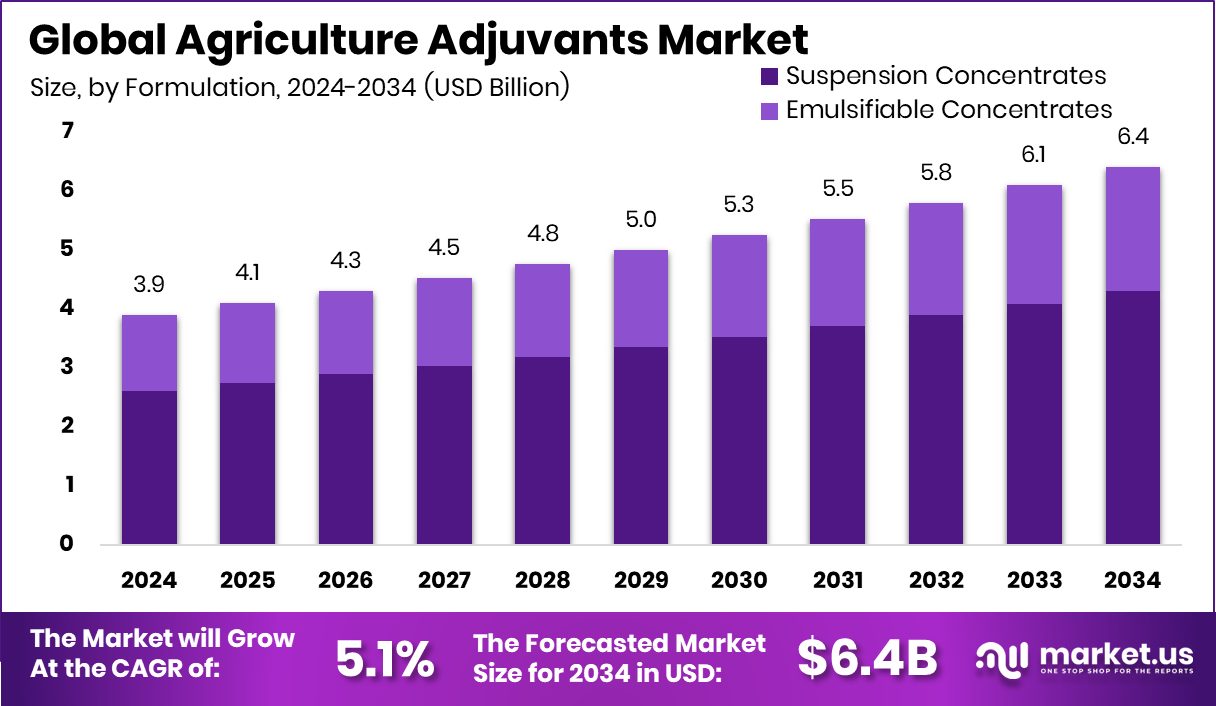
The Global Agriculture Adjuvants Market is expected to be worth around USD 6.4 billion by 2034, up from USD 3.9 billion in 2024, and is projected to grow at a CAGR of 5.1% from 2025 to 2034. The Agriculture Adjuvants Market in North America recorded 37.9% and USD 1.4 Bn.
Agriculture adjuvants are supporting ingredients added to crop protection products to improve how sprays spread, stick, mix, and perform in the field. They help pesticides work better by strengthening spray coverage, reducing drift, and increasing absorption on plant surfaces. The Agriculture Adjuvants Market includes different formulation types such as suspension concentrates and emulsifiable concentrates, adoption stages like in-formulation and tank mix, and multiple functions ranging from activator adjuvants and surfactants to oil-based adjuvants, buffers, antifoaming agents, and drift control agents. These products are used across cereals and grains, oilseeds, pulses, fruits, vegetables, and several crop protection applications, including herbicides, fungicides, and insecticides.
 15% to reach $20 billion.
Higher sector funding boosts adoption of digital tools, mechanized sprayers, and optimized crop protection methods—all areas where adjuvants improve results. As precision farming becomes mainstream across major crop-growing regions, the need for more reliable tank-mix and in-formulation adjuvants continues to grow, opening new avenues for manufacturers.
Latest Trends
Shift toward eco-friendly adjuvant formulations
A clear trend in the Agriculture Adjuvants Market is the shift toward eco-friendly and low-impact formulations that support sustainable farming. Farmers are increasingly looking for products that enhance pesticide performance while reducing environmental burdens. This interest aligns with wider industry discussions, such as the call from G’s Growers chairman to renew the £40m fruit and vegetable fund, which reflects growing pressure to strengthen sustainable production systems.
Such initiatives push the sector toward greener inputs, encouraging the 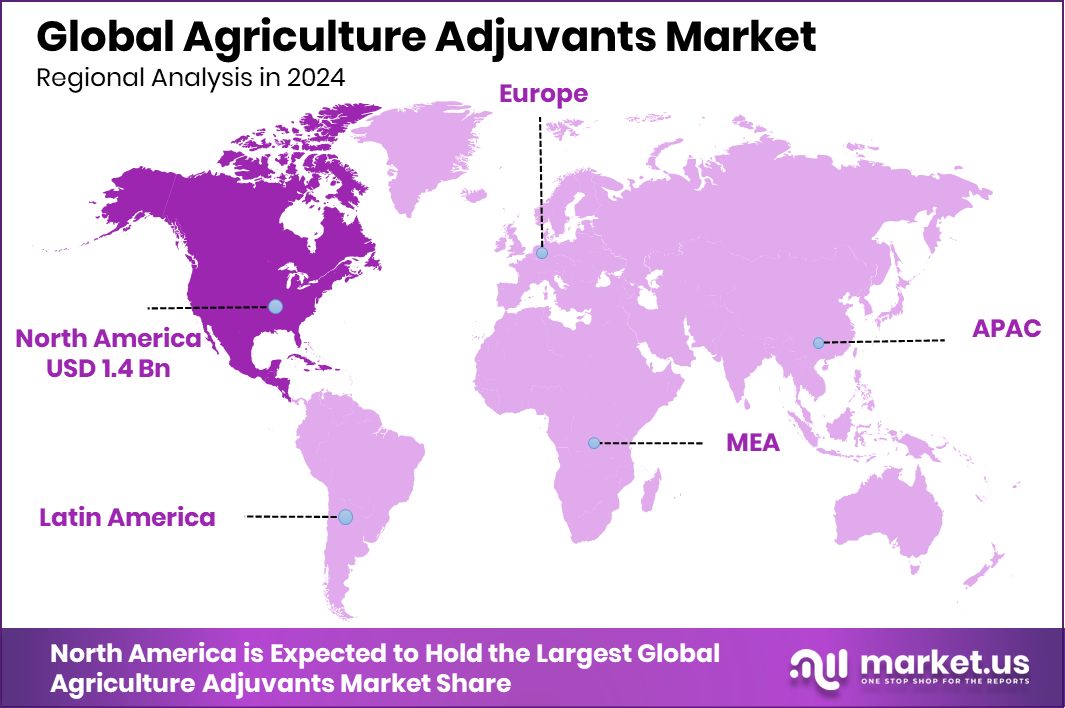
Regional Analysis
North America led the Agriculture Adjuvants Market with 37.9%, reaching USD 1.4 Bn.
In the Agriculture Adjuvants Market, North America remained the leading region in 2024, holding a dominant 37.9% share and reaching a valuation of USD 1.4 Bn, supported by the region’s strong adoption of crop protection technologies and large-scale farming operations. Europe followed with steady demand as farmers focused on improving spray efficiency across cereals, grains, and high-value horticulture crops.
The Asia Pacific region continued expanding due to rising agricultural output and greater use of adjuvants to enhance herbicide and fungicide performance in densely cultivated countries. Markets in the Middle East & Africa showed gradual development, driven by efforts to improve crop resilience in arid conditions. Latin America maintained consistent adoption, supported by extensive soybean, corn, and sugarcane cultivation across major agricultural economies.
Key Regions and Countries
- North America
- US
- Canada
- Europe
- Germany
- France
- The UK
- Spain
- Italy
- Rest of Europe
- Asia Pacific
- China
- Japan
- South Korea
- India
- Australia
- Rest of APAC
- Latin America
- Brazil
- Mexico
- Rest of Latin America
- Middle East & Africa
- GCC
- South Africa
- Rest of MEA
Key Players Analysis
Clariant AG continued positioning itself as a performance-driven player by focusing on adjuvant solutions that enhance spray effectiveness and support consistent field application. Its emphasis on formulation stability and compatibility allowed it to remain relevant across herbicide-dominant cropping systems, especially where growers demand better yield support and operational efficiency.
Solvay SA maintained strong engagement in functional additives that contribute to better penetration and improved spreadability. The company’s technical capabilities and chemistry-focused approach helped address the need for reliable activators and utility adjuvants, especially as farmers sought improved crop protection outcomes under variable weather conditions. Its strategic orientation toward performance-enhancing formulations kept it competitive among global input suppliers.
The Dow Chemical Company remained influential due to its long-standing expertise in agricultural chemistry, offering adjuvant components designed to improve spray uniformity, reduce drift, and support field consistency. The company’s broad presence across crop solutions contributed to stable demand for its adjuvant-related offerings, particularly in large-scale farming regions where application precision is a priority.
Top Key Players in the Market
- Clariant AG
- Solvay SA
- The Dow Chemical Company
- Huntsman International LLC
- Evonik Industries AG
- Ingevity
- Nufarm Limited
- Corteva Agriscience
- Croda International PLC
- BASF SE
- Miller Chemical & Fertilizer, LLC.
Recent Developments
- In September 2025, Ingevity announced it entered a deal to sell its North Charleston crude tall oil refinery and most of its Industrial Specialties product line to Mainstream Pine Products. This change is meant to simplify its portfolio and focus the company more on higher-value specialty chemicals and solutions. The sale is expected to be completed by early 2026.
- In May 2025, Huntsman announced the completion of its European Maleic Anhydride business review and confirmed the closure of its Moers, Germany, facility by the end of that quarter. This move was part of reshaping its chemical portfolio and may influence production support for related compounds used in agricultural applications, including adjuvant component sourcing.