

Report Overview
The Global Commercial Security Market size is expected to be worth around USD 423.3 billion by 2035, from USD 215.2 billion in 2025, growing at a CAGR of 7.0% during the forecast period from 2025 to 2035. North America held a dominant market position, capturing more than a32.5% share, holding USD 69.9 billion in revenue.
The commercial security market comprises products and services designed to protect businesses, facilities, assets, and personnel from physical threats, unauthorized access, theft, vandalism, and security breaches. Key solutions include access control systems, surveillance cameras, intrusion detection sensors, alarm systems, and integrated security platforms. Businesses are increasingly adopting layered security frameworks to protect physical and digital assets.
Growth in e-commerce, urban infrastructure development, and regulatory emphasis on workplace safety have strengthened demand for commercial security solutions. Key driver factors in this market include rising security breaches at business locations, expansion of smart building technologies, and greater adoption of real-time monitoring.
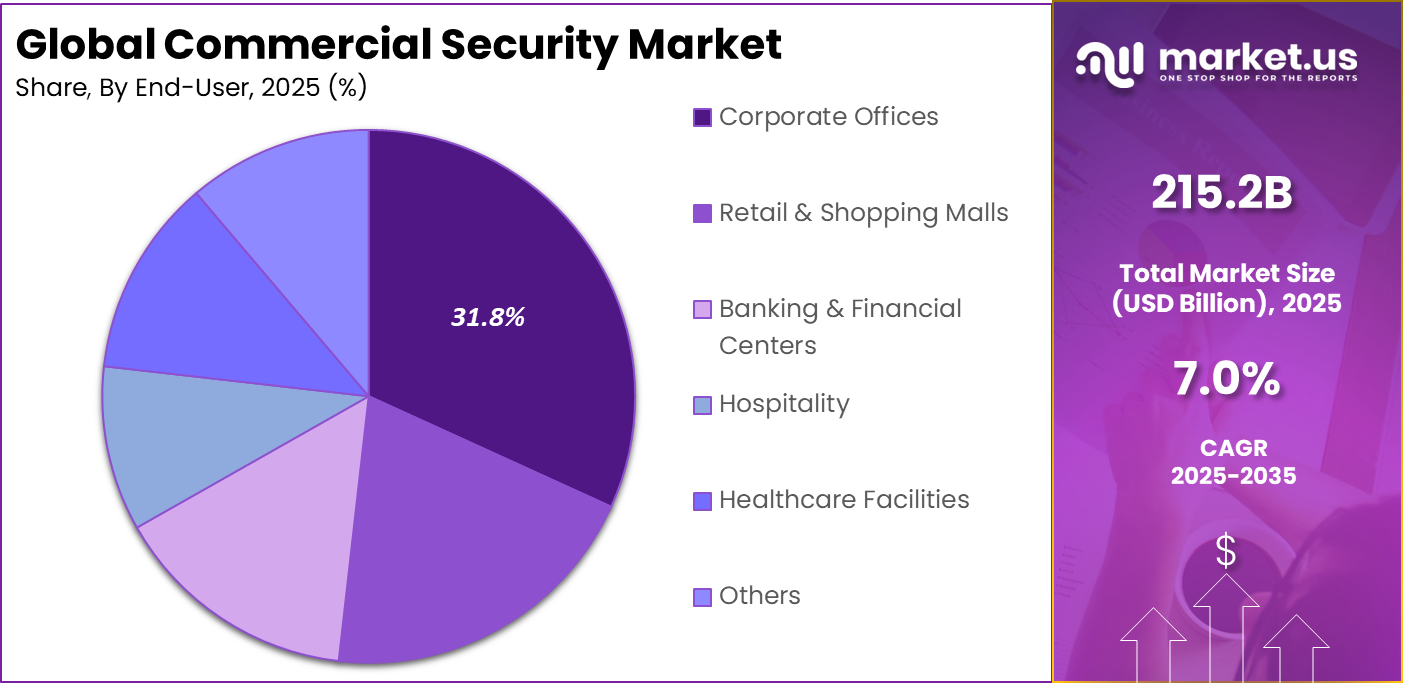
Customer expectations in the commercial security market are being reshaped by the demand for real time visibility, faster incident response, and simplified system management. Businesses increasingly prefer security solutions that provide centralized dashboards, mobile access, and automated alerts, allowing security teams to respond quickly without constant manual monitoring. This shift is improving operational efficiency while reducing reliance on on site personnel. Customers are also placing higher value on scalable systems that can grow with business expansion and adapt to changing threat profiles. Key disruptors influencing customer impact include the adoption of intelligent analytics, cloud based security platforms, and mobile enabled access control. Advanced analytics reduce false alarms and improve threat detection accuracy, directly improving user trust in security systems. Cloud deployment lowers upfront costs and simplifies updates, making advanced security more accessible to mid sized businesses. These disruptors are shifting purchasing decisions away from standalone hardware toward integrated, service oriented security ecosystems. Products account for 58.7% of overall adoption in the Commercial Security Market. This dominance reflects sustained investment in physical security equipment such as cameras, access control devices, sensors, and alarms. Organizations prioritize tangible security assets to protect premises and assets. The strong demand for products is also linked to modernization cycles. Legacy systems are being replaced with higher resolution and network enabled devices. This replacement activity continues to support product led adoption across commercial environments. For Instance, in January 2026, Johnson Controls International plc showcased new integrated security products at AHR 2026. The company highlighted advanced hardware like sensors and access controls designed for commercial buildings. These innovations focus on seamless connectivity and real-time threat detection, helping businesses upgrade their physical defenses efficiently. Booth demos drew crowds interested in mission-critical reliability. Video surveillance systems represent 42.3% of system type demand. This leadership is driven by the need for continuous monitoring, incident investigation, and deterrence. Video systems provide visual evidence and real time oversight across offices, campuses, and facilities. The adoption of video surveillance is further reinforced by integration with analytics and remote monitoring. Centralized control improves operational visibility and response time. These capabilities sustain the leading role of video surveillance systems. For instance, in January 2025, Hanwha Vision Co., Ltd. unveiled key trends for video surveillance, pushing super-intelligent cameras. Their edge AI solutions enable autonomous decision-making with generative AI for intrusion and fire detection. This positions their systems as leaders in commercial setups, offering multi-camera tracking and behavioral analysis for better oversight in offices and stores. Corporate offices account for 31.8% of end user demand in the Commercial Security Market. Office environments require layered security to manage employee safety, visitor access, and asset protection. Security systems support controlled entry and internal monitoring. The growth of hybrid work models has increased the need for flexible security solutions. Offices must secure premises even during variable occupancy. This maintains steady demand from corporate office users. For Instance, in September 2025, G4S plc released its World Security Report 2025, warning of rising violence threats to executives in corporate offices. The report urges enhanced procedures like risk assessments and online monitoring for office security. It highlights fraud and theft jumps, prompting corporates to bolster protections with layered systems amid hybrid work challenges. North America Europe Asia Pacific Latin America Middle East & Africa The company evaluation landscape in the commercial security market can be assessed across two primary dimensions: solution breadth and technology maturity. Providers offering end to end portfolios that combine access control, surveillance, intrusion detection, and monitoring services are positioned more favorably than those with narrow, single function offerings. Broad portfolios allow customers to consolidate vendors and simplify system integration, which is increasingly valued in complex commercial environments. On the technology maturity axis, companies investing in analytics, cloud architecture, and interoperability score higher in long term competitiveness. Vendors that support open interfaces and integration with existing infrastructure reduce switching costs for customers and accelerate adoption. In contrast, providers reliant on closed or legacy systems face higher risk of displacement as customer preferences shift toward flexible and future ready security platforms.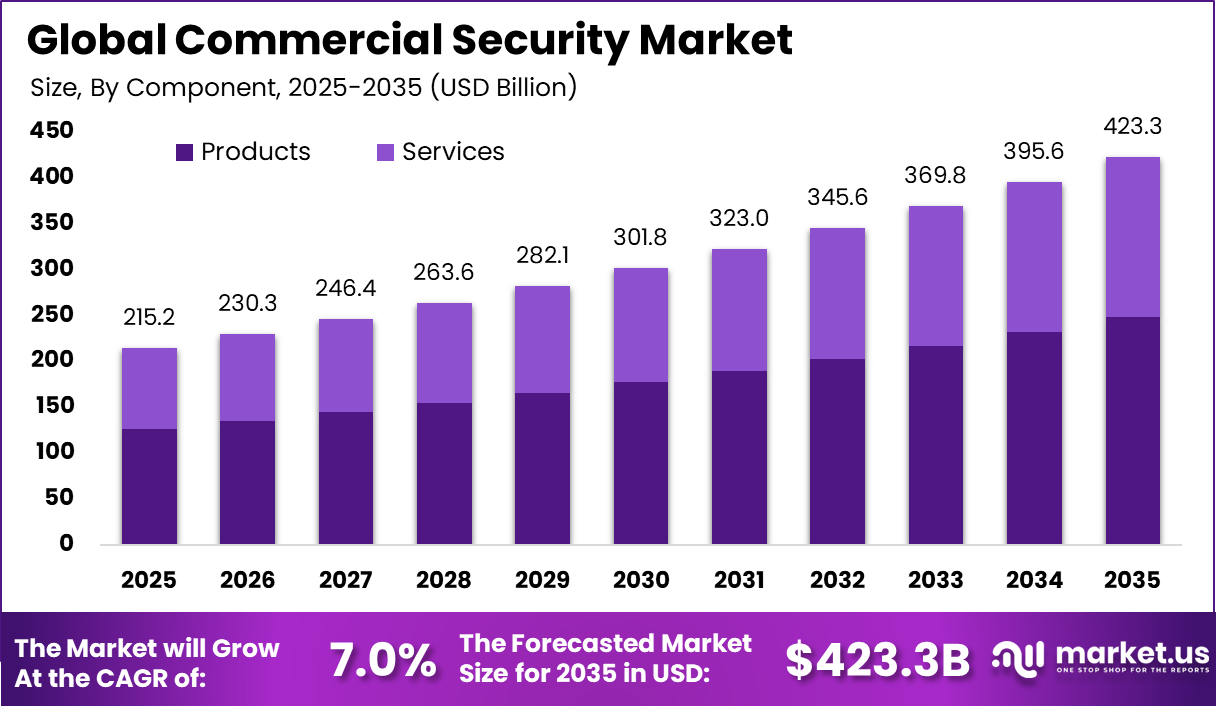
Key Restraint Impact on CAGR Forecast (~) % Geographic Relevance Impact Timeline High upfront cost of advanced security systems -1.8% Emerging Markets Short to medium term Integration challenges with legacy security infrastructure -1.4% Global Medium term Privacy concerns related to surveillance technologies -1.2% Europe, North America Medium term Skilled labor shortages for installation and maintenance -1.0% Global Medium term Budget constraints among small and mid-sized enterprises -0.8% Emerging Markets Medium to long term Customer Impact: Trends and Disruptors
By Component
By System Type
By End User
Technology Enabler Impact on CAGR Forecast (~) % Primary Function Geographic Relevance Adoption Timeline AI-based video surveillance and analytics +2.0% Threat detection and monitoring Global Short to medium term Cloud-based security management platforms +1.7% Centralized control and scalability Global Medium term Biometric access control systems +1.4% Secure identity authentication North America, Europe Medium term IoT-enabled sensors and alarms +1.1% Real-time incident response Global Medium to long term Integrated physical and cyber security systems +0.9% Holistic risk management Europe, North America Long term Key Market Segments
By Component
By System Type
By End-User
By Service Type
Key Regions and Countries
Company Evaluation Matrix
Company Quadrant Market Presence Capabilities Highlights Johnson Controls International plc Leader High Smart building platforms, AI-driven analytics, strong global expansion footprint Honeywell International, Inc. Leader High Advanced access control, AI and IoT integration, cost-efficient enterprise solutions Bosch Security Systems, Inc. Leader High Video and surveillance leadership, edge AI capabilities, regulatory compliance strength ADT, Inc. Leader High Monitored security services, strong execution in commercial and residential segments Securitas AB Challenger High Global security services portfolio, technology integration through STANLEY Security Axis Communications AB Leader Medium-High High-performance video solutions, low-light imaging, open ecosystem standards Assa Abloy AB Leader High Access control leadership, cloud-based and mobile credential solutions Allegion plc Challenger Medium Mechanical and electronic locking systems, strong position in selected verticals Carrier Global Corporation Emerging Medium Building system integration, growing focus on smart security offerings Hikvision Digital Technology Co., Ltd. Challenger High (Asia) High-resolution video solutions, competitive pricing, regional compliance constraints Dahua Technology Co., Ltd. Niche Medium Cost-efficient surveillance products, adoption limited by security concerns Hanwha Vision Co., Ltd. Challenger Medium Edge AI analytics, NDAA-compliant solutions, strong outdoor performance STANLEY Security Challenger Medium Service-led security solutions, technology depth supported by Securitas G4S plc Niche Medium Guarding and monitoring services, extensive global service network Verkada, Inc. Emerging Low-Medium Cloud-native deployment model, closed ecosystem, past data security challenges Others Niche Low Startups focused on AI-driven surveillance and perimeter security technologies Top Key Players in the Market
Recent Developments