

Data Freshness Monitoring Market Size
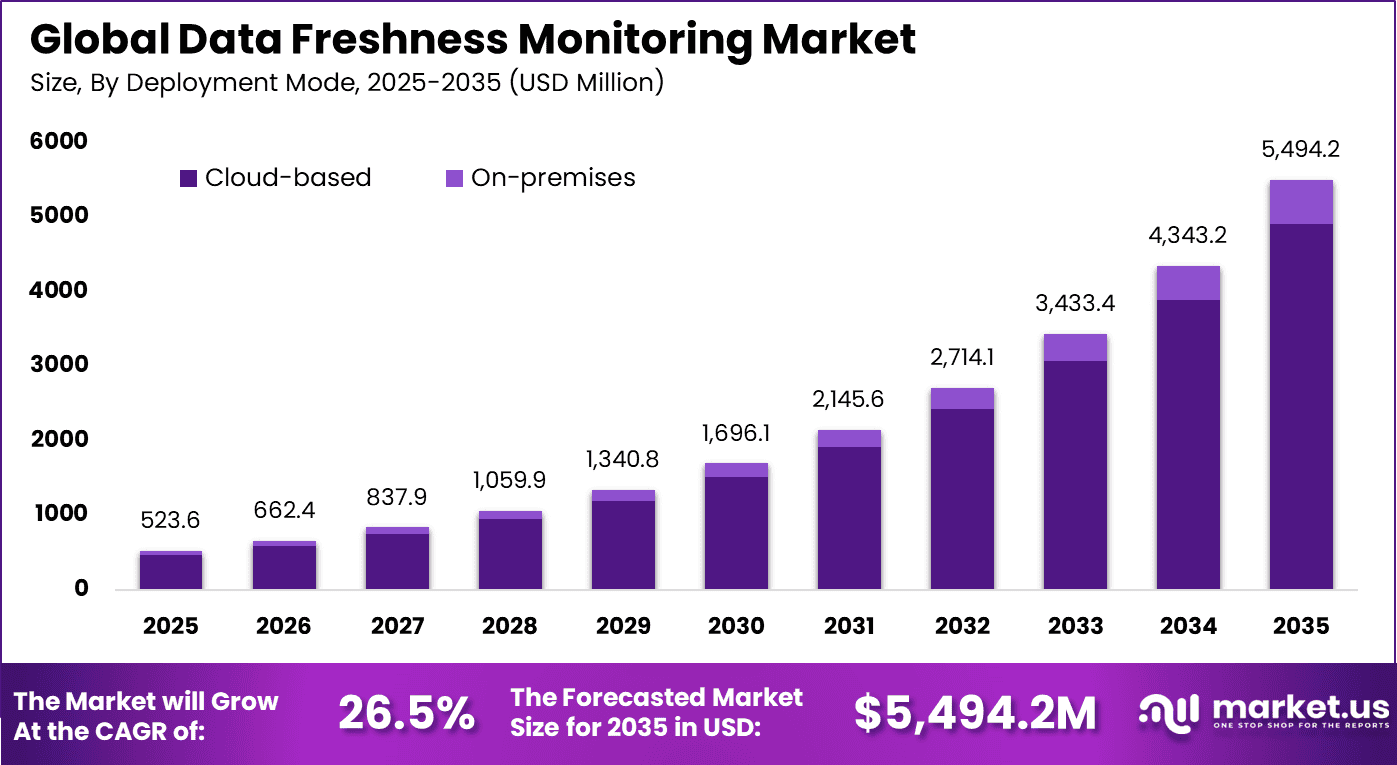
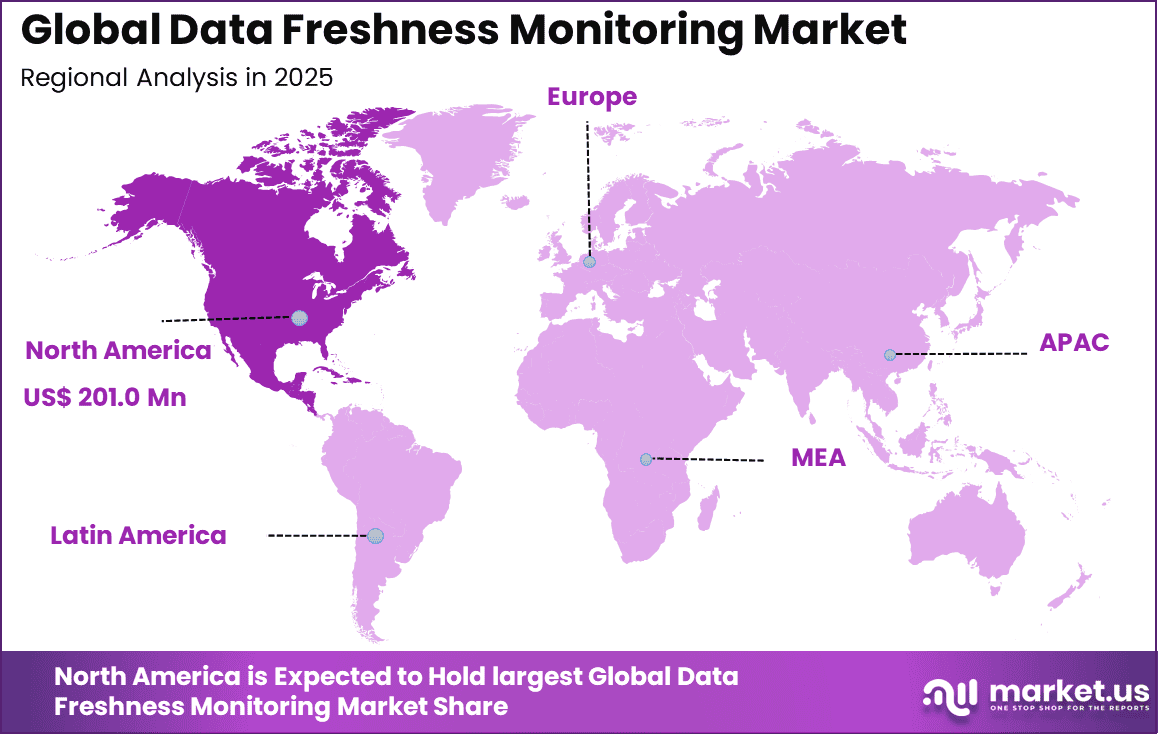
The Global Data Freshness Monitoring Market size is expected to be worth around USD 5,494.2 million by 2035, from USD 523.6 million in 2025, growing at a CAGR of 38.4% during the forecast period from 2025 to 2035. North America held a dominant market position, capturing more than a38.4% share, holding USD 201.0 million in revenue.
Data freshness monitoring focuses on measuring the time lag between data generation and its availability for use, which is critical as B2B data can decay at a rate exceeding 70% per year. Common metrics include the age of the most recent data row, ingestion latency, and update frequency. These indicators help organizations assess whether data remains timely and reliable for analytics and decision making.
Monitoring is often supported by anomaly detection to identify pipeline failures and unexpected delays. Effective implementations distribute alerts across the data pipeline, with around 34% of monitors placed in the initial landing layer and 26% in the gold or consumption layer. This layered approach improves visibility across ingestion, transformation, and consumption stages, enabling faster issue resolution and sustained data reliability.
Key Takeaway
- By deployment mode, cloud based solutions dominated the Data Freshness Monitoring Market with a 89.4% share, supported by demand for scalable and real time monitoring across distributed data systems.
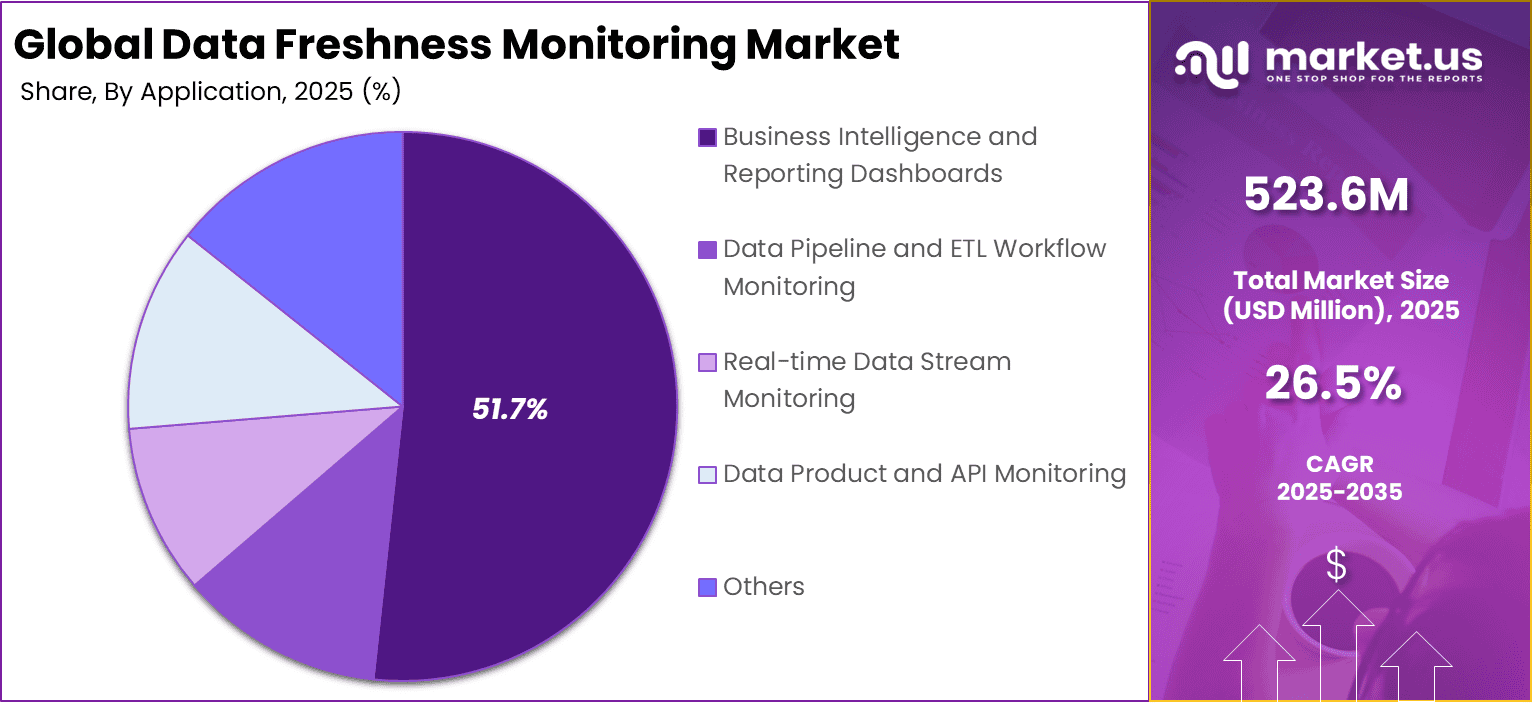
- By application, business intelligence and reporting dashboards accounted for 51.7% of total adoption, reflecting the need for accurate and up to date analytics outputs.
- By end user industry, financial services and trading represented 44.3% of market demand, driven by strict timing requirements and regulatory reporting standards.
- Regionally, North America held a 38.4% share of the market, supported by mature data governance practices.
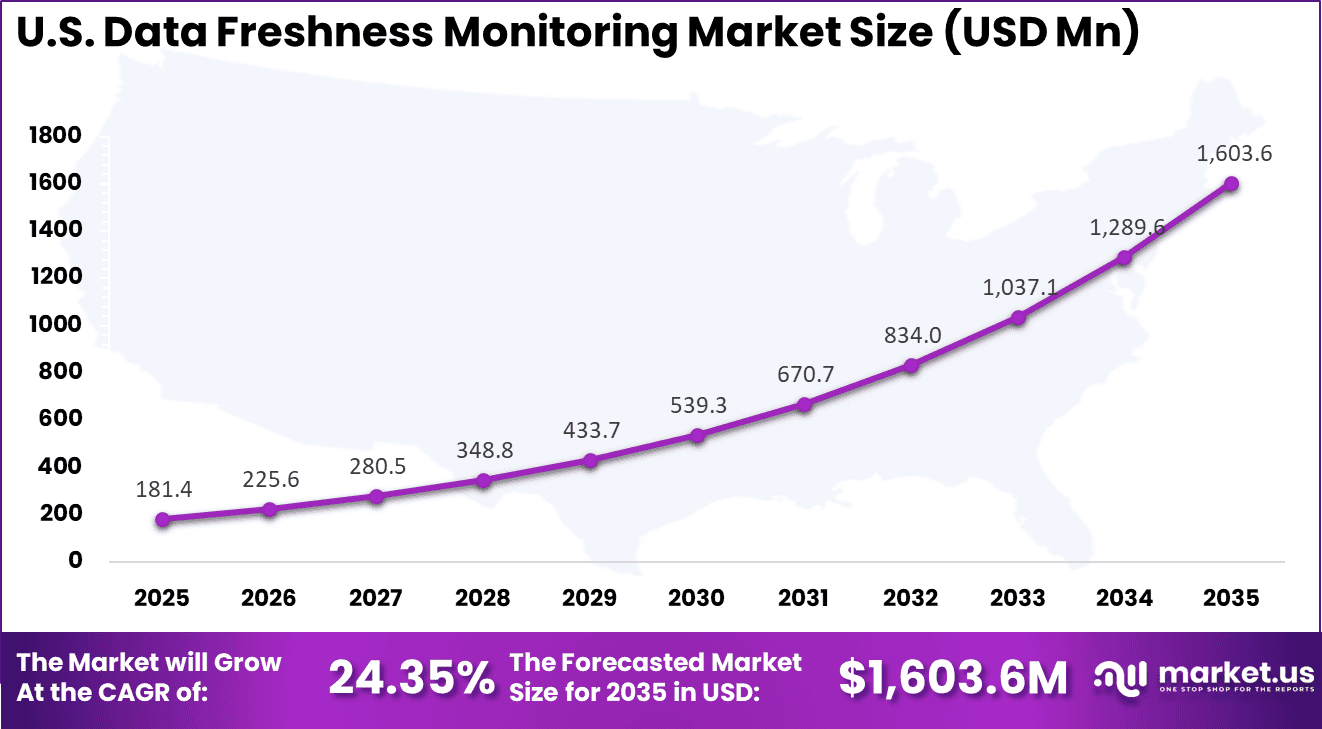
- In the US, the Data Freshness Monitoring Market was valued at USD 181.4 million and recorded a CAGR of 24.35%, reflecting strong investment in real time data reliability solutions.
Key Metrics and Statistics
- According to landbase, B2B contact data shows a severe annual decay rate of 70.3%, with monthly decay rising to 3.6% in late 2024, making continuous validation essential for effective go to market execution.
- Poor data quality has a substantial financial impact, costing US businesses an estimated USD 3.1 trillion annually, while individual organizations lose around USD 12.9 million per year and face revenue reductions exceeding 10% due to CRM data decay.
- Sales teams lose 27.3% of their productive time, or approximately 546 hours per year, pursuing outdated leads, and 94% of businesses suspect inaccuracies within their customer databases.
- AI driven data quality initiatives deliver measurable returns, with organizations reporting up to 30% accuracy improvement within the first year and achieving 20% higher campaign response rates.
- Real time analytics provide competitive benefits, as 70% of marketers consider them critical to strategy execution, contributing to 15% higher retail sales and a 25% reduction in stockouts.
- Despite available automation tools, 65% of companies continue to rely on manual Excel based data cleansing methods, even though 85% of customers indicate strong demand for automated solutions.
Report Overview
The data freshness monitoring market focuses on solutions that track whether data is updated within expected time windows across enterprise systems. These tools ensure that analytics, dashboards, and automated decisions are based on the most recent available data. As organizations rely heavily on real time and near real time insights, outdated data can lead to incorrect decisions and financial risk. Data freshness monitoring has therefore become a critical layer within modern data operations.
A primary driver of the data freshness monitoring market is the proliferation of real-time data use cases. Sectors such as ecommerce, financial services, logistics, and telecommunications increasingly depend on up-to-minute data to detect patterns, respond to incidents, and guide operations. Traditional batch updates may no longer suffice, prompting organisations to invest in tools that actively monitor data arrival times and notify when currency thresholds are breached.
Financial services, ecommerce, logistics, and digital platforms depend on current data for daily operations. Delayed data can disrupt reporting and automated workflows. This operational dependency sustains consistent demand. Another area of demand growth is business leadership and operational teams. Executives and managers expect dashboards to reflect current conditions. When reports lag behind reality, trust erodes. Freshness monitoring supports transparency and confidence in business metrics.
Drivers Impact Analysis
| Key Driver | Impact on CAGR Forecast (~%) | Geographic Relevance | Impact Timeline |
|---|---|---|---|
| Increasing reliance on real-time analytics and AI-driven decision systems | +9.4% | North America, Europe | Short to medium term |
| Rapid expansion of streaming data pipelines and event-driven architectures | +8.2% | Global | Medium term |
| Growing financial and operational risk from stale or delayed data | +7.1% | Global | Short term |
| Cloud-native data lake and warehouse adoption | +6.4% | North America, Asia Pacific | Medium term |
| Demand for automated observability in DataOps environments | +5.6% | Global | Medium to long term |
Restraint Impact Analysis
| Key Restraint | Impact on CAGR Forecast (~%) | Geographic Relevance | Impact Timeline |
|---|---|---|---|
| Complexity of monitoring distributed multi-cloud environments | -5.8% | Global | Short to medium term |
| Integration challenges with legacy data architectures | -4.9% | North America, Europe | Medium term |
| Limited budget allocation in mid-sized enterprises | -4.1% | Asia Pacific, Latin America | Medium term |
| Alert fatigue and high false positive rates | -3.5% | Global | Medium term |
| Shortage of DataOps and observability expertise | -3.0% | Global | Medium to long term |
By Deployment Mode
Cloud based solutions accounted for 89.4% of adoption, reflecting the dominance of cloud data platforms. Cloud deployment allows continuous monitoring across distributed pipelines and data stores. Organizations benefit from rapid setup and elastic scaling without infrastructure constraints. This aligns with cloud native data strategies.
Cloud platforms enable real time alerts when data updates are delayed or missed. Data teams can respond immediately to pipeline issues. Centralized access also supports collaboration across teams and regions. These advantages have reinforced cloud leadership.
Security and reliability improvements in cloud environments have strengthened confidence. Sensitive operational data is protected through access controls and encryption. As a result, cloud based deployment has become the standard approach for freshness monitoring.
For Instance, in July 2025, Monte Carlo rolled out unstructured data monitoring for cloud warehouses. Integrated with Snowflake and Databricks, it flags freshness lags in texts and images using native AI functions. This no-code deploy helps enterprises scale freshness checks across massive cloud data lakes, ensuring AI-ready data stays current.
By Application
Business intelligence and reporting dashboards accounted for 51.7% of usage, highlighting the importance of timely data in decision making. Executives and analysts rely on dashboards for daily operational and strategic insights. Delayed data can distort performance indicators and trends. Freshness monitoring ensures dashboards reflect current business conditions.
Automated alerts notify teams when data feeding dashboards is outdated. This prevents incorrect conclusions and reactive decisions. Data teams can resolve issues before stakeholders are impacted. This improves trust in reporting systems.
As self service analytics adoption increases, reliance on automated data pipelines grows. Freshness monitoring provides assurance that insights are based on current information. This continues to drive strong adoption in reporting focused use cases.
For instance, in September 2025, Anomalo advanced its platform for BI freshness monitoring. Continuous tracking of arrival times and latency now alerts on dashboard data delays via configurable thresholds. Financial BI users gain proactive notifications, keeping reports fresh and accurate for real-time insights without manual hunts.
By End User Industry
Financial services and trading accounted for 44.3% of adoption due to their dependence on real time data. Trading decisions, risk assessments, and pricing models require up to date information. Even short data delays can lead to financial loss. Freshness monitoring helps mitigate this risk.
Financial institutions operate in highly volatile environments. Continuous validation of data timeliness supports operational stability. Automated alerts enable rapid intervention when delays occur. This reduces exposure to market and compliance risk.
The growth of algorithmic trading and real time risk systems has increased data velocity. Freshness monitoring ensures these systems operate on current inputs. As financial markets become more data intensive, this industry remains a leading adopter.
For Instance, in December 2024, IBM enhanced data quality tools tailored for financial services. Integrated freshness checks ensure timely data for trading analytics, aligning with regulatory demands. This update strengthens pipeline reliability, helping banks avoid fines from outdated info in fast-paced markets.
Regional Analysis
North America accounted for 38.4% of market adoption, supported by advanced data infrastructure and analytics maturity. Enterprises in the region prioritize real time insights for competitive advantage. High cloud adoption has accelerated freshness monitoring deployment.
For instance, in October 2025, Datadog announced at DASH 2025 new observability features, including automated insights, RUM recommendations, and reliability engineering reports. Based in New York, these updates enhance real-time data monitoring and anomaly detection, reinforcing North American dominance in comprehensive data freshness and performance observability.
The United States leads regional activity with market value of USD 181.4 Mn and a CAGR of 24.35%. Financial institutions, technology firms, and large enterprises are key contributors. Investment in data reliability and automation remains strong.
Ongoing innovation continues to reinforce regional leadership. Integration with observability and data quality platforms has improved monitoring effectiveness. As data driven decision making expands, data freshness monitoring remains a critical enterprise capability.
For instance, in April 2025, Acceldata introduced multivariate anomaly detection in its XLake platform, spotting complex data issues across multiple dimensions like sales, region, and time. From San Jose, this AI-powered capability ensures fresher, more reliable data for AI training, exemplifying U.S. innovation in advanced data freshness monitoring.
Investor Type Impact Matrix
| Investor Type | Growth Sensitivity | Risk Exposure | Geographic Focus | Investment Outlook |
|---|---|---|---|---|
| Data observability and monitoring platform providers | Very High | Medium | North America, Europe | Strong SaaS scalability |
| Cloud and data warehouse providers | High | Medium | Global | Embedded monitoring expansion |
| Enterprise analytics vendors | High | Medium | Global | Cross-platform integration opportunity |
| Private equity firms | Medium | Medium | North America, Europe | Consolidation of observability vendors |
| Venture capital investors | Very High | High | North America | Innovation in AI-driven freshness analytics |
Technology Enablement Analysis
| Technology Enabler | Impact on CAGR Forecast (~%) | Primary Function | Geographic Relevance | Adoption Timeline |
|---|---|---|---|---|
| Real-time pipeline monitoring and latency tracking tools | +9.8% | Immediate freshness validation | Global | Short to medium term |
| AI-driven anomaly and delay detection models | +8.3% | Predictive freshness alerts | North America, Europe | Medium term |
| Integration with streaming platforms and event buses | +7.0% | Continuous data flow monitoring | Global | Medium term |
| Automated root cause analysis engines | +6.2% | Faster issue remediation | Global | Medium to long term |
| Unified observability dashboards across data stacks | +5.4% | End-to-end visibility | Global | Long term |
Emerging Trends Analysis
An emerging trend in the data freshness monitoring market is increased automation in alerting and remediation workflows. Rather than simply notifying teams of stale data, modern platforms can trigger automated data recovery or re-ingestion processes. This reduces manual effort and improves reliability of analytical outcomes. Automated remediation is enhancing operational efficiency.
Another trend is the use of machine learning to establish dynamic freshness baselines. Instead of fixed thresholds, adaptive models learn expected data delivery patterns and detect anomalies when freshness deviates. This approach reduces false alerts and improves relevance.
Growth Factors Analysis
One of the key growth factors for the data freshness monitoring market is the expanding use of real-time analytics and decision systems. As organisations embed data driven processes into core operations, reliance on timely data increases. Freshness monitoring supports this structural demand by ensuring that analytics reflect current conditions rather than stale snapshots.
Another growth factor is regulatory and compliance expectations around data reporting. Standards often require up-to-date disclosures and audit trails. Monitoring data freshness helps organisations demonstrate that reports, dashboards, and decision systems are operating on current and compliant information. This compliance driven need reinforces market growth.
Key Market Segments
By Deployment Mode
- Cloud-based
- On-premises
By Application
- Business Intelligence and Reporting Dashboards
- Data Pipeline and ETL Workflow Monitoring
- Real-time Data Stream Monitoring
- Data Product and API Monitoring
- Others
By End-User Industry
- Financial Services and Trading
- Retail and E-commerce
- Logistics and Supply Chain
- Media and Online Services
- Others
Key Regions and Countries
North America
- US
- Canada
Europe
- Germany
- France
- The UK
- Spain
- Italy
- Russia
- Netherlands
- Rest of Europe
Asia Pacific
- China
- Japan
- South Korea
- India
- Australia
- Singapore
- Thailand
- Vietnam
- Rest of APAC
Latin America
- Brazil
- Mexico
- Rest of Latin America
Middle East & Africa
- South Africa
- Saudi Arabia
- UAE
- Rest of MEA
Key Players Analysis
Specialized data observability providers such as Monte Carlo, Bigeye, and Anomalo lead the data freshness monitoring market through automated detection of delayed or stale datasets. Acceldata, Soda, and Metaplane focus on real-time alerts and root cause analysis. These platforms help analytics teams maintain reliable dashboards and reports. Demand is driven by real-time decision environments and growing data pipeline complexity.
Observability and monitoring vendors such as Datadog, Splunk, and Observe integrate freshness signals into broader infrastructure monitoring. Unravel Data and StreamSets strengthen pipeline visibility and performance optimization. These players benefit from enterprise-wide monitoring adoption. Freshness tracking is increasingly embedded into DevOps and DataOps workflows.
Cloud and enterprise technology providers such as IBM, Microsoft, Google, and Amazon Web Services incorporate freshness monitoring within managed data services. Their scalable cloud infrastructure supports automated alerts and policy enforcement. Other vendors expand innovation and regional presence. This competitive landscape supports reliable, real-time data environments across enterprises.
Top Key Players in the Market
- Monte Carlo
- Datadog
- Acceldata
- Bigeye
- Anomalo
- Soda
- Metaplane
- Observe
- IBM
- Microsoft
- Amazon Web Services
- Splunk
- Unravel Data
- StreamSets
- Others
Recent Developments
- In October 2025, Datadog at DASH 2025 rolled out automated insights and one-click recommendations in its Observe platform, including reliability reports and DORA metrics for data freshness tracking. This gives teams instant visibility into pipeline health and cost optimization, making it easier to spot stale data before it hits production.
- In May 2025, Acceldata unveiled its Agentic Data Management Platform at Autonomous 25, featuring real-time control for data freshness, automated anomaly remediation, and closed-loop governance. The distributed control plane uses AI agents to enforce quality policies, cutting downtime from stale data by streamlining detection and fixes.