

Report Overview
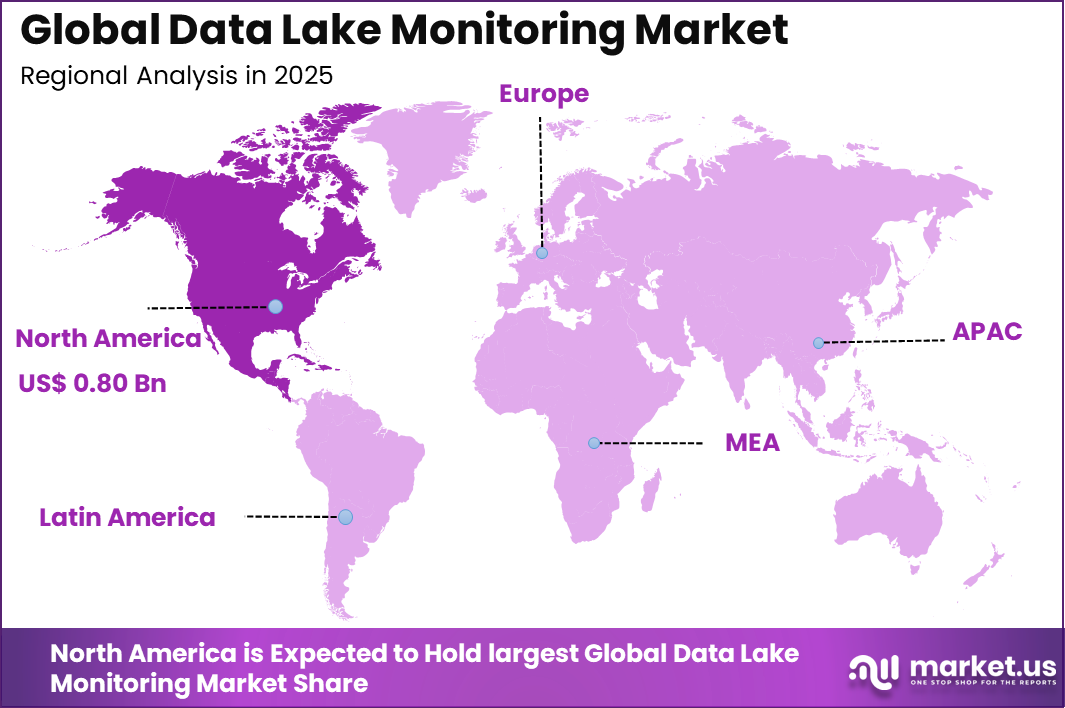
The Global Data Lake Monitoring Market size is expected to be worth around USD 17.46 billion by 2035, from USD 1.86 billion in 2025, growing at a CAGR of 25.1% during the forecast period from 2025 to 2035. North America held a dominant market position, capturing more than a43.15% share, holding USD 0.80 billion in revenue.
The data lake monitoring market refers to the collection of technologies and services that oversee the performance, health, and quality of data within data lakes. This market has grown as enterprises generate and store increasing volumes of unstructured and structured data. Monitoring ensures that data remains accessible, reliable, and compliant with organizational standards. Effective monitoring supports operational continuity across complex data environments.
The scope of the data lake monitoring market includes tools that track ingestion, transformation, and storage processes. Monitoring also involves alerting on anomalies and ensuring data governance policies are enforced. As data lakes are often central to analytics and decision making, visibility into their performance is essential for business operations. The market reflects the priority organizations place on dependable data infrastructure.
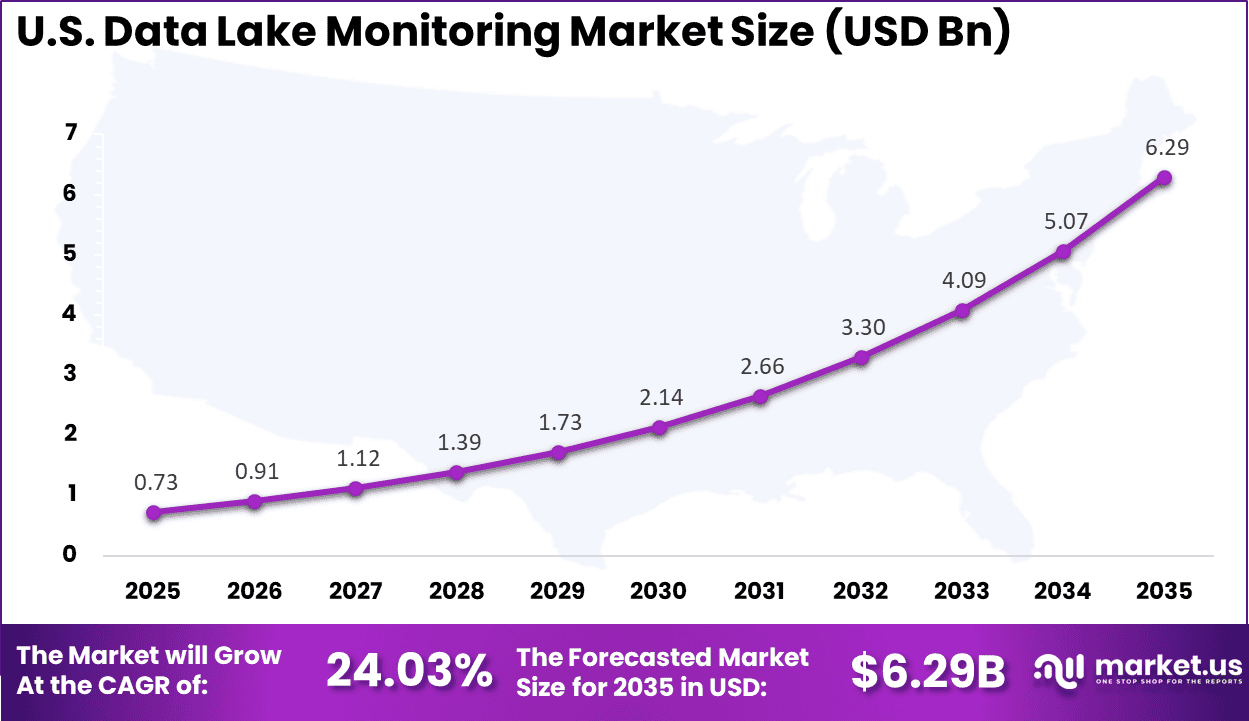
For Instance, in October 2025, Monte Carlo integrates with Databricks for data lake observability. It covers freshness, volume, and schema for BFSI pipelines. This prevents quality issues in transaction data, helping financial teams maintain trust and speed in analytics. North America holds 43.15% of the regional share in the data lake monitoring market. The region demonstrates strong digital infrastructure and advanced cloud adoption. Enterprises in this region actively invest in analytics modernization and data governance initiatives. Monitoring systems are increasingly integrated with broader enterprise data strategies. This strengthens operational resilience and analytical accuracy. For instance, in September 2025, Cisco unveiled AI-powered enhancements to its Splunk portfolio at Splunk .conf25, including agentic AI automation and unified data architectures for enhanced data lake observability. Key features include AI troubleshooting agents and Splunk Machine Data Lake for AI-ready analytics, demonstrating North America’s dominance in AI-driven data lake monitoring. The United States plays a central role in regional growth, supported by strong enterprise technology adoption. The market in the US is expanding at a CAGR of 24.03%, indicating sustained investment momentum. Organizations prioritize regulatory compliance, cybersecurity, and real-time data visibility. The presence of advanced financial, healthcare, and technology sectors further drives demand. Overall, North America remains a leading hub for data lake monitoring innovation and adoption. For instance, in May 2025, IBM introduced its GenAI Lakehouse at IBM Think 2025, featuring AI-aware telemetry, workload introspection, and hybrid deployment capabilities in DB2 Warehouse. This platform reframes enterprise data readiness for generative AI with proactive governance and anomaly detection, solidifying U.S. leadership in data lake management. Several technologies are being adopted to enhance data lake monitoring capabilities across organizations. Machine learning algorithms are being used to detect anomalies in data flows and usage patterns. These algorithms can learn from historical behavior and identify irregularities without extensive manual configuration. The application of machine learning reduces the burden on IT teams and increases detection accuracy. Cloud native monitoring tools are also increasingly adopted. These tools are designed to work with cloud based data lake architectures and integrate with platform services. They provide visibility into performance, cost, and resource utilization within the cloud environment. By aligning with cloud services, monitoring becomes more seamless and efficient for cloud centric organizations. Organizations adopt data lake monitoring to ensure data reliability and integrity within complex environments. Monitoring provides early detection of issues and supports corrective action before business impact occurs. This reduces downtime and minimizes the risk of data corruption. Strong oversight builds confidence among data consumers. Another key reason is to support governance and compliance. As regulatory requirements increase, organizations must demonstrate control over data usage and lineage. Monitoring tools help track changes and ensure that policies are applied consistently. This is critical for audit readiness and maintaining trust with stakeholders. Investment opportunities in the data lake monitoring market are present across technology development and services. Vendors that offer adaptable and scalable monitoring solutions are positioned to benefit from broad enterprise demand. There is opportunity in developing tools that integrate with hybrid and multi cloud environments. Solutions that simplify deployment and management will attract organizational interest. Another area for investment lies in advanced analytics capabilities. Tools that leverage predictive insights to anticipate issues before they occur provide added value. These capabilities reduce manual oversight and increase automation. Investors may also explore partnerships that extend monitoring into adjacent data management functions. Service based offerings present additional opportunity, particularly for organizations without in house expertise. Managed monitoring services enable firms to outsource complex oversight tasks to specialists. This lowers barriers to adoption for smaller and mid sized firms. The continued growth of data centric operations suggests that investment in monitoring services will remain relevant. North America Europe Asia Pacific Latin America Middle East & Africa A prominent emerging trend in the data lake monitoring domain is the integration of advanced observability and data observability practices directly into data lake environments. Modern observability tools are being designed to provide continuous, real-time insights into the health of data pipelines, including automated monitoring for freshness, schema changes, lineage tracking, and error conditions, enabling proactive identification of anomalies before they impact downstream analytics. These capabilities are becoming foundational requirements rather than optional enhancements, reflecting an industry shift toward preventative rather than reactive monitoring across distributed data systems. As observability practices mature, they are expected to become standard components of comprehensive data lake monitoring strategies. Furthermore, this trend is supported by the adoption of machine learning models within monitoring tools to create predictive models of normal data behavior, alerting on deviations such as unexpected missing values or pipeline disruptions. Predictive monitoring facilitates faster resolution of data incidents and enhances trust in analytical outcomes by ensuring that quality and reliability metrics are continually assessed and maintained. The primary driver behind increased adoption of data lake monitoring solutions is the exponential growth of data volumes and complexity in modern enterprise environments. As organizations ingest larger and more diverse datasets spanning structured, semi-structured, and unstructured formats, the pressure to ensure data reliability, performance, and integrity has intensified. Scalable monitoring frameworks are required to track utilization patterns, service levels, and performance metrics across data lakes to meet operational and analytical expectations. In addition, the proliferation of cloud-native architectures, microservices, and distributed applications has created more sources of telemetry data that must be monitored in real time. This shift has underscored the need for unified monitoring platforms that can handle operational data alongside business-critical analytics workloads. The increasing reliance on data lakes for AI and machine learning model training further fuels investment in monitoring tools, as data quality directly influences model accuracy and decision-making processes. A significant restraint in the data lake monitoring ecosystem is the complexity associated with integrating monitoring tools into existing data infrastructures. Data lakes often support diverse data formats and legacy systems, requiring intricate architectural adjustments and custom integrations to ensure monitoring controls work effectively across all components. Such complexity can slow implementation and limit the immediate utility of monitoring platforms if not carefully managed. Moreover, the requirement for specialized technical skills can restrict the adoption of sophisticated monitoring solutions. Skilled professionals capable of configuring observability frameworks, interpreting complex telemetry data, and tuning alerting mechanisms are in high demand but relatively scarce. This skills gap can reduce the pace at which enterprises deploy comprehensive data lake monitoring practices, particularly in smaller or resource-constrained organizations. An important opportunity in the data lake monitoring market lies in the development of unified platforms that bridge observability, governance, and analytics. Tools that integrate monitoring metrics with metadata catalogs, lineage tracking, and governance workflows can deliver enhanced visibility into data health and lineage, supporting improved compliance and decision-making. This convergence can drive efficiencies by reducing the need to maintain separate systems for monitoring, cataloging, and quality enforcement. Additionally, the increasing adoption of artificial intelligence and machine learning within monitoring solutions presents a significant growth opportunity. Automated anomaly detection, root cause analysis, and predictive insights powered by AI can improve responsiveness and reduce the risk of data downtime. As organizations prioritize data accuracy for advanced analytics and AI applications, solutions that embed intelligent monitoring capabilities will be positioned for strong demand. A primary challenge in this sector is ensuring that monitoring systems can scale efficiently with growing data volumes and evolving workloads. Data lakes are designed to hold vast amounts of raw data which, without effective indexing, governance, and management, can lead to performance bottlenecks that complicate monitoring efforts. Ensuring performance and query responsiveness in the face of increasing scale requires optimized architectures and sometimes, significant investment in infrastructure upgrades. Another persistent challenge is balancing comprehensive monitoring with cost management. Continuous, real-time observability and alerting across extensive data pipelines can incur substantial processing and storage costs, particularly in cloud environments where resource usage is closely tied to expense. Organizations must therefore design monitoring strategies that capture essential metrics without generating excessive overhead. Effective cost optimization in monitoring infrastructures remains a key obstacle for many enterprises. Observability and monitoring leaders such as Datadog, Splunk, and IBM play a central role in the data lake monitoring market. Their platforms provide real-time visibility into storage layers, query performance, and ingestion pipelines. Advanced analytics and anomaly detection improve data reliability. These vendors benefit from strong enterprise integration and hybrid cloud capabilities. Demand is driven by increasing data lake adoption for analytics and AI workloads. Cloud and data platform providers such as Amazon Web Services, Microsoft, Google, Snowflake, and Cloudera embed monitoring capabilities within managed data lake services. These platforms support scalability, governance, and performance tracking. Adoption is strong among enterprises managing petabyte-scale datasets and real-time analytics environments. Specialized data observability providers such as Acceldata, Monte Carlo, Bigeye, Anomalo, Soda, Metaplane, and Hydrolix focus on freshness, quality, and cost optimization. These players enhance proactive issue detection and governance compliance. Other vendors expand innovation and regional presence, supporting steady growth in data lake monitoring solutions.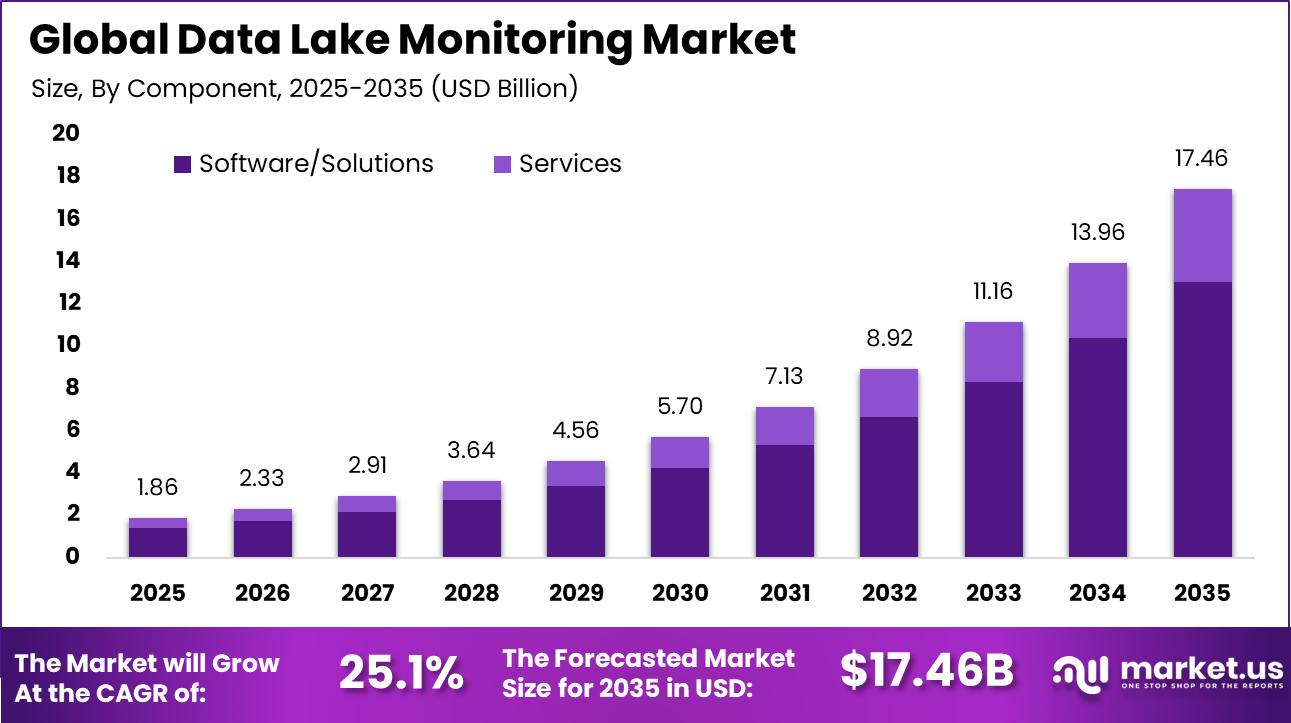
North America Overview
Increasing Adoption Technologies
Investment Opportunities
Key Market Segments
By Component
By Deployment Mode
By Organization Size
By Application
By End-User Industry
Key Regions and Countries
Emerging Trend Analysis
Driver Analysis
Restraint Analysis
Opportunity Analysis
Challenge Analysis
Key Players Analysis
Top Key Players in the Market
Recent Developments