

Report Overview
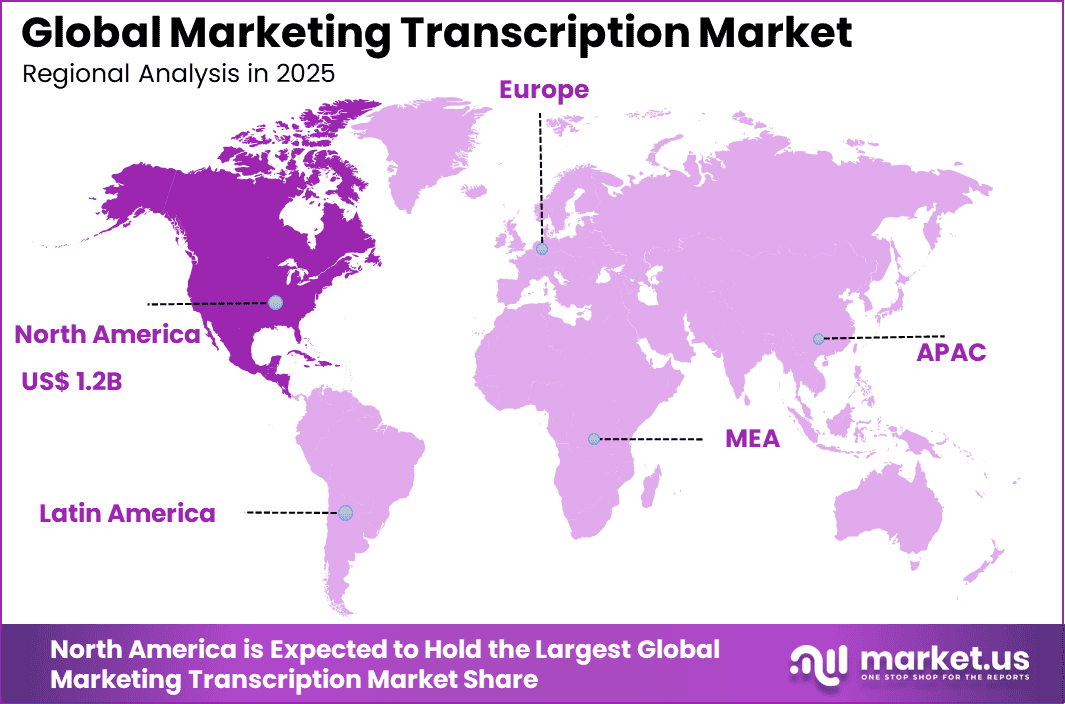
The Global Marketing Transcription Market size is expected to be worth around USD 6.7 Billion By 2035, from USD 2.9 billion in 2025, growing at a CAGR of 8.9% during the forecast period from 2026 to 2035. North America held a dominant Market position, capturing more than a 43.2% share, holding USD 1.2 Billion revenue.
The marketing transcription market refers to the ecosystem of services and technologies that convert spoken content into written text specifically for marketing use cases. This includes transcribing customer interviews, focus group recordings, webinars, podcasts, and campaign discussions to enable analysis, archiving, and insight generation. These solutions help marketing teams convert qualitative voice data into searchable, structured text that can be used for planning, messaging, and strategy development.
Transcription services may be delivered through human linguists, automated software, or hybrid models that combine both, depending on accuracy and turnaround requirements. The output often supports content repurposing, compliance documentation, and research analysis alongside campaign optimization. In a landscape where data driven insights are valued, converting spoken data into text provides a foundation for further analytics and trend identification.
Cloud deployment allows marketing teams to access transcription tools on demand, scale services based on needs, and integrate outputs with other cloud-based marketing platforms. The shift to cloud platforms also supports flexible business models, such as subscription-based pricing, which can appeal to small and medium enterprises. These dynamics are supporting broader uptake of marketing transcription solutions across varied organizational sizes. One notable restraint in the marketing transcription market is the challenge of ensuring high accuracy across diverse accents, dialects, and languages present in global audio and video content. Automated transcription engines often encounter difficulties accurately converting nuanced speech patterns, industry-specific terminology, and overlapping talk in multi-participant recordings, which can necessitate manual review and correction. Another restraint arises from concerns related to data privacy and security when handling sensitive audio content. Marketing materials may contain proprietary information, customer data, or insights that firms are reluctant to expose to external processing systems without robust safeguards. Ensuring compliance with data protection regulations and implementing secure data transmission and storage protocols can increase the complexity and cost of deploying transcription solutions. A significant opportunity within the marketing transcription market lies in expanding services for multilingual and multicultural content processing. As global marketing initiatives span diverse geographic regions, demand is growing for transcription solutions that can accurately handle multiple languages and cultural speech nuances. Enhancing support for real-time translation and cross-language transcription can unlock new market segments and support international campaigns more effectively. These capabilities can also enable broader content accessibility, supporting compliance with regional language requirements and expanding audience reach. Additionally, there is opportunity in combining transcription outputs with analytics platforms to derive deeper insights from conversational data. Transcribed text can be fed into sentiment analysis, keyword extraction, and customer behavior models to inform strategic marketing decisions. Integrations with customer relationship management and marketing automation systems can further enhance the value of transcription data by linking it to campaign performance metrics. As organizations seek richer insights from unstructured content, advanced analytics-linked transcription services will be positioned for strong demand. A primary challenge for the marketing transcription market is balancing the trade-off between automation and contextual understanding. While AI-driven tools can efficiently transcribe large volumes of content, they may struggle to fully interpret context, such as sarcasm, humor, or industry-specific expressions used in marketing communications. This can result in transcripts that require manual post-editing, undermining the efficiency gains sought from automation. Another challenge relates to cost-effectiveness for small and medium-sized enterprises that may have limited budgets for advanced transcription services. While cloud-based solutions provide scalable pricing models, access to high-accuracy, real-time transcription with multilingual and analytics features can still incur significant expense. Smaller organizations may need to balance the benefits of transcription against budget constraints and may adopt more basic solutions that offer limited functionality. AI-driven transcription platforms such as Otter.ai, Sonix.ai, and Speechmatics lead the marketing transcription market. Their solutions use advanced speech-to-text engines to convert webinars, podcasts, and campaign videos into searchable text. Real-time transcription and multi-language support improve content accessibility. These platforms benefit from growing demand for video marketing and digital content repurposing. Adoption is driven by the need for faster content turnaround and improved SEO performance. Hybrid and enterprise-focused providers such as Rev.com, Verbit, and Trint combine AI with human review for higher accuracy. Descript integrates transcription directly into content editing workflows. These players are widely adopted by marketing agencies and media teams. Demand is supported by compliance requirements and brand consistency needs. Affordable and niche transcription services such as Temi, Scribie, and Happy Scribe address SMEs and independent creators. Their platforms focus on cost efficiency and ease of use. Other emerging vendors expand language coverage and AI accuracy. This competitive landscape supports steady growth in marketing transcription solutions across digital channels.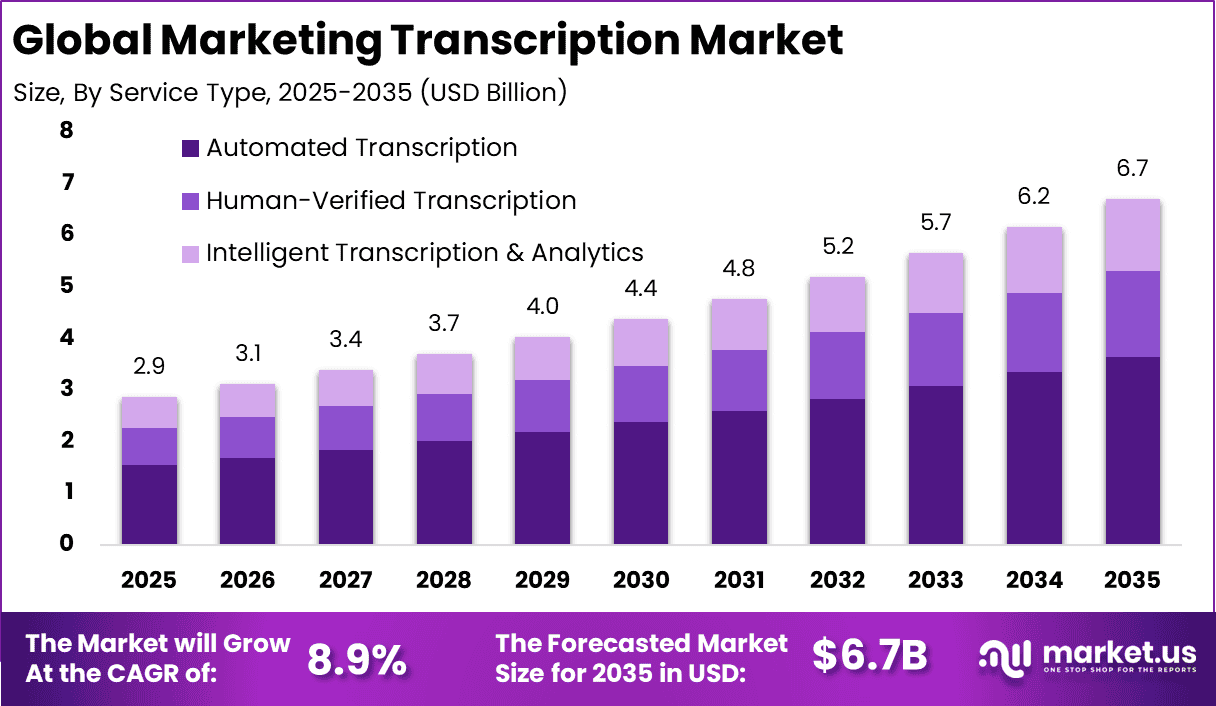
Restraint Analysis
Opportunity Analysis
Challenge Analysis
Competitive Analysis
Top Key Players in the Market
Recent Developments