

Report Overview
The Global Agricultural Planting and Fertilizing Machinery Market size is expected to be worth around USD 174.3 billion by 2034 from USD 114.4 billion in 2024, growing at a CAGR of 4.3% during the forecast period 2025 to 2034.
Agricultural planting and fertilizing machinery covers equipment used to sow seeds, apply nutrients, and prepare soil at scale. Farmers rely on seed drills, planters, fertilizer spreaders, and combined seed-cum-fertilizer drills. These machines help producers reduce labor costs, improve planting accuracy, and manage inputs more efficiently across large field operations.
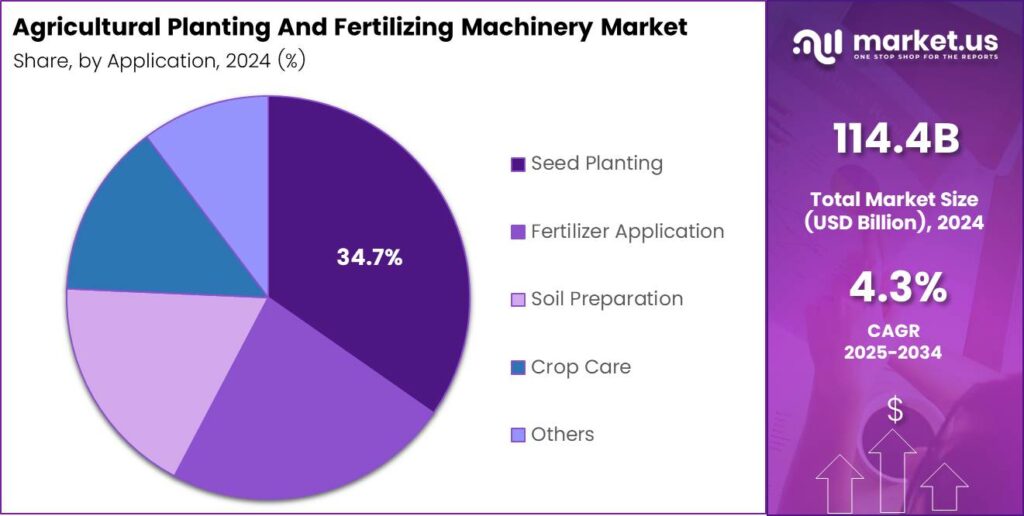
Large-Scale Commercial Farms dominate with 62.9% due to high equipment investment capacity and productivity-driven mechanization demand. In 2025, Large-Scale Commercial Farms held a dominant market position in the By End Use segment of the Agricultural Planting and Fertilizing Machinery Market, with a 62.9% share. Commercial farm operators prioritize high-throughput planting and fertilizing equipment to maximize seasonal productivity. Moreover, these farms generate sufficient revenue to justify capital investment in precision-enabled machinery that delivers measurable returns through input savings and yield improvement. Family-Owned Farms represent a large and growing end-user segment supported by government mechanization programs. Subsidized equipment financing and cooperative purchasing models help family farms access mid-capacity and automatic machinery. Additionally, digital platforms offering machinery-as-a-service models allow smaller farms to benefit from precision agriculture technology without bearing full capital ownership costs, broadening market access across this segment. Farmers increasingly demand spreaders that receive real-time soil data and adjust application rates automatically. Moreover, ISOBUS-controlled dynamic-weighting systems enable operators to manage multiple field zones from a single cab interface, reducing errors and improving nutrient placement accuracy across diverse crop programs. Autonomous and semi-autonomous spreader platforms gain mainstream adoption across large commercial operations. Equipment makers integrate machine vision, GPS-RTK guidance, and section control into standard spreader configurations. Consequently, farms reduce headland overlap losses and boundary over-application while meeting stricter EU Farm-to-Fork and Nitrates Directive mandates that require documented evidence of reduced fertilizer use across enrolled agricultural land areas. High-capacity automatic machinery dominates new equipment purchases on large-scale commercial farms globally. Operators favor wide-boom planters and high-output spreaders that complete field operations within narrow weather windows. Additionally, the shift to single-pass seed-cum-fertilizer drills in dryland zones reduces fuel consumption significantly, aligning with both operational cost goals and the growing carbon-footprint reporting requirements tied to sustainability-linked farm financing programs. Persistent farm labor shortages accelerate the adoption of automated seeders and spreaders across all major production regions. Farm operators cannot source sufficient seasonal workers at viable wage levels, making mechanization economically necessary rather than optional. Consequently, manufacturers report strong order pipelines for automatic planting equipment that replaces manual field operations with consistent, GPS-guided mechanical processes requiring minimal skilled labor involvement. Widespread variable-rate precision technologies deliver double-digit input savings that justify premium equipment investments. Farmers using prescription-map-driven planters and spreaders reduce seed and fertilizer usage by optimizing rates to actual field requirements. Moreover, government subsidy programs in North America and Europe specifically fund precision agriculture equipment purchases, further accelerating adoption among farm operators who seek to improve margins while meeting environmental performance standards. Prohibitive upfront costs of precision-enabled planters and applicators restrict market access for small and mid-scale farm operations. Advanced equipment with GPS, variable-rate drives, and sensor arrays commands significant price premiums over conventional machinery. Consequently, many family-owned farms in developing markets cannot afford these systems without substantial government subsidy support, limiting the pace of precision agriculture adoption beyond the large commercial farm segment. Technical skill gaps in GPS calibration, prescription mapping, and sensor diagnostics create adoption barriers across emerging agricultural markets. Farm operators and service technicians often lack the training required to operate and maintain advanced precision systems effectively. Moreover, limited rural dealer infrastructure means equipment downtime during critical planting and fertilizing seasons can result in significant yield and revenue losses that discourage further investment in complex technology platforms. Widening carbon-credit revenue streams rewards farms that verify nutrient reduction through precision placement practices. Programs in North America and Europe now pay farmers directly for documented fertilizer input reductions achieved through variable-rate application technology. Consequently, equipment investments in precision planters and spreaders deliver dual financial returns — direct input cost savings plus tradable carbon credits — strengthening the business case for advanced machinery adoption. Rising demand for high-specification machinery in controlled-environment and desert farming projects creates premium growth opportunities for equipment manufacturers. Gulf states, Israel, and North African nations invest heavily in mechanized agriculture systems that perform reliably under extreme heat and water-limited conditions. The proliferation of single-pass seed-cum-fertilizer drills in dryland zones reduces fuel consumption while improving nutrient placement, making these machines central to expanding arid-region food production programs globally. North America leads the global agricultural planting and fertilizing machinery market, holding a 36.8% share valued at USD 42.1 billion. The United States and Canada operate large-scale, highly mechanized farm sectors that consistently invest in precision planting and fertilizing equipment. Moreover, government support programs and strong commodity crop production volumes sustain robust machinery replacement and upgrade cycles across the region’s extensive grain and oilseed farming areas. Asia Pacific emerges as the fastest-growing regional market for agricultural machinery, supported by strong government mechanization policies. India, China, and Southeast Asian nations fund equipment subsidies that convert smallholder farms into productive commercial operations. Additionally, Deutz-Fahr Group’s 2025 strategic partnership with Topcon Agriculture to expand precision agriculture solutions signals growing multinational interest in serving the region’s rapidly modernizing farm equipment demand landscape. Middle East and Africa represent emerging opportunity markets for advanced planting and fertilizing machinery, particularly in desert and arid-zone farming projects. Gulf nations invest in controlled-environment agriculture that requires high-specification mechanized systems. Moreover, African governments increasingly prioritize farm mechanization as a food security strategy, creating new demand for affordable mid-capacity planting and fertilizing equipment suited to diverse smallholder and commercial farm environments across the continent. Latin America sustains strong agricultural machinery demand led by Brazil and Argentina’s large-scale soy, corn, and sugarcane production sectors. Farmers in these markets invest heavily in high-capacity planters and precision fertilizer application systems. Consequently, Latin America delivers consistent volume opportunities for global machinery manufacturers, supported by export-oriented farm economics that demand productivity-enhancing equipment capable of covering millions of hectares each growing season efficiently. North America Europe Asia Pacific Latin America Middle East & Africa AGCO Corporation operates as one of the world’s largest agricultural equipment manufacturers, delivering planting and fertilizing solutions under its Fendt, Massey Ferguson, and Challenger brands. AGCO invests heavily in precision agriculture integration, including variable-rate planting technology and ISOBUS-compatible spreader systems. The company serves both large commercial and family farm segments across North America, Europe, and high-growth Asia-Pacific markets with a broad product portfolio. CLAAS reported net sales of €4,997.4 million for its fiscal year ended September 30, 2024, supported by research and development costs of €330.8 million during the same period. This R&D investment reflects CLAAS’s commitment to advancing precision seeding and fertilizing technologies. The company’s EBITDA reached €584.2 million in FY2024, demonstrating strong operational performance that funds continued product innovation across its planting and harvesting machinery lines. CNH Industrial reported full-year consolidated revenues of $19.84 billion for FY2024, with a full-year net income of $1,259 million. CNH’s Case IH and New Holland brands deliver industry-leading planting and fertilizing equipment for large commercial farms globally. In 2025, CNH advanced planter automation through Active and Passive Implement Guidance systems, achieving over 95% seed placement accuracy within 0–5 cm of the intended path, directly improving farm productivity and input efficiency. Kubota Corporation recorded consolidated revenue of ¥3,018,891 million for FY2025, with its Farm and Industrial Machinery segment contributing ¥2,628.6 billion in revenue. Overseas revenue reached ¥2,273.8 billion, confirming Kubota’s strong global market presence. The company’s operating profit for FY2025 stood at ¥265,470 million, reflecting efficient operations and growing demand for Kubota’s mid-capacity and precision-enabled planting and fertilizing equipment across North American, European, and Asian markets.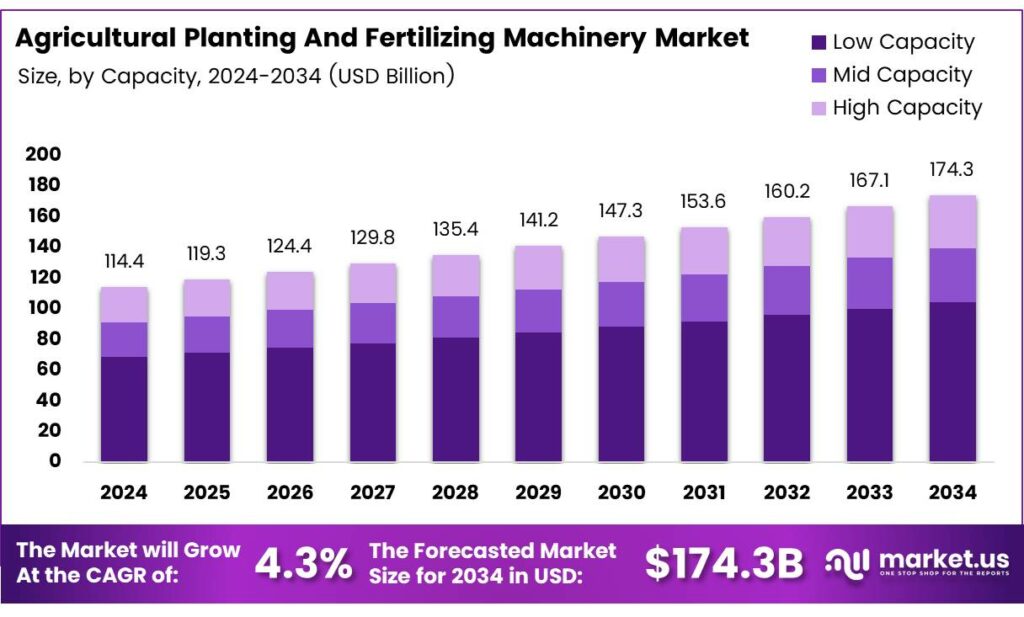
End Use Analysis
Key Market Segments
By Type
By Operation
By Power Source
By Capacity
By Application
By End Use
Emerging Trends
Precision Fertilizing and Autonomous Spreading Technologies Reshape the Agricultural Machinery Landscape
Drivers
Labor Shortages, Policy Support, and Precision Input Savings Drive Strong Agricultural Machinery Market Growth
Restraints
High Capital Costs and Technical Skill Gaps Slow Precision Agricultural Machinery Adoption in Key Markets
Growth Factors
Carbon Credits, AgTech-as-a-Service Models, and Desert Farming Expansion Unlock New Market Opportunities
Regional Analysis
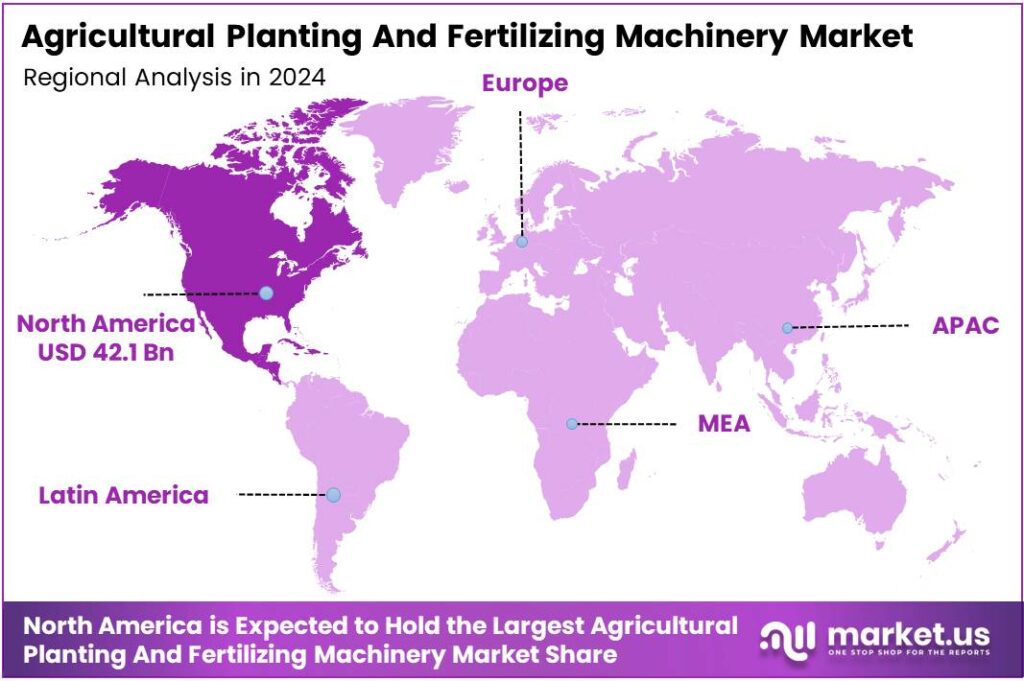
North America Dominates the Agricultural Planting and Fertilizing Machinery Market with a Market Share of 36.8%, Valued at USD 42.1 Billion
Key Regions and Countries
Key Players Analysis
Top Key Players in the Market
Recent Developments