

Report Overview
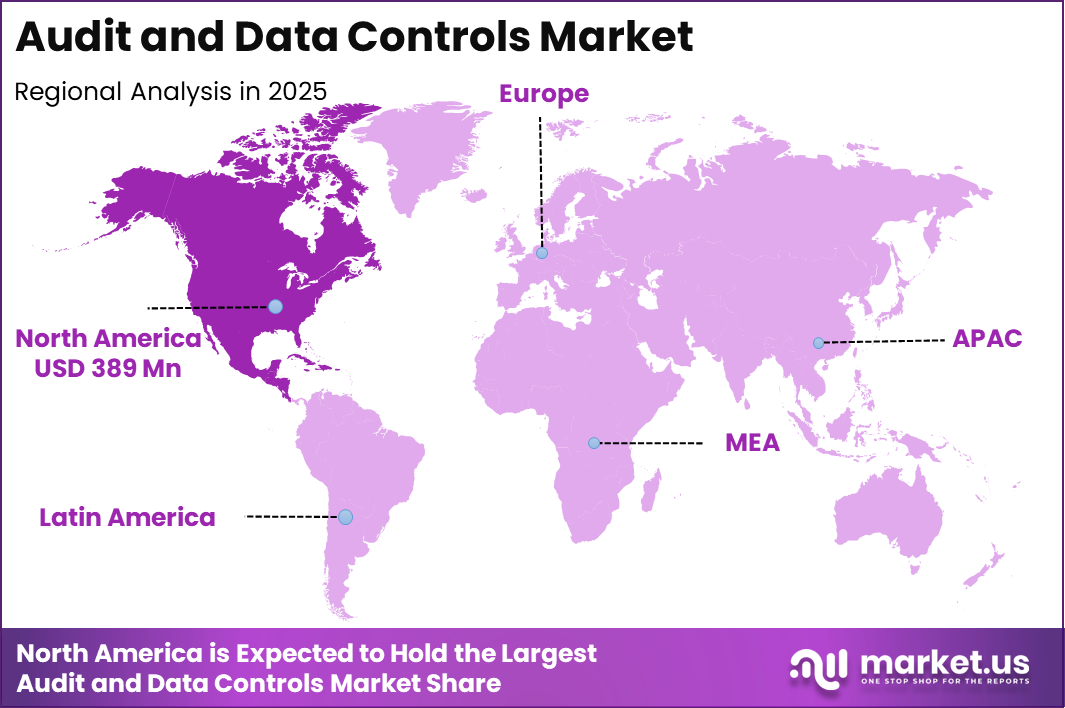
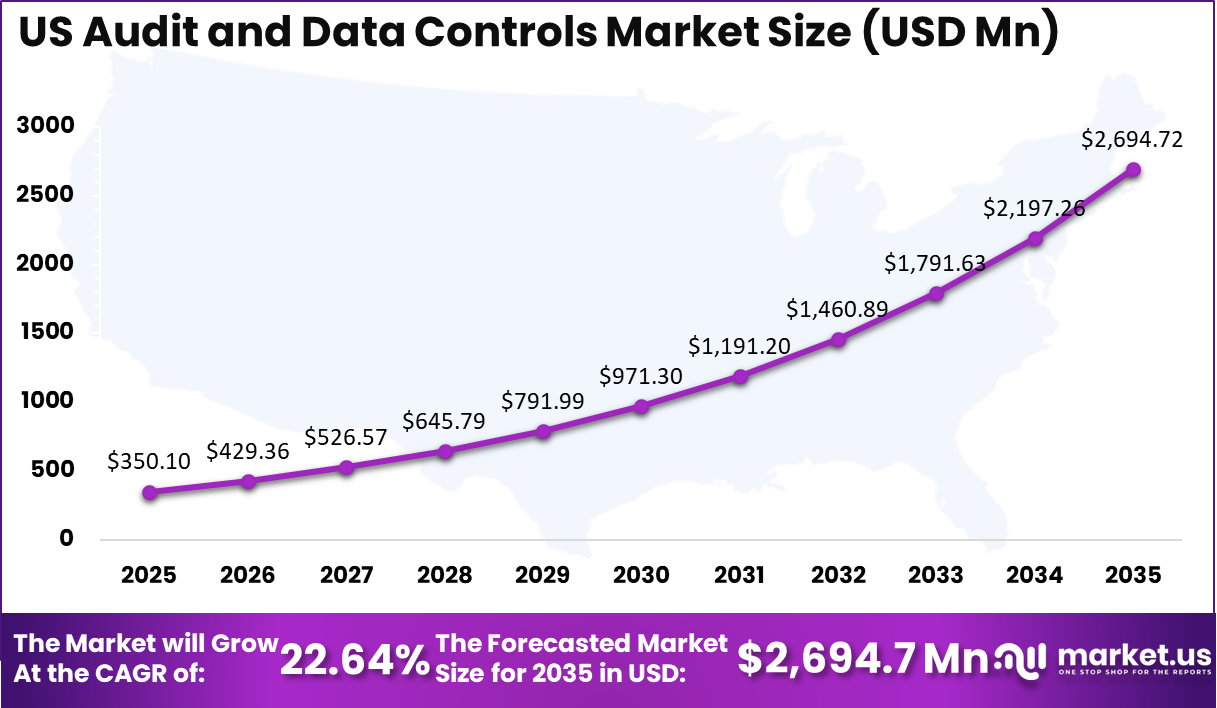
The Audit and Data Controls Market is valued at USD 915.3 million in 2025 and is projected to reach USD 8,189.4 million by 2035, expanding at a 24.50% CAGR. North America accounts for 42.5% share, with a 2025 size of USD 389 million. The US market is valued at USD 350.1 million in 2025 and is projected to reach USD 2,694.7 million by 2035, growing at a 22.64% CAGR.
Audit and data controls are becoming a board-level priority as organizations face tighter expectations for accurate reporting, stronger internal controls, and defensible evidence during audits. Enterprises are moving away from manual, spreadsheet-driven control testing toward systems that can standardize control libraries, automate evidence collection, and maintain clear traceability across processes, users, and datasets.
Demand is being reinforced by increasing reliance on cloud platforms and third-party applications, where access governance, change tracking, and continuous monitoring are essential to reduce audit findings and control failures. Buyers are prioritizing tools that shorten audit cycles, improve the quality of control documentation, and support faster remediation when exceptions are identified.
North America leads adoption due to mature compliance programs and higher audit intensity across regulated industries, while US growth is supported by ongoing investments in governance automation, stronger accountability across business units, and the need to demonstrate reliable controls across complex data environments.
Retail, manufacturing, and energy utilities are also investing as supply chains digitize and critical infrastructure requirements tighten. Even so, BFSI retains the largest share because audit intensity is higher, reporting cycles are frequent, and the cost of non-compliance and remediation is substantial. North America holds 42.5% share of the audit and data controls market and is valued at USD 389 million in 2025. North America remains the leading region for audit and data controls adoption because organizations in the region operate under mature governance expectations and high audit intensity across both regulated and large enterprise environments. Companies are placing stronger emphasis on audit readiness, control documentation quality, and defensible evidence trails that can be produced quickly during internal and external reviews. Adoption is being reinforced by the growing complexity of enterprise data environments, where key records and approvals are spread across ERP systems, cloud applications, and third-party platforms. This has increased the need for standardized control frameworks that can improve visibility into who accessed data, what changed, and whether approvals and policies were followed consistently. North American buyers also tend to prioritize audit efficiency, focusing on tools that reduce manual workpaper preparation, streamline evidence requests, and accelerate remediation workflows when exceptions are identified. As organizations expand digital operations and rely more on automated processes, audit and data controls are increasingly treated as an operational requirement rather than a periodic compliance exercise. This combination of strong governance culture, complex data estates, and a continuous focus on audit efficiency explains why North America commands the largest share and a sizeable 2025 market base. The US audit and data controls market is valued at USD 350.1 million in 2025 and is projected to reach USD 2,694.7 million by 2035, expanding at a 22.64% CAGR. The US is a high adoption market for audit and data controls because organizations face strong expectations for audit readiness, accurate financial reporting, and defensible evidence across business processes and IT systems. Enterprises are investing in platforms that standardize audit workflows, strengthen internal control documentation, and improve the speed and quality of evidence collection during internal and external audits. Adoption is also being reinforced by the complexity of modern data environments where critical records sit across ERP platforms, cloud applications, and third-party systems, making it harder to maintain consistent approvals, access governance, and change tracking. US buyers tend to prioritize solutions that shorten audit cycles, reduce manual testing effort, and provide clear accountability for remediation when control gaps are identified. Continuous monitoring is becoming more important as companies aim to detect exceptions earlier, reduce repeat findings, and support year-round assurance rather than periodic compliance preparation. Audit and data controls adoption is being driven by heavier scrutiny on reporting quality and the cost of weak governance. Regulators continue to pursue disclosure, reporting, and control related misconduct, and the SEC reported 583 total enforcement actions in fiscal year 2024 with USD 8.2 billion in financial remedies, which reinforces the need for stronger evidence trails, faster audit response, and more defensible control testing. At the same time, internal control programs are becoming more resource-intensive, pushing organizations to automate. KPMG’s 2025 SOX survey reported an average SOX program budget of USD 2.3 million and an average time effort of 15,580 hours, with both cost and hours rising substantially over the prior two years, which increases pressure to reduce manual testing and improve workflow efficiency through software. Audit quality oversight is also acting as a catalyst, since inspection bodies keep highlighting deficiencies that require firms and issuers to strengthen documentation, management review controls, and data integrity practices across systems. These forces are accelerating investment in platforms that centralize audit workpapers, standardize control libraries, automate evidence collection, and track remediation in real time, so organizations can reduce repeat findings and sustain year-round readiness rather than preparing only around audit season. A major restraint in audit and data controls market adoption is the capability gap within internal audit and compliance teams. Many organizations are expanding expectations for continuous monitoring, data integrity checks, and technology-enabled assurance, but resourcing and skills are not keeping pace. One indicator is that 66% of internal audit teams say their capabilities do not fully align with their organization’s priorities, which slows tool selection, limits automation ambition, and increases dependence on manual workarounds even after software is deployed. Another restraint is the integration burden created by fragmented data estates. Audit evidence often sits across ERP platforms, identity systems, ticketing tools, cloud logs, spreadsheets, and vendor portals, so consolidating it into a single control narrative requires data mapping, workflow redesign, and sustained ownership from process teams. This challenge is compounded by the broader enterprise problem of disconnected datasets and duplication, where siloed data makes it harder to maintain consistent, auditable definitions and to reproduce results when auditors reperform testing. As a result, implementation timelines extend, stakeholder fatigue rises, and some projects get limited to narrow use cases rather than scaling across the enterprise. A major opportunity is the shift from periodic audits to continuous controls monitoring, where exceptions are detected earlier, and remediation is tracked in near real time. Audit oversight trends are reinforcing this direction. In the US, PCAOB inspection results reported audit deficiencies in 39% of inspections in 2024, down from 46% in 2023, showing both pressure and momentum for better quality and more consistent evidence. As boards and audit committees demand stronger assurance, enterprises are investing in platforms that connect process controls, IT change logs, access reviews, and issue management into a single evidence trail that can stand up to re-performance and regulator scrutiny. Another opportunity is AI-enabled audit analytics that reduces manual sampling and expands coverage across large datasets. A Wolters Kluwer survey found 39% of internal auditors already use AI, and another 41% intend to adopt it within 12 months, implying a fast scaling market for tools that automate testing, highlight anomalies, and accelerate workpaper completion. At the same time, readiness gaps create demand for packaged capabilities and managed services to operationalize AI safely. For example, one industry report noted only 28% of internal audit leaders feel confident about their teams’ ability to audit AI risks, which opens space for governance templates, control libraries, and assurance frameworks focused on AI systems. Audit and data controls are trending toward technology-assisted assurance, where audit teams rely more on data analytics, automated testing, and digital evidence trails instead of manual sampling. The direction is clear in internal audit skill priorities, as 92% of CAEs say data analytics is the most important technology skill for the future, which is accelerating investments in controls that can continuously capture logs, approvals, and exceptions in a structured and reusable way. Another trend is early but growing use of generative AI in internal audit, with 41% of teams reporting some GenAI use, while frequent or extensive use remains limited, showing the market is moving from experimentation to governance-focused adoption. This is also shaping demand for stronger auditability of AI outputs, model change tracking, and documentation standards. A third trend is the rising focus on technology-assisted analysis in external audits, reinforced by PCAOB amendments that clarify auditor responsibilities when using technology-based tools, effective for fiscal years beginning on or after December 15, 2025. Together, these trends are pushing buyers toward platforms that unify audit management, control testing, and continuous monitoring, with clearer traceability across data sources and faster evidence production during audits and regulatory reviews. Competition in audit and data controls is split between platform vendors that deliver repeatable workflows and suites that embed controls into enterprise systems. IBM positions OpenPages as an integrated GRC platform with dedicated internal audit management to plan, execute, and report audits within a broader risk and compliance view. Oracle competes by tying audit and compliance directly to ERP controls, emphasizing user access control, activity monitoring, and automated compliance workflows for Oracle Cloud ERP environments. SAP follows a similar control-first approach, with access control capabilities focused on detecting access risks, embedding compliance checks into processes, and supporting workflow-driven access requests and approvals. A second lane is cloud native workflow and content-led compliance. Microsoft competes through Microsoft Purview Compliance Manager, focused on assessing and managing compliance across multicloud environments with control management and auditor reporting support. ServiceNow competes by operationalizing GRC in daily work, including policy and compliance workflows that map procedures to external regulations and support continuous monitoring. MetricStream and NAVEX compete through integrated risk and compliance platforms that centralize regulations, risks, controls, audits, and reporting, while Diligent and Wolters Kluwer compete strongly with unified governance and audit execution platforms such as Diligent One and TeamMate+ for end-to-end audit workflow. Thomson Reuters supports this ecosystem with Regulatory Intelligence content coverage across 1,200-plus regulatory bodies and 2,500-plus collections, often feeding regulatory change processes used by platforms and advisory teams. Big Four firms, including Deloitte, PwC, EY, and KPMG, compete by implementing and operating controls programs through controls assurance, managed services, and SOX support. Over the next few years, audit and data controls are expected to move from annual, checklist-driven programs to continuous assurance that runs alongside day-to-day operations. SOX programs are already consuming heavy resources, with an average budget of USD 2.3 million and 15,580 hours of effort reported in KPMG’s 2025 SOX survey, so buyers are anticipated to accelerate automation to reduce manual testing and evidence chasing. Internal audit teams are also expected to scale AI-assisted procedures quickly, as Wolters Kluwer reported AI adoption is projected to double to 80% in 2026, driven by productivity and faster anomaly detection. External audit practices are likely to reinforce this shift, since PCAOB amendments related to technology-assisted analysis become effective for audits of fiscal years beginning on or after December 15, 2025, pushing stronger use of advanced analytics and more consistent electronic evidence expectations.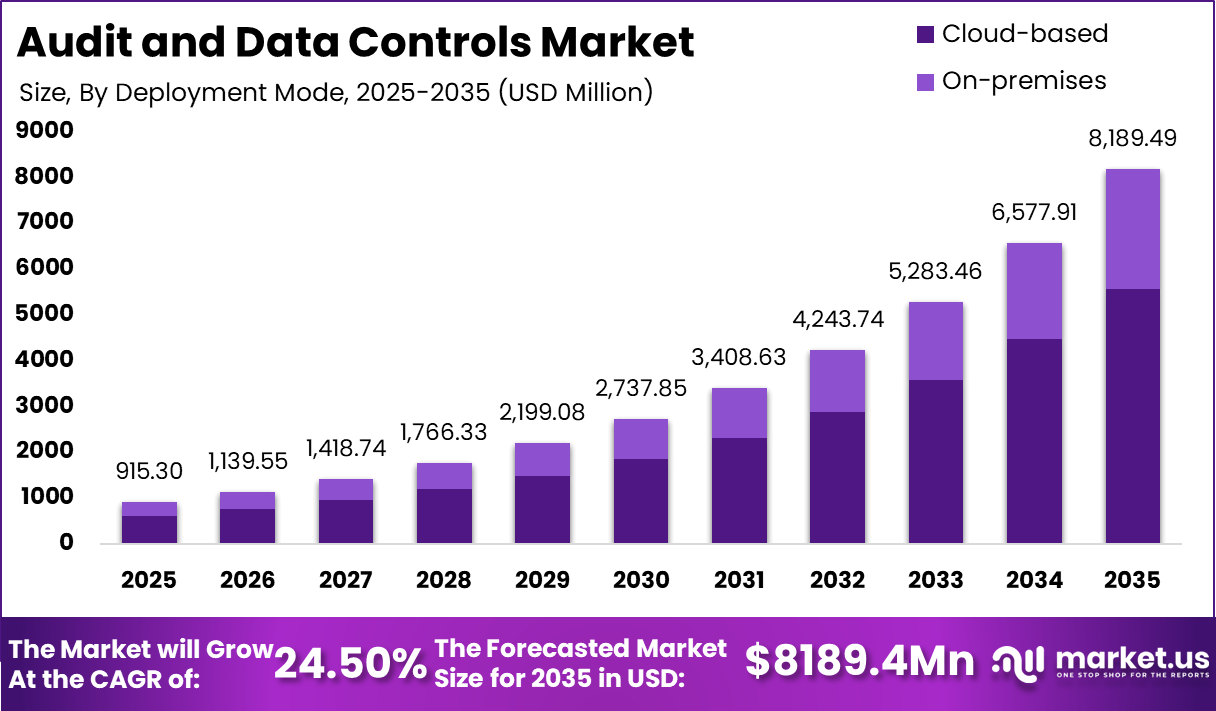
Key Market Segments
By Deployment Mode
By Application
By End-User Industry
Regional Analysis
US Market Size
Regional Analysis and Coverage
Driving Factors
Restraint factors
Growth Opportunities
Trending factors
Competitive Analysis
Top Key Players in the Market
Future Predictions
Recent Developments