

Report Overview
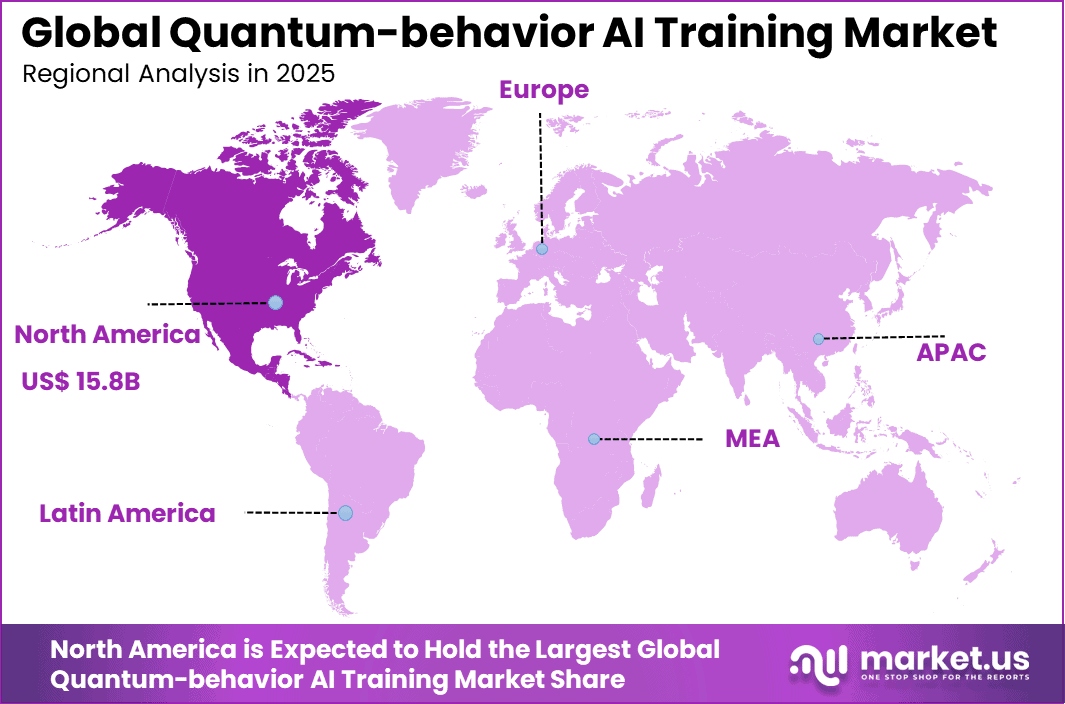
The Global Quantum-behavior AI Training Market size is expected to be worth around USD 692.4 Billion By 2035, from USD 41.2 billion in 2025, growing at a CAGR of 32.6% during the forecast period from 2026 to 2035. North America held a dominant Market position, capturing more than a 38.5% share, holding USD 15.8 Billion revenue.
The Quantum-Behavior AI Training Market refers to solutions and services that enable artificial intelligence models to learn and adapt using principles inspired by quantum computing and behavioral learning theories. These training systems combine advanced computational frameworks with adaptive algorithms to improve learning efficiency and decision making in complex environments. The market includes software platforms, training frameworks, and specialized hardware support that facilitate this novel approach to AI development.
Market growth has been supported by the increasing demand for AI systems capable of handling complex, high dimensional problems with enhanced generalization abilities. Traditional AI training methods are challenged by tasks involving uncertainty, dynamic environments, and large state spaces. Quantum-behavior approaches aim to address these limitations by integrating probabilistic reasoning and optimization strategies influenced by quantum computing concepts.
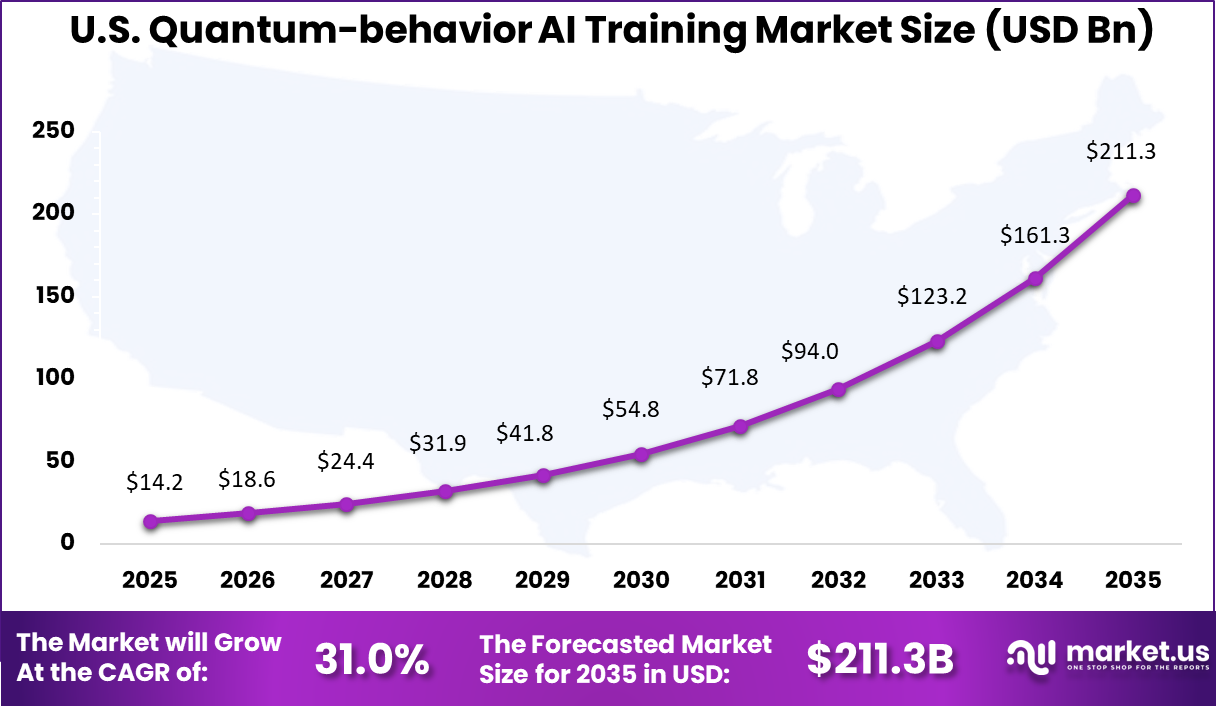
The United States leads regional growth with a market value of USD 14.29 Bn and a CAGR of 31.02%. Organizations across finance, technology, and research sectors are accelerating adoption of hybrid computational frameworks. Investment in cloud infrastructure and advanced analytics strengthens deployment capabilities. Continuous innovation momentum reinforces regional leadership. North America remains a key center for quantum-behavior AI training advancement. The Quantum behavior AI Training market is evolving around the integration of quantum inspired algorithms with advanced machine learning models. Researchers and technology developers are exploring hybrid computing frameworks where quantum simulation techniques enhance pattern recognition and optimization tasks. This trend is driven by the need to solve complex problems that classical systems struggle to process efficiently. Another emerging trend is the development of specialized cloud based quantum simulation platforms for AI experimentation. Enterprises and research institutions are leveraging cloud access to quantum development environments without requiring physical quantum hardware. This approach accelerates experimentation in quantum aware neural networks and probabilistic modeling. A key driver of the Quantum behavior AI Training market is the increasing demand for high performance computational models capable of solving optimization and combinatorial problems. Industries such as finance, pharmaceuticals, and advanced materials research require enhanced modeling accuracy and faster solution discovery. Quantum inspired AI training techniques offer potential improvements in solving multi variable problems. This demand for computational efficiency is encouraging early investment and research. Another important driver is the growing strategic focus on next generation computing infrastructure. Governments and private enterprises are allocating funding toward quantum research initiatives and AI advancement programs. The convergence of quantum theory and artificial intelligence is being viewed as a long term technological priority. Such institutional support is fostering innovation and pilot deployments in controlled environments. One significant restraint in this market is the limited availability of fully scalable and stable quantum hardware. Current quantum processors face challenges related to error rates, coherence time, and qubit stability. These technical constraints limit the practical implementation of large scale AI training directly on quantum systems. As a result, most applications remain experimental or hybrid in nature. Another restraint involves the shortage of professionals skilled in both quantum physics and advanced AI modeling. The interdisciplinary expertise required to design and train quantum aware AI systems is rare. Organizations must invest heavily in research talent and specialized training programs. This talent gap slows commercialization and broader adoption. A major opportunity lies in the application of quantum behavior AI training for complex simulation and predictive modeling. Fields such as drug discovery, climate modeling, and financial risk assessment involve large scale variable interactions. Quantum inspired AI models can potentially improve computational speed and modeling precision. Early adopters in research intensive sectors may gain competitive advantages through enhanced analytics capabilities. Another opportunity is the expansion of cloud based quantum development services. As quantum computing platforms become more accessible through cloud infrastructure, enterprises can experiment without heavy capital investment. This model lowers entry barriers and encourages broader participation in quantum AI research. Service providers that offer integrated development tools and training environments can capture emerging demand. A central challenge is demonstrating clear commercial value in the short to medium term. Many quantum behavior AI applications remain at proof of concept stages, with limited real world deployment. Enterprises require measurable performance gains before committing significant budgets. Bridging the gap between theoretical advantage and practical benefit remains complex. Another challenge involves ensuring data security and regulatory compliance in hybrid quantum cloud environments. Sensitive datasets used for AI training must be protected while interacting with experimental computing frameworks. Establishing standardized protocols for encryption, validation, and governance is essential. Without clear standards, enterprise adoption may proceed cautiously. Quantum hardware and computing innovators such as D-Wave Quantum Inc., IonQ Inc., Rigetti and Co. LLC, Xanadu Quantum Technologies Inc., and Origin Quantum form the technological foundation of the quantum-behavior AI training market. These companies develop quantum processors and hybrid architectures to accelerate complex optimization and model training tasks. Demand is driven by research in advanced AI algorithms and high-dimensional data modeling. Cloud and enterprise technology providers such as Amazon Web Services Inc., Microsoft Corp., Google LLC, Alibaba Cloud, International Business Machines Corp., and Fujitsu Ltd. integrate quantum capabilities into cloud-based AI development platforms. These vendors enable hybrid classical-quantum workflows. Adoption is currently concentrated in research institutions and large enterprises exploring next-generation AI training methods. Quantum software and algorithm specialists such as QC Ware, Zapata Computing, 1QB Information Technologies Inc., and Honeywell Quantum Solutions focus on quantum-enhanced AI models and simulation tools. These players emphasize optimization, cryptography, and advanced neural network experimentation. Other vendors expand innovation and regional research initiatives, supporting early-stage growth in quantum-behavior AI training solutions.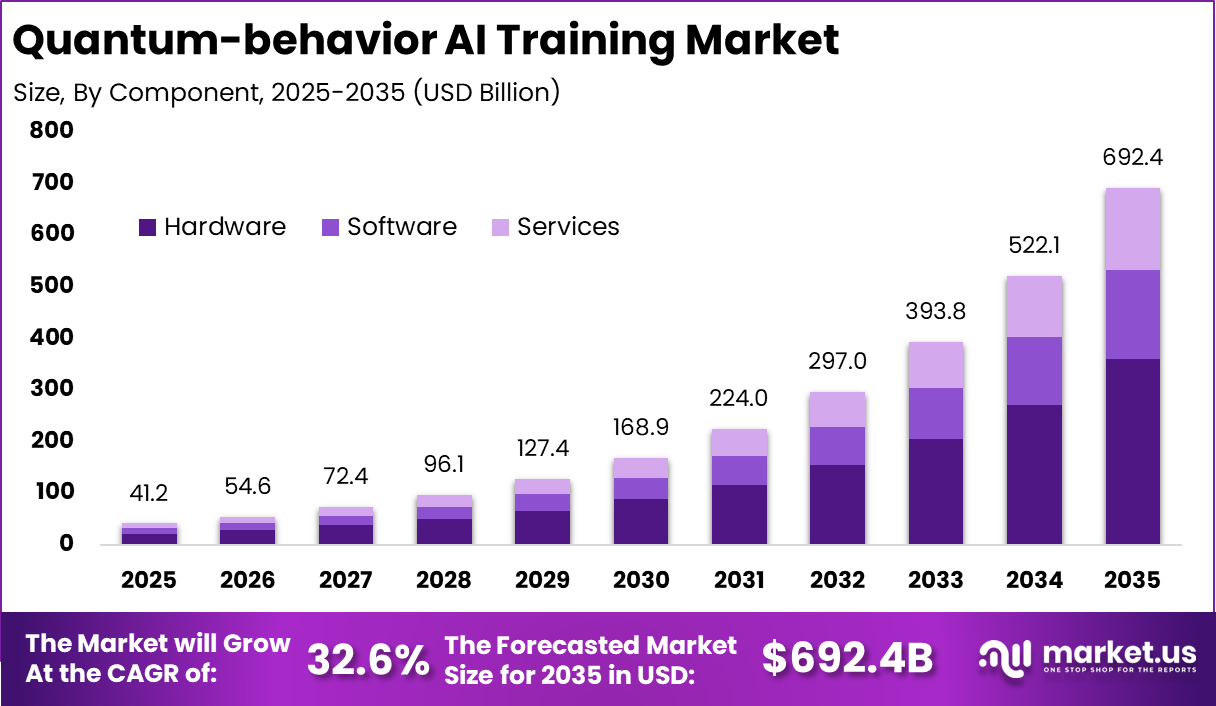
Key Market Segments
By Component
By Technology
By Deployment Mode
By End-Use Industry
Regional Analysis and Coverage
Emerging Trends Analysis
Driver Analysis
Restraint Analysis
Opportunity Analysis
Challenge Analysis
Competitive Analysis
Top Key Players in the Market
Recent Developments