

Report Overview
As someone seriously evaluating potential research investments, I find the outlook for the Unsupervised Learning Market compelling and strategically vital. In 2025, this market is forecast to be valued at USD 4.86 billion, and with a robust compound annual growth rate (CAGR) of 26.20%, it is projected to expand substantially to approximately USD 49.80 billion by 2035.
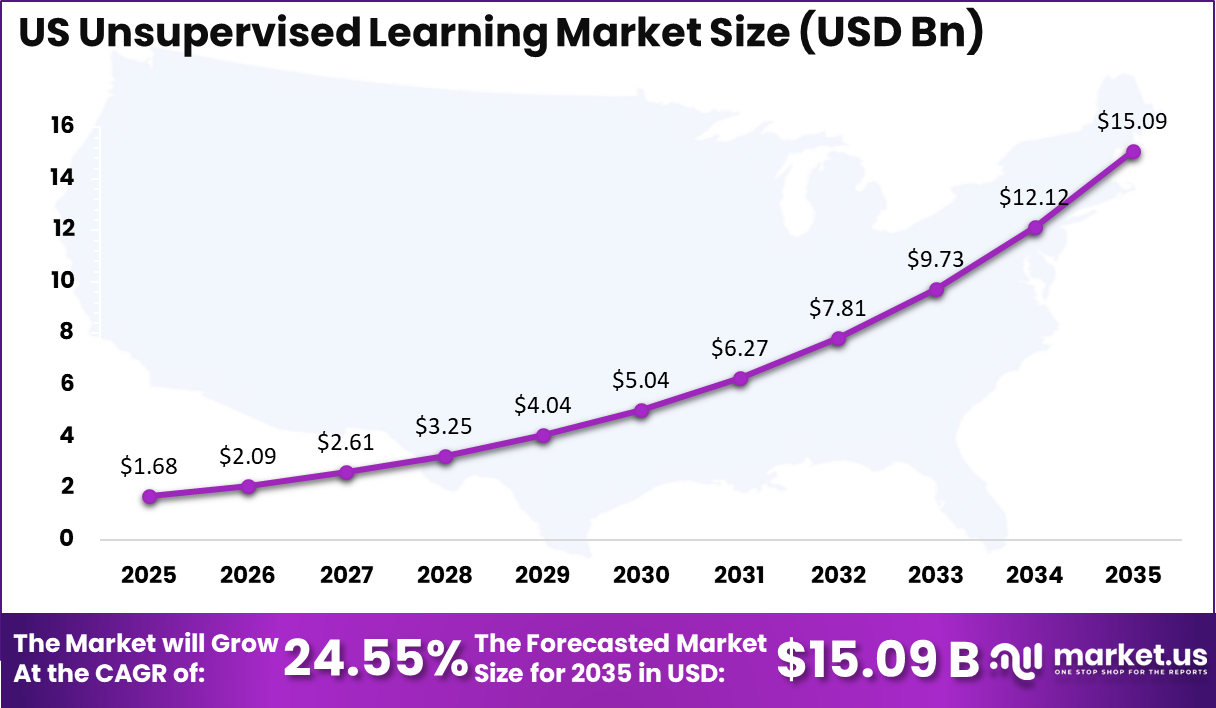
Such a growth trajectory highlights not only accelerating adoption across industries but also a significant shift toward advanced analytical methods that can extract insights from data without predefined labels. From a regional perspective, North America dominates with a 38.5% share of the market, amounting to USD 1.87 billion in 2025.
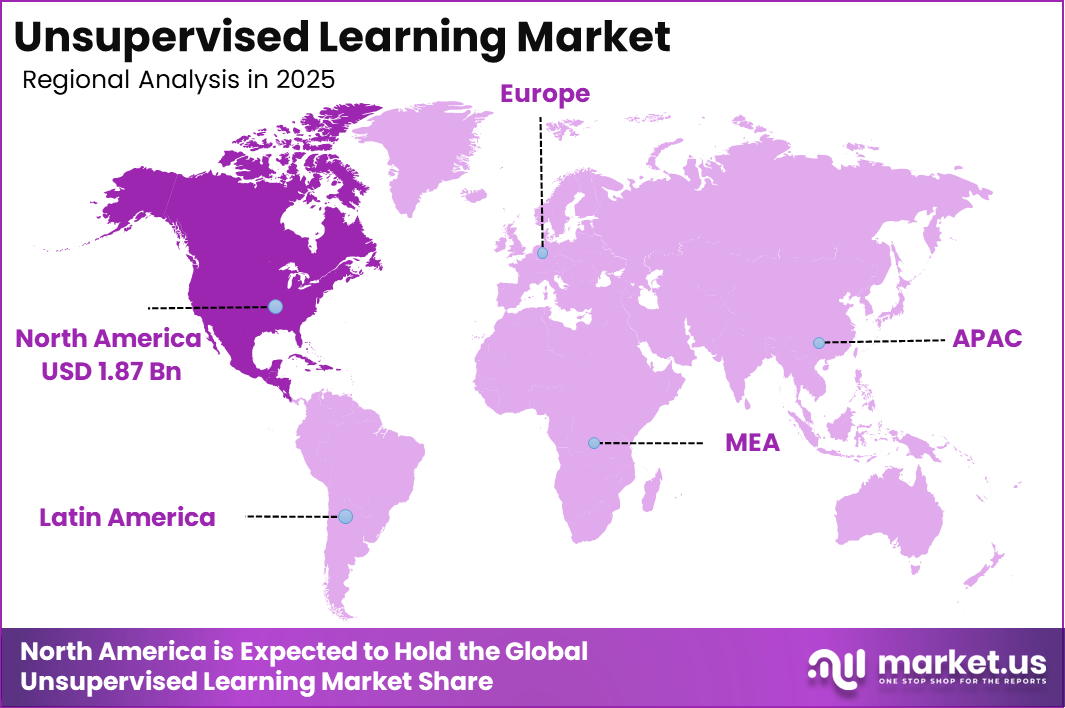
Within this region, the United States is particularly influential, representing USD 1.68 billion of the North American total. By 2035, the U.S. segment alone is projected to reach USD 15.09 billion, with a strong CAGR of 24.55% over the forecast period, underscoring enduring demand from enterprises seeking competitive advantage through intelligent data processing.
These figures signal substantial opportunity for stakeholders looking to understand market dynamics, competitive positioning, and investment potential in unsupervised learning technologies. The growth of the Unsupervised Learning Market reflects a broader industry trend where organizations increasingly prioritize data-driven decision-making and automation.
Businesses are leveraging unsupervised learning algorithms to uncover hidden patterns, detect anomalies, and optimize operations without relying on labeled datasets, making these solutions highly versatile across sectors such as finance, healthcare, retail, and manufacturing.
The United States represents the largest and most influential segment of the Unsupervised Learning Market in North America, with a market size of USD 1.68 billion in 2025. The country’s adoption is driven by a combination of advanced technological infrastructure, extensive enterprise data resources, and a strong focus on artificial intelligence and machine learning integration across industries. Financial services, healthcare, IT, and retail sectors are at the forefront of adoption, deploying unsupervised learning algorithms for fraud detection, customer segmentation, predictive analytics, and operational optimization. By 2035, the U.S. market is projected to reach USD 15.09 billion, growing at a CAGR of 24.55% over the forecast period, reflecting sustained investment and expanding applications. Large enterprises dominate adoption due to their capacity to invest in robust IT infrastructure, skilled AI professionals, and on-premise deployment solutions, while SMEs increasingly leverage cloud-based platforms to implement cost-effective AI solutions. The strong growth trajectory is supported by continuous advancements in natural language processing, computer vision, and speech recognition, which enhance the effectiveness and scalability of unsupervised models. Government initiatives promoting AI research, combined with active venture capital funding and innovation hubs, further accelerate market expansion. Overall, the United States remains a critical driver of global unsupervised learning growth, offering significant opportunities for technology providers and enterprise adopters. Industry adoption of unsupervised learning is being driven by several quantifiable, market‑validated factors that are making these technologies indispensable for modern enterprises. A key driver is the explosion of unstructured data – organizations now generate vast amounts of text, transactional, and sensor data that cannot be efficiently labeled manually. Unsupervised models such as clustering and dimensionality reduction offer scalable pattern discovery without labeled inputs, enabling insights that traditional methods cannot deliver. In fact, over 58 % of global enterprises are already using unsupervised models for applications such as cybersecurity and fraud detection, demonstrating real‑world deployment beyond experimentation. Advancements in AI infrastructure are another major force. Increasing computational power, cloud‑based platforms, and AI hardware have reduced barriers to implementation, allowing even mid‑sized enterprises to adopt sophisticated unsupervised techniques. Across industries, over 61 % of large enterprises deploy unsupervised models for high‑value functions like customer segmentation and network monitoring, illustrating enterprise‑level commitment. Operational efficiency gains also fuel adoption. Organizations report up to 42 % improvements in efficiency and significant reductions in manual data labeling costs by leveraging unsupervised methods, strengthening business cases for investment. Despite strong growth momentum, the Unsupervised Learning Market faces several restraining factors that could slow broader adoption and impact deployment outcomes. One of the most significant challenges is model interpretability and transparency: unsupervised algorithms often generate patterns or clusters that lack clear explanation or context, making it difficult for decision‑makers to trust and act on results, especially in regulated industries such as finance and healthcare, where explainability is critical. Another restraint stems from data quality and evaluation complexity. Unsupervised learning operates without labeled outputs, which means organizations cannot easily measure performance against ground truth or standardized accuracy metrics. This lack of clear evaluation makes validating model outputs subjective and often reliant on domain expertise, increasing implementation risk. High computational and resource requirements are also barriers; many unsupervised techniques require powerful hardware and extensive preprocessing to handle large, high‑dimensional datasets, driving up costs and limiting adoption by smaller organizations. Skill shortages further hinder growth, as implementing and tuning unsupervised models demands advanced data science expertise that many enterprises struggle to recruit and retain. The Unsupervised Learning Market presents significant growth opportunities driven by evolving technology trends, expanding use cases, and increasing enterprise demand for advanced analytics. One major opportunity lies in the explosive growth of unstructured data: global data creation is projected to reach hundreds of zettabytes in the coming years, creating a pressing need for solutions that can efficiently extract insights without labeled datasets. This fuels demand across industries such as IT, healthcare, finance, and manufacturing, where pattern recognition, anomaly detection, customer segmentation, and predictive analytics are increasingly strategic. Integration with emerging technologies such as edge AI, federated learning, and hybrid AI models unlocks new avenues for deployment. Edge‑based unsupervised learning enables real‑time analytics on IoT devices, reducing data transfer costs and supporting smart infrastructure applications in manufacturing and autonomous systems. Federated learning frameworks enhance privacy‑preserving model training across decentralized data sources, particularly relevant in regulated sectors like healthcare and banking. platforms and AutoML solutions also lower barriers to entry, enabling small and medium‑sized enterprises to adopt unsupervised learning without heavy upfront infrastructure or specialized talent, broadening the addressable market. Rapid innovation in self‑supervised transformers, contrastive learning, and multimodal models further expands capabilities, allowing organizations to tackle complex, cross‑domain problems and drive improved operational decision‑making. The competitive landscape of the Unsupervised Learning Market is shaped by a mix of global technology leaders and specialized AI innovators, with the top 5 companies controlling an estimated 48–52% of overall market influence as of 2025. Major industry players such as IBM, Microsoft, Google, Amazon Web Services (AWS), SAP, Oracle, H2O.ai, DataRobot, NVIDIA, Intel, Salesforce, SAS Institute, and Databricks dominate the development and deployment of unsupervised learning tools and enterprise platforms. These firms leverage deep pockets in R&D, extensive AI ecosystems, and broad customer bases to secure leadership positions. IBM’s Watson platform provides sophisticated unsupervised analytics capabilities that are widely used for clustering, dimensionality reduction, and anomaly detection across sectors such as finance and healthcare, reinforcing its competitive edge. Microsoft and Google continue to expand unsupervised learning services through Azure AI and Google Cloud, respectively, often integrating AutoML and foundation models to simplify deployment. AWS competes strongly with scalable cloud‑native solutions supporting diverse unsupervised workloads. Specialized vendors like DataRobot and H2O.ai focus on automated machine learning frameworks, helping enterprises accelerate model building with minimal coding overhead, while NVIDIA’s hardware innovations optimize large model training. Strategic partnerships, product enhancements, and cloud integrations are common tactics among these competitors to deepen market penetration and enhance analytics performance. Looking forward, emerging technologies, including self‑supervised learning, hybrid AI models, and foundation model integration, are expected to enhance model accuracy and expand capabilities across multimodal datasets. Cloud-native deployments and edge AI solutions will support real-time analytics in IoT, autonomous systems, and smart infrastructure applications. Federated learning and privacy-preserving frameworks will unlock adoption in regulated sectors like healthcare and financial services, where centralized data storage is restricted. Increasing emphasis on explainable AI and more efficient algorithm design will reduce barriers related to interpretability and operational cost. Collectively, these trends indicate that unsupervised learning will become an integral part of enterprise analytics and automation strategies, driving innovation and competitive advantage over the next decade. The increasing availability of cloud platforms, AutoML solutions, and scalable computational infrastructure is enabling small and medium-sized enterprises to implement these models without extensive in-house expertise. Combined with the accelerating development of hybrid AI models and real-time analytics solutions, these factors are expected to make unsupervised learning a core component of enterprise AI strategies, driving long-term value creation, operational efficiency, and competitive differentiation across industries worldwide.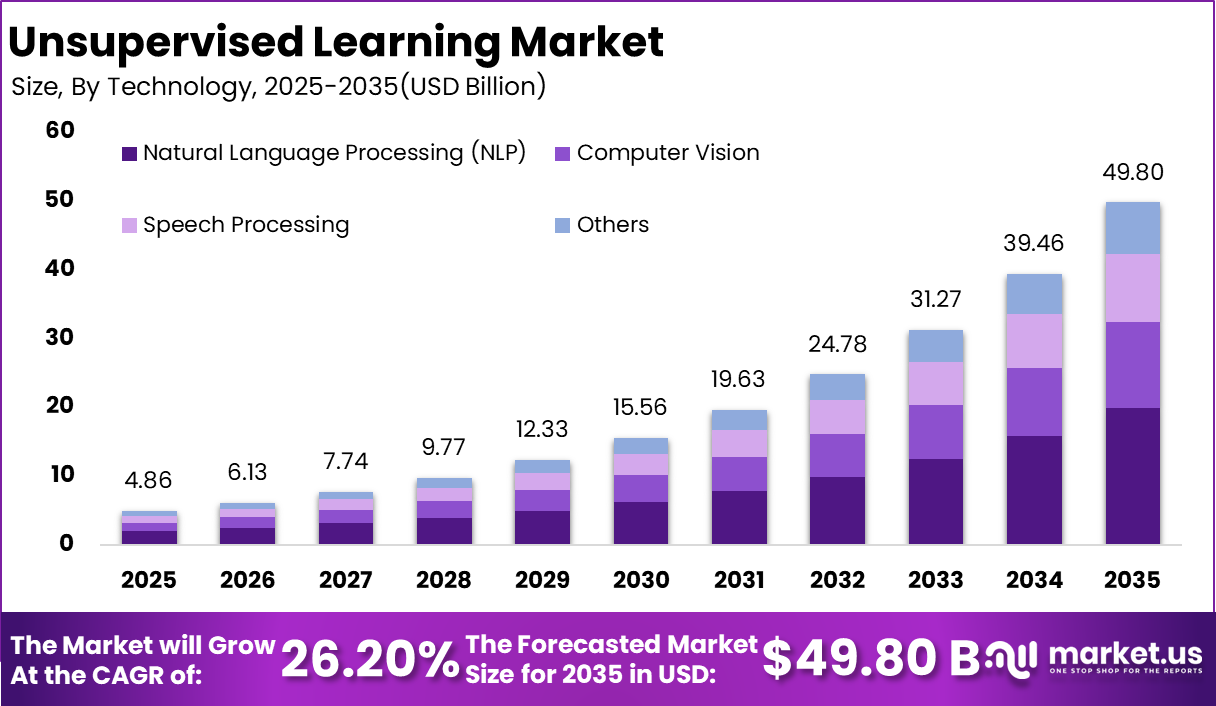
US Market Size
Regional Analysis and Coverage
Driving Factors
Restraint factors
Growth Opportunities
Trending factors
Competitive Analysis
Top Key Players in the Market
Future Predictions
Recent Developments