

Report Overview
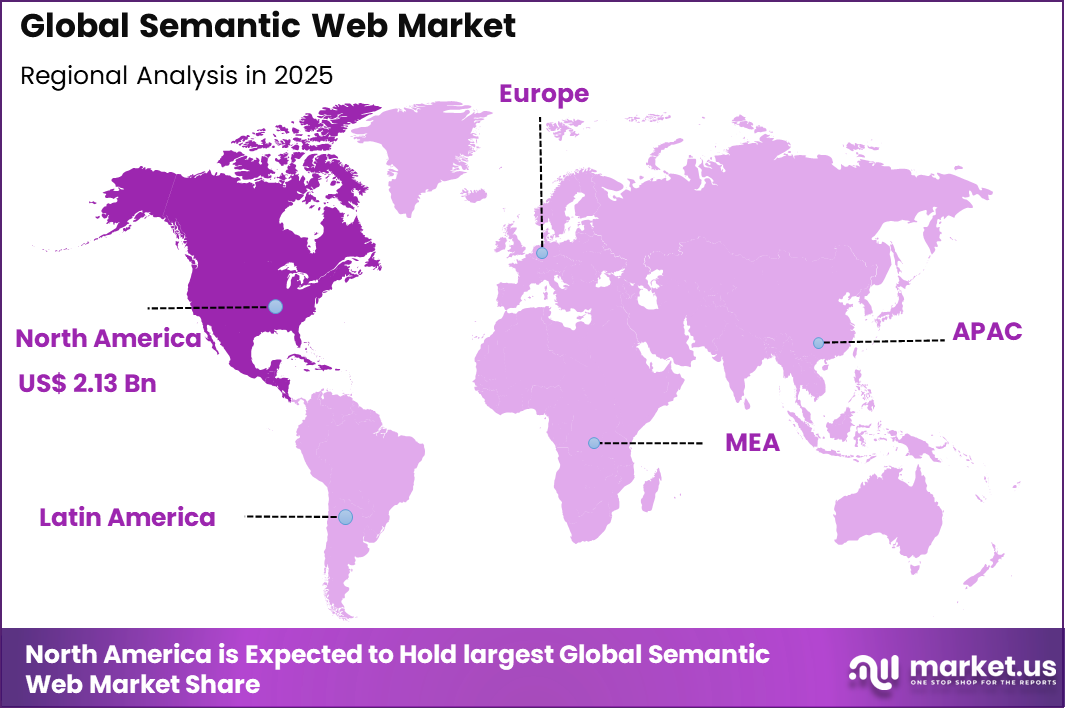
The Global Semantic Web Market generated USD 5.6 billion in 2025 and is predicted to register growth from USD 7.8 billion in 2026 to about USD 169.1 billion by 2035, recording a CAGR of 40.70% throughout the forecast span. In 2025, North America held a dominan market position, capturing more than a 38.4% share, holding USD 2.13 Billion revenue.
The Semantic Web refers to a framework that enables data to be shared and reused across application and enterprise boundaries through common standards and meaning-aware representations. This is typically achieved by representing information as graphs of entities and relationships, supported by ontologies that define concepts and rules. A core element is RDF, which provides a standard model for describing resources and their relationships, enabling data merging even when schemas differ.
The market includes software platforms for knowledge graphs and graph databases, semantic integration tools, ontology management, metadata and master data tooling, semantic search and discovery, and professional services for modeling and implementation. In many deployments, these capabilities are paired with enterprise AI and analytics so that models can work with well-defined entities and relationships rather than only unstructured text or isolated tables.
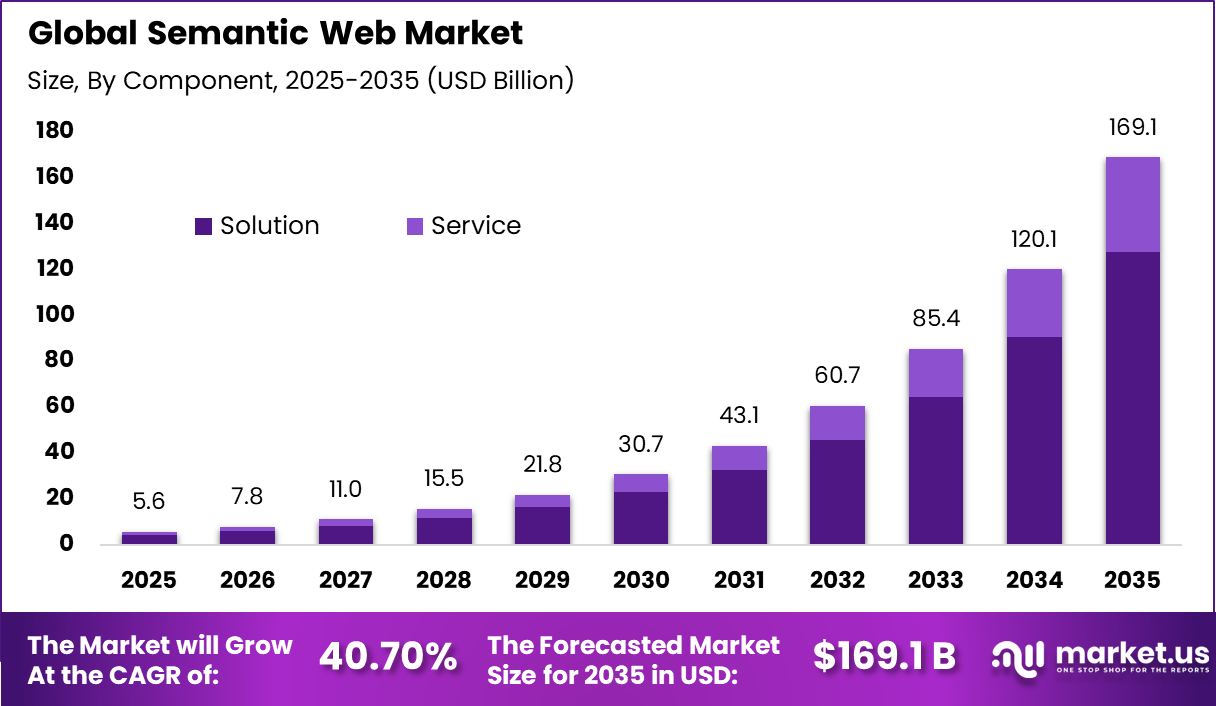 A key growth factor in this market is the rising demand for better data integration across enterprise environments. Many organisations operate with large volumes of structured and unstructured information stored across multiple platforms, which makes it difficult to combine and analyse data effectively. Semantic technologies provide a structured framework that links datasets through shared meaning, enabling smoother information exchange and improved decision support.
Another important driver is the growing need for intelligent digital systems that can understand context in large information environments. Applications such as smart search, recommendation engines, and automated knowledge management rely on data that carries clear relationships and meaning. Semantic web technologies support these capabilities by enabling machines to interpret data connections, which improves accuracy, reduces manual interpretation, and enhances the overall usefulness of digital information systems.
Key Market Segments
By Component
- Solution
- Service
By Deployment Type
- Public
- Private
- Hybrid
By Enterprise Size
- Large Enterprises
- Small and Medium-sized Enterprises
By Industry Vertical
- BFSI
- IT and Telecom
- Retail and E-commerce
- Healthcare and Life Science
- Media and Publishing
- Government and Public Sector
- Education
- Others
Regional Analysis
North America accounts for 38.4% of the semantic web market, supported by strong adoption of advanced data management technologies and knowledge graph frameworks. Enterprises and research institutions in the region are increasingly using semantic technologies to structure complex datasets, enable machine-readable information, and improve interoperability across digital platforms. Demand is driven by the growth of AI-driven analytics, rising data integration requirements, and the need for more accurate contextual search and decision systems.
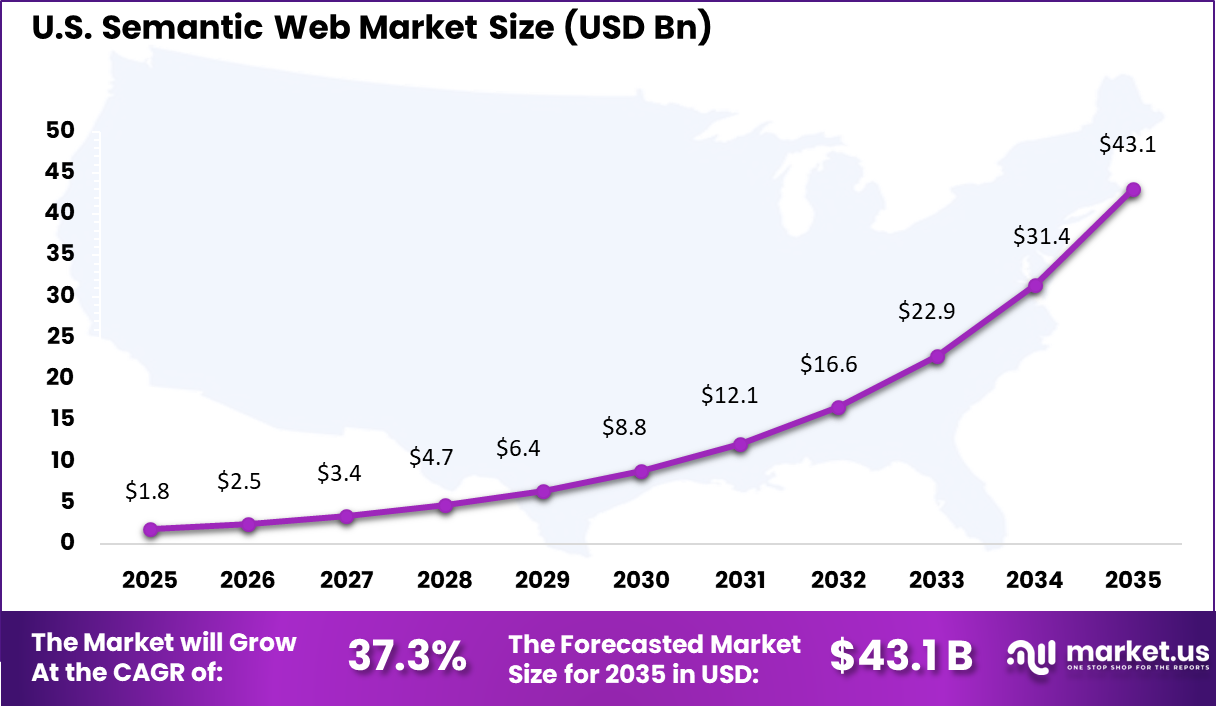
The U.S. market is valued at USD 1.81 Bn and is expanding at a CAGR of 37.3%, reflecting rapid adoption of semantic data models within enterprise data architectures. Adoption is influenced by increasing use of knowledge graphs, linked data frameworks, and intelligent data discovery platforms. Growth is further supported by expanding AI applications, automated reasoning capabilities, and growing reliance on semantic technologies to enhance data understanding across complex digital ecosystems.
Key Regions and Countries
- North America
- US
- Canada
- Europe
- Germany
- France
- The UK
- Spain
- Italy
- Russia
- Netherlands
- Rest of Europe
- Asia Pacific
- China
- Japan
- South Korea
- India
- Australia
- Singapore
- Thailand
- Vietnam
- Rest of APAC
- Latin America
- Brazil
- Mexico
- Rest of Latin America
- Middle East & Africa
- South Africa
- Saudi Arabia
- UAE
- Rest of MEA
Competitive Analysis
The Semantic Web Market is supported by a combination of enterprise technology companies and specialized semantic data platform providers. Microsoft Corporation plays an important role by integrating semantic technologies within cloud, AI, and knowledge graph frameworks. These capabilities allow organizations to structure large volumes of data and improve machine understanding of relationships between datasets.
Specialized semantic data vendors provide advanced knowledge graph, ontology management, and linked data platforms. Altova, OpenLink Software Inc., Franz Inc., and Cambridge Semantics deliver tools for data integration, semantic reasoning, and metadata management. Their platforms help enterprises transform complex datasets into structured knowledge graphs that support analytics and artificial intelligence applications.
Emerging vendors and research focused companies expand innovation within the market. Semantic Web Company, Ontotext, TopQuadrant, Cycorp Inc., and NetBase Quid focus on ontology engineering, semantic search, and AI driven knowledge discovery. These vendors contribute to the development of intelligent data ecosystems that improve contextual search and decision making.
Top Key Players in the Market
- Altova
- NetBase Quid
- OpenLink Software Inc.
- Semantic Web Company
- Franz Inc.
- Microsoft Corporation
- Cambridge Semantics
- Ontotext
- TopQuadrant
- Cycorp Inc.
- Others
Future Outlook
The future outlook for the Semantic Web Market is positive as organizations increasingly focus on connecting and structuring large volumes of data for better analysis. Semantic web technologies help systems understand relationships between data, which improves search, data integration, and decision making.
Demand is expected to grow with the rising use of artificial intelligence, knowledge graphs, and advanced analytics. Overall, the market is likely to expand as businesses prioritize intelligent data management and improved interoperability across digital systems.
Recent Developments
- Altova delivers XML and semantic tools that bridge data formats for enterprise integration. Their MissionKit suite, updated in January 2026, now handles RDF triples with drag-and-drop mapping, easing knowledge graph builds for mid-sized firms. It’s practical for teams juggling legacy systems without deep coding.
- NetBase Quid shines in social analytics with semantic search across billions of online conversations. In February 2026, they launched a real-time brand monitoring dashboard using ontology-driven insights, helping 200+ clients spot trends 48 hours faster. Marketers rely on it for actionable consumer signals.
- OpenLink Software Inc. powers the Semantic Web through its Virtuoso hybrid server, blending SQL and RDF for massive datasets. A Q1 2026 release boosted SPARQL query speeds by 300%, drawing in government users for linked open data projects. It’s a workhorse for scalable triplestores.
- Semantic Web Company focuses on PoolParty for taxonomy and metadata management. Their November 2025 upgrade integrated LLMs for auto-tagging, cutting manual curation by 40% in media archives. Publishers and libraries turn to them for structured content at scale.
- Franz Inc. leads with AllegroGraph, a graph database excelling in reasoning over complex semantic networks. In March 2026, they added federated learning for multi-cloud deployments, serving 50+ enterprises in life sciences with billions of triples. It’s tough, reliable tech for AI-driven discovery.