

Report Overview
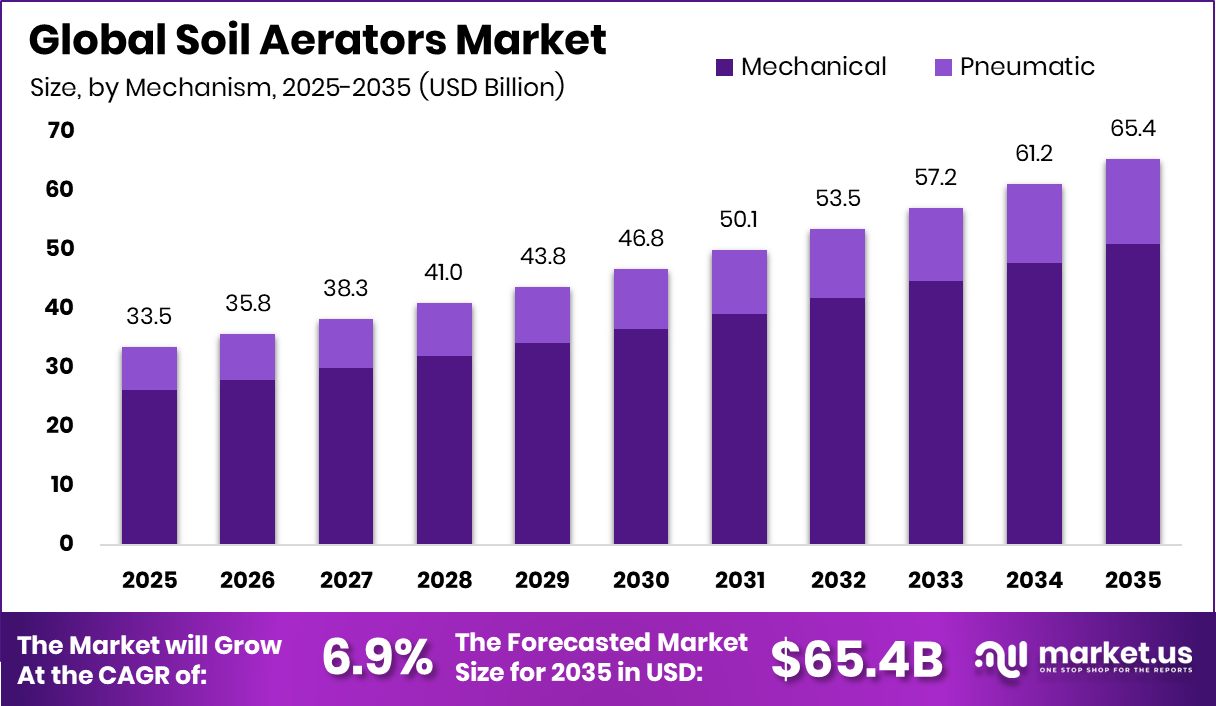
The Global Soil Aerators Market is expected to be worth around USD 65.4 billion by 2035, up from USD 33.5 billion in 2025, and is projected to grow at a CAGR of 6.9% from 2026 to 2035. The soil aerators market in North America accounted for 44.6%, valued at USD 14.9 Bn.
Soil aerators are agricultural and turf management tools designed to improve soil structure by creating small holes or channels in the ground. These openings allow air, water, and nutrients to move more freely through compacted soil, helping plant roots grow deeper and stronger. Aeration is commonly used in farming fields, lawns, sports grounds, and landscaped areas where soil compaction can limit plant growth. Equipment used for this purpose can vary from simple mechanical spike systems to more advanced mounted or trailed machines that work alongside tractors and other farm equipment.
 36% from Q2 to Q3, indicating changing investment priorities within the sector. Despite short-term fluctuations, continued experimentation with advanced machinery and precision field management technologies is expected to open new opportunities for soil aeration equipment designed to support modern, technology-driven farming systems.
Key Takeaways
- The Global Soil Aerators Market is expected to be worth around USD 65.4 billion by 2035, up from USD 33.5 billion in 2025, and is projected to grow at a CAGR of 6.9% from 2026 to 2035.
- In the Soil Aerators Market, primary tillage equipment dominates with 37.5% share due to widespread soil preparation needs.
- Mechanical mechanisms lead the Soil Aerators Market, holding 78.1% share because of reliability and easier maintenance.
- Mounted equipment accounts for 67.2% of the Soil Aerators Market, preferred for compatibility with tractors.
- Agriculture remains the largest end use in the Soil Aerators Market, representing 54.7% demand globally.
- Direct sales dominate the Soil Aerators Market distribution channels with a significant 67.9% market share.
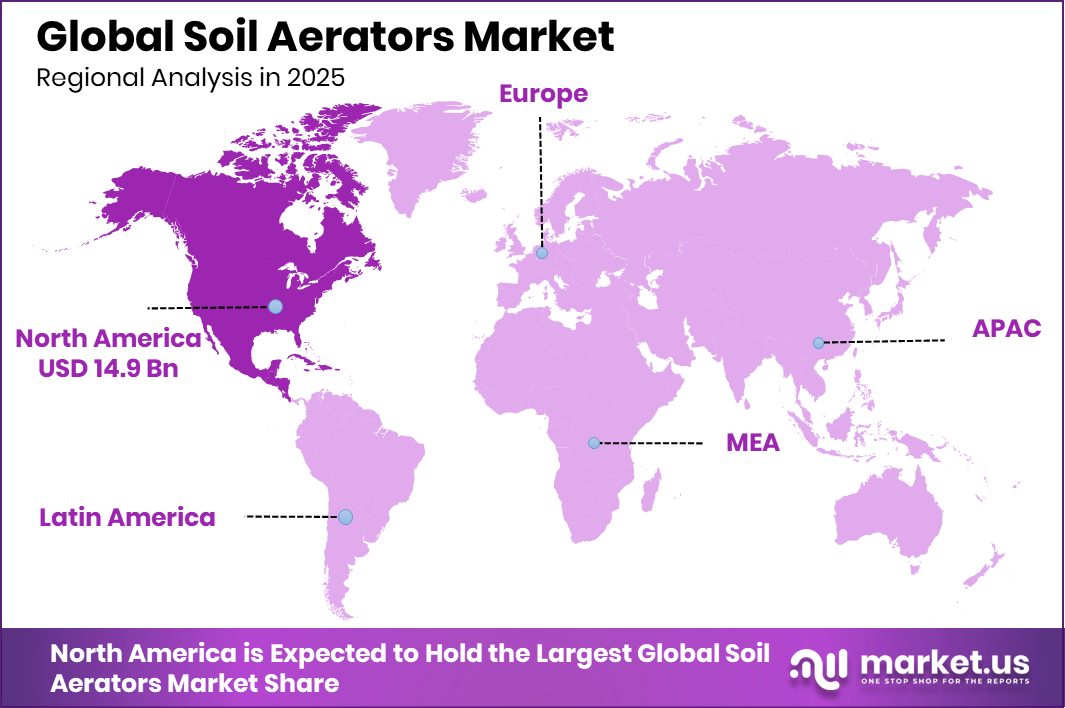
- North America dominated the soil aerators market with a 44.6% share, totaling USD 14.9 Bn in 2025.
By Product Type Analysis
Primary tillage equipment dominates the Soil Aerators Market, accounting for 37.5% share.
In 2025, the Soil Aerators Market witnessed significant demand from primary tillage equipment, accounting for 37.5% of the overall market share. Primary tillage aerators are widely used for breaking compacted soil layers and improving soil structure before planting. Farmers increasingly rely on these tools to enhance soil porosity, allowing better air, water, and nutrient movement within the soil profile.
The growing focus on improving crop productivity and maintaining soil health has encouraged the adoption of advanced tillage-based aeration equipment. Many agricultural producers are investing in durable and efficient aerators capable of handling large field areas. Additionally, the expansion of commercial farming and mechanized agriculture across developing regions has further contributed to the strong demand for primary tillage equipment within the soil aeration equipment market.
By Mechanism Analysis
Mechanical mechanisms lead the Soil Aerators Market with a strong 78.1% share.
In 2025, mechanical systems dominated the Soil Aerators Market by mechanism, holding 78.1% of the total market share. Mechanical aerators are widely preferred due to their reliability, durability, and cost-effective operation in both small and large farming environments. These aerators operate through rotating tines, spikes, or blades that penetrate the soil and create channels for improved airflow and water absorption.
Farmers favor mechanical aerators because they require minimal maintenance and provide consistent performance in varying soil conditions. The simplicity of mechanical designs also makes them suitable for integration with tractors and other farm machinery. With increasing mechanization in agriculture and landscaping activities, the adoption of mechanical soil aerators has continued to expand, supporting efficient soil management practices across agricultural and turf management sectors.
For instance, the U.S. Department of Agriculture announced US$212 million in agriculture export development funding, which encourages improvements in farming productivity and global competitiveness. Additionally, the Agriculture and Food Security Trust Fund and the International Committee of the Red Cross secured a $1 million grant from the Saudi Fund to strengthen agriculture and food security in Afghanistan, highlighting ongoing international investment in agricultural improvement and technology adoption. Increasing development of automated soil aerators Automation and advanced machinery development are emerging trends shaping the Soil Aerators Market. Agricultural equipment manufacturers and technology developers are increasingly exploring automated systems that reduce labor requirements while improving operational efficiency in soil management. Automated or semi-automated aeration equipment can support large-scale farming operations, landscaping projects, and municipal land management programs where consistent soil maintenance is necessary. Training and capacity-building initiatives are also supporting the adoption of advanced agricultural technologies. For example, Delta State announced plans to train agricultural pilots with $1.75 million in federal funding, encouraging the use of modern agricultural technologies and aerial systems. Additionally, the World Bank granted Morocco $4 million to strengthen climate-smart agriculture initiatives, supporting farming practices that improve soil sustainability, resource efficiency, and long-term agricultural productivity across evolving agricultural systems. In 2025, North America held 44.6% of the soil aerators market share, reaching USD 14.9 Bn. The soil aerators market demonstrates varied regional dynamics across North America, Europe, Asia Pacific, the Middle East & Africa, and Latin America, influenced by differences in agricultural practices and mechanization levels. North America dominates the global soil aerators market, accounting for 44.6% of the total share and reaching a value of USD 14.9 Bn. The region’s strong position is supported by advanced farming infrastructure, widespread adoption of mechanized agricultural equipment, and consistent demand for soil management solutions that enhance crop productivity and soil health. Farmers and commercial agricultural operators across the region prioritize soil aeration technologies to improve water infiltration, nutrient distribution, and root development, strengthening equipment demand. In Europe, the market is supported by established agricultural systems and an increasing emphasis on sustainable soil management practices. The Asia Pacific region continues to experience steady expansion due to the modernization of farming activities and growing awareness of soil health management. Meanwhile, the Middle East & Africa and Latin America markets are gradually developing, driven by expanding agricultural activities and rising interest in improving soil productivity through mechanized aeration solutions across farming landscapes. In 2025, Alamo continued to maintain a notable presence in the Soil Aerators Market through its strong focus on equipment engineering and durable outdoor maintenance machinery. The company is recognized for designing equipment suited for demanding agricultural and land management applications, including soil preparation and turf maintenance. Its product approach emphasizes durability, performance efficiency, and compatibility with widely used agricultural machinery. By maintaining a broad portfolio of vegetation and land management equipment, Alamo supports applications across agriculture, landscaping, and municipal land care. This operational diversity allows the company to remain relevant in soil aeration equipment solutions where reliability and consistent field performance are essential. Bobcat plays an important role in the Soil Aerators Market by offering equipment designed for versatility and compact power across various land management tasks. Known for its strong presence in compact machinery, Bobcat provides aeration attachments and equipment compatible with its machinery platforms. This approach allows operators to integrate soil aeration functions into existing equipment fleets, improving operational flexibility. The company’s emphasis on equipment adaptability supports applications ranging from landscaping and turf maintenance to small-scale agricultural soil preparation, making it a practical choice for operators seeking multifunctional machinery solutions. Briggs & Stratton contributes to the Soil Aerators Market primarily through its engine technologies that power various outdoor equipment and turf management machines. The company is widely recognized for producing reliable small engines used in a variety of agricultural and landscaping equipment, including soil aerators. By focusing on engine efficiency, durability, and consistent performance, Briggs & Stratton supports equipment manufacturers and end users who require dependable power systems. Its long-standing experience in engine development continues to support soil aeration equipment used in agricultural fields, turf care, and landscape maintenance operations.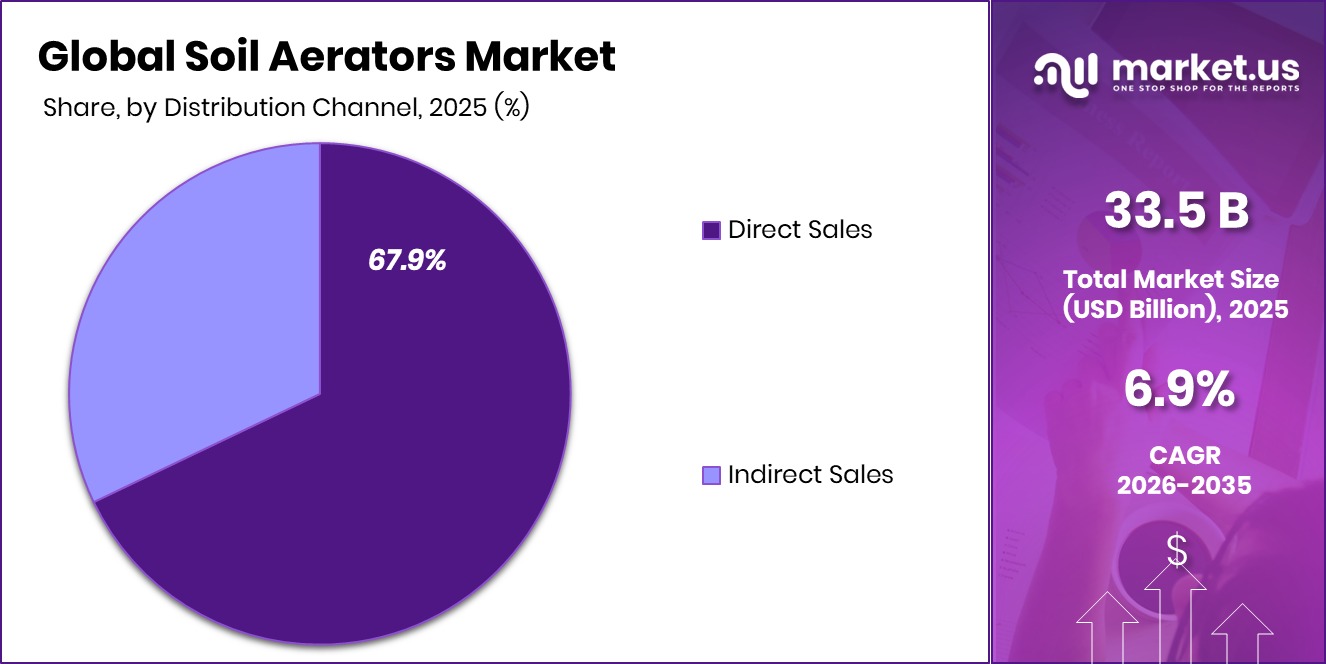
Latest Trends
Regional Analysis
Key Regions and Countries
Key Players Analysis
Top Key Players in the Market
Recent Developments