

Report Overview
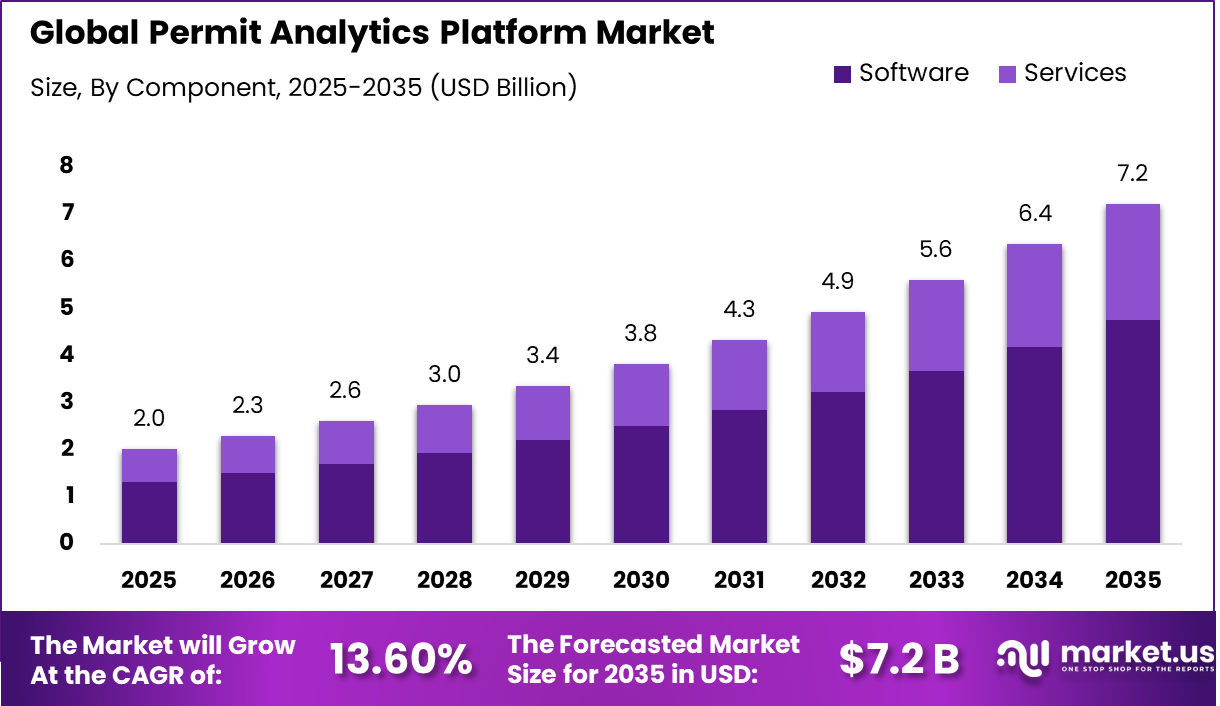
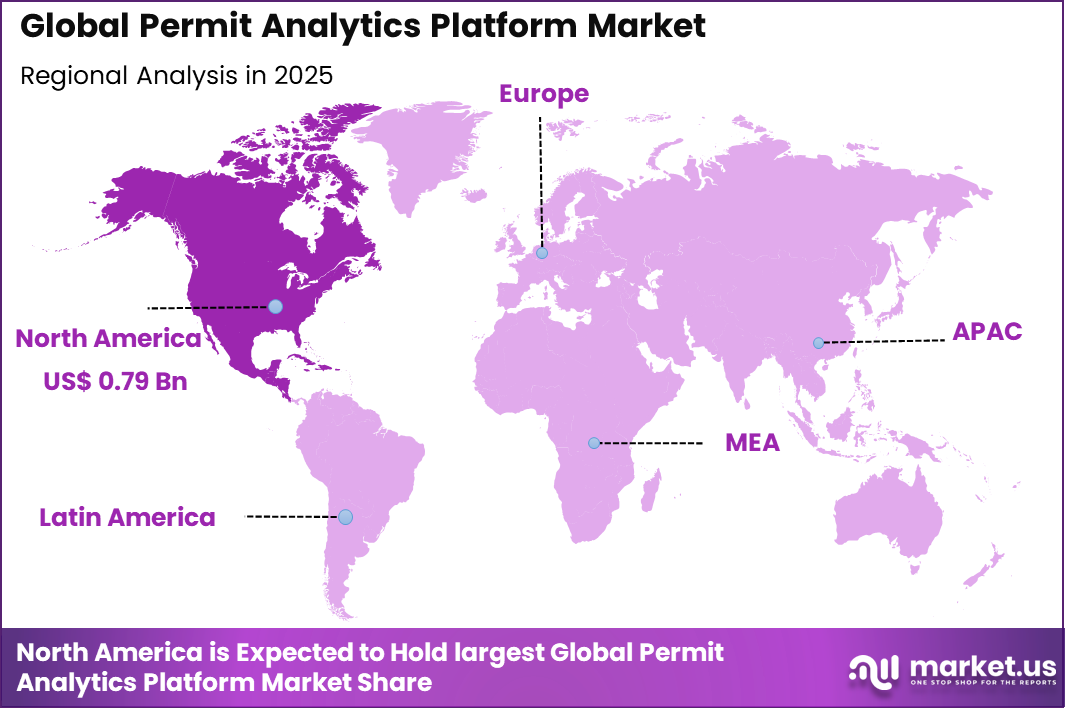
The Global Permit Analytics Platform Market generated USD 2 billion in 2025 and is predicted to register growth from USD 2.3 billion in 2026 to about USD 7.2 billion by 2035, recording a CAGR of 13.60% throughout the forecast span. In 2025, North America held a dominan market position, capturing more than a 39.2% share, holding USD 0.79 Billion revenue.
The permit analytics platform market refers to digital systems designed to collect, analyze, and interpret data related to regulatory permits, licensing approvals, and compliance documentation across industries. These platforms integrate data from government agencies, construction authorities, environmental departments, and municipal systems to provide insights that help organizations manage permit processes more efficiently.
Permit analytics tools help stakeholders monitor approval timelines, identify regulatory requirements, and improve compliance planning through data-driven analysis. Organizations in sectors such as construction, infrastructure development, energy, and manufacturing often deal with complex regulatory approval processes. Permit analytics platforms consolidate permit data from multiple jurisdictions and provide dashboards that track application status, regulatory trends, and potential compliance risks.
Top Market Takeaways
- By Component, software dominates with 65.7% share, delivering AI-driven permit tracking, compliance forecasting, and workflow automation across municipal and state jurisdictions.
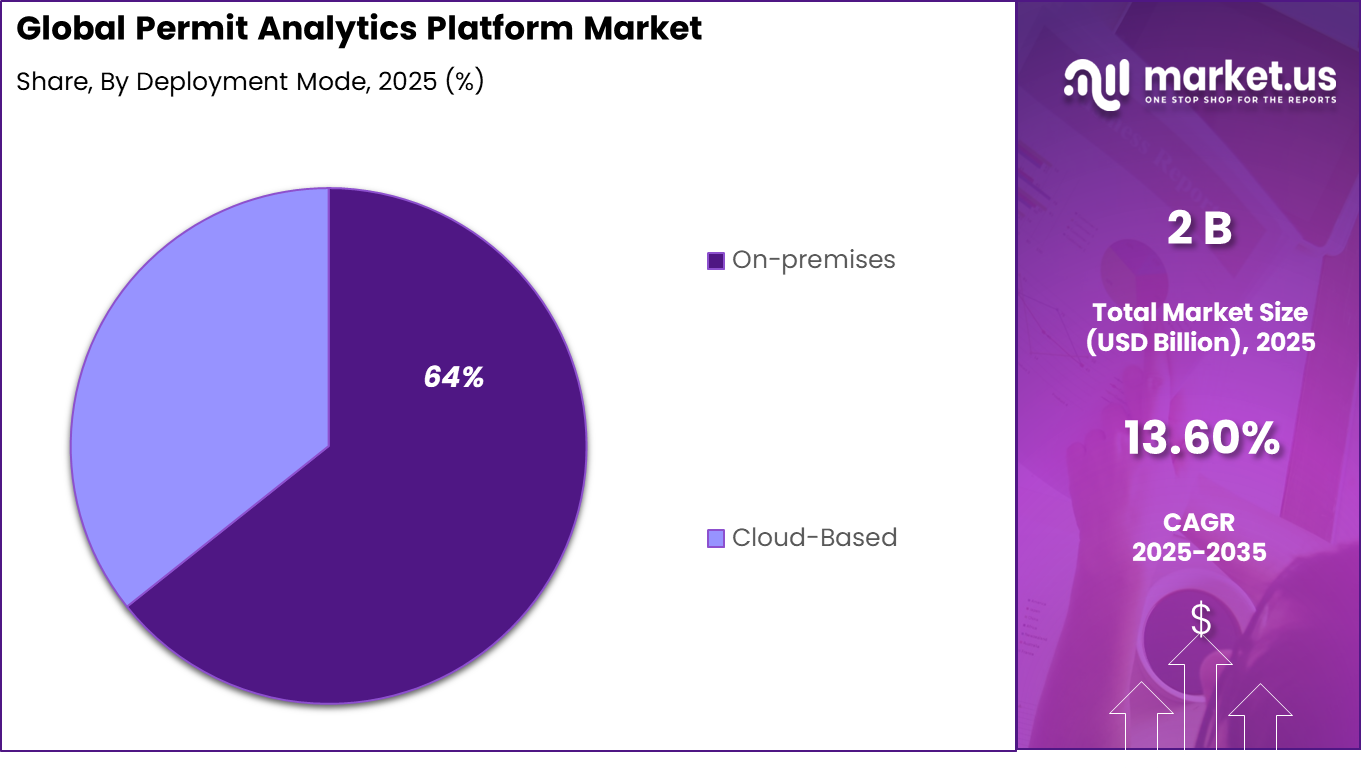
- By Deployment Mode, on-premises captures 64.3%, ensuring data sovereignty, integration with legacy GIS systems, and secure handling of sensitive project blueprints.
- By Application, construction leads at 35.6%, accelerating approvals for commercial builds, zoning variances, and environmental impact assessments.
- By End-User, contractors hold 40.6%, leveraging analytics for bid optimization, delay prediction, and multi-jurisdiction permit portfolio management.
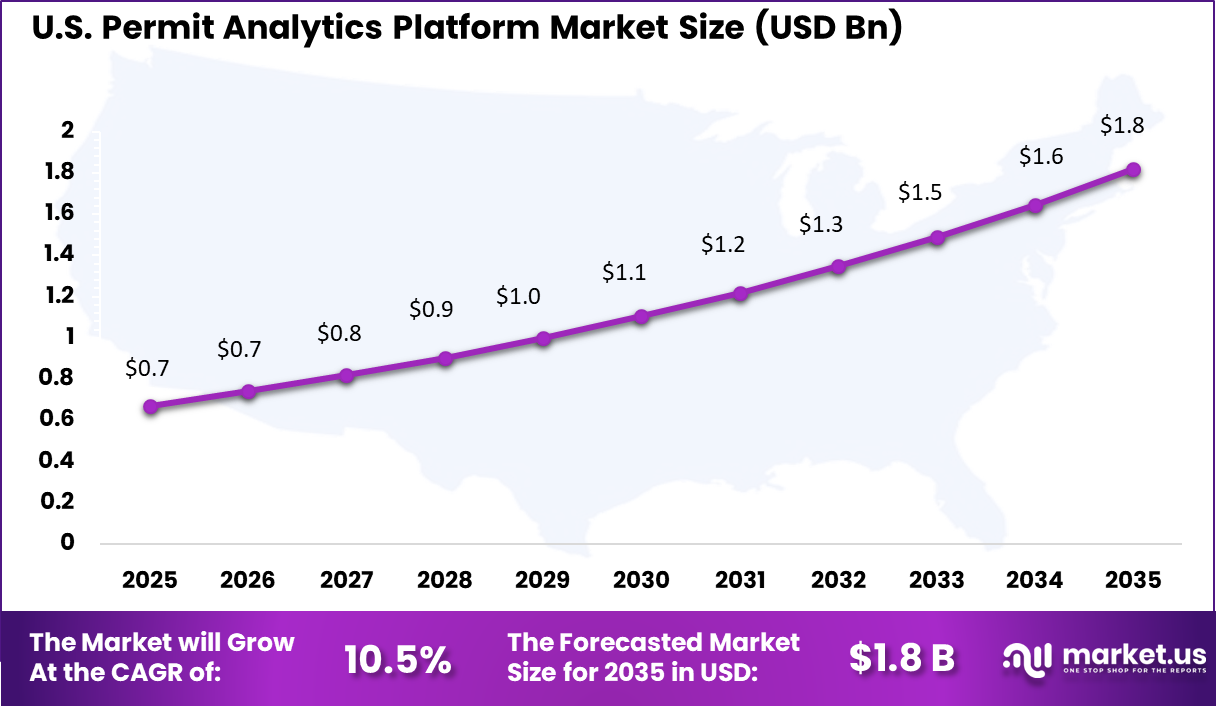
- Regionally, North America accounts for 39.2% global share, with the U.S. market valued at USD 0.67 billion and a CAGR of 10.5%, driven by smart city initiatives and permitting backlogs.
Drivers Impact Analysis
| Key Drivers | Impact on CAGR Forecast (~%) | Geographic Relevance | Impact Timeline | Strategic Importance |
|---|---|---|---|---|
| Increasing Digitalization of Government Services | +3.0% | North America, Europe | Short to Medium Term | Accelerates adoption of online permitting platforms |
| Growth in Construction and Infrastructure Projects | +2.6% | APAC, North America | Medium to Long Term | Expands permit processing volumes |
| Rising Demand for Real-time Compliance Monitoring | +2.2% | Europe, North America | Medium Term | Improves regulatory transparency |
| Integration of GIS and Data Visualization Tools | +1.9% | North America | Medium to Long Term | Enhances spatial planning insights |
| Smart City Development Initiatives | +1.6% | APAC, Middle East | Long Term | Drives centralized permit analytics systems |
Restraints Impact Analysis
| Key Restraints | Impact on CAGR Forecast (~%) | Geographic Relevance | Impact Timeline | Market Constraint Level |
|---|---|---|---|---|
| Budget Constraints in Municipal Authorities | -2.1% | Emerging Markets | Short to Medium Term | Slows digital transformation pace |
| Resistance to Change from Legacy Paper-based Systems | -1.7% | Europe, Latin America | Medium Term | Delays full automation |
| Data Privacy and Regulatory Complexity | -1.4% | North America, Europe | Medium Term | Requires strict governance controls |
| Integration Challenges with Existing ERP Systems | -1.1% | Global | Medium Term | Extends implementation timelines |
By Component
Software accounts for 65.7% of the market, reflecting the strong reliance on digital platforms that manage permit data, regulatory documentation, and approval workflows. These systems enable organizations to collect, organize, and analyze permit related information across multiple projects. Automated analytics tools help identify bottlenecks in approval processes and provide insights that support faster project planning.
The adoption of permit analytics software is also supported by its integration with project management systems and geographic information systems. These integrations allow users to visualize permit activity across locations and track compliance requirements efficiently. As construction projects become more complex, software platforms remain central to permit data management.
By Deployment Mode
On premises deployment represents 64.3% of the market, highlighting the need for secure control over regulatory and project documentation. Many organizations manage sensitive infrastructure data that requires strict internal governance. On premises systems allow companies and government agencies to maintain direct oversight of permit records and approval processes.
Maintaining permit analytics systems within internal infrastructure also supports integration with legacy planning and compliance databases. Construction companies and regulatory authorities often rely on established internal systems that require customized connectivity. As regulatory documentation becomes more detailed, on premises deployment continues to be widely adopted.
By Application
Construction represents 35.6% of market applications, reflecting the importance of permit analytics in managing large infrastructure and development projects. Construction companies must navigate complex regulatory frameworks that require multiple approvals before project initiation. Permit analytics platforms help track approval timelines and identify regulatory requirements across jurisdictions.
These platforms also assist project managers in forecasting potential delays related to permit approvals. Data insights allow construction firms to coordinate with local authorities and maintain compliance with planning regulations. As urban development continues to expand, construction related permit analytics applications remain a key driver of market demand.
By End User
Contractors account for 40.6% of market adoption due to their direct involvement in project execution and regulatory compliance. Contractors rely on permit analytics tools to monitor permit status, manage documentation, and coordinate with regulatory agencies. Access to accurate permit data helps ensure that construction activities remain aligned with approved project plans.
Permit analytics systems also support contractors in maintaining compliance with safety regulations and environmental standards. By analyzing historical permit data, contractors can anticipate approval timelines and plan project schedules more effectively. As infrastructure development becomes more data driven, contractors remain a major user group for permit analytics platforms.
Investors Type Impact Analysis
| Investor Type | Growth Sensitivity | Risk Exposure | Geographic Focus | Investment Outlook |
|---|---|---|---|---|
| Venture Capital | Medium to High | Medium | North America | Focus on GovTech and civic tech platforms |
| Private Equity | Medium | Medium | North America, Europe | Stable public sector contract models |
| Strategic IT Service Providers | Medium | Low to Medium | Global | Integration with smart city ecosystems |
| Institutional Investors | Medium | Low to Medium | Developed Markets | Long-term digital infrastructure allocation |
| Government-backed Funds | Low to Medium | Low | APAC, Middle East | Infrastructure modernization priority |
Technology Enablement Analysis
| Technology Enabler | Impact on CAGR Forecast (~%) | Geographic Relevance | Impact Timeline | Adoption Momentum |
|---|---|---|---|---|
| Cloud-based Permit Management Platforms | +3.2% | North America, Europe | Short to Medium Term | Improves scalability and accessibility |
| AI-driven Workflow Automation | +2.5% | Global | Medium Term | Reduces approval cycle time |
| GIS and Geospatial Analytics Integration | +2.1% | North America, APAC | Medium to Long Term | Enhances zoning and planning accuracy |
| API-enabled Data Exchange Systems | +1.7% | Global | Medium Term | Supports cross-department coordination |
| Predictive Analytics for Permit Demand Forecasting | +1.3% | North America | Long Term | Improves infrastructure planning efficiency |
Key Challenges
- Permit rules differ across cities and states, so standardizing workflows becomes difficult.
- Permit records are often incomplete or outdated, and inconsistent formats reduce analytics accuracy.
- Legacy permitting systems and manual steps limit automation and slow adoption.
- Integrating permit data with GIS, planning, inspection, and payment systems can be complex and costly.
- Privacy, security, and compliance requirements increase implementation effort and governance needs.
- Budget limits and long procurement cycles can delay platform purchases and upgrades.
Emerging Trends
In the Permit Analytics Platform market, a noticeable trend is the development of systems that help organisations view permit activity and status in one shared interface. Rather than relying solely on isolated permit logs, these platforms bring together application details, review steps, and compliance checks so that users can see where delays or bottlenecks occur.
This trend supports clearer communication between teams involved in issuing, reviewing, and tracking permits, making the process feel more predictable for applicants and administrators alike. Another emerging pattern is the use of simple visual summaries that show the flow of permits through stages, helping managers understand where work is held up and why without needing deep analytical expertise.
Growth Factors
A key growth driver in this market is the increasing complexity of compliance requirements across industries such as construction, environmental services, and public works. Organisations face a growing need to manage multiple permit types, renewals, and conditions, and an analytics platform helps reduce confusion by organising this information in a coherent, shared view. This clarity supports better planning and reduces mistakes that can arise from miscommunication or outdated records.
Another important factor is the rising expectation for timely and transparent interactions between organisations and their stakeholders. Applicants value updates that are clear and easy to understand, and permit analytics platforms help service teams respond with consistent information. Together, these needs are encouraging the adoption of tools that strengthen operational insight and make the permit process smoother and more reliable for all parties.
Key Market Segments
By Component
- Software
- Services
By Deployment Mode
- Cloud-Based
- On-Premises
By Application
- Construction
- Real Estate
- Government
- Utilities
- Transportation
- Others
By End-User
- Government Agencies
- Contractors
- Architects & Engineers
- Property Developers
- Others
Regional Analysis
North America holds 39.2% of the market share, supported by strong adoption of digital governance systems and advanced construction management technologies. Government agencies and private contractors in the region increasingly rely on data analytics platforms to manage regulatory approvals and urban development planning. The presence of mature infrastructure sectors has further strengthened regional demand.
The U.S. market is valued at USD 0.67 Bn and is expanding at a CAGR of 10.5%, reflecting steady modernization of building and infrastructure approval processes. Adoption is influenced by rising construction activity, regulatory complexity, and increasing focus on workflow automation within permitting departments. Growth is further supported by integration of GIS systems, cloud-based dashboards, and predictive analytics tools that improve operational efficiency and long-term infrastructure planning.
Key Regions and Countries
- North America
- US
- Canada
- Europe
- Germany
- France
- The UK
- Spain
- Italy
- Russia
- Netherlands
- Rest of Europe
- Asia Pacific
- China
- Japan
- South Korea
- India
- Australia
- Singapore
- Thailand
- Vietnam
- Rest of APAC
- Latin America
- Brazil
- Mexico
- Rest of Latin America
- Middle East & Africa
- South Africa
- Saudi Arabia
- UAE
- Rest of MEA
Competitive Analysis
The Permit Analytics Platform Market is supported by technology providers that deliver digital permitting and regulatory management systems for government agencies. Accela, OpenGov, and Tyler Technologies are widely recognized for providing integrated permitting, licensing, and compliance management platforms. Their solutions help municipalities automate permit processing, monitor inspections, and improve transparency in public administration.
Enterprise public sector software vendors also contribute significantly to the market. Infor through Infor Public Sector, along with EnerGov and CivicPlus, provide platforms that combine permitting workflows with financial management and citizen engagement tools. These systems enable agencies to track permits, manage land use regulations, and analyze development trends.
Emerging cloud based vendors are expanding competition through modern digital permitting solutions. Cloudpermit, GovPilot, ViewPoint Cloud, SmartGov, Municity, Cityworks, IWorQ, PermitTrax, and Citizenserve focus on cloud deployment, real time reporting, and citizen self service portals. These providers enable municipalities to streamline permit approvals and enhance data driven decision making.
Top Key Players in the Market
- Accela
- OpenGov
- CityView
- Clariti
- Tyler Technologies
- Infor Public Sector
- BasicGov
- MyGov
- EnerGov
- ePermitHub
- CivicPlus
- Cloudpermit
- GovPilot
- ViewPoint Cloud
- SmartGov
- Municity
- Cityworks
- IWorQ
- PermitTrax
- Citizenserve
- Others
Future Outlook
In the coming years, permit analytics platforms are expected to be adopted more widely as cities and agencies push for faster approvals, better transparency, and stronger compliance. More value is likely to be created through automation of permit checks, digital workflow tracking, and integrated reporting across departments, which can reduce delays caused by manual hand offs.
Deeper use of geospatial data, connected inspection records, and standardized data sharing is also expected to improve planning accuracy and risk control. Overall, demand can be supported by continued investment in digital government services and the growing need to manage higher permit volumes with limited staff.
Recent Developments
- December, 2025 – Cloudpermit acquired CityReporter to expand its local government suite. The deal integrates office administration with field maintenance. Municipalities now manage permits alongside asset tracking in one platform.
- February, 2026 – Software Solutions Inc partnered with GovPilot for cloud permitting. SSI customers access digital plan review and licensing. The move targets small towns seeking efficiency gains.
- December, 2025 – Cloudpermit reviewed its 2025 growth with new Property Data Management launch. Tools improve parcel data for permitting decisions. Agencies report 30 percent faster reviews.