

Report Overview
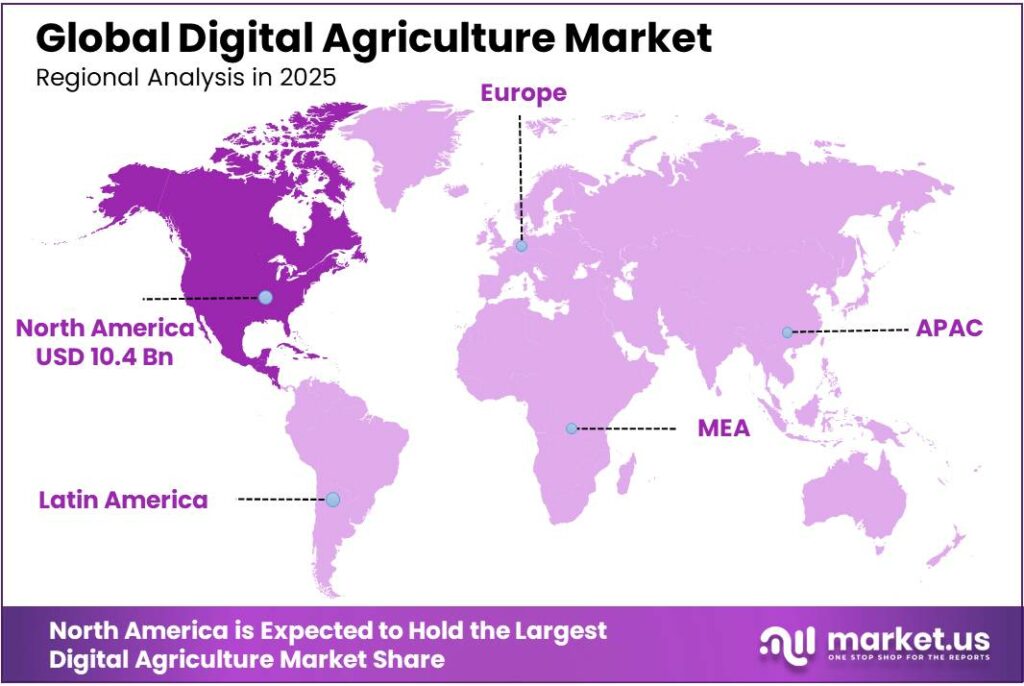
The Global Digital Agriculture Market size is expected to be worth around USD 64.2 Billion by 2035, from USD 24.4 Billion in 2025, growing at a CAGR of 10.2% during the forecast period from 2026 to 2035. In 2025, North America held a dominant market position, capturing more than a 42.8% share, holding USD 10.4 billion revenue.
Digital agriculture refers to the integration of advanced digital technologies such as artificial intelligence (AI), Internet of Things (IoT), remote sensing, drones, satellite imagery, and big data analytics into agricultural production and supply chain management. These technologies enable precision farming, real-time monitoring of crops and livestock, predictive analytics for weather and disease outbreaks, and improved decision-making across agricultural value chains.
- According to the Food and Agriculture Organization (FAO), approximately 892 million people globally depend on agriculture and forestry for their income, highlighting the sector’s significant socioeconomic importance and the need for technological transformation to improve productivity and resilience.
Governments are also supporting this trend. For example, India’s Digital Agriculture Mission tied digital sensor use into its larger strategy by mapping soil health and integrating digital data streams into the advisory services offered to farmers. So far, the mission has completed soil profile mapping for 29 million hectares of land, contributing to databases that help farmers understand soil conditions at a detailed level. This data, collected through digital tools and sensors, is helping to craft better crop plans and nutrient recommendations tailored to specific locations and seasons. The shift toward sensor-driven farming also brings young people into agriculture. Many young farmers and agri-entrepreneurs are building mobile apps and cloud platforms that interpret sensor data and make it easy to understand. This human element — the connection between technology and everyday life on the farm — inspires creativity and expands opportunities beyond traditional farming roles. Feeding a Growing World: Why Food Security Drives Digital Agriculture One of the most important reasons digital agriculture is spreading so fast around the world is the urgent need to produce more food with fewer resources. As the global population keeps growing, agriculture faces pressure unlike anything before. The Food and Agriculture Organization of the United Nations (FAO) estimates that by 2050, agriculture must produce about 70 % more food while using only about 5 % more land than it does today to meet demand. This huge gap between food demand and available agricultural land makes traditional farming methods untenable and pushes farmers, businesses, and governments toward digital solutions that can help do more with less. Governments are taking concrete steps in this direction. For example, in India, the Digital Agriculture Mission was approved with a total financial outlay of Rs 2,817 crore, including Rs 1,940 crore from the central government, to build digital public infrastructure for agriculture. This plan includes large-scale soil mapping over almost 142 million hectares of farmland and digital estimation surveys to improve yield accuracy and decision-making. Another dimension of this driving force is the essential link between food production and economic stability. Countries with strong agricultural productivity are usually able to support thriving rural communities, lower poverty rates and strengthen their national economy. According to World Bank data, agriculture provides jobs and income for about 80 % of the world’s poorest people, most of whom live in rural areas and depend directly on farming for their food and livelihood. This deep connection between agriculture and rural prosperity pushes governments to adopt digital agriculture strategies that can help farmers improve both productivity and income. Limited Digital Access in Rural Areas Hampers Digital Agriculture Progress One of the biggest challenges slowing down the spread of digital agriculture is the lack of reliable digital access and connectivity in rural farming communities. This gap doesn’t just make it harder for farmers to adopt new tools — it creates a barrier that keeps many of them from even seeing the benefits of digital technology. While farmers around the world are increasingly aware that data, sensors, apps, and connected machines can make farming more productive, many still struggle with basic connectivity and access to digital infrastructure needed to use these tools in the first place. Governments and development agencies recognize this problem, and some have begun to take steps to close the digital gap. For example, when India launched its Digital Agriculture Mission, the plan included efforts to expand rural digital infrastructure alongside soil mapping and advisory services. The idea was that better connectivity would make it easier for farmers to access digital platforms and benefit from precision farming tools; but scaling this infrastructure across hundreds of millions of hectares of farmland is still a massive undertaking. A report by the Food and Agriculture Organization of the United Nations (FAO) highlights this divide clearly. According to FAO’s analysis, roughly 70% of the rural population in least developed countries still does not have access to the internet. This means a large proportion of farmers in the countries that need productivity gains the most are unable to tap into digital services such as remote crop monitoring, weather forecasts, or mobile advisory tools that could help improve yields and reduce losses. Expanding Digital Tools Offers New Horizons for Farmers and Food Systems One of the biggest growth opportunities for digital agriculture today lies in enhanced access to real-time data and decision support tools, which have the potential to transform how farmers make choices and manage their crops. Digital technologies — such as sensors, remote sensing systems, mobile advisory services, and integrated data platforms — are being increasingly recognized as vital tools for improving agricultural productivity while reducing waste and risk. What makes this opportunity especially compelling is that these tools help farmers not just increase output, but do so in ways that are more efficient, sustainable, and resilient to challenges like climate change and market volatility. The Food and Agriculture Organization (FAO) underscores the importance of these digital solutions, explaining that they “boost efficiency and productivity and tackle bottlenecks in food safety, postharvest handling, market access, finance and supply chain management.” What makes this growth opportunity humane and far-reaching is how it supports smallholder farmers and rural communities. For many smallholders, access to digital advisories via mobile phones or apps means they no longer have to wait for occasional visits from extension workers to get critical information. Instead, they can receive tailored crop advice, pest alerts, and market insights in their own hands. FAO’s broader digital agriculture strategy intentionally seeks to empower rural households and inspire youth entrepreneurship by making digital solutions more accessible and locally relevant. North America stands tall with a 42.8% share and USD 10.4 billion in digital agriculture as the region leads global adoption In 2024, North America continued to dominate the global digital agriculture landscape, accounting for a commanding 42.8% share of the market with an estimated regional value of USD 10.4 billion. This dominance stems from a combination of highly mechanized agriculture, well-developed farm equipment infrastructure, and significant investment in cutting-edge technologies such as GPS-enabled machinery, IoT sensors, remote sensing, and data analytics. The widespread use of precision farming systems across major crop belts has been one of the key reasons behind this leadership. In many parts of North America, farmers use digital apps to monitor soil moisture, crop health, and weather patterns in real time, enabling more informed decisions that reduce waste and save costs. Historical agricultural surveys show that technologies such as yield mapping and guidance automation are increasingly applied across the major corn, soybean, and wheat acres, indicating a deeper penetration of digital tools into everyday farm operations. Syngenta Group, headquartered in Switzerland, reported revenue of around USD 16.98 billion in 2024 while integrating digital tools into its agricultural portfolio. Syngenta’s digital farming platform, Cropwise, combines data analytics, weather modelling, and field insights, empowering growers to improve yield, resource efficiency, and crop quality. Alongside crop protection and seed businesses, Syngenta leverages digital tools to support sustainable farming decisions and to strengthen farm-to-market connectivity for growers worldwide. In 2024, Syngenta reported USD 16.98 billion in revenue, showing the scale of its operations across seeds, crop protection, and digital solutions.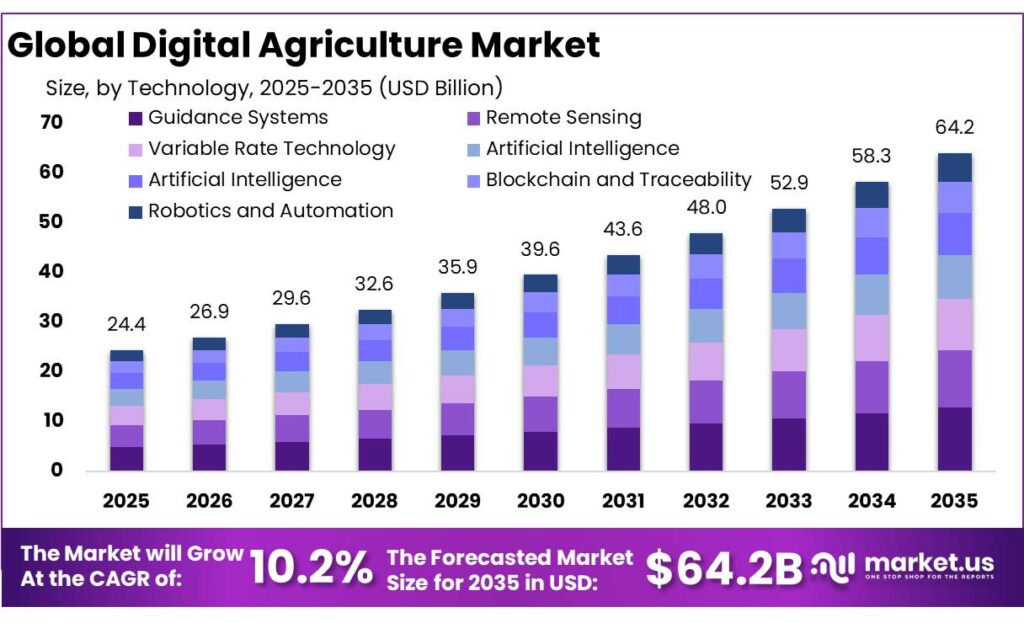
Drivers
Restraints
Opportunity
Regional Insights
Top Key Players Outlook
Recent Industry Developments