

Report Overview
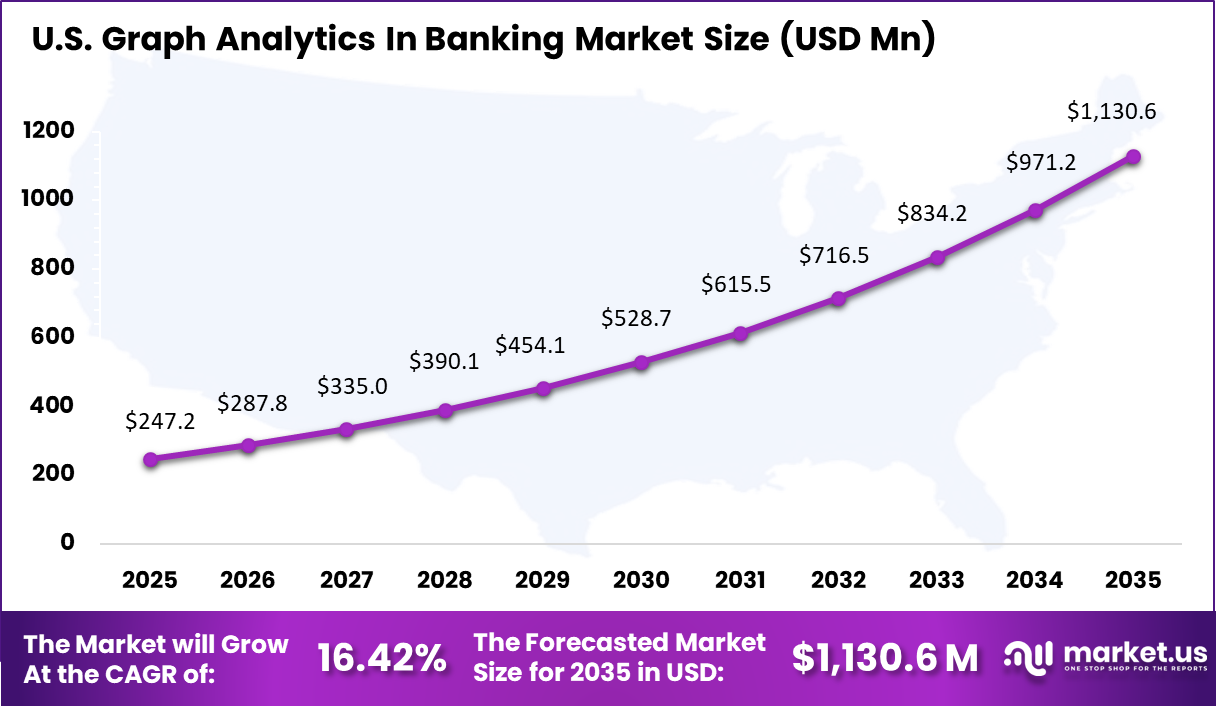
The Global Graph Analytics In Banking Market generated USD 652.4 million in 2025 and is predicted to register growth from USD 773.7 million in 2026 to about USD 3,592.2 million by 2035, recording a CAGR of 18.60% throughout the forecast span. In 2025, North America held a dominant market position, capturing more than a 41.2% share, holding USD 268.78 Million revenue.
The Graph Analytics in Banking Market refers to analytical platforms and methods that use graph based data structures to model, analyze, and interpret complex relationships within banking data. These systems represent entities such as customers, accounts, transactions, merchants, and devices as connected nodes and links. This structure allows banks to uncover hidden relationships and behavioral patterns that are difficult to detect with traditional tabular analytics.
Graph analytics is increasingly used to support fraud detection, risk management, and customer intelligence. By 2025, an estimated 80% of data and analytics innovations in banking are expected to leverage graph technologies. This shift reflects the growing need to understand complex relationships across customers, transactions, and accounts.
An emerging trend in the graph analytics in banking market is the adoption of real-time graph processing. Traditional analytics often operate in batch mode, but fraud and risk detection benefit from near instant insights. Real-time graph updates and streaming graph analytics support faster detection of suspicious linkages as events occur. This trend improves responsiveness and operational agility. Another trend is increased integration with explainable AI and model transparency frameworks. Banks require clear explanations for risk alerts and customer segment recommendations. Graph analytics supports interpretability by visually mapping relationships and highlighting specific connection paths that contribute to insights. This trend aligns with regulatory expectations for transparent AI use. One of the key growth factors for the graph analytics in banking market is rising investment in advanced risk and compliance programs. Regulatory enforcement around AML, fraud reporting, and KYC/CDD obligations has increased. Graph analytics plays a strategic role in improving risk coverage and audit documentation, driving adoption. Another growth factor is the expansion of digital banking services and channels. Online, mobile, and API driven interactions generate complex behavioural and networked data. Understanding connections across channels and products supports unified customer views and informed decision making. Graph analytics enables this multi-dimensional insight, reinforcing its market relevance. A significant opportunity in the graph analytics in banking market lies in enhanced regulatory compliance and risk reporting. Regulators increasingly expect banks to demonstrate robust surveillance of suspicious patterns and rapid identification of networked risk. Graph analytics improves AML, fraud detection, and sanctions screening by revealing complex entity connections. This capability supports regulatory audit readiness and improves oversight. Another opportunity is the integration of graph analytics with machine learning and predictive modelling. Combining graph-based feature extraction with predictive algorithms improves accuracy of risk and churn models. Graph features such as centrality, connectivity, and cluster patterns enrich model inputs and support deeper analytics. This convergence expands use cases beyond detection into forecasting and segmentation. A major challenge for the graph analytics in banking market is ensuring data quality and consistency across sources. Graph analytics depends on accurate and complete entity resolution—linking records from disparate systems into unified nodes. Poor quality data can create incorrect relationships or mask significant connections. Strong data governance and cleansing are essential for reliable insight. Another challenge is scaling performance for large enterprise graphs. Banking environments generate massive volumes of transactional and customer data. Processing high-volume graph queries in near real-time requires robust computational resources and optimised graph engines. Performance tuning and infrastructure design remain critical challenges. Customers leveraging graph analytics in banking see faster detection of fraud and financial crime, resulting in improved trust and reduced loss exposure. Real-time pattern detection helps banks react quickly to suspicious behaviour, which enhances overall security. Customers also benefit from more personalised services as banks use relationship-driven insights to tailor offers and services. A major disruptor is the convergence of graph analytics with open banking data; this expands visibility into cross-institution relationships and increases analytical depth but requires harmonisation of external data sources. Specialized graph database vendors such as Neo4j, Inc. and TigerGraph, Inc. lead the graph analytics in banking market. Their platforms enable relationship mapping across accounts, transactions, and entities. These capabilities support fraud detection, anti money laundering, and risk modeling. DataStax, Inc. and Objectivity, Ltd. strengthen scalable graph processing. Demand is driven by the need to analyze complex financial networks in real time. Cloud and enterprise technology providers such as Microsoft Corporation, Amazon Web Services, Inc., IBM Corporation, and Oracle Corporation integrate graph analytics into broader data ecosystems. SAS Institute, Inc. and Teradata Corporation enhance advanced modeling and compliance workflows. These players benefit from strong banking relationships and hybrid cloud deployments. Visualization and analytics specialists such as Linkurious SAS, Cambridge Intelligence, Ltd., Tom Sawyer Software, Lynx Analytics, Ltd., and Expero, Inc. support investigative and intelligence use cases. Their tools improve decision clarity for compliance and fraud teams. Other vendors enhance innovation and regional adoption, supporting steady expansion of graph analytics in banking. The future outlook for the Graph Analytics in Banking Market is positive as banks increasingly use advanced data tools to uncover relationships and patterns in complex data. Demand for graph analytics solutions is expected to grow because these tools help detect fraud, improve customer insights, and enhance network analysis. Adoption of machine learning and real-time processing capabilities will support more effective risk management and personalized services. Growth can be attributed to rising volumes of data, stronger focus on security, and the need for improved decision making. Overall, the market is anticipated to expand as financial institutions seek deeper analytical capabilities.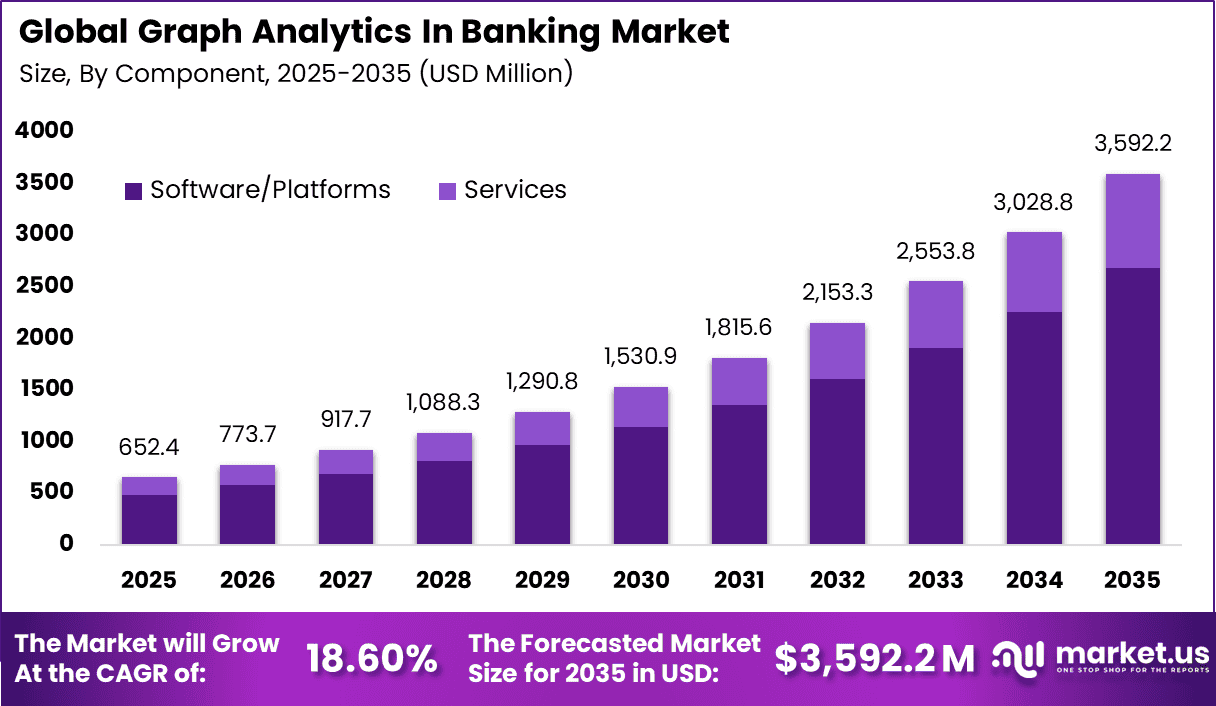
Key Regions and Countries
Emerging Trends Analysis
Growth Factors Analysis
Opportunity Analysis
Challenge Analysis
Customer Impact: Trends and Disruptors
Competitive Analysis
Top Key Players in the Market
Future Outlook
Recent Developments