

Report Overview
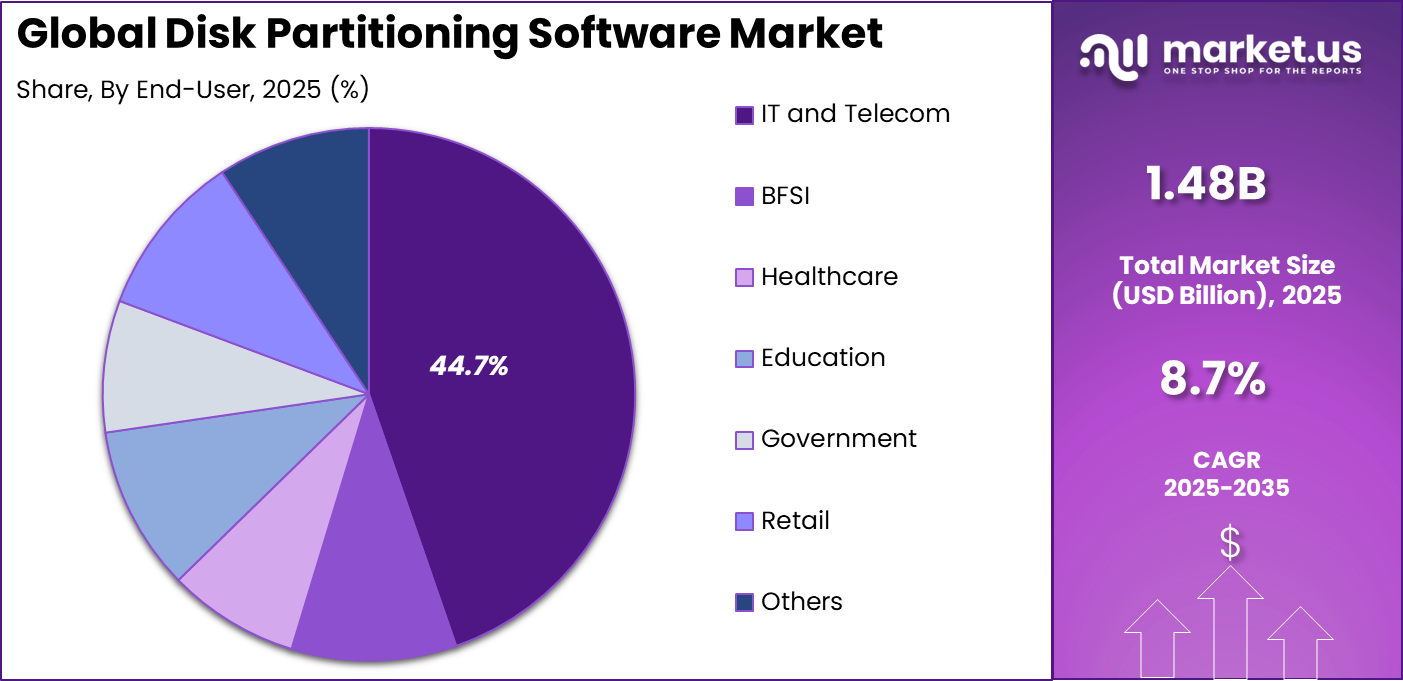
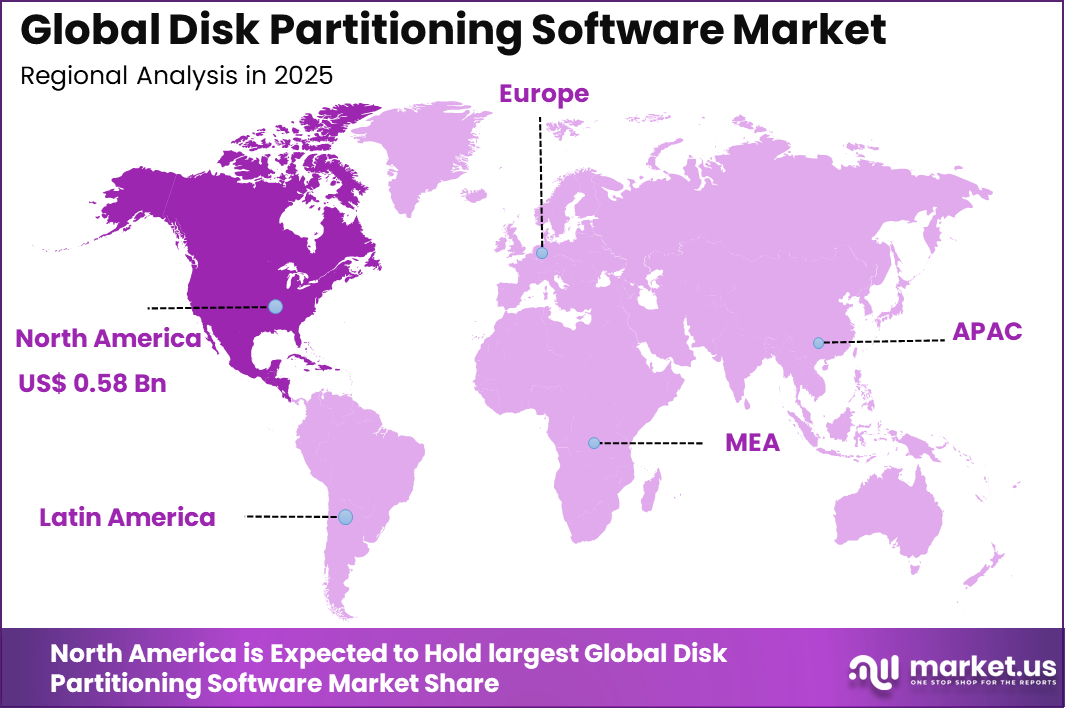
The Global Disk Partitioning Software Market size is expected to be worth around USD 3.41 billion by 2035, from USD 1.48 billion in 2025, growing at a CAGR of 8.7% during the forecast period from 2025 to 2035. North America held a dominant market position, capturing more than a39.7% share, holding USD 0.58 billion in revenue.
Disk Partitioning Software refers to a tool that helps divide a hard drive or storage device into separate sections for better data management. It allows users to organize files, install multiple operating systems, improve storage use, and protect important data. These tools are widely used in both personal and business computing environments.
The market is mainly driven by exploding data volumes, as over 90% of businesses now handle massive files each day that need smart division. Rising use of larger drives and multi-device environments also adds demand, since users manage laptops, servers, and external systems together. The move toward hybrid setups further increases the need for better control today.
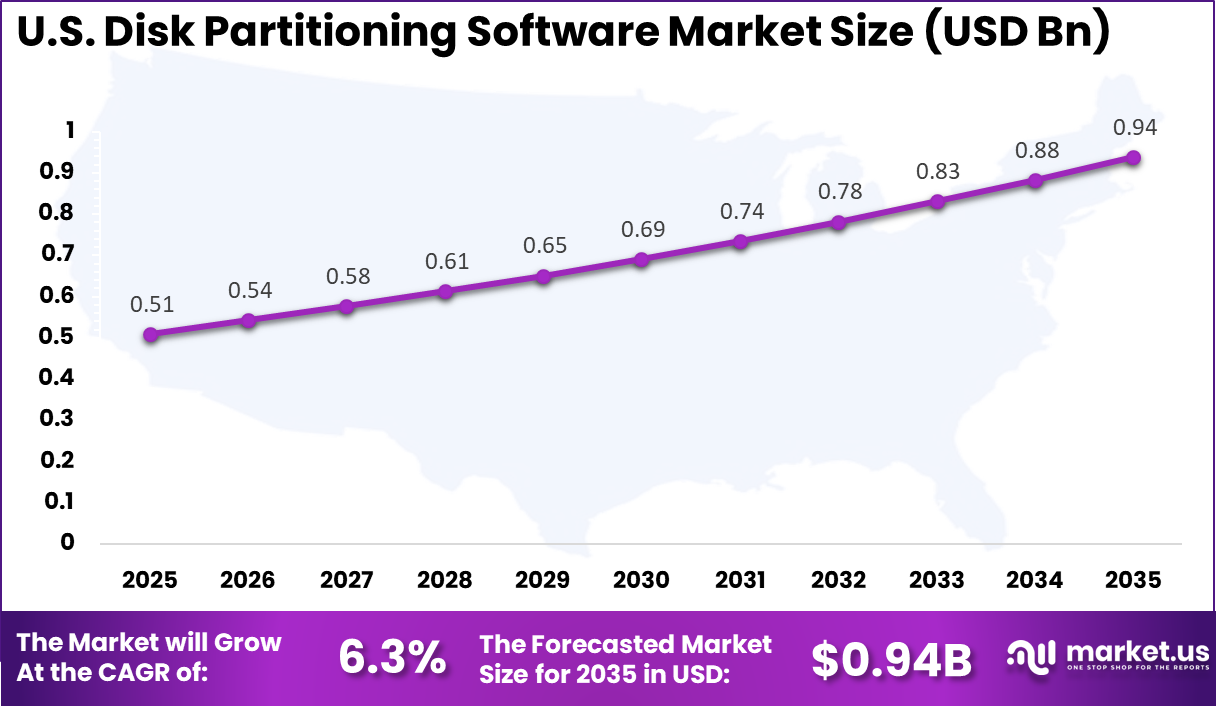
North America holds 39.7% of the market share due to strong adoption of advanced IT infrastructure and enterprise computing systems. Organizations in the region invest in software tools that support efficient data storage and system optimization. The presence of large technology companies further supports regional market growth. For instance, in February 2026, IM-Magic Inc., headquartered in Walnut Creek, California, released advanced partition management features in its latest software update, improving resize operations and recovery for large drives. The enhancements strengthen North America’s dominance in disk partitioning software through reliable, user-friendly tools that handle complex partitioning tasks without data loss. Within North America, the United States contributes USD 0.51 billion with a growth rate of 6.3%. The country’s mature IT sector and widespread use of enterprise computing systems have strengthened demand for disk partitioning software. Continued investment in data management and infrastructure optimization is expected to support steady market development. For instance, in January 2026, Stellar Data Recovery launched major upgrades to its data recovery software, boosting deep scan speeds by 40% and adding macOS Tahoe 26 support. These enhancements solidify U.S. leadership in disk partitioning tools by enabling faster recovery from NTFS, exFAT, and EXT4 partitions across Windows and Mac systems. Cloud integration is becoming a major trend, with 45% of partitioning tools now supporting hybrid local cloud setups for easier data movement. Users increasingly want software that can resize partitions across multiple devices without disruption. This shift is becoming stronger as remote work expands and businesses rely on more flexible storage environments. Another clear trend is the growing support for exFAT and other advanced file systems. This appeared in 30% more releases last year, reflecting demand for larger drives and better cross platform compatibility. The trend also matches rising SSD adoption, which reached 60% in consumer PCs and changed how storage is managed. Rising data volumes are a major growth factor for disk partitioning software. Around 70% of businesses report that storage limits are forcing them to adjust partitions more often. At the same time, faster NVMe drives require frequent resizing and better optimization, which is encouraging users to upgrade to more capable software tools. Security is also supporting market growth, especially as users become more careful about protecting data during storage changes. Features such as encryption during partitioning now matter more, with 50% of users prioritizing them amid cyber threats. This balance of performance and protection keeps the category steady even in difficult economic conditions. North America Europe Asia Pacific Latin America Middle East & Africa This growth is driven by the increasing need to organize large volumes of data across systems and devices. As businesses generate more files daily, structured storage becomes essential to avoid confusion, improve access speed, and maintain workflow efficiency in both enterprise and personal computing environments. It also helps organizations manage data in a more controlled way, reducing errors and improving system reliability. Proper partitioning allows teams to separate workloads, maintain system stability, and ensure that critical data is easy to locate and manage, supporting smoother operations across departments and digital platforms. For instance, in January 2025, Acronis International GmbH rolled out updates to its disk tools that help users sort large data sets into neat partitions. Teams found it easier to handle growing files from daily work, cutting down time spent hunting for info. This move fits right into how businesses want quick access to organized storage without constant tweaks. This limitation arises from concerns about data loss or corruption during partitioning processes, especially when changes are made to active systems. Users often hesitate to modify disk structures due to the risk of accidental deletion, system failure, or exposure of sensitive information during operations. Security concerns also increase as cyber risks grow and data protection becomes more important for businesses. Without proper safeguards, partitioning tasks may expose vulnerabilities, making users cautious about adopting or upgrading tools. This slows adoption, particularly in environments where data sensitivity and compliance requirements are high. For instance, in October 2025, Paragon Software Group faced user feedback on partition risks during data moves in their latest release notes. Folks pointed out worries over files getting exposed mid-process, slowing down adoptions in tight-security setups. The company added alerts, but hesitation lingered for those guarding sensitive info. This opportunity is emerging from the rapid shift toward hybrid and virtual storage environments, where data is spread across local and cloud systems. Managing such setups requires flexible partitioning solutions that can handle dynamic storage needs and support seamless data movement between platforms. As remote work and distributed systems expand, demand for tools that manage virtual disks and mixed storage environments continues to grow. This creates strong opportunities for advanced partitioning software that can adapt to changing workloads, improve storage visibility, and simplify management across different storage infrastructures. For instance, in March 2026, MiniTool Solution Ltd. launched a feature for mixing local and cloud partitions in their free edition update. IT admins loved how it smoothed hybrid setups, letting them shift space between drives and virtual machines effortlessly. This tapped into firms building flexible storage without big overhauls. This challenge comes from the need to maintain high system performance while efficiently using available storage space. Poor partition planning can lead to slower system response, uneven space usage, and reduced overall efficiency, especially in systems handling large and complex data loads. Users must carefully allocate storage to avoid performance drops while ensuring enough flexibility for future needs. Achieving this balance requires thoughtful configuration and ongoing adjustments, making it difficult for less experienced users and increasing the need for smarter tools that simplify decision making. For instance, in December 2025, Stellar Data Recovery posted recovery stories tied to partition squeezes in their forum. Customers battled efficiency dips when cramming data onto fast drives, losing speed gains. The team suggested split strategies, underscoring the tough act of matching hardware to daily demands. The Disk Partitioning Software Market is supported by software providers that offer data management, storage optimization, and system recovery solutions. Acronis International GmbH, Paragon Software Group, EaseUS, and AOMEI Technology Co., Ltd. provide comprehensive tools for partition creation, resizing, cloning, and backup management. Mid tier and specialized vendors contribute user friendly and cost effective partition management tools. MiniTool Solution Ltd., Stellar Data Recovery, Macrorit Software, and Tenorshare Co., Ltd. focus on simplified interfaces and advanced recovery features. Their platforms enable users to manage disk space, recover lost partitions, and optimize system storage with minimal technical expertise. Open source and niche software providers further expand the competitive landscape. GParted, Active@ Partition Manager, IM-Magic Inc., and DiskGenius offer flexible and cost efficient solutions for disk partitioning and system maintenance. These tools are widely used by IT professionals and advanced users for custom partition management tasks.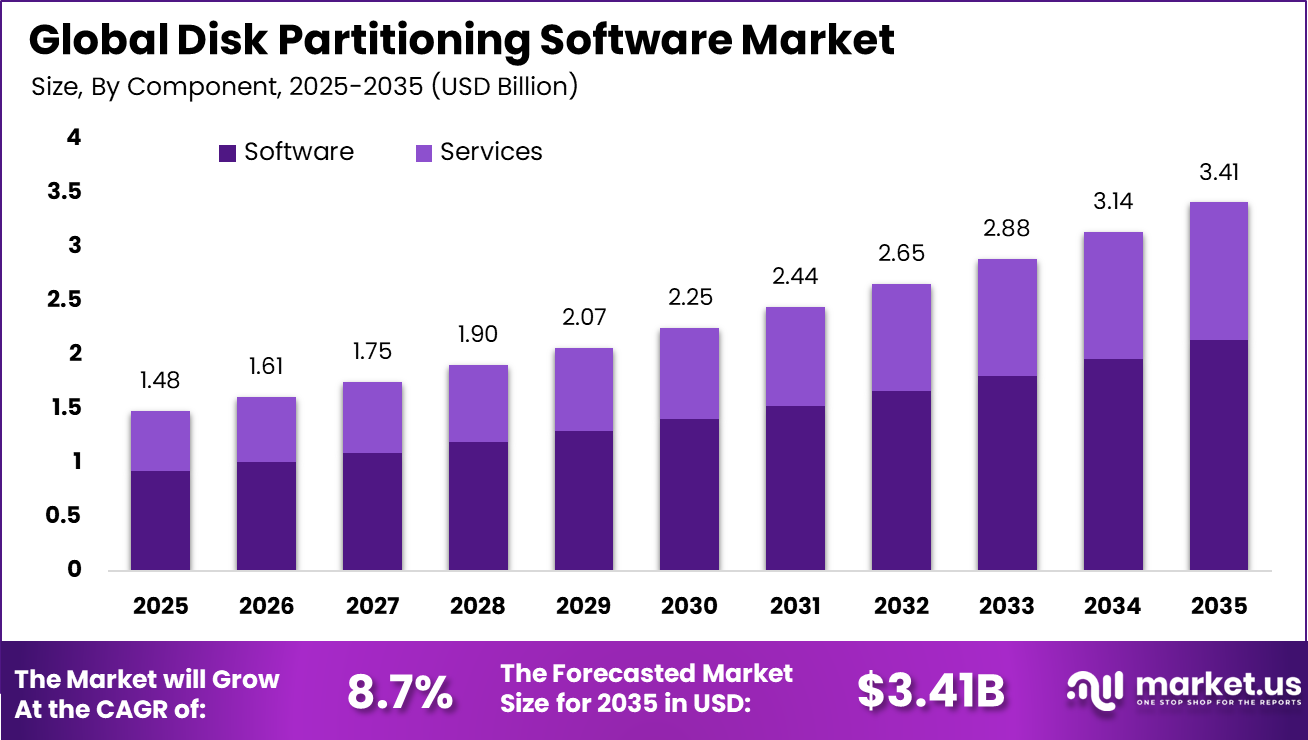
By Region
Emerging Trends
Growth Factors
Key Market Segments
By Component
By Platform
By Enterprise Size
By End-User
Key Regions and Countries
Drivers
Rising Need for Structured Data Management
Restraint
Data Security Concern
Opportunities
Growth of Hybrid and Virtual Storage
Challenges
Balancing Performance and Storage Efficiency
Key Players Analysis
Top Key Players in the Market
Recent Developments