

Report Overview
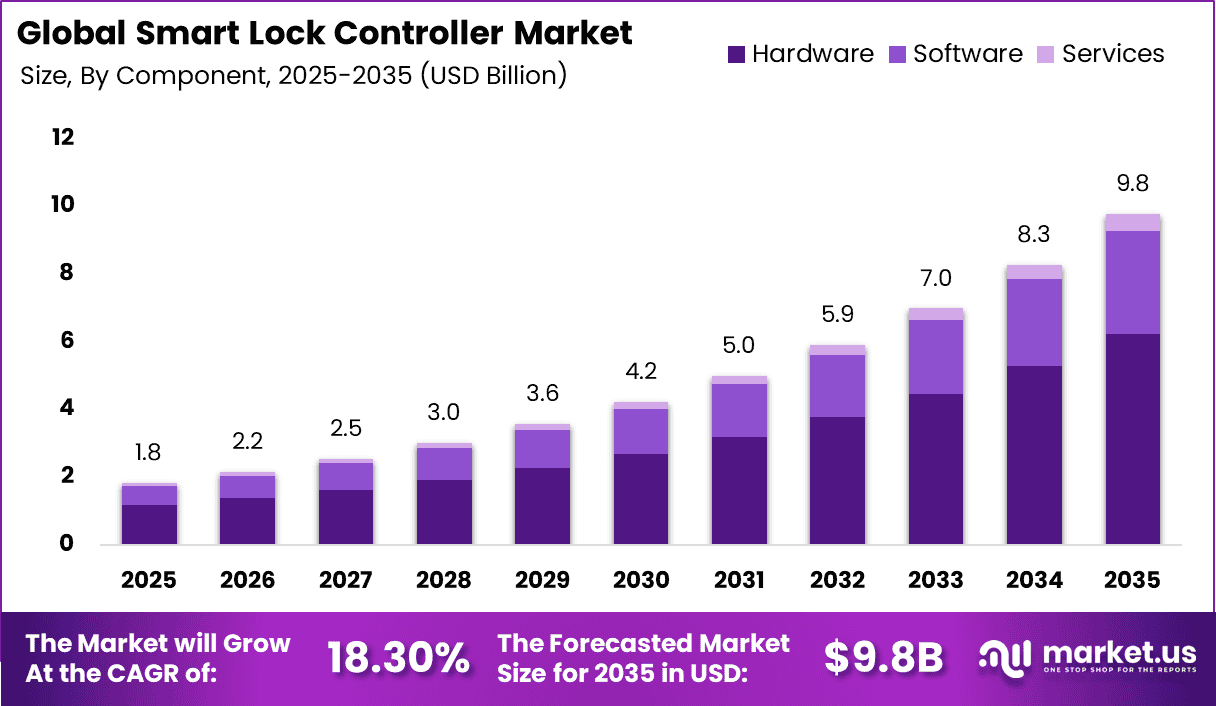
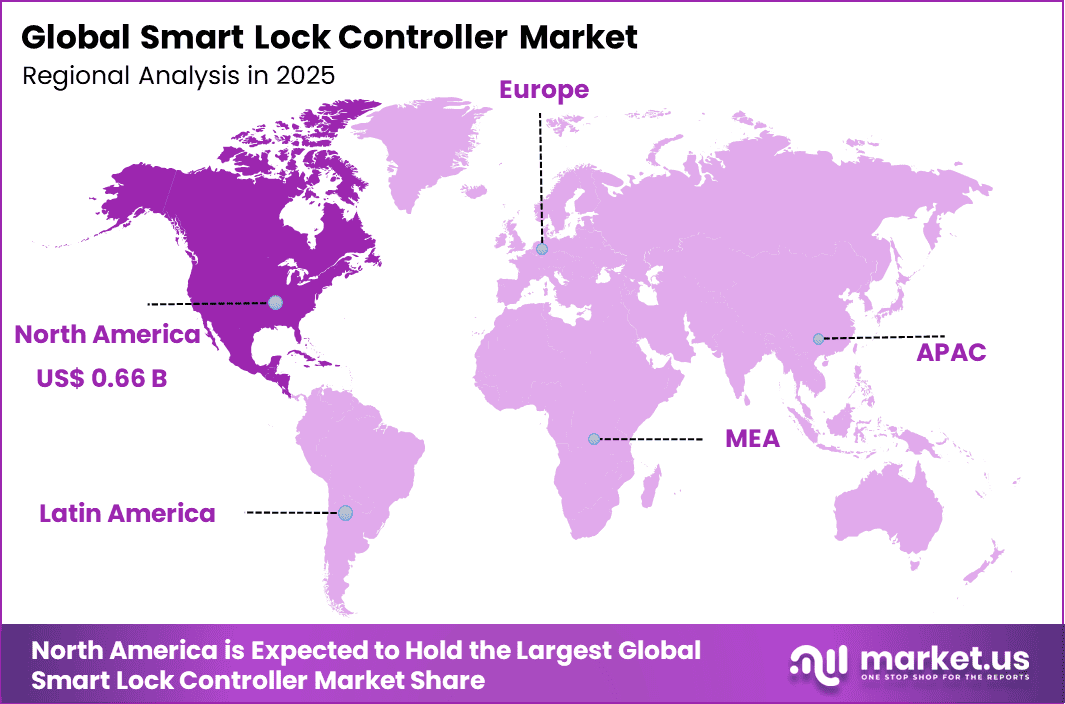
The Global Smart Lock Controller Market generated USD 1.8 billion in 2025 and is predicted to register growth from USD 2.2 billion in 2026 to about USD 9.8 billion by 2035, recording a CAGR of 18.30% throughout the forecast span. In 2025, North America held a dominan market position, capturing more than a 36.7% share, holding USD 0.66 Billion revenue.
The smart lock controller market refers to electronic control systems that manage the operation of smart locks in residential, commercial, and industrial environments. These controllers act as the central processing unit of smart locking systems, enabling functions such as remote access, authentication, access logging, and integration with broader smart home or building automation platforms.
The market is expanding as security systems evolve from traditional mechanical locks to connected digital solutions. Smart lock controllers provide enhanced security, convenience, and control by allowing users to manage access remotely and monitor entry activity in real time. Their integration with IoT ecosystems and home automation systems is transforming access control into a data-driven and intelligent function.
One of the main factors driving this market is the growing need for flexible and secure access management. Building owners and businesses want solutions that allow remote control, faster permission changes, and better tracking of who enters a property. The rise of smart homes, digital workplaces, and modern building security systems is also supporting adoption, as smart lock controllers fit well into wider automation and access control strategies.
Demand for smart lock controllers is increasing across residential, commercial, and hospitality sectors where secure and simple access control is becoming more important. Businesses are adopting these systems to improve operational control, while homeowners are using them for convenience and added safety. Demand is also rising in new building projects and renovation activity, where digital access infrastructure is increasingly included as part of modern property upgrades.
Top Market Takeaways
- By Component, hardware dominates with 63.8% share, delivering bridge modules, hub integrations, and retrofit controllers for seamless lock ecosystem interoperability.
- By Connectivity, Z-Wave captures 38.7%, enabling mesh networking, low-power operation, and certified device compatibility across multi-vendor smart home platforms.
- By Lock Type, deadbolt controllers lead at 71.4%, securing primary entry points with motorized actuators, tamper detection, and geofencing automation.
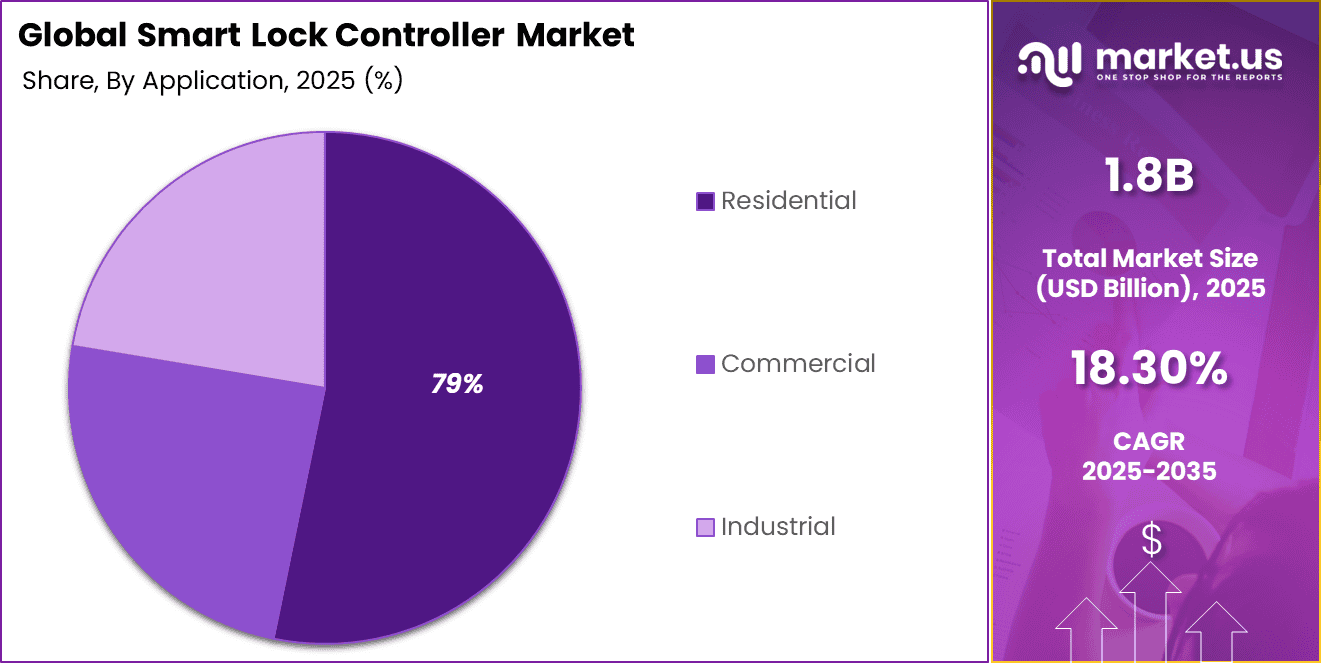
- By Application, residential claims 78.5%, powering family-shared access, delivery codes, and vacation rental management through app-controlled permissions.
- By Sales Channel, direct-to-consumer holds 52.6%, leveraging e-commerce trials, subscription unlocking, and influencer-driven adoption.
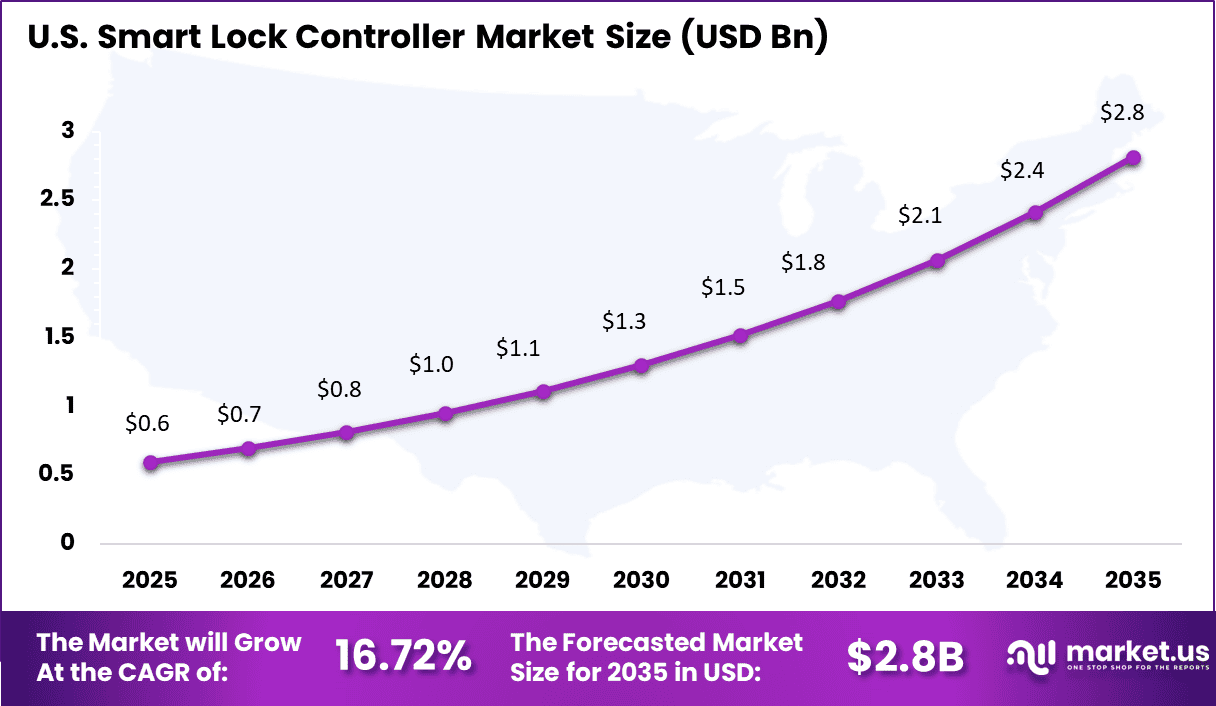
- Regionally, North America accounts for 36.7% global share, with the U.S. market valued at USD 0.60 billion and a CAGR of 16.72%, driven by Amazon Key integration and rental market growth.
Drivers Impact Analysis
| Key Driver | Impact on CAGR Forecast (~%) | Geographic Relevance | Impact Timeline | Strategic Effect |
|---|---|---|---|---|
| Rising adoption of smart home security systems | +3.2% | North America, Europe, Asia Pacific | Short to Mid Term (2025–2031) | Expands demand for connected access control |
| Growth in smart city and digital infrastructure projects | +2.9% | Asia Pacific, Middle East, Europe | Mid to Long Term (2026–2035) | Encourages deployment in public facilities |
| Increasing use of mobile based access control | +2.6% | Global | Short to Mid Term (2025–2030) | Improves convenience and user adoption |
| Rising demand for secure access in commercial buildings | +2.3% | North America, Europe | Mid Term (2026–2032) | Strengthens enterprise security systems |
| Expansion of IoT enabled home automation ecosystems | +2.1% | US, China, South Korea, Europe | Mid to Long Term (2026–2035) | Integrates smart locks with home devices |
Restraints Impact Analysis
| Key Restraint | Impact on CAGR Forecast (~%) | Geographic Relevance | Impact Timeline | Strategic Effect |
|---|---|---|---|---|
| Cybersecurity vulnerabilities in connected lock systems | -2.2% | Global | Short to Mid Term (2025–2031) | Raises concerns over hacking risks |
| High installation and device costs | -1.9% | Global | Mid Term (2026–2032) | Slows adoption among price sensitive consumers |
| Compatibility issues with legacy door hardware | -1.7% | North America, Europe | Mid Term (2026–2032) | Increases integration complexity |
| Data privacy concerns related to connected devices | -1.5% | Europe, North America | Mid to Long Term (2026–2035) | Creates regulatory barriers |
| Limited awareness in emerging markets | -1.3% | Asia Pacific, Latin America | Short to Mid Term (2025–2030) | Reduces adoption rate |
By Component Analysis
Hardware accounted for 63.8% of the Smart Lock Controller Market. This segment leads because physical devices such as controllers, sensors, and locking mechanisms form the core of smart lock systems. Consumers and property owners prioritize reliable hardware to ensure secure access control and smooth integration with smart home setups.
The demand for hardware continues to grow as smart home adoption increases across residential and commercial spaces. Users prefer durable and responsive locking systems that can operate consistently while supporting remote access and automation features, which strengthens the position of hardware in the market.
By Connectivity Analysis
Z Wave held 38.7% of the market. This segment leads because Z Wave technology is widely used in smart home ecosystems due to its low power consumption and stable connectivity. It allows smart lock controllers to communicate efficiently with other devices such as sensors, alarms, and home automation hubs.
The segment is supported by the growing preference for secure and reliable wireless communication standards. Z Wave networks are designed to reduce interference and maintain consistent performance, making them suitable for home security applications where dependable connectivity is essential.
By Lock Type Analysis
Deadbolt controllers accounted for 71.4% of the market. This segment dominates because deadbolt locks are commonly used in residential properties due to their strong physical security. Smart deadbolt controllers enhance traditional locking systems by adding remote control, access monitoring, and automation features.
The segment also benefits from consumer preference for familiar and trusted lock types. Upgrading existing deadbolt systems with smart controllers allows users to improve security without replacing entire door structures, which encourages higher adoption rates.
By Application Analysis
Residential held 79% of the Smart Lock Controller Market. This segment leads because homeowners are increasingly adopting smart home technologies to improve convenience, safety, and access control. Smart lock controllers allow users to manage entry remotely, grant temporary access, and monitor door activity in real time.
The growth of this segment is driven by rising awareness of home security and the expansion of connected living environments. As more households adopt smart devices, integrating smart locks becomes a natural extension of home automation systems.
By Sales Channel Analysis
Direct to consumer accounted for 52.6% of the market. This segment leads because many smart lock products are sold through online platforms and brand websites, allowing customers to purchase and install devices without intermediaries. Direct sales channels provide convenience and faster access to product options.
The segment is also supported by increasing consumer confidence in self installation and digital purchasing. Buyers prefer comparing features, prices, and reviews online before making decisions, which continues to drive the growth of direct to consumer sales in the smart lock controller market.
Investor Type Impact Analysis
| Investor Type | Growth Sensitivity | Risk Exposure | Geographic Focus | Investment Outlook |
|---|---|---|---|---|
| Venture Capital Firms | High | Medium | US, Europe, Israel | Growth in smart home startups |
| Private Equity Firms | High | Medium | North America, Europe | Expansion of security technology companies |
| Strategic Technology Investors | Very High | Medium | US, China, South Korea | Strengthens IoT ecosystem |
| Corporate Venture Arms | High | Medium | Global | Smart home platform partnerships |
| Government and Smart Infrastructure Funds | Medium | Low | Asia Pacific, Europe | Support for smart city security |
Technology Enablement Analysis
| Technology Enabler | Impact on CAGR Forecast (~%) | Geographic Relevance | Impact Timeline | Implementation Significance |
|---|---|---|---|---|
| IoT based smart lock connectivity | +3.0% | Global | Short to Mid Term (2025–2031) | Enables remote access control |
| Biometric authentication technologies | +2.7% | North America, Europe, Asia Pacific | Mid Term (2026–2032) | Improves security accuracy |
| Mobile app based lock management | +2.5% | Global | Short to Mid Term (2025–2030) | Enhances user convenience |
| AI driven access monitoring systems | +2.2% | US, Europe, China | Mid to Long Term (2026–2035) | Detects abnormal access behavior |
| Cloud based smart home platforms | +2.0% | Global | Mid Term (2026–2032) | Improves device integration |
Key Challenges
- Cybersecurity remains a major challenge because smart lock controllers connected to mobile apps, Wi Fi, or cloud platforms can become targets for hacking and unauthorized access.
- Compatibility issues are common, as smart lock controllers may not work smoothly with all door types, home automation systems, or building security platforms.
- Power and connectivity problems can reduce system reliability because battery failure, internet disruption, or signal weakness may affect lock performance.
- High installation and maintenance costs create barriers for some users, especially when advanced controllers require professional setup, software updates, and regular servicing.
- Consumer trust is still a challenge because users worry about data privacy, system failure, and the risk of being locked out during technical issues.
Emerging Trends
A key trend in the Smart Lock Controller market is the growing integration of access control systems with connected home and building environments. Smart lock controllers are increasingly linked with mobile applications, security systems, and automation platforms, allowing users to manage access remotely and monitor entry activity in real time.
This shift supports more flexible and convenient access management for residential and commercial spaces. Users can grant temporary access, track usage, and control locks through digital interfaces, which reflects a broader move toward connected and automated security solutions.
Growth Factors
The increasing focus on safety and controlled access is supporting the growth of smart lock controller solutions. Property owners, businesses, and facility managers seek reliable ways to manage entry without relying on traditional keys.
Smart lock controllers provide better control over who can access specific areas and help reduce the risks associated with lost or duplicated keys. At the same time, the expansion of smart homes and modern infrastructure encourages the adoption of connected access systems that improve both security and user convenience.
Key Market Segments
By Component
- Hardware
- Software
- Services
By Connectivity
- Z-Wave
- Zigbee
- Wi-Fi
- Bluetooth
- Others
By Lock Type
- Deadbolt Controllers
- Mortise Lock Controllers
- Handle Set Controllers
- Others
By Application
- Residential
- Commercial
- Industrial
By Sales Channel
- Direct-to-Consumer (Online/Retail)
- Professional Installers & Security Dealers
- Original Equipment Manufacturers (OEMs)
Regional Analysis
North America accounted for 36.7% of the Smart Lock Controller Market, reflecting strong adoption of connected home and building automation technologies across the region. Consumers and businesses increasingly install smart access systems to improve security, convenience, and remote control of entry points.
Residential users adopt smart lock controllers as part of smart home ecosystems, while commercial facilities integrate them with access management and surveillance systems. The rising focus on digital security and seamless user access continues to support demand for smart lock control solutions across North America.
The U.S. generated about USD 0.60 Bn within the regional market and is projected to expand at a CAGR of 16.72%. Property owners and enterprises across the country continue to shift toward keyless entry systems supported by mobile applications and cloud connectivity. Smart lock controllers help manage user permissions, track entry activity, and enhance overall building security. As smart homes, rental properties, and commercial spaces increasingly adopt automated access solutions, demand for smart lock controllers continues to grow rapidly across the US market.
Key Regions and Countries
- North America
- US
- Canada
- Europe
- Germany
- France
- The UK
- Spain
- Italy
- Russia
- Netherlands
- Rest of Europe
- Asia Pacific
- China
- Japan
- South Korea
- India
- Australia
- Singapore
- Thailand
- Vietnam
- Rest of APAC
- Latin America
- Brazil
- Mexico
- Rest of Latin America
- Middle East & Africa
- South Africa
- Saudi Arabia
- UAE
- Rest of MEA
Competitive Analysis
The Smart Lock Controller Market is driven by global security and access control providers that deliver advanced locking systems integrated with digital connectivity. Assa Abloy AB and Allegion plc maintain strong positions through their extensive portfolios of smart locks and access management solutions. These companies focus on secure authentication, remote access control, and integration with building management systems.
Technology ecosystem players are expanding smart lock capabilities through connected home platforms. Apple Inc., Amazon, and Google LLC enable smart lock integration with voice assistants, mobile applications, and home automation systems. Samsung Electronics also contributes through smart home ecosystems and IoT enabled devices. These platforms enhance user convenience by enabling remote monitoring, keyless entry, and automation features.
Emerging smart lock brands and IoT focused companies further strengthen the competitive landscape. Wyze Labs, Aqara, Level Home, SwitchBot, Kwikset, Master Lock Company, Danalock, and Nuki Home Solutions focus on affordable smart lock controllers with mobile connectivity and user friendly interfaces. These vendors emphasize ease of installation, interoperability, and enhanced security features.
Top Key Players in the Market
- Assa Abloy AB
- Allegion plc
- Samsung Electronics Co., Ltd.
- Apple, Inc.
- Amazon.com, Inc.
- Google LLC
- Wyze Labs, Inc.
- Aqara
- Ultraloq
- Level Home, Inc.
- SwitchBot
- Kwikset
- Master Lock Company LLC
- Danalock
- Nuki Home Solutions GmbH
- Others
Recent Developments
- January, 2026 – Assa Abloy integrated Level Lock tech with Aliro standard support. Users tap any NFC phone for entry across ecosystems. Adoption cut key requests by 50% in apartments. Yale Assure Lock 2 adds keypad and Home Key options. Matter compatibility works with Alexa, Google, Siri. Assa equips 20 million doors globally.
- February, 2026 – Ultraloq Bolt Fingerprint earned top ratings for multi-method unlock. Fingerprint, app, keypad access with built-in Wi-Fi. Battery lasts 12 months; installs in 15 minutes. Alexa, Google, HomeKit integration. Third-party APIs expand automations. Ultraloq ships 5 million units yearly.